MTG Star Trek Commander Decks: All 4 Precons Explained
By ElderArticles · Updated 10/30/2026 · 12 min read
Compare all four MTG Star Trek Commander decks, their confirmed commanders, strategies, strengths, weaknesses, decklists, and upgrade guides.
Table of contents
Four Star Trek Commander decks. Four famous captains. Four very different ways to turn a peaceful first contact into a forty-minute argument about combat triggers.
The complete decklists are now public, so choosing between them no longer requires guessing from colors or packaging. Federation Fleet is a Jeskai historic and Spacecraft value deck. Landing Party is a Bant lands deck led by Commander Spock. Klingon Fury is a Mardu combat deck that rewards attacking multiple opponents. We Are the Borg is an Esper artifact-creature army built around Borg tokens and assimilation.
This guide compares what each precon actually does, where its stock list is strongest, and which type of Commander player should buy it. For the full 100-card lists, upgrades, and cards to cut, follow the dedicated guides in each section.
U.S.S. Enterprise-D, Galaxy-Class | Illustration by Pablo Mendoza
Updated October 30, 2026: Wizards has revealed all four complete decklists. Magic: The Gathering | Star Trek releases on November 13, 2026. New cards may appear as not yet Commander-legal in card databases before release because they are unreleased, not because they are banned.
The four Star Trek Commander decks at a glance
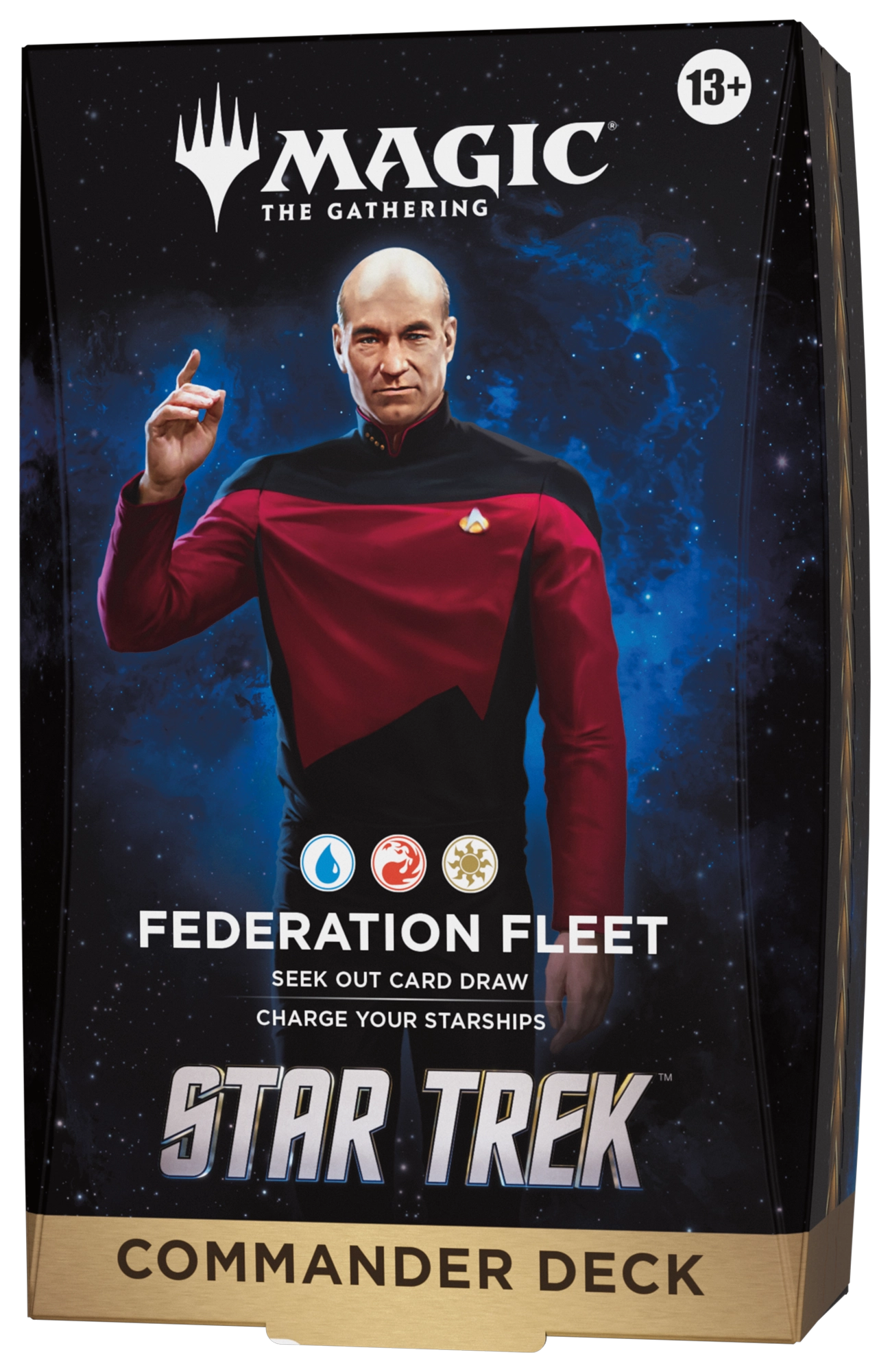
Federation Fleet is white-blue-red, commonly called Jeskai. Jean-Luc Picard, Luminary leads a historic-permanent midrange deck with card draw, charge counters, and Spacecraft.
Landing Party is green-white-blue, commonly called Bant. Commander Spock rewards differently named lands, top-deck setup, landfall, and free spells.
Klingon Fury is red-white-black, commonly called Mardu. Worf, Defiant Commander rewards you for attacking multiple opponents and turns aggression into temporary card advantage.
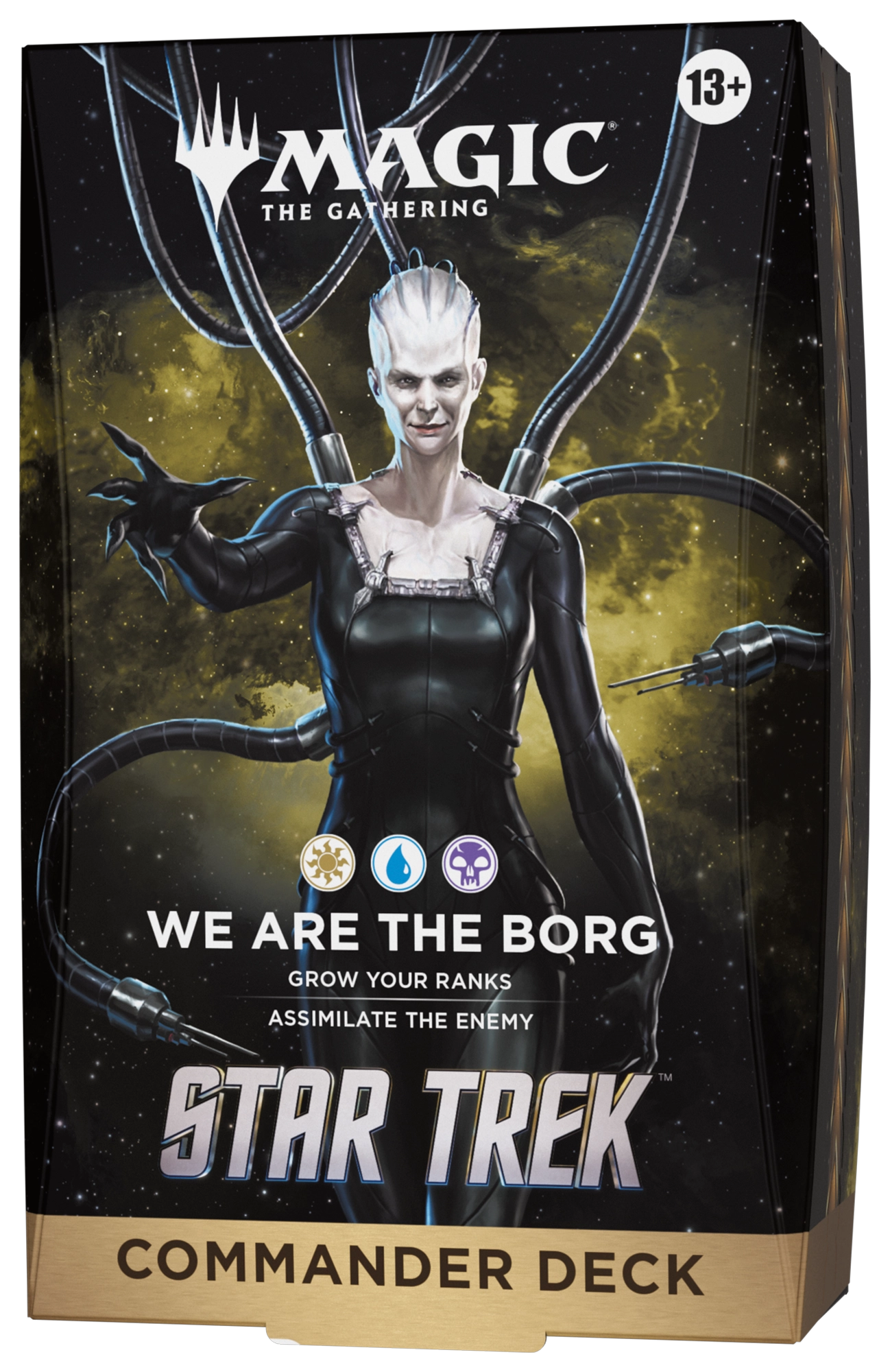
We Are the Borg is white-blue-black, commonly called Esper. The Borg Queen leads an artifact-creature deck that builds Borg tokens, assimilates opposing creatures, and wins through a wide enhanced army.
All four are ready-to-play 100-card Commander decks. Standard editions include a traditional foil borderless face commander, while Collector’s Editions use surge foil treatments throughout the deck. Each product also includes 10 double-sided tokens.
AI-generated article, published by an ElderDecks editor.
Federation Fleet
Federation Fleet | Official product image: Wizards of the Coast
Colors: White, blue, and red (Jeskai)
Face commander: Jean-Luc Picard, Luminary
Backup commander: Captain Janeway, Endgame
Primary plan: Historic permanents, drawing a second card, charge counters, and Spacecraft
Federation Fleet is not simply a Spacecraft deck with a captain standing in front of it. Jean-Luc Picard, Luminary rewards historic permanents with mana value three or greater. Artifacts, legendary permanents, and Sagas qualify, and the stock list contains enough of them to keep Picard drawing cards through the middle of the game.
Picard’s seek out ability rewards the second card you draw during each turn. The trigger puts a +1/+1 counter on another creature and two charge counters on a Spacecraft. If the deck draws twice on opponents’ turns as well as its own, Picard can prepare several ships without asking your creatures to spend every main phase stationing them.
The result is a Jeskai historic midrange deck with three connected engines: cast historic permanents, draw cards, then convert the second-card triggers into counters. The stock list has 38 lands, ten dedicated mana rocks, five Spacecraft, and a dense group of legendary creatures.
Federation Fleet strengths
Picard can generate cards without attacking, and many of the deck’s historic permanents remain useful if the commander is removed. The deck also has several paths to value, so one piece of artifact removal does not necessarily stop the entire plan.
Federation Fleet weaknesses
The list has a busy middle of the curve and several lands that enter tapped. Its historic, seek out, and Spacecraft packages can feel like separate decks when the wrong half of each engine appears. Picard also ignores cheap mana rocks for his enter trigger because they do not meet the mana-value requirement.
Who should choose Federation Fleet?
Choose this precon if you enjoy incremental value, legendary permanents, artifact synergies, and building toward a powerful fleet rather than attacking immediately. It is the most attractive option for players who want The Next Generation and later-era Starfleet flavor.
Landing Party | Official product image: Wizards of the Coast
Colors: Green, white, and blue (Bant)
Face commander: Commander Spock
Backup commander: Captain Kirk, Boldly Going
Primary plan: Differently named lands, landfall, top-deck setup, and free spells
Landing Party is the Commander Spock deck, and its most important resource is not simply the number of lands you control. It is the number of differently named lands you control.
Whenever Spock enters or attacks, you reveal the top card of your library. If its mana value is no greater than the number of differently named lands you control, you may cast it for free. A revealed land may enter tapped instead. If the card remains on top, Spock lets you draw it, so a failed free-cast check still replaces itself.
That makes Landing Party a Bant lands deck with a top-deck engine attached. Cards such as Brainstorm and Ponder arrange a useful hit before Spock enters or attacks. Farseek, Nature’s Lore, Lotus Cobra, and the deck’s varied mana base increase the unique-name count while advancing ordinary landfall payoffs.
The official list contains eight basic lands, but that is not automatically a deck-building mistake. Its ramp and fetch effects still need basic targets. The practical upgrade is to replace some duplicate basics with functional utility lands, not remove every basic and make the ramp package worse.
Landing Party strengths
Spock supplies a card even when the free-cast condition fails, and the deck’s ramp package functions without him. Once six or seven unique land names are in play, his enter and attack triggers can deploy much of the deck without spending mana.
Landing Party weaknesses
Spock costs five mana and needs a safe attack to repeat his trigger naturally. A utility land is not an upgrade if it constantly enters tapped at the wrong time or prevents the deck from producing all three colors. The list also needs top-deck control to turn Spock from a value commander into a reliable free-spell engine.
Who should choose Landing Party?
Choose Landing Party if you like landfall, sequencing land drops, and manipulating the top of your library. It is the clearest choice for Original Series fans and for players who prefer a resource engine over a typal creature deck.
Klingon Fury | Official product image: Wizards of the Coast
Colors: Red, white, and black (Mardu)
Face commander: Worf, Defiant Commander
Backup commander: Kor, Cause of Vengeance
Primary plan: Attack multiple opponents, create Klingon Warriors, and convert combat into cards
Klingon Fury is the aggressive deck, but Worf asks you to fight differently from a normal Voltron commander. His battlefront ability cares about the number of opponents you attacked during the turn. At a four-player table, sending at least one creature toward each opponent can exile three cards from the top of your library for you to play through the end of your next turn.
Worf does not need to attack, and you do not need to deal combat damage. That makes small tokens more important than one enormous attacker. The stock list supports the plan with Klingon Warriors, goad, melee, sacrifice outlets, and extra-combat effects.
Extra combats are particularly dangerous because Worf triggers whenever you attack, not only once each turn. The deck can turn a board of modest creatures into several batches of temporary cards. Those cards still need mana, so Treasure production and a disciplined curve matter as much as combat power.
Klingon Fury strengths
The deck has a real card-advantage engine in the command zone, token makers that spread attacks across the table, and several extra-combat effects that multiply Worf’s trigger. Its disposable Warriors also work with sacrifice and death-trigger cards when attacking is no longer safe.
Klingon Fury weaknesses
Attacking three opponents exposes small creatures to three sets of blockers. The stock list needs more cheap protection and evasion to keep its battlefront engine running. It can also exile more cards than it can afford to cast if the curve remains too expensive.
Who should choose Klingon Fury?
Choose Klingon Fury if you want proactive combat, multiple attack steps, Klingon flavor, and the option to turn creatures into sacrifice value. It rewards careful attack distribution more than simply choosing the weakest opponent and swinging everything there.
We Are the Borg | Official product image: Wizards of the Coast
Colors: White, blue, and black (Esper)
Face commander: The Borg Queen
Primary plan: Artifact creatures, Borg tokens, assimilation, combat-damage triggers, and Spacecraft
We Are the Borg starts building the Collective long before its seven-mana commander reaches the battlefield. Cheap artifact creatures and mana rocks establish the network. Cards such as Conquest Mission turn later artifacts into additional Borg, while Locutus of Borg and Co-Option Adjutant reward artifact creatures for connecting in combat.
The Borg Queen supplies the dramatic finish. She gives your artifact creatures +2/+2 and assimilates a creature whenever she enters or attacks. Assimilated creatures become Borg artifact creatures with +1/+1 counters, so the cards stolen from opponents immediately join the deck’s artifact synergies.
The stock list is more coherent than a generic pile of crossover references. Nearly every creature in the 99 is an artifact creature, and the support cards reward going wide, dealing combat damage, or adding counters. Borg Scout Sphere can eventually give the artifact army flying, while One, Borg Evolved turns even a small collection of tokens into a lethal threat.
We Are the Borg strengths
The deck can develop without its expensive commander, its small artifact creatures trigger multiple engines, and assimilation gives it access to threats from opposing graveyards and battlefields. Several sweepers also leave the artifact-heavy Collective in a better position than creature decks around it.
We Are the Borg weaknesses
The Borg Queen costs seven mana, making commander tax painful. The deck also creates more bookkeeping than the other three precons because assimilated cards change characteristics and may belong to different players. Its combat-damage engines need evasion before a wide board of 1/1 creatures becomes productive.
Who should choose We Are the Borg?
Choose this precon if you enjoy artifact creatures, token armies, counters, and using your opponents’ cards against them. It has the strongest faction identity of the four, but it also asks the pilot to track the most moving pieces.
There is no honest universal winner because the decks reward different skills and play patterns.
Choose Federation Fleet for historic value, card draw, and Spacecraft. Choose Landing Party for lands, top-deck manipulation, and free spells. Choose Klingon Fury for aggressive combat, extra combats, and sacrifice value. Choose We Are the Borg for artifact creatures, tokens, and stealing opposing creatures.
For a newer player, Landing Party’s green ramp is forgiving, but Spock’s top-deck decisions still reward planning. Klingon Fury is the easiest deck to understand at a glance, although choosing attacks across three opponents can be politically complicated. Federation Fleet has several overlapping engines, while We Are the Borg creates the most rules and ownership tracking.
If your decision is based on fandom, buy the crew or faction you actually want to see every game. A precon can be upgraded. It cannot become a different television series.
What comes in each Star Trek Commander deck?
Each standard deck contains a ready-to-play 100-card Commander deck, a traditional foil borderless face commander, 99 nonfoil cards, and 10 double-sided tokens. The Collector’s Edition contains the same decklist in surge foil, including a surge foil borderless face commander.
Wizards lists an official US MSRP of $74.99 for a standard Commander deck and $159.99 for a Collector’s Edition deck. Those are suggested prices, not guarantees of a retailer’s current price.
The global tabletop release is November 13, 2026. Wizards has also warned that some Commander deck shipments may arrive after release in certain regions, including North America. Confirm availability with your retailer if you are planning a release-weekend game.
Star Trek Commander deck FAQs
Are all four Star Trek Commander decklists revealed?
Yes. Wizards published the complete lists for Federation Fleet, Landing Party, Klingon Fury, and We Are the Borg before October 30, 2026. Each dedicated ElderDecks guide links to the official list and includes an interactive 100-card decklist.
Which deck is led by Commander Spock?
Landing Party is the green-white-blue Commander Spock deck. It rewards differently named lands, landfall, and manipulating the top card of your library.
Which deck is led by Worf?
Klingon Fury is the red-white-black Worf, Defiant Commander deck. It rewards attacking multiple opponents, creating Klingon Warriors, and taking extra combats.
Which precon is the Spacecraft deck?
Federation Fleet has the clearest dedicated Spacecraft package because Picard’s seek out trigger adds charge counters. Landing Party includes Starship Enterprise, and We Are the Borg also uses Spacecraft as part of its artifact plan, but neither is as centered on charging a fleet.
Are the Commander cards Standard-legal?
New cards printed in the TRC Commander set are intended for Commander, Legacy, and Vintage, not Standard. Reprints remain legal in formats where their other printings are already legal.
Do I need booster packs to upgrade a precon?
No. Each product is a complete 100-card deck. Buy singles after playing a few games and identifying the cards that underperform. Opening booster packs is not a required upgrade step.
Final comparison
Federation Fleet builds value from historic permanents and turns repeated card draw into charge counters. Landing Party converts a varied mana base into free Spock spells. Klingon Fury spreads combat across the table to keep Worf’s cards flowing. We Are the Borg turns an artifact network into a growing, assimilating army.
That is a much more useful distinction than asking which box is strongest in a vacuum. Choose the deck whose ordinary turns sound enjoyable, then use the dedicated guide to tighten its weakest pieces.
Four Star Trek Commander decks. Four famous captains. Four very different ways to turn a peaceful first contact into a forty-minute argument about combat triggers.
The complete decklists are now public, so choosing between them no longer requires guessing from colors or packaging. Federation Fleet is a Jeskai historic and Spacecraft value deck. Landing Party is a Bant lands deck led by Commander Spock. Klingon Fury is a Mardu combat deck that rewards attacking multiple opponents. We Are the Borg is an Esper artifact-creature army built around Borg tokens and assimilation.
This guide compares what each precon actually does, where its stock list is strongest, and which type of Commander player should buy it. For the full 100-card lists, upgrades, and cards to cut, follow the dedicated guides in each section.
U.S.S. Enterprise-D, Galaxy-Class | Illustration by Pablo Mendoza
Updated October 30, 2026: Wizards has revealed all four complete decklists. Magic: The Gathering | Star Trek releases on November 13, 2026. New cards may appear as not yet Commander-legal in card databases before release because they are unreleased, not because they are banned.
The four Star Trek Commander decks at a glance
Federation Fleet is white-blue-red, commonly called Jeskai. Jean-Luc Picard, Luminary leads a historic-permanent midrange deck with card draw, charge counters, and Spacecraft.
Landing Party is green-white-blue, commonly called Bant. Commander Spock rewards differently named lands, top-deck setup, landfall, and free spells.
Klingon Fury is red-white-black, commonly called Mardu. Worf, Defiant Commander rewards you for attacking multiple opponents and turns aggression into temporary card advantage.
We Are the Borg is white-blue-black, commonly called Esper. The Borg Queen leads an artifact-creature deck that builds Borg tokens, assimilates opposing creatures, and wins through a wide enhanced army.
All four are ready-to-play 100-card Commander decks. Standard editions include a traditional foil borderless face commander, while Collector’s Editions use surge foil treatments throughout the deck. Each product also includes 10 double-sided tokens.
Federation Fleet
Federation Fleet | Official product image: Wizards of the Coast
Primary plan: Historic permanents, drawing a second card, charge counters, and Spacecraft
Federation Fleet is not simply a Spacecraft deck with a captain standing in front of it. Jean-Luc Picard, Luminary rewards historic permanents with mana value three or greater. Artifacts, legendary permanents, and Sagas qualify, and the stock list contains enough of them to keep Picard drawing cards through the middle of the game.
Picard’s seek out ability rewards the second card you draw during each turn. The trigger puts a +1/+1 counter on another creature and two charge counters on a Spacecraft. If the deck draws twice on opponents’ turns as well as its own, Picard can prepare several ships without asking your creatures to spend every main phase stationing them.
The result is a Jeskai historic midrange deck with three connected engines: cast historic permanents, draw cards, then convert the second-card triggers into counters. The stock list has 38 lands, ten dedicated mana rocks, five Spacecraft, and a dense group of legendary creatures.
Federation Fleet strengths
Picard can generate cards without attacking, and many of the deck’s historic permanents remain useful if the commander is removed. The deck also has several paths to value, so one piece of artifact removal does not necessarily stop the entire plan.
Federation Fleet weaknesses
The list has a busy middle of the curve and several lands that enter tapped. Its historic, seek out, and Spacecraft packages can feel like separate decks when the wrong half of each engine appears. Picard also ignores cheap mana rocks for his enter trigger because they do not meet the mana-value requirement.
Who should choose Federation Fleet?
Choose this precon if you enjoy incremental value, legendary permanents, artifact synergies, and building toward a powerful fleet rather than attacking immediately. It is the most attractive option for players who want The Next Generation and later-era Starfleet flavor.
Primary plan: Differently named lands, landfall, top-deck setup, and free spells
Landing Party is the Commander Spock deck, and its most important resource is not simply the number of lands you control. It is the number of differently named lands you control.
Whenever Spock enters or attacks, you reveal the top card of your library. If its mana value is no greater than the number of differently named lands you control, you may cast it for free. A revealed land may enter tapped instead. If the card remains on top, Spock lets you draw it, so a failed free-cast check still replaces itself.
That makes Landing Party a Bant lands deck with a top-deck engine attached. Cards such as Brainstorm and Ponder arrange a useful hit before Spock enters or attacks. Farseek, Nature’s Lore, Lotus Cobra, and the deck’s varied mana base increase the unique-name count while advancing ordinary landfall payoffs.
The official list contains eight basic lands, but that is not automatically a deck-building mistake. Its ramp and fetch effects still need basic targets. The practical upgrade is to replace some duplicate basics with functional utility lands, not remove every basic and make the ramp package worse.
Landing Party strengths
Spock supplies a card even when the free-cast condition fails, and the deck’s ramp package functions without him. Once six or seven unique land names are in play, his enter and attack triggers can deploy much of the deck without spending mana.
Landing Party weaknesses
Spock costs five mana and needs a safe attack to repeat his trigger naturally. A utility land is not an upgrade if it constantly enters tapped at the wrong time or prevents the deck from producing all three colors. The list also needs top-deck control to turn Spock from a value commander into a reliable free-spell engine.
Who should choose Landing Party?
Choose Landing Party if you like landfall, sequencing land drops, and manipulating the top of your library. It is the clearest choice for Original Series fans and for players who prefer a resource engine over a typal creature deck.
Primary plan: Attack multiple opponents, create Klingon Warriors, and convert combat into cards
Klingon Fury is the aggressive deck, but Worf asks you to fight differently from a normal Voltron commander. His battlefront ability cares about the number of opponents you attacked during the turn. At a four-player table, sending at least one creature toward each opponent can exile three cards from the top of your library for you to play through the end of your next turn.
Worf does not need to attack, and you do not need to deal combat damage. That makes small tokens more important than one enormous attacker. The stock list supports the plan with Klingon Warriors, goad, melee, sacrifice outlets, and extra-combat effects.
Extra combats are particularly dangerous because Worf triggers whenever you attack, not only once each turn. The deck can turn a board of modest creatures into several batches of temporary cards. Those cards still need mana, so Treasure production and a disciplined curve matter as much as combat power.
Klingon Fury strengths
The deck has a real card-advantage engine in the command zone, token makers that spread attacks across the table, and several extra-combat effects that multiply Worf’s trigger. Its disposable Warriors also work with sacrifice and death-trigger cards when attacking is no longer safe.
Klingon Fury weaknesses
Attacking three opponents exposes small creatures to three sets of blockers. The stock list needs more cheap protection and evasion to keep its battlefront engine running. It can also exile more cards than it can afford to cast if the curve remains too expensive.
Who should choose Klingon Fury?
Choose Klingon Fury if you want proactive combat, multiple attack steps, Klingon flavor, and the option to turn creatures into sacrifice value. It rewards careful attack distribution more than simply choosing the weakest opponent and swinging everything there.
Primary plan: Artifact creatures, Borg tokens, assimilation, combat-damage triggers, and Spacecraft
We Are the Borg starts building the Collective long before its seven-mana commander reaches the battlefield. Cheap artifact creatures and mana rocks establish the network. Cards such as Conquest Mission turn later artifacts into additional Borg, while Locutus of Borg and Co-Option Adjutant reward artifact creatures for connecting in combat.
The Borg Queen supplies the dramatic finish. She gives your artifact creatures +2/+2 and assimilates a creature whenever she enters or attacks. Assimilated creatures become Borg artifact creatures with +1/+1 counters, so the cards stolen from opponents immediately join the deck’s artifact synergies.
The stock list is more coherent than a generic pile of crossover references. Nearly every creature in the 99 is an artifact creature, and the support cards reward going wide, dealing combat damage, or adding counters. Borg Scout Sphere can eventually give the artifact army flying, while One, Borg Evolved turns even a small collection of tokens into a lethal threat.
The deck can develop without its expensive commander, its small artifact creatures trigger multiple engines, and assimilation gives it access to threats from opposing graveyards and battlefields. Several sweepers also leave the artifact-heavy Collective in a better position than creature decks around it.
We Are the Borg weaknesses
The Borg Queen costs seven mana, making commander tax painful. The deck also creates more bookkeeping than the other three precons because assimilated cards change characteristics and may belong to different players. Its combat-damage engines need evasion before a wide board of 1/1 creatures becomes productive.
Who should choose We Are the Borg?
Choose this precon if you enjoy artifact creatures, token armies, counters, and using your opponents’ cards against them. It has the strongest faction identity of the four, but it also asks the pilot to track the most moving pieces.
There is no honest universal winner because the decks reward different skills and play patterns.
Choose Federation Fleet for historic value, card draw, and Spacecraft. Choose Landing Party for lands, top-deck manipulation, and free spells. Choose Klingon Fury for aggressive combat, extra combats, and sacrifice value. Choose We Are the Borg for artifact creatures, tokens, and stealing opposing creatures.
For a newer player, Landing Party’s green ramp is forgiving, but Spock’s top-deck decisions still reward planning. Klingon Fury is the easiest deck to understand at a glance, although choosing attacks across three opponents can be politically complicated. Federation Fleet has several overlapping engines, while We Are the Borg creates the most rules and ownership tracking.
If your decision is based on fandom, buy the crew or faction you actually want to see every game. A precon can be upgraded. It cannot become a different television series.
What comes in each Star Trek Commander deck?
Each standard deck contains a ready-to-play 100-card Commander deck, a traditional foil borderless face commander, 99 nonfoil cards, and 10 double-sided tokens. The Collector’s Edition contains the same decklist in surge foil, including a surge foil borderless face commander.
Wizards lists an official US MSRP of $74.99 for a standard Commander deck and $159.99 for a Collector’s Edition deck. Those are suggested prices, not guarantees of a retailer’s current price.
The global tabletop release is November 13, 2026. Wizards has also warned that some Commander deck shipments may arrive after release in certain regions, including North America. Confirm availability with your retailer if you are planning a release-weekend game.
Star Trek Commander deck FAQs
Are all four Star Trek Commander decklists revealed?
Yes. Wizards published the complete lists for Federation Fleet, Landing Party, Klingon Fury, and We Are the Borg before October 30, 2026. Each dedicated ElderDecks guide links to the official list and includes an interactive 100-card decklist.
Landing Party is the green-white-blue Commander Spock deck. It rewards differently named lands, landfall, and manipulating the top card of your library.
Which deck is led by Worf?
Klingon Fury is the red-white-black Worf, Defiant Commander deck. It rewards attacking multiple opponents, creating Klingon Warriors, and taking extra combats.
Which precon is the Spacecraft deck?
Federation Fleet has the clearest dedicated Spacecraft package because Picard’s seek out trigger adds charge counters. Landing Party includes Starship Enterprise, and We Are the Borg also uses Spacecraft as part of its artifact plan, but neither is as centered on charging a fleet.
Are the Commander cards Standard-legal?
New cards printed in the TRC Commander set are intended for Commander, Legacy, and Vintage, not Standard. Reprints remain legal in formats where their other printings are already legal.
Do I need booster packs to upgrade a precon?
No. Each product is a complete 100-card deck. Buy singles after playing a few games and identifying the cards that underperform. Opening booster packs is not a required upgrade step.
Final comparison
Federation Fleet builds value from historic permanents and turns repeated card draw into charge counters. Landing Party converts a varied mana base into free Spock spells. Klingon Fury spreads combat across the table to keep Worf’s cards flowing. We Are the Borg turns an artifact network into a growing, assimilating army.
That is a much more useful distinction than asking which box is strongest in a vacuum. Choose the deck whose ordinary turns sound enjoyable, then use the dedicated guide to tighten its weakest pieces.