Landing Party Commander Decklist (2026): Best Spock Upgrades & Cards to Cut
By ElderArticles · Updated 10/29/2026 · 18 min read
See the complete Landing Party decklist, learn Commander Spock’s strategy, and find the best upgrades and cards to cut from the Star Trek precon.
Table of contents
Commander Spock rewards you for exploring strange new worlds. The more differently named lands you control, the more powerful his ability becomes.
So why does the official Landing Party deck still contain eight basic lands?
The newly revealed precon includes some excellent landfall staples, but its mana base raises an interesting question: how much more powerful could Spock become with just a handful of changes?
Let’s examine the full decklist, identify its biggest weaknesses, and find out which Landing Party upgrades deserve your attention first.
Wizards revealed the complete list on October 29, 2026. Landing Party releases with Magic: The Gathering | Star Trek on November 13, 2026. Until then, Scryfall correctly marks its unreleased cards as not yet Commander-legal; that is a release-date issue, not a ban.
The official stock list contains 1 commander and 99 cards in the main deck, including 40 lands. Commander Spock leads the deck; Captain Kirk, Boldly Going is included in the 99 as the alternate commander.
Browse by card type below, search for a specific card, switch to Cards for the gallery, or use Copy decklist to copy the full list. Quantities are shown beside every card. The upgrade recommendations later in this guide are separate from this stock list.
AI-generated article, published by an ElderDecks editor.
Landing Party at a Glance
- Face commander: Commander Spock
- Backup commander: Captain Kirk, Boldly Going
- Colors: Green, white, and blue, commonly called Bant
- Primary plan: Increase the number of differently named lands, then turn Spock's enter and attack triggers into free spells
- Supporting themes: Landfall, extra land drops, Spacecraft, top-deck manipulation, and enter-the-battlefield value
- Deck size: 100 cards
- Basic lands: Eight total: four Forests, two Plains, and two Islands
- Release date: November 13, 2026
The stock deck is more thoughtful than the basic-land count makes it look. Exploration, Lotus Cobra, Tireless Tracker, Scute Swarm, Ancient Greenwarden, Fabled Passage, Evolving Wilds, Terramorphic Expanse, and several new cards all reward land development. The tension is that Spock does not count lands. He counts differently named lands. Your fourth Forest still casts spells, but it does not raise his ceiling.
How Commander Spock Works
Commander Spock costs five mana for a 3/5 Vulcan Human Scientist. Whenever he enters or attacks, you reveal the top card of your library. If its mana value is no greater than the number of differently named lands you control, you may cast it without paying its mana cost. A revealed land may enter tapped instead. If the card stays on top, you draw it.
That last sentence is the safety valve. A seven-mana spell revealed while you control five unique land names does not disappear. It becomes your draw for the trigger. Spock therefore supplies a card even when the free-cast test fails. The real payoff for building around unique names is tempo: the more distinct lands you establish, the larger the spell you can deploy while keeping your mana available.
The trigger happens on entry and attack. That makes protection, haste, blinking, and trigger-copying unusually valuable. Spock can generate one card when first cast, another on the first attack, and more if you safely repeat either event. He does not need to deal combat damage.
What counts as a differently named land?
Use the names printed on the cards. Command Tower, Forest, Temple of Mystery, and Risa are four differently named lands. Four Forests still contribute only one name. A double-faced card on the battlefield uses the name of its current face. Copying a land normally copies its name too, so a copy does not create a new name unless the copy effect says otherwise.
Why Does Landing Party Play Eight Basics?
Because basics still do jobs Spock needs. They enter untapped, survive cards that punish nonbasic lands, and give Cultivate, Farseek, Nature's Lore, Rampant Growth, Fabled Passage, Evolving Wilds, Terramorphic Expanse, and the landcycling on Cold-Blooded Crew something to find. Cutting all eight would make several stock cards worse and could leave fetch effects without targets.
The right answer is not “remove every basic.” It is “keep enough basics for the search package, then replace redundant copies.” One Forest, one Plains, and one Island already provide three unique names and preserve basic targets. That leaves five duplicate basics you can reconsider, though you do not need to replace all five at once.
I would begin with three changes, play the deck, then decide whether the extra utility is worth slower or more painful mana. A land entering tapped can raise Spock's count and still cost you the turn in which you wanted to cast him. Unique is valuable; functional is mandatory.
How to Play the Commander Spock Deck
Early Game: Develop Names, Not Just Mana
Keep hands that can produce all three colors and make a useful play before Spock. A green source plus Farseek, Nature's Lore, Growth Spiral, or Lotus Cobra is a much better start than three attractive Star Trek legends and no acceleration.
Sequence lands with the unique-name count in mind. If your hand contains Forest and Temple of Mystery, playing the Temple on turn one is usually painless and its scry helps set up later turns. When Fabled Passage can find the color you need, it also turns one land drop into two landfall events. Avoid fetching a second basic with the same name unless color requirements demand it.
Brainstorm and Ponder are not filler here. They can put a castable spell on top before Spock enters or attacks. Save them when practical instead of firing them off for minor selection on turn one.
Midgame: Make the First Spock Trigger Count
Five mana is the key turn. Before casting Spock, ask two questions: how many unique land names do I control, and what is on top? If the answer to the second question is “I have no idea,” cast Ponder or use a scry land first when possible.
Do not attack Spock into a profitable block merely because the trigger exists. A 3/5 survives small creatures, but commander tax turns the next casting into seven mana. Protection such as Heroic Intervention and an open lane matter more than squeezing in three damage.
Endgame: Convert Free Spells into a Board
Once seven or more names are online, most of the deck becomes a valid hit. Ancient Greenwarden doubles landfall triggers, Scute Swarm multiplies, Tireless Tracker produces Clues, and Starship Enterprise accumulates charge counters as lands enter. That is the point at which Spock stops feeling like a draw engine and starts behaving like a second main phase attached to every safe attack.
Wrath of God remains useful even in a creature deck. If the table develops faster than you do, reset the battlefield, then recast Spock and rebuild from the cards and mana he supplies.
The Best Cards Already in Landing Party
Brainstorm and Ponder
Both one-mana spells fix the top of the library before a Spock trigger. Brainstorm can place an expensive card from your hand on top, turning a card you could not cast into a free spell. Ponder looks three cards deep and can shuffle when none is suitable. Their ceiling is much higher here than “cheap cantrip.”
Exploration and Ancient Greenwarden
Exploration accelerates the unique-name count by allowing an extra land each turn. Ancient Greenwarden lets you play lands from the graveyard and doubles landfall triggers. With Fabled Passage or another self-sacrificing land, the Greenwarden turns the graveyard into a second hand while doubling Lotus Cobra, Tireless Tracker, Scute Swarm, Starship Enterprise, and other landfall rewards.
Lotus Cobra and Tireless Tracker
Spock may cast the top card for free, but the rest of your hand still needs mana. Lotus Cobra converts every land into colored mana, which helps cast Spock on time and pay for interaction after he resolves. Tireless Tracker converts the same land drops into Clues and grows into a legitimate attacker. Neither card needs Spock to be useful.
Captain Kirk, Boldly Going
Captain Kirk is the more linear backup commander. The four-mana 3/4 has vigilance, gives your Spacecraft creatures +3/+3, and searches your library or graveyard for a basic land or Starship Enterprise whenever he enters or attacks. Kirk does not offer Spock's free-spell ceiling, but he makes land drops, repeatedly recovers the Enterprise, and turns the ship package into a real combat plan.
The 8 Best Landing Party Upgrades
The first four upgrades improve Spock directly. The next four reshape the mana base without deleting every basic land.
1. Roaming Throne
Roaming Throne | Illustration by Wizard of BargeCold-Blooded Crew | Illustration by John Tyler Christopher
Choose Scientist as Roaming Throne enters. Commander Spock is a Scientist, so his enter and attack abilities trigger an additional time. One safe attack can reveal two cards, and each resolves separately using your current count of differently named lands.
Recommended cut: Cold-Blooded Crew. The six-mana 4/4 places two +1/+1 counters when it enters and can basic-landcycle for two. That flexibility is acceptable in Limited, but Landing Party already has stronger ramp and its high-cost creature mode does not advance Spock's engine.
2. Sensei's Divining Top
Sensei's Divining Top | Illustration by Greg StaplesHarmonize | Illustration by Dan Murayama Scott
Sensei's Divining Top lets you inspect and reorder the top three cards before each Spock trigger. It turns spare mana into repeated control, hides from removal by drawing itself, and can set up both the enter trigger and the next attack.
Recommended cut: Harmonize. Three cards for four mana is fair, but it is generic one-shot value in a deck whose commander already draws. Top does the thing this commander specifically needs: it decides which card Spock sees.
3. Strionic Resonator
Strionic Resonator | Illustration by Sam WhiteSatyr Wayfinder | Illustration by Steve Prescott
Two mana copies Spock's triggered ability. Resonator works on both the enter and attack trigger, does not require Spock to attack twice, and remains useful with other triggered abilities in the deck. Leave two mana open before casting Spock when you want immediate value.
Recommended cut: Satyr Wayfinder. Wayfinder helps hit a land and stocks the graveyard for Sun Titan or Ancient Greenwarden, but a 1/1 that mills four cards is a low-impact draw later. Resonator turns the commander itself into the stronger engine.
4. Scroll Rack
Scroll Rack | Illustration by Heather HudsonEcho of Eons | Illustration by Victor Adame Minguez
Scroll Rack turns cards from your hand into a prepared sequence on top of the library. Put the expensive permanent you want to cast first, attack with Spock, then let the free spell resolve. Fetch lands are especially useful because shuffling clears unwanted cards left on top.
Recommended cut: Echo of Eons. A six-mana wheel can rescue an empty hand, but it also gives every opponent seven fresh cards and erases the top-deck order you worked to build. Scroll Rack is asymmetrical and aligned with Spock.
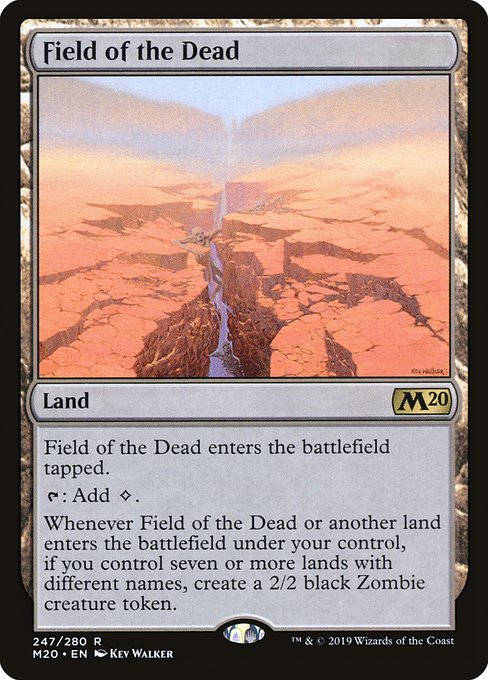
5. Field of the Dead
Field of the Dead | Illustration by Kev WalkerTemple of the False God | Illustration by James Zapata
Field of the Dead rewards the exact condition Spock wants. Once you control seven lands with different names, each additional land creates a 2/2 Zombie. The stock deck reaches that requirement naturally, and Ancient Greenwarden can double the trigger.
Recommended cut: Temple of the False God. Temple has a unique name, but it does nothing before your fifth land and produces no colored mana. Spock needs three colors and costs five; a land that can fail to help cast him is the wrong kind of uniqueness.
6–7. Boseiju, Who Endures and Otawara, Soaring City
Boseiju, Who Endures | Illustration by Chris OstrowskiOtawara, Soaring City | Illustration by Alayna Danner
These legendary lands enter untapped, produce colors Spock needs, and carry channel abilities that function like spells without using spell slots. Boseiju answers an artifact, enchantment, or nonbasic land. Otawara can return a creature, enchantment, artifact, or planeswalker to its owner's hand. Each raises the unique-name count while remaining useful when drawn late.
Use them in place of redundant basics, but keep at least one Forest and one Island for the stock search lands and ramp spells. These are premium upgrades, not requirements. A normal basic is better than a utility land you do not own.
8. Eiganjo, Seat of the Empire
Eiganjo, Seat of the Empire | Illustration by Julian Kok Joon Wen
Eiganjo is the white member of the same cycle. It enters untapped, contributes a distinct name, and can channel to deal four damage to an attacking or blocking creature. Landing Party wants Spock to attack without trading him away, so removing a blocker from hand is more valuable than it first appears. Replace one of the two Plains if you add it, leaving the other as a search target.
Eight Clean Changes to Start With
If you want a focused first pass, use this package:
- Add Roaming Throne; cut Cold-Blooded Crew. Double Spock's triggers instead of paying six mana for a modest creature.
- Add Sensei's Divining Top; cut Harmonize. Control what Spock reveals instead of relying on generic one-shot draw.
- Add Strionic Resonator; cut Satyr Wayfinder. Copy the commander's best trigger instead of accepting a low-impact late draw.
- Add Scroll Rack; cut Echo of Eons. Turn your hand into a prepared top deck without refilling three opponents.
- Add Field of the Dead; cut Temple of the False God. Gain a unique-name payoff without risking a land that fails before turn five.
- Add Boseiju, Who Endures in a redundant Forest slot.
- Add Otawara, Soaring City in the second Island slot.
- Add Eiganjo, Seat of the Empire in the second Plains slot.
This keeps five basics: three Forests, one Plains, and one Island. You retain an untapped foundation and enough named basic types for the stock search package while removing three duplicate names. Do not cut lands to make these changes. Spock costs five and wants land drops after he resolves.
Other Strong Landing Party Upgrades
Swiftfoot Boots gives Spock haste and hexproof. Haste converts a recast into an immediate attack trigger, while hexproof makes that attack plan harder to disrupt. Lightning Greaves is faster but shroud can interfere with your own targeted effects.
Teleportation Circle blinks Spock at the end of your turn, creating another enter trigger without paying commander tax. The timing means the free spell arrives late, so prioritize permanents and sorceries you can legally cast from the resolving trigger.
Panharmonicon doubles Spock's enter trigger but not his attack trigger. It becomes stronger if you preserve the deck's large collection of creatures and artifacts with enter abilities. Roaming Throne is the first choice because it works on both halves of Spock.
Reconnaissance lets Spock attack, trigger, and then retreat from combat after blockers are declared. It can also untap him after combat damage during the end-of-combat step. Add it if crowded battlefields repeatedly shut off the attack trigger.
Dryad of the Ilysian Grove supplies an extra land drop and fixes colors, but remember that changing land types does not change land names. It accelerates Spock's count only when you have differently named lands to play.
Spock or Kirk: Who Should Lead Landing Party?
Commander Spock is the better default leader for the stock deck. Most cards support lands or generate value, and Spock converts that broad shell into cards and free spells. He does not require a Spacecraft to be present.
Captain Kirk is better when you want to rebuild around Spacecraft. He finds Starship Enterprise from the library or graveyard, gives every Spacecraft creature +3/+3, and attacks with vigilance. The cost is predictability. Kirk repeatedly finds one signature card; Spock can turn almost any top card into value.
A useful middle ground is to keep Kirk in the 99. Spock's trigger can cast him for free once four unique land names are established. Kirk then finds a basic for the next land drop or recovers Starship Enterprise.
Landing Party's Biggest Weaknesses
Spock Costs Five Mana
The deck looks like landfall, but the commander is still a five-mana engine. An opening hand that does nothing before turn five is not acceptable just because it contains three different land names. Keep ramp and color access together.
The Mana Base Can Lose Tempo
The stock list contains several lands that enter tapped or require conditions to enter untapped. Replacing every basic with another tapped utility land makes the unique-name count prettier while delaying Spock. Upgrade for function first, novelty second.
Top-Deck Control Is Limited Out of the Box
Brainstorm, Ponder, and the three Temples help, but the deck cannot always choose what Spock reveals. That creates awkward turns where a small spell is cast for free and a much stronger card remains stranded in hand. Sensei's Divining Top and Scroll Rack fix the problem directly.
Attacking Exposes the Engine
Spock's five toughness is respectable, not invulnerable. Deathtouch creatures, large blockers, and instant-speed removal can convert one attack into seven mana of commander tax. Treat the attack trigger as optional value, not an instruction to throw Spock away.
Landing Party FAQ
Is the Landing Party decklist official?
Yes. Wizards published the complete 100-card Landing Party decklist on October 29, 2026. The product releases on November 13, 2026.
Is Commander Spock legal in Commander right now?
Not before the release date. Scryfall lists the new Star Trek Commander cards as not legal while they are unreleased. They are designed for the Commander product and become available for ordinary Commander play on release, subject to the format's banned list and any event rules.
Does each basic land increase Spock's count?
Only the first land with each name does. Forest, Plains, and Island provide three names. A second Forest does not provide a fourth.
Does Spock cast lands?
No. If the revealed card is a land, you may put it onto the battlefield tapped. That does not use your normal land play for the turn.
What happens when Spock reveals a spell that costs too much?
If the card remains on top of your library after the free-cast check, you draw it. You do not lose the card.
Does Roaming Throne double Commander Spock?
Yes. Choose Scientist as Roaming Throne enters. Spock is a Scientist, and both his enter and attack ability are triggered abilities of another Scientist you control.
Should I remove all eight basics?
No. The stock list contains several cards that search for basics, and basics provide untapped, resilient mana. Start by replacing duplicate basics while keeping at least one of each basic type.
Does the Collector's Edition use a different decklist?
No. Both editions contain the same 100 cards. The surge-foil version changes the finish, not the strategy.
Final Verdict
Landing Party has a real engine before you buy a single upgrade. It ramps, plays extra lands, rewards landfall, and gives Commander Spock enough raw material to keep revealing cards. The surprising eight-basic package is not proof that the deck failed to understand its own commander. It is the safety system that lets the ramp and fetch package function.
The opportunity is in the duplicates. Replace a few redundant basics with useful names, add repeatable top-deck control, and give Spock more than one trigger per turn cycle. Roaming Throne is the most explosive spell upgrade. Sensei's Divining Top is the most consistent. Field of the Dead is the land that best turns the deck's existing plan into a win condition.
Start there, keep enough basics for the search package, and let the first few games tell you whether the next slot should improve speed, protection, or Spacecraft. The best Commander Spock deck will not have the highest possible count of unique lands. It will have the highest count it can support without forgetting to cast its commander on time.
Research checked October 29, 2026. Oracle text, color identity, release date, and artwork credits were checked against Scryfall and the official Wizards list. The decklist is official. Upgrade recommendations and cuts are original ElderDecks editorial judgments, not claims based on measured win rates or private playtesting. Prices for unreleased Star Trek singles are intentionally omitted because dependable market prices do not yet exist.
Commander Spock rewards you for exploring strange new worlds. The more differently named lands you control, the more powerful his ability becomes.
So why does the official Landing Party deck still contain eight basic lands?
The newly revealed precon includes some excellent landfall staples, but its mana base raises an interesting question: how much more powerful could Spock become with just a handful of changes?
Let’s examine the full decklist, identify its biggest weaknesses, and find out which Landing Party upgrades deserve your attention first.
Wizards revealed the complete list on October 29, 2026. Landing Party releases with Magic: The Gathering | Star Trek on November 13, 2026. Until then, Scryfall correctly marks its unreleased cards as not yet Commander-legal; that is a release-date issue, not a ban.
The official stock list contains 1 commander and 99 cards in the main deck, including 40 lands. Commander Spock leads the deck; Captain Kirk, Boldly Going is included in the 99 as the alternate commander.
Browse by card type below, search for a specific card, switch to Cards for the gallery, or use Copy decklist to copy the full list. Quantities are shown beside every card. The upgrade recommendations later in this guide are separate from this stock list.
- Face commander:Commander Spock
- Backup commander:Captain Kirk, Boldly Going
- Colors: Green, white, and blue, commonly called Bant
- Primary plan: Increase the number of differently named lands, then turn Spock's enter and attack triggers into free spells
- Supporting themes: Landfall, extra land drops, Spacecraft, top-deck manipulation, and enter-the-battlefield value
- Deck size: 100 cards
- Basic lands: Eight total: four Forests, two Plains, and two Islands
- Release date: November 13, 2026
Commander Spock costs five mana for a 3/5 Vulcan Human Scientist. Whenever he enters or attacks, you reveal the top card of your library. If its mana value is no greater than the number of differently named lands you control, you may cast it without paying its mana cost. A revealed land may enter tapped instead. If the card stays on top, you draw it.
That last sentence is the safety valve. A seven-mana spell revealed while you control five unique land names does not disappear. It becomes your draw for the trigger. Spock therefore supplies a card even when the free-cast test fails. The real payoff for building around unique names is tempo: the more distinct lands you establish, the larger the spell you can deploy while keeping your mana available.
The trigger happens on entry and attack. That makes protection, haste, blinking, and trigger-copying unusually valuable. Spock can generate one card when first cast, another on the first attack, and more if you safely repeat either event. He does not need to deal combat damage.
What counts as a differently named land?
Use the names printed on the cards. Command Tower, Forest, Temple of Mystery, and Risa are four differently named lands. Four Forests still contribute only one name. A double-faced card on the battlefield uses the name of its current face. Copying a land normally copies its name too, so a copy does not create a new name unless the copy effect says otherwise.
The right answer is not “remove every basic.” It is “keep enough basics for the search package, then replace redundant copies.” One Forest, one Plains, and one Island already provide three unique names and preserve basic targets. That leaves five duplicate basics you can reconsider, though you do not need to replace all five at once.
I would begin with three changes, play the deck, then decide whether the extra utility is worth slower or more painful mana. A land entering tapped can raise Spock's count and still cost you the turn in which you wanted to cast him. Unique is valuable; functional is mandatory.
Keep hands that can produce all three colors and make a useful play before Spock. A green source plus Farseek, Nature's Lore, Growth Spiral, or Lotus Cobra is a much better start than three attractive Star Trek legends and no acceleration.
Sequence lands with the unique-name count in mind. If your hand contains Forest and Temple of Mystery, playing the Temple on turn one is usually painless and its scry helps set up later turns. When Fabled Passage can find the color you need, it also turns one land drop into two landfall events. Avoid fetching a second basic with the same name unless color requirements demand it.
Brainstorm and Ponder are not filler here. They can put a castable spell on top before Spock enters or attacks. Save them when practical instead of firing them off for minor selection on turn one.
Midgame: Make the First Spock Trigger Count
Five mana is the key turn. Before casting Spock, ask two questions: how many unique land names do I control, and what is on top? If the answer to the second question is “I have no idea,” cast Ponder or use a scry land first when possible.
Do not attack Spock into a profitable block merely because the trigger exists. A 3/5 survives small creatures, but commander tax turns the next casting into seven mana. Protection such as Heroic Intervention and an open lane matter more than squeezing in three damage.
Endgame: Convert Free Spells into a Board
Once seven or more names are online, most of the deck becomes a valid hit. Ancient Greenwarden doubles landfall triggers, Scute Swarm multiplies, Tireless Tracker produces Clues, and Starship Enterprise accumulates charge counters as lands enter. That is the point at which Spock stops feeling like a draw engine and starts behaving like a second main phase attached to every safe attack.
Wrath of God remains useful even in a creature deck. If the table develops faster than you do, reset the battlefield, then recast Spock and rebuild from the cards and mana he supplies.
Both one-mana spells fix the top of the library before a Spock trigger. Brainstorm can place an expensive card from your hand on top, turning a card you could not cast into a free spell. Ponder looks three cards deep and can shuffle when none is suitable. Their ceiling is much higher here than “cheap cantrip.”
Spock may cast the top card for free, but the rest of your hand still needs mana. Lotus Cobra converts every land into colored mana, which helps cast Spock on time and pay for interaction after he resolves. Tireless Tracker converts the same land drops into Clues and grows into a legitimate attacker. Neither card needs Spock to be useful.
Captain Kirk is the more linear backup commander. The four-mana 3/4 has vigilance, gives your Spacecraft creatures +3/+3, and searches your library or graveyard for a basic land or Starship Enterprise whenever he enters or attacks. Kirk does not offer Spock's free-spell ceiling, but he makes land drops, repeatedly recovers the Enterprise, and turns the ship package into a real combat plan.
The 8 Best Landing Party Upgrades
The first four upgrades improve Spock directly. The next four reshape the mana base without deleting every basic land.
Roaming Throne | Illustration by Wizard of BargeCold-Blooded Crew | Illustration by John Tyler Christopher
Choose Scientist as Roaming Throne enters. Commander Spock is a Scientist, so his enter and attack abilities trigger an additional time. One safe attack can reveal two cards, and each resolves separately using your current count of differently named lands.
Recommended cut: Cold-Blooded Crew. The six-mana 4/4 places two +1/+1 counters when it enters and can basic-landcycle for two. That flexibility is acceptable in Limited, but Landing Party already has stronger ramp and its high-cost creature mode does not advance Spock's engine.
Sensei's Divining Top | Illustration by Greg StaplesHarmonize | Illustration by Dan Murayama Scott
Sensei's Divining Top lets you inspect and reorder the top three cards before each Spock trigger. It turns spare mana into repeated control, hides from removal by drawing itself, and can set up both the enter trigger and the next attack.
Recommended cut: Harmonize. Three cards for four mana is fair, but it is generic one-shot value in a deck whose commander already draws. Top does the thing this commander specifically needs: it decides which card Spock sees.
Strionic Resonator | Illustration by Sam WhiteSatyr Wayfinder | Illustration by Steve Prescott
Two mana copies Spock's triggered ability. Resonator works on both the enter and attack trigger, does not require Spock to attack twice, and remains useful with other triggered abilities in the deck. Leave two mana open before casting Spock when you want immediate value.
Recommended cut: Satyr Wayfinder. Wayfinder helps hit a land and stocks the graveyard for Sun Titan or Ancient Greenwarden, but a 1/1 that mills four cards is a low-impact draw later. Resonator turns the commander itself into the stronger engine.
Scroll Rack | Illustration by Heather HudsonEcho of Eons | Illustration by Victor Adame Minguez
Scroll Rack turns cards from your hand into a prepared sequence on top of the library. Put the expensive permanent you want to cast first, attack with Spock, then let the free spell resolve. Fetch lands are especially useful because shuffling clears unwanted cards left on top.
Recommended cut: Echo of Eons. A six-mana wheel can rescue an empty hand, but it also gives every opponent seven fresh cards and erases the top-deck order you worked to build. Scroll Rack is asymmetrical and aligned with Spock.
Field of the Dead | Illustration by Kev WalkerTemple of the False God | Illustration by James Zapata
Field of the Dead rewards the exact condition Spock wants. Once you control seven lands with different names, each additional land creates a 2/2 Zombie. The stock deck reaches that requirement naturally, and Ancient Greenwarden can double the trigger.
Recommended cut: Temple of the False God. Temple has a unique name, but it does nothing before your fifth land and produces no colored mana. Spock needs three colors and costs five; a land that can fail to help cast him is the wrong kind of uniqueness.
Boseiju, Who Endures | Illustration by Chris OstrowskiOtawara, Soaring City | Illustration by Alayna Danner
These legendary lands enter untapped, produce colors Spock needs, and carry channel abilities that function like spells without using spell slots. Boseiju answers an artifact, enchantment, or nonbasic land. Otawara can return a creature, enchantment, artifact, or planeswalker to its owner's hand. Each raises the unique-name count while remaining useful when drawn late.
Use them in place of redundant basics, but keep at least one Forest and one Island for the stock search lands and ramp spells. These are premium upgrades, not requirements. A normal basic is better than a utility land you do not own.
Eiganjo, Seat of the Empire | Illustration by Julian Kok Joon Wen
Eiganjo is the white member of the same cycle. It enters untapped, contributes a distinct name, and can channel to deal four damage to an attacking or blocking creature. Landing Party wants Spock to attack without trading him away, so removing a blocker from hand is more valuable than it first appears. Replace one of the two Plains if you add it, leaving the other as a search target.
Eight Clean Changes to Start With
If you want a focused first pass, use this package:
This keeps five basics: three Forests, one Plains, and one Island. You retain an untapped foundation and enough named basic types for the stock search package while removing three duplicate names. Do not cut lands to make these changes. Spock costs five and wants land drops after he resolves.
Other Strong Landing Party Upgrades
Swiftfoot Boots gives Spock haste and hexproof. Haste converts a recast into an immediate attack trigger, while hexproof makes that attack plan harder to disrupt. Lightning Greaves is faster but shroud can interfere with your own targeted effects.
Teleportation Circle blinks Spock at the end of your turn, creating another enter trigger without paying commander tax. The timing means the free spell arrives late, so prioritize permanents and sorceries you can legally cast from the resolving trigger.
Panharmonicon doubles Spock's enter trigger but not his attack trigger. It becomes stronger if you preserve the deck's large collection of creatures and artifacts with enter abilities. Roaming Throne is the first choice because it works on both halves of Spock.
Reconnaissance lets Spock attack, trigger, and then retreat from combat after blockers are declared. It can also untap him after combat damage during the end-of-combat step. Add it if crowded battlefields repeatedly shut off the attack trigger.
Dryad of the Ilysian Grove supplies an extra land drop and fixes colors, but remember that changing land types does not change land names. It accelerates Spock's count only when you have differently named lands to play.
Spock or Kirk: Who Should Lead Landing Party?
Commander Spock is the better default leader for the stock deck. Most cards support lands or generate value, and Spock converts that broad shell into cards and free spells. He does not require a Spacecraft to be present.
Captain Kirk is better when you want to rebuild around Spacecraft. He finds Starship Enterprise from the library or graveyard, gives every Spacecraft creature +3/+3, and attacks with vigilance. The cost is predictability. Kirk repeatedly finds one signature card; Spock can turn almost any top card into value.
A useful middle ground is to keep Kirk in the 99. Spock's trigger can cast him for free once four unique land names are established. Kirk then finds a basic for the next land drop or recovers Starship Enterprise.
Landing Party's Biggest Weaknesses
Spock Costs Five Mana
The deck looks like landfall, but the commander is still a five-mana engine. An opening hand that does nothing before turn five is not acceptable just because it contains three different land names. Keep ramp and color access together.
The Mana Base Can Lose Tempo
The stock list contains several lands that enter tapped or require conditions to enter untapped. Replacing every basic with another tapped utility land makes the unique-name count prettier while delaying Spock. Upgrade for function first, novelty second.
Top-Deck Control Is Limited Out of the Box
Brainstorm, Ponder, and the three Temples help, but the deck cannot always choose what Spock reveals. That creates awkward turns where a small spell is cast for free and a much stronger card remains stranded in hand. Sensei's Divining Top and Scroll Rack fix the problem directly.
Attacking Exposes the Engine
Spock's five toughness is respectable, not invulnerable. Deathtouch creatures, large blockers, and instant-speed removal can convert one attack into seven mana of commander tax. Treat the attack trigger as optional value, not an instruction to throw Spock away.
Landing Party FAQ
Is the Landing Party decklist official?
Yes. Wizards published the complete 100-card Landing Party decklist on October 29, 2026. The product releases on November 13, 2026.
Not before the release date. Scryfall lists the new Star Trek Commander cards as not legal while they are unreleased. They are designed for the Commander product and become available for ordinary Commander play on release, subject to the format's banned list and any event rules.
Does each basic land increase Spock's count?
Only the first land with each name does. Forest, Plains, and Island provide three names. A second Forest does not provide a fourth.
Does Spock cast lands?
No. If the revealed card is a land, you may put it onto the battlefield tapped. That does not use your normal land play for the turn.
What happens when Spock reveals a spell that costs too much?
If the card remains on top of your library after the free-cast check, you draw it. You do not lose the card.
Yes. Choose Scientist as Roaming Throne enters. Spock is a Scientist, and both his enter and attack ability are triggered abilities of another Scientist you control.
Should I remove all eight basics?
No. The stock list contains several cards that search for basics, and basics provide untapped, resilient mana. Start by replacing duplicate basics while keeping at least one of each basic type.
Does the Collector's Edition use a different decklist?
No. Both editions contain the same 100 cards. The surge-foil version changes the finish, not the strategy.
Final Verdict
Landing Party has a real engine before you buy a single upgrade. It ramps, plays extra lands, rewards landfall, and gives Commander Spock enough raw material to keep revealing cards. The surprising eight-basic package is not proof that the deck failed to understand its own commander. It is the safety system that lets the ramp and fetch package function.
The opportunity is in the duplicates. Replace a few redundant basics with useful names, add repeatable top-deck control, and give Spock more than one trigger per turn cycle. Roaming Throne is the most explosive spell upgrade. Sensei's Divining Top is the most consistent. Field of the Dead is the land that best turns the deck's existing plan into a win condition.
Start there, keep enough basics for the search package, and let the first few games tell you whether the next slot should improve speed, protection, or Spacecraft. The best Commander Spock deck will not have the highest possible count of unique lands. It will have the highest count it can support without forgetting to cast its commander on time.
Research checked October 29, 2026. Oracle text, color identity, release date, and artwork credits were checked against Scryfall and the official Wizards list. The decklist is official. Upgrade recommendations and cuts are original ElderDecks editorial judgments, not claims based on measured win rates or private playtesting. Prices for unreleased Star Trek singles are intentionally omitted because dependable market prices do not yet exist.
AI-generated article, published by an ElderDecks editor.