MTG Nauctis Commander Decks: All 4 Precons, Colors, Strategies & What We Know
By ElderArticles · Updated 11/14/2026 · 11 min read
Explore all four Nauctis Commander decks, their colors and strategies, confirmed release details, and early upgrade ideas before choosing your next MTG precon.
Table of contents
Last updated: November 13, 2026
A Shark feeding frenzy, a Merfolk army, a suspiciously generous seal, and monsters that refuse to stay buried. Picking a Nauctis Commander deck might come down to one question: what kind of trouble do you want to cause underwater?
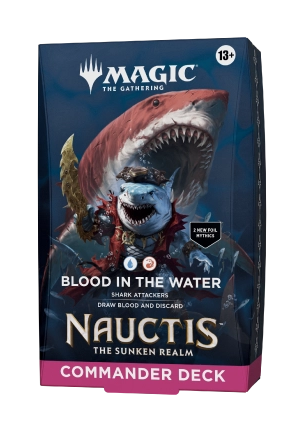
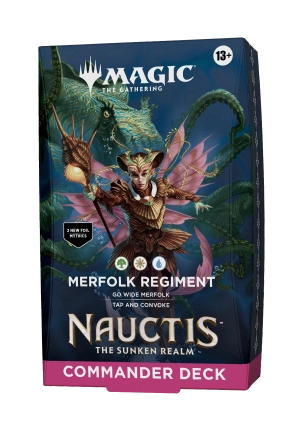
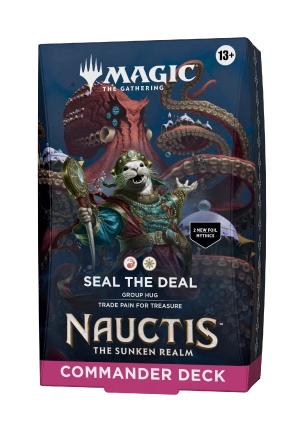
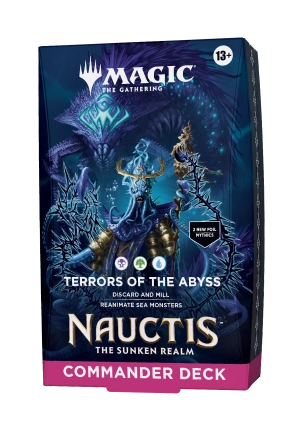
There are four Nauctis Commander decks: Blood in the Water, Merfolk Regiment, Seal the Deal, and Terrors of the Abyss. Their packaging points to blue-red Sharks and discard, green-white-blue Merfolk and convoke, red-white group hug and Treasure, and black-green-blue graveyard sea monsters.
Nauctis: The Sunken Realm releases February 5, 2027. Although early coverage relied on packaging circulating before the reveal, Wizards’ November 13 First Look now officially lists all four products. Complete decklists and verified face-commander abilities remain the missing pieces in this guide.
That’s enough to explore their strategies—not enough to declare a strongest deck or recommend buying specific upgrades blindly.
Shark Typhoon | Illustration by Caio Monteiro
Shark Typhoon is existing Magic artwork illustrating one of this guide’s suggested support cards, not a preview of a confirmed Nauctis inclusion.
The names below are officially listed by Wizards. Colors and strategy descriptions come from the packaging shown in its First Look article.
Blood in the Water — Blue/red (Izzet). Shark attackers; Blood and discard.
Merfolk Regiment — Green/white/blue (Bant). Go-wide Merfolk; tapping and convoke.
Seal the Deal — Red/white (Boros). Group hug; trading pain for Treasure.
Terrors of the Abyss — Black/green/blue (Sultai). Discard and mill; sea-monster reanimation.
Blood in the Water — official product image courtesy of Wizards of the CoastMerfolk Regiment — official product image courtesy of Wizards of the CoastSeal the Deal — official product image courtesy of Wizards of the CoastTerrors of the Abyss — official product image courtesy of Wizards of the Coast
These are product themes, not substitutes for commander rules text. Packaging cannot tell us whether an ability triggers once per turn, requires combat damage, or restricts which creatures it supports.
Wizards confirms that each standard deck contains 100 cards, including a foil face commander and a foil featured commander. Premium Editions also exist, but they are versions of these four decks—not four additional strategies.
Every existing card suggested below is a deckbuilding candidate, not a confirmed precon inclusion. Their current Commander legality and color identities were checked against Scryfall.
Blood in the Water — Izzet Sharks and Discard
Sharks want to attack. Discard decks want to turn cards leaving your hand into something useful. Blood in the Water appears designed to connect those jobs.
November 13 product-description coverage names Shredmouth and describes attacking Sharks generating Blood tokens. Treat that as product-description information, not a verified transcription of a commander’s ability.
The interesting deckbuilding question is how much space each half needs. Too many expensive Sharks could leave your discard payoffs stranded. Too many discard engines could leave you without enough attackers.
Existing cards worth considering
Shark Typhoon | Illustration by Caio MonteiroBrallin, Skyshark Rider | Illustration by Paul Scott Canavan
Shark Typhoon: Cycling it both discards a card and creates a flying Shark. Cast as an enchantment, it rewards noncreature spells instead. That flexibility is appealing, although its six-mana enchantment mode needs enough supporting spells.
Brallin, Skyshark Rider: Each discarded card grows Brallin and damages every opponent. He can also give a Shark trample. Those are unusually relevant jobs for one slot.
Containment Construct | Illustration by Julian Kok Joon WenCurrency Converter | Illustration by Sean Murray
Containment Construct: Lets you exile a discarded card from your graveyard and play it that turn. You still pay costs and obey normal timing and land-play restrictions; this isn’t free casting.
Currency Converter: Stores discarded cards, then turns them into Treasure or Rogue tokens. It offers a slower backup engine, but competes with Containment Construct for the same discarded card.
This looks appealing for players who enjoy attacking while assembling incremental value. The unknown is whether the final commander strongly rewards Shark density, repeated discards, or a particular balance.
Merfolk Regiment asks an excellent Commander question: why should your creatures stop working just because attacking is a bad idea?
Convoke lets creatures help pay for spells. A crowded battlefield can therefore become both an army and a resource engine. Newly entered creatures can help convoke, too; summoning sickness does not prevent that use.
There’s still a real decision involved. A creature tapped to convoke cannot also attack that turn without being untapped, and tapping the whole team can leave your shields down.
Existing cards worth considering
Deeproot Pilgrimage | Illustration by Rémi JacquotJudge of Currents | Illustration by Dan Murayama Scott
Deeproot Pilgrimage: Produces a hexproof Merfolk token when one or more nontoken Merfolk become tapped. Crucially, tapping several simultaneously gives one trigger—not one token per Merfolk.
Judge of Currents: Offers life whenever an individual Merfolk becomes tapped. It can cushion attacks coming back at you, although life gain alone won’t close a game.
Merrow Reejerey | Illustration by Thomas M. BaxaChord of Calling | Illustration by Scott M. Fischer
Merrow Reejerey: Strengthens your other Merfolk and provides a tap-or-untap trigger when you cast a Merfolk spell. Tokens entering do not trigger that second ability.
Chord of Calling: Turns spare creatures into help finding a specific creature directly onto the battlefield. It rewards having useful targets, not simply the largest possible creature.
This is the natural starting point for players who like creature synergy and an expanding board. Its complexity will come from sequencing: when to attack, when to tap for value, and how much protection to leave available.
Product-description reporting names Captain Hanno Corolean, but we still need verified rules text before deciding which tapping effects deserve priority.
Giving an opponent resources is easy. Making sure those resources don’t immediately beat you is the hard part.
Seal the Deal’s packaging pairs group hug with Treasure and a pain-for-rewards pitch. That suggests political decisions, but does not establish exactly who takes damage, who receives Treasure, or how frequently either happens. Earlier coverage explicitly speculated about those details.
A useful group-hug deck needs more than generosity. It needs a way to benefit disproportionately—or turn a friendly table into a winning position.
Existing cards worth considering
Humble Defector | Illustration by Slawomir ManiakSecret Rendezvous | Illustration by Dwarf Fortress
Humble Defector: Draws you two cards before an opponent gains control of it. You can negotiate its return, but that agreement is politics, not a rules guarantee.
Secret Rendezvous: Gives you and one opponent three cards. Choose carefully: helping the player with an empty hand is different from refueling the player already threatening to win.
Xorn | Illustration by Ian PermanaProfessional Face-Breaker | Illustration by Dan Murayama Scott
Xorn: Adds one Treasure to each event in which you would create Treasure. It does not double a large batch and does nothing without reliable Treasure production.
Professional Face-Breaker: Rewards combat damage to players with Treasure and lets you sacrifice Treasure for temporary access to cards. It’s a candidate for an attacking build, not an automatic inclusion in a passive political deck.
Product descriptions name Gallorte, but the exact commander incentives remain essential to evaluating these options.
Choose this direction if negotiating, choosing beneficiaries, and changing alliances sound more entertaining than following a fixed sequence.
Terrors of the Abyss — Sultai Mill and Reanimation
An enormous sea monster in your opening hand can be a problem. The same monster in your graveyard can be an opportunity.
Terrors of the Abyss combines discard and mill with reanimation. Product-description coverage names The Noble Serpent and describes moving sea monsters into the graveyard before returning them to play.
That suggests three packages: ways to fill the graveyard, worthwhile creatures to recover, and spells that bring them back. Overload any one package and the deck can stumble. A hand full of monsters isn’t useful if you cannot discard them; reanimation spells need targets.
Existing cards worth considering
Stitcher's Supplier | Illustration by Chris SeamanVictimize | Illustration by Val Mayerik
Stitcher's Supplier: Mills three cards when it enters and again when it dies. It helps stock your graveyard, though random milling cannot guarantee the target you want.
Victimize: Exchanges a creature on your battlefield for two creature cards in your graveyard, returning them tapped. Supplier makes useful sacrifice material, but you need two legal targets before casting Victimize.
Spawning Kraken | Illustration by Kev WalkerWhelming Wave | Illustration by Slawomir Maniak
Spawning Kraken: Turns combat damage from your Krakens, Leviathans, Octopuses, and Serpents into additional 9/9 Krakens. It rewards connecting, not simply controlling big creatures.
Whelming Wave: Returns creatures except those four types to their owners’ hands. It can clear blockers while preserving your monsters—but opponents’ qualifying creatures stay, too.
This direction suits players who enjoy dramatic recovery turns and managing the graveyard as a resource. Its obvious pressure point is graveyard hate, so an eventual upgrade plan should retain enough mana to cast threats normally.
Choose the gameplay you enjoy before choosing a box. These are preliminary playstyle assessments, not tested power rankings.
Blood in the Water: Best for attacking with a discard engine. The learning challenge is balancing attackers and value pieces; early upgrade directions include efficient discard payoffs and reliable Sharks.
Merfolk Regiment: Best for creature synergy and wide boards. Practice sequencing attacks, tapping, and convoke; consider Merfolk density, protection, and tap rewards when upgrading.
Seal the Deal: Best for politics and multiplayer deals. Learn to give resources without enabling an opponent’s win; look for reliable Treasure production and a clear closing plan.
Terrors of the Abyss: Best for graveyard setup and huge threats. Balance setup, targets, and recovery; consistent self-mill and resilient reanimation are sensible upgrade directions.
Merfolk Regiment is my tentative beginner shortlist pick: developing creatures and using them together offers a visible game plan. That is not a verdict on its unrevealed commander or stock list.
Seal the Deal may demand the most table awareness. Terrors asks you to manage another resource zone. Blood in the Water could sit between straightforward combat and more intricate discard sequencing.
We cannot responsibly compare consistency, mana bases, or out-of-box strength without the complete lists.
Nauctis Commander Decklists and Upgrade Guides
At this update, we have not verified complete official Nauctis Commander decklists or the face commanders’ full rules text. A product description naming a character is not the same as a revealed card.
Once those details are available, the useful next step is examining each 100-card list: mana, early plays, interaction, card advantage, and how it actually wins. Only then do precise “add this, cut that” Nauctis precon upgrades make sense.
For now, use the suggestions above as an unofficial concept shortlist, not a shopping list. Some candidates could already be included; others may fit the theme but miss the commander’s actual incentives.
Bookmark this guide, keep your experiments clearly labeled, and refine them as cards become available. ElderDecks’ builder is free to start without registration.
Four. Wizards officially lists four standard decks and Premium Edition versions of the same lineup.
What are their names?
Blood in the Water, Merfolk Regiment, Seal the Deal, and Terrors of the Abyss.
When does Nauctis release?
The confirmed tabletop release date is February 5, 2027.
What colors are the decks?
Blood in the Water is blue-red; Merfolk Regiment is green-white-blue; Seal the Deal is red-white; Terrors of the Abyss is black-green-blue.
Have the face commanders been revealed?
Product imagery and descriptions are available, including reported character names. This guide has not verified full face-commander cards and rules text, so it does not assign abilities or assume which depicted character occupies each commander slot.
Are the full 100-card decklists available?
No complete official lists were verified during this update. Wizards confirms the decks contain 100 cards, but that is not a card-by-card reveal.
Which deck looks best for beginners?
Merfolk Regiment is a tentative starting point for someone who enjoys creature combat. Wait for the commanders and decklists before treating any deck as the definitive beginner recommendation.
Pick Your Strategy, Then Wait for the Details
Nauctis already offers four genuinely different starting points. You can attack and discard, turn Merfolk into a resource engine, negotiate for advantage, or haul monsters out of the graveyard.
The smart move now is deciding which of those turns you want to take. Leave the final cuts—and the victory predictions—until we can read all 100 cards.