By ElderArticles · Updated 11/8/2026 · 29 min read
Explore the 20 best Boros commanders, ranked with red-white strategies, four high-synergy cards per commander, key rules tips, and honest drawbacks.
Table of contents
You knock one player out, lose your board to a sweeper, and spend the next three turns drawing swords with nobody left to hold them. If that sounds like your last Boros game, the problem might be sitting in your command zone.
The best Boros commanders do more than make combat hurt. They keep cards moving, build a second wave, or turn a pile of harmless-looking permanents into a table-wide problem. Red-white can run spell engines, recycle artifacts, cook up Food, and even put a planeswalker in charge.
So which leaders actually deliver, and which need too much help before they get going? This countdown ranks twenty worthwhile options, with four specific synergy cards for every commander. The top spot comes last—but the right choice for your table might be hiding much further down.
Aurelia, the Warleader | Illustration by Slawomir Maniak
How We Ranked the Best Boros Commanders
This is an editorial ranking for multiplayer Commander, not a popularity chart or a claim about tournament win rates. We give the most weight to resource generation, speed, repeatability, resilience, and the ability to finish a game against multiple opponents. A commander that supplies its own engine earns more credit than one that only improves a board you already built.
We also consider setup costs and how narrow the supporting deck must be. A high ceiling matters, but so does what happens after the first removal spell. Higher-ranked does not mean more suitable for every playgroup, and this is not a cEDH tier list.
Every ranked entry has exactly red-white color identity and was marked Commander-legal in Scryfall during our November 8, 2026 check. This edition ranks individual commanders, not partner pairs. Quintorius qualifies because its rules explicitly allow it to be your commander. Star Trek release-window candidates are reserved for a later update rather than mixed into this verified field.
The synergy packages are starting points, not mandatory shopping lists. No card prices or personal playtesting results are claimed here.
#20. Alibou, Ancient Witness
AI-generated article, published by an ElderDecks editor.
Alibou, Ancient Witness | Illustration by Matt Stewart
A table full of tapped artifacts looks much less innocent when Alibou starts counting them.
Alibou gives your other artifact creatures haste and turns an artifact-creature attack into damage plus a deep scry. The useful distinction is that all your tapped artifacts count, not just the creatures attacking. Mana rocks, Vehicles, and artifacts tapped for other costs can contribute without entering combat.
This is an artifact deck that happens to attack, not a creature deck with a few rocks thrown in. Set up your artifacts before combat, then use the damage to remove a blocker or pressure a player. Scrying improves future draws, but it does not put another card in your hand.
Four cards worth pairing:
Clock of Omens: Taps artifacts to untap an artifact, giving utility pieces another job while helping arrange Alibou's damage count.
Losheel, Clockwork Scholar: Protects attacking artifact creatures from combat damage and supplies a once-per-turn draw trigger for artifact creatures entering.
Myr Battlesphere: Brings four Myr. When it attacks alongside Alibou's trigger, resolve Battlesphere's trigger first if you want its newly tapped Myr counted by Alibou.
Smuggler's Copter: Gives you a flying artifact attacker and looting, while crew helps put an otherwise idle creature to work.
The catch: Five mana, no immediate card advantage, and a substantial artifact requirement. Alibou earns its place through flexibility, but it is not rescuing an empty board. Play it if you enjoy making every mana rock and machine contribute to combat.
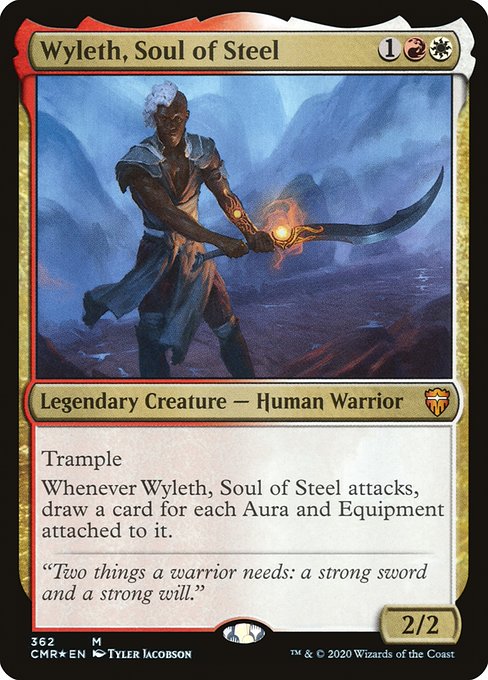
Wyleth, Soul of Steel | Illustration by Tyler Jacobson
Wyleth asks a wonderfully straightforward question: how many things can one person wear?
Each Aura and Equipment attached to Wyleth becomes a card when it attacks. You do not need to connect, and the trigger is not limited to once per turn. That makes the engine easy to understand and gives a focused Voltron deck a way to refill without giving up its central plan.
The discipline is knowing when to stop adding weapons. A hand full of expensive Equipment does not help if you cannot cast Wyleth, attach something, and leave up protection. Start with efficient attachments and enough mana to use them.
Four cards worth pairing:
Sram, Senior Edificer: Draws from casting your Auras and Equipment before Wyleth ever attacks.
Puresteel Paladin: Rewards Equipment entering and can remove equip costs once metalcraft is active.
Blackblade Reforged: Converts normal land development into a substantial power boost, with a discounted equip ability for legendary creatures.
Spirit Mantle: Protection from creatures makes blocking Wyleth difficult and keeps creature-based interaction from targeting it.
The catch: Opponents can remove Wyleth before attackers are declared, and repeated commander tax makes rebuilding awkward. Choose it if you want one clear attacker and a draw engine that rewards committing to that plan.
General Ferrous Rokiric | Illustration by Matt Stewart
A removal spell that comes with a 4/4 is an excellent way to make ordinary interaction feel unfair.
Ferrous creates a Golem whenever you cast a multicolored spell. You can answer a threat, recover resources, or protect your board while quietly assembling an army. Because the trigger cares about casting, countering the original spell does not automatically stop the Golem trigger.
The deck's challenge is restraint. It is tempting to fill every slot with a red-white card, but a mediocre gold spell does not become a great inclusion just because it arrives with a friend. Keep enough efficient removal and card access to function without the general.
Four cards worth pairing:
Boros Charm: Protects your permanents from destruction while generating a Golem from the cast trigger.
Rip Apart: Answers several permanent types and advances your board at the same time.
Lightning Helix: An inexpensive-in-mana interaction spell that can remove a small threat while adding another body.
Reconstruct History: Recovers a spread of card types, giving a spell-heavy build useful material for its next turn.
The catch: Hexproof from monocolored is helpful, not universal protection. Sweepers and appropriate multicolored interaction still work. This is for players who want their answers to double as threats rather than building around one giant attacker.
Taii Wakeen, Perfect Shot | Illustration by David Auden Nash
Most burn decks are happy when the creature dies. Taii checks your arithmetic first.
The draw trigger requires noncombat damage from a source you control to equal the creature's toughness. Dealing one damage to a three-toughness creature that already has two damage marked on it can kill it, but that one damage is not equal to three. Lethal damage and exact damage are different things here.
Taii's activated ability adjusts the damage your sources deal for the rest of the turn, letting small sweepers reach more useful numbers. That can turn an opposing token board into several cards, but the right value of X depends on what is actually on the battlefield.
Four cards worth pairing:
End the Festivities: Starts with one damage to opposing creatures, planeswalkers, and players; Taii can increase that amount.
Tectonic Hazard: Another one-mana starting point for damaging opposing creatures and players.
Spiteful Banditry: Lets you choose a damage amount and can leave a Treasure-producing enchantment behind.
Pyrohemia: Offers repeatable damage pulses, but hits your own creatures and you as well. Check Taii's survival before activating it.
The catch: Mixed toughness values complicate the draw plan, and a board-light opponent gives you fewer opportunities. Pick Taii if you enjoy precision removal and sequencing puzzles more than declaring an enormous attack.
Nelly Borca, Impulsive Accuser | Illustration by James Ryman
Nelly's favorite attacker belongs to somebody else.
Her attack trigger suspects a creature, then goads all suspected creatures. Suspected creatures have menace and cannot block, which helps turn the battlefield into a place where holding back is increasingly inconvenient. When an opponent's creatures connect with another opponent, Nelly rewards both you and the attacking player with a card.
That shared reward is the sales pitch. You are not merely telling someone where to attack; you are offering them something for doing it. Still, giving a dangerous opponent more cards is a real cost, not free political upside.
Four cards worth pairing:
Disrupt Decorum: Sends opposing boards into combat without waiting for Nelly to suspect creatures individually.
Taunt from the Rampart: Adds a temporary no-blocking clause to its mass goad effect, helping attacks actually connect.
Duelist's Heritage: Can grant double strike to an opponent's attacker, encouraging a useful attack and potentially producing draw triggers in both damage steps.
Windborn Muse: Makes attacks directed at you more expensive while you develop the political game.
The catch: Goad does not stop the last remaining opponent from attacking you. You need a finishing plan for that stage. Nelly suits players who enjoy negotiating combat and reading the table; our goad commander guide explores that endgame problem further.
Otharri remembers its progress even when the battlefield forgets.
Each attack gives you an experience counter and creates an attacking Rebel for every experience counter you have. Those counters belong to you, so destroying Otharri does not reset the count. Flying, haste, and lifelink also make the commander useful on the turn you cast it.
Its graveyard ability provides another recovery route, but only if you keep Otharri in the graveyard and have a Rebel to tap. That is a meaningful choice: leaving it there exposes it to graveyard interaction, and returning tapped does not produce an immediate attack.
Four cards worth pairing:
Lae'zel, Vlaakith's Champion: Adds an extra experience counter when Otharri gives you one, accelerating future armies.
Roaming Throne: Naming Phoenix adds another Otharri attack trigger; each trigger adds experience and then makes its own batch of Rebels.
Nesting Dovehawk: Populates a Rebel and grows as your creature tokens arrive.
Reconnaissance: Can pull Otharri out of an unfavorable combat after its attack trigger has done the important work.
The catch: Five mana is a serious investment, and exile removal can shut down the graveyard option. Otharri is best for players who want a growing token army with a recovery plan built into the commander.
Lightning only needs one opening to make an opponent's next turn uncomfortable.
When it deals combat damage to a player, damage to that player and their permanents is doubled until your next turn. First strike matters: with double strike, Lightning can connect in the first-strike step, establish the doubling effect, then hit harder in the regular damage step.
The effect also applies to damage from other sources, including opponents. Suddenly someone else's attack or damage spell can help finish the player Lightning marked. It is a potent pressure tool, but not a reason to forget the other two players.
Four cards worth pairing:
Duelist's Heritage: Supplies double strike without attaching another permanent to Lightning.
Embercleave: Adds power and double strike, with a flash attachment that can change combat after attackers are declared.
Boros Charm: Provides either double strike or protection from destruction, depending on what the turn demands.
Chandra's Ignition: After Lightning connects, its damage to the marked player and that player's creatures benefits from the established doubling effect.
The catch: You must connect with a player, and the initial damage event is not retroactively doubled. Removing Lightning before combat damage can derail an entire turn. Choose this commander if you like compact, explosive combat plans with a real incentive to think about damage-step timing.
Thorin, King of Durin's Folk | Illustration by Dmitry Burmak
Thorin turns a Treasure pile into a difficult decision: spend the mana, or keep the damage?
Thorin and your other entering Dwarves generate Treasures. Meanwhile, your other Dwarves receive extra power for each artifact token you control. That second ability counts more than Treasure, making Clues and Food useful even before you sacrifice them.
The result is a creature-type deck whose resource engine and combat plan feed each other. You want enough Dwarves to keep production moving, but also ways to turn a wide, high-power board into damage instead of watching it trade with disposable blockers.
Four cards worth pairing:
Magda, Brazen Outlaw: Rewards tapping Dwarves with more Treasures and can convert five Treasures into an artifact or Dragon.
Universal Automaton: Changeling makes it a Dwarf, giving you a low-mana creature that fits the engine.
Academy Manufactor: Replaces each Treasure-making event with a package of Treasure, Food, and Clue tokens, all relevant to Thorin's power bonus.
Maskwood Nexus: Makes your creatures Dwarves and expands which creatures trigger Thorin when they enter.
The catch: Thorin does not grant trample, protection, or card draw. Sacrificing artifact tokens also shrinks the bonus, and Thorin itself does not receive its own boost. Play it if you enjoy a creature-type deck with meaningful resource-management decisions.
Pia Nalaar, Consul of Revival | Illustration by Marta Nael
Pia pays you for using the cards you were already planning to play.
Playing a land from exile or casting a spell from exile produces a flying Thopter, and Pia gives those Thopters haste. The engine starts at two mana and rewards a stream of small plays rather than asking you to save for one spectacular turn.
There is an important distinction: exiling cards alone does nothing for Pia. You must actually play them. That makes mana curve and sequencing crucial. Exiling four expensive spells with no mana left is a disappointing way to manufacture zero airplanes.
Four cards worth pairing:
Reckless Impulse: Provides two exiled cards with a play window extending through your next turn.
Wrenn's Resolve: Adds redundancy to that same two-card setup, helping the deck find its core effect consistently.
Showdown of the Skalds: Opens a larger exile window, then rewards subsequent spell casts with counters.
Laelia, the Blade Reforged: Supplies a card from exile when it attacks and grows as your other effects exile cards from the library or graveyard.
The catch: Exile access expires, normal land-play limits still apply, and a pile of 1/1 flyers needs a way to finish. Choose Pia if you enjoy chaining efficient spells into a board rather than committing your whole hand to a single threat.
Nahiri, Forged in Fury | Illustration by Marta Nael
Nahiri's printed mana cost looks expensive until you count the Equipment already lying around.
Affinity for Equipment reduces the generic part of her cost, including applicable commander-tax increases. Once she is in play, every equipped attacker gives you an exiled card to use that turn, and Equipment spells found this way can be cast without paying their mana costs.
The incentive is to spread the weapons around. Three equipped creatures generate three triggers; one creature carrying three swords generates one. Equipment that arrives with its own body is especially useful because it contributes to both sides of that equation.
Four cards worth pairing:
Hexgold Halberd: Its For Mirrodin! ability brings an equipped Rebel, providing both a creature and an Equipment.
Barbed Batterfist: Another self-contained equipped body, with a low equip cost if you need to move it later.
Danitha Capashen, Paragon: Reduces the cost of Equipment you still need to cast from hand and provides a capable carrier.
Stone Haven Outfitter: Improves equipped creatures and draws cards when they die, helping a damaged board leave something behind.
The catch: Free to cast is not free to equip, and attack triggers do not override normal spell timing. Nahiri wants a genuinely wide Equipment deck, not a random collection of costly weapons. For a broader look at that archetype, see our Equipment commander ranking.
Aurelia, the Warleader | Illustration by Slawomir Maniak
Sometimes the elegant solution is to have another combat phase.
Aurelia provides haste, an immediate aerial threat, and a second attack for your team the first time she attacks each turn. That second combat is more than another pile of damage: it lets you repeat attack triggers, create more tokens, and extract another round of value from Equipment.
Six mana is the price of admission, so the rest of the deck needs to establish a useful board before Aurelia arrives. Casting her into an empty battlefield is acceptable pressure. Casting her with several attackers and productive attack triggers is the reason to choose her.
Four cards worth pairing:
Sword of the Animist: Can find another basic land each time its equipped creature attacks, helping combat fund future turns.
Adeline, Resplendent Cathar: Generates a fresh group of attacking Humans in each combat where you attack.
Reconnaissance: Lets you withdraw creatures from bad blocks; used in the end-of-combat step, it can untap creatures after they have dealt damage.
Akroma's Will: Can turn an established team into a lethal aerial attack while providing several forms of protection when you control your commander.
The catch: Aurelia does not draw cards, and the untap from her trigger happens when that trigger resolves—not again immediately before the extra combat. She belongs in a deck that already has attackers worth sending twice, with protection available when everyone notices the second combat coming.
Ragost, Deft Gastronaut | Illustration by Zack Stella
Boros can win by throwing dinner at the table. Ragost makes that a real deck, not just a joke you tell while losing.
Ragost turns your artifacts into Foods and can sacrifice a Food to deal three damage to each opponent. If you gained life during a turn, Ragost untaps at the beginning of that turn's end step. With repeatable life gain and sufficient mana and artifacts, that can give you activity on several players' turns.
Here is the trap: Ragost's damage ability does not gain life. Sacrificing a Food to that ability also does not activate the Food's own life-gain ability. You need a separate source of life gain to arrange the untap.
Four cards worth pairing:
Witch's Oven: Converts creatures into Food, producing two tokens when the sacrificed creature has sufficient toughness.
Prized Statue: Creates a Treasure when it enters and another when it goes to the graveyard, making it productive sacrifice material.
Sun Droplet: Can gain life on different players' turns if it has charge counters, helping enable Ragost's end-step untap.
Well of Lost Dreams: Turns your separate life-gain events into optional card draw if you keep mana available.
The catch: You are assembling food supply, life gain, mana, and the commander. Missing one slows the kitchen considerably. Ragost is excellent for players who want repeatable damage that reaches every opponent without relying on combat.
Quintorius, History Chaser | Illustration by Darren Tan
Quintorius makes the graveyard an unusually busy place for a red-white deck.
Its first ability creates a 3/2 Spirit whenever one or more cards leave your graveyard. The +1 helps stock that graveyard while turning a discarded card into two draws and a mill. Eventually, the −4 gives your Spirits double strike and vigilance for a decisive attack.
The phrase "one or more" matters. Moving five cards out in one event produces one Spirit, not five. Separate events are what keep the board growing. That gives the deck a satisfying rhythm: fill the graveyard, take something useful back, and collect a body along the way.
Four cards worth pairing:
Squee, Goblin Nabob: Can return to your hand during upkeep, creating a leave-the-graveyard event and providing repeatable discard material.
Squee, the Immortal: Can be cast from your graveyard, creating another way to move a card out while developing the battlefield.
Soul-Guide Lantern: Its entry trigger can exile a card from your own graveyard for a Spirit if that is useful; its other abilities still offer interaction or a card.
Sevinne's Reclamation: Returns a small permanent, and casting it with flashback creates an additional graveyard-departure event before the spell resolves.
The catch: Quintorius needs protection from attackers, and graveyard hate can strip away its resources. It explicitly can be your commander despite being a planeswalker. Pick it for a red-white value deck where the creatures are the reward for doing other useful things.
Osgir, the Reconstructor | Illustration by Victor Adame Minguez
Osgir looks at a broken artifact and sees two working ones.
Its first ability gives you a way to sacrifice artifacts. Its second exiles an artifact card from your graveyard and creates two token copies for a payment matching that card's mana value. Small utility artifacts become particularly appealing: use the original, put it in the graveyard, and rebuild twice the value.
This is not ordinary reanimation. The original card is exiled as an activation cost, so graveyard removal cannot take that same card away after you have paid the cost. Opponents can still stop the activated ability or remove the artifact before you get a chance to activate Osgir.
Four cards worth pairing:
Ichor Wellspring: Draws on entry and when it goes from battlefield to graveyard, fitting both halves of Osgir's engine.
Solemn Simulacrum: Offers land ramp and a death-trigger draw, with copied bodies providing more opportunities to collect both.
Thousand-Year Elixir: Lets a newly cast Osgir use its tap ability and can untap it for another activation.
Scrap Trawler: Recovers smaller artifacts when larger ones go to the graveyard, supporting the sacrifice half of the deck.
The catch: The copying ability is sorcery-speed and requires a tap. Large targets remain expensive to copy, and exile-based removal is uncomfortable. Choose Osgir if you would rather keep rebuilding useful machinery than wager everything on one combat.
Lorehold, the Historian | Illustration by Raymond Swanland
A two-mana miracle is exciting. Arranging one on someone else's turn is where Lorehold becomes a problem.
Lorehold gives instant and sorcery cards in your hand miracle for two generic mana and offers a discard-then-draw during each opponent's upkeep. That creates repeated chances to reveal a powerful spell as your first card drawn that turn and cast it through miracle.
The timing is not optional bookkeeping. You cannot decide halfway through your main phase that a spell you drew earlier should have been a miracle. Plan the top of your library and recognize the first draw of each turn as it happens.
Four cards worth pairing:
Sensei's Divining Top: Arranges upcoming draws so the upkeep opportunity is less of a gamble.
Scroll Rack: Moves expensive spells from your hand onto your library. Rack does not itself draw those cards, so plan a subsequent actual draw.
Austere Command: A flexible sweeper whose modes let you plan which parts of the battlefield survive.
Apex of Power: Still adds its mana when cast from your hand for a miracle cost. However, its permission to cast exiled spells does not waive ordinary timing restrictions, so an opponent's upkeep limits which hits you can use.
The catch: Five mana, setup pieces, discard fuel, and mana held open. A hand full of giant spells can be miserable before Lorehold arrives. This is for players who enjoy top-deck planning and explosive spell turns, not those looking for uncomplicated red-white combat.
The Jolly Balloon Man | Illustration by Richard Luong
The Balloon Man does not care how much you paid for the creature. He charges one mana for the balloon.
His activated ability copies another creature you control as a temporary 1/1 with flying and haste. The small body is rarely the point. Entry triggers, death triggers, and useful text boxes survive the makeover, giving Boros a remarkably flexible creature-value engine.
Haste lets the commander begin working immediately. The restrictions are equally important: you can activate only at sorcery speed, the ability requires a tap, and the token is scheduled for sacrifice at the next end step. Build for value now rather than assuming the copy will stick around.
Four cards worth pairing:
Solemn Simulacrum: A copy can find a basic land when it enters and draw a card when the Balloon is sacrificed.
Village Bell-Ringer: A copied Bell-Ringer untaps your creatures, including the commander, making further activations possible if you can pay for them.
Thousand-Year Elixir: Adds another untap route and supports other tap-ability creatures in the deck.
Impact Tremors: Turns the stream of copies into damage to every opponent, giving the engine a route beyond incremental value.
The catch: Bell-Ringer plus the commander is not infinite on its own; each activation still needs mana. You also need a worthwhile creature to copy. Choose this commander if you enjoy assembling a board of useful creatures and finding new ways to reuse their abilities.
Feather, the Redeemed | Illustration by Wayne Reynolds
Feather takes the disposable half of a combat trick and crosses it out.
When you cast an instant or sorcery targeting a creature you control, Feather can exile that card as it resolves and return it to your hand at the beginning of the next end step. It does not have to target Feather. A one-mana cantrip becomes a recurring source of cards, and protection spells can remain available turn after turn.
The deck wins by making small spells do an unreasonable amount of work. Leaving mana open is part of that plan: you can use suitable instants on opponents' turns, then receive them back at the next end step.
Four cards worth pairing:
Defiant Strike: Replaces itself while adding power, then returns for another use if Feather's effect applies.
Expedite: A one-mana draw spell when it targets your creature, with haste relevant when you need a new attacker immediately.
Shelter: Combines a card with protection from a chosen color, making it useful defensively or to get past blockers.
Gods Willing: Protects a creature and scries, helping you preserve the engine and improve your next draw.
The catch: A countered spell does not resolve, so Feather does not rescue it this way. Losing Feather also leaves many support spells noticeably less impressive. This is a strong choice for players who want repeatable card advantage and enjoy keeping track of protection, targets, and end-step returns.
Arabella, Abandoned Doll | Illustration by J.P. Targete
The smallest creatures at the table can be the reason everybody else starts doing life-total math.
Arabella counts your creatures with power two or less when its attack trigger resolves, deals that much damage to each opponent, and gains you that much life. You do not need to attack with the whole team or get through blockers. Arabella just needs to be declared as an attacker.
That is unusually efficient multiplayer pressure from a two-mana commander. With six qualifying creatures, the trigger deals six to each opponent and gains you six life—not eighteen. The damage is also noncombat damage, so it does not count toward the 21-point commander-damage rule.
Four cards worth pairing:
Adeline, Resplendent Cathar: Creates small attacking Humans. Put Arabella's trigger on the stack first so Adeline's token-making trigger resolves before Arabella counts.
Delney, Streetwise Lookout: Can give Arabella an additional attack trigger while its power is two or less, and restricts which creatures can block your small creatures.
Dolmen Gate: Prevents combat damage to your attackers, helping Arabella survive the attack it must make.
Welcoming Vampire: Turns qualifying small creatures entering into card draw, limited to once each turn.
The catch: Anthem effects that push creatures above two power can reduce the damage instead of increasing it. The deck also needs to preserve its creature count through sweepers. Arabella suits players who want an easy-to-understand engine with a surprisingly demanding set of combat and sequencing decisions.
Anim Pakal, Thousandth Moon | Illustration by Chris Rahn
One attacker becomes a Gnome. Then more Gnomes. Then somebody asks whether you really need another die.
Whenever you attack with one or more non-Gnomes, Anim Pakal gains a +1/+1 counter and produces attacking Gnome artifact tokens equal to its counter count. Crucially, Anim Pakal does not need to attack. Another suitable creature can start the machinery while your commander stays out of combat.
The combination of growing output, artifact bodies, and a three-mana commander is why this ranks so highly. The tokens can pressure players, enable artifact synergies, or simply provide a board for a payoff that never needs combat damage.
Four cards worth pairing:
Lae'zel, Vlaakith's Champion: Adds an extra +1/+1 counter each time Anim Pakal receives counters, speeding up token production.
Mondrak, Glory Dominus: Doubles the Gnomes created by each trigger.
Cathars' Crusade: The entering Gnomes trigger counters for your creatures, including Anim Pakal. Those counters increase later token batches, not the batch already created.
Impact Tremors: Converts each Gnome entering into damage to every opponent, making token production dangerous even through a stalled battlefield.
The catch: Recasting Anim Pakal loses its old counters, and the commander does not draw cards. You also need a non-Gnome attacker to keep triggering it. Choose it if you want a token engine that can operate from the back line and scale through several overlapping synergies.
Winota, Joiner of Forces | Illustration by Magali Villeneuve
Winota wins the top spot because she changes what a modest board is allowed to become.
Every non-Human creature you attack with produces a separate look at the top six cards of your library. Each trigger can put a Human directly onto the battlefield attacking, with indestructible until end of turn. You skip the Human's mana cost and do not have to send Winota into combat herself.
That is the decisive advantage: inexpensive attackers can produce several expensive threats in the same combat. You need both enablers and payoffs, but the commander supplies the connection between them at four mana. An opponent cannot safely judge your attack by the creatures already on the table.
Four cards worth pairing:
Loyal Apprentice: Creates a hasty, non-Human Thopter at the beginning of combat if you control your commander, ready to generate a Winota trigger.
Goblin Rabblemaster: Supplies another non-Human attacker each combat, and Rabblemaster itself can also trigger Winota when it attacks.
Blade Historian: A Human hit that gives your attacking creatures double strike, immediately raising the stakes of the combat already underway.
Angrath's Marauders: Another Human payoff; its damage-doubling effect applies while it is on the battlefield, including to the upcoming combat damage.
The catch: Too many Humans means too few triggers; too few Humans means more misses. Creatures entering already attacking do not trigger their own "whenever this creature attacks" abilities. The indestructible granted to the Humans does not protect Winota, and repeated removal before combat can strand expensive payoffs in hand.
Winota is our strongest overall pick here, not our default recommendation for a relaxed precon table. Choose it when your group wants explosive combat and is comfortable answering a commander that can turn a few small attackers into a game-ending threat.
The easiest red-white deckbuilding mistake is adding another finisher when the deck actually needs another way to see cards. Before you fill the final slots, ask three questions.
What happens if the commander is removed twice?
Your deck should still cast useful spells. Include card access and development that do not require the commander, then decide how much protection and recursion your particular engine needs. Equipment on an empty battlefield and spells that only matter beside one creature are both warning signs.
What is your plan for all three opponents?
A large attacker can eliminate one player while leaving you exposed to two others. Token production, repeatable damage, extra combats, and a healthy hand each address that problem differently. Choose a finishing plan that grows out of what the deck already does instead of adding an unrelated combo at the last minute.
Are your support cards pulling in the same direction?
Read the exact conditions. An attack trigger is not the same as a creature entering attacking. Casting from exile is not the same as exiling a card. Power increases can even work against an engine that wants small creatures. Four synergistic cards that support the same plan are a better starting point than four individually impressive cards pulling the deck apart.
Boros means red-white. For deck construction, use the commander's color identity, not just the colors in its casting cost. A Boros deck can include red, white, red-white, and colorless cards whose identities fit; an off-color mana symbol elsewhere in a card's rules can make it ineligible. Reminder text does not contribute to color identity.
Which Boros commander should a beginner choose?
Anim Pakal offers a clear plan: keep the commander safe, attack with a non-Gnome, and build a Gnome army. Wyleth is another approachable starting point if you prefer one equipped attacker and straightforward attack-trigger draw. Neither choice removes the need to learn protection and avoid overcommitting into a board wipe.
Can Boros win without combat damage?
Yes. Arabella's attack-trigger damage is noncombat damage, and Ragost can damage every opponent through its activated ability. Creature-token engines can also use Impact Tremors to turn new creatures into direct damage. Those routes still need resources and interaction; avoiding combat damage does not mean ignoring the battlefield.
Is Winota banned in Commander?
Winota was Commander-legal in our November 8, 2026 check. A ban in a different format does not establish a Commander ban. Always consult the current Commander section of the official banned list when checking a deck.
Can Quintorius, History Chaser really be your commander?
Yes. Its card text specifically permits it. Do not generalize that permission to every planeswalker: check the individual card and the format's rules.
Are these budget decks or cEDH recommendations?
Neither. These are commander recommendations with starting synergy packages, not fully priced decklists or a tournament ranking. Build choices can change speed, consistency, and the experience at the table dramatically. Agree on expectations with your group rather than treating a position in this list as a power-level label.
Choose the Engine You Want to Play
The best red-white deck is not necessarily the one that hits hardest on turn five. It is the one whose plan you still enjoy after someone removes the commander, blocks your favorite attacker, or resets the board.
Winota earns our top position for the speed and scale of its combat conversion. But the rest of this list gives Boros something just as important: options. You can recycle artifacts, reuse spells, build tokens, manage Food, or turn opposing combat into your own card advantage.
Pick the commander whose engine appeals to you, start with its four-card package, and add the mana, interaction, protection, and card access that let that engine keep working. Red-white has plenty of ways to finish a game. The interesting part is choosing how you want to get there.
Sources and Verification
Card text, color identity, and Commander legality were checked against Scryfall on November 8, 2026. Each ranked entry links to its card record and rulings. Supporting-card text and legality were checked individually through Scryfall's card data. Rankings and strategic recommendations are ElderDecks editorial judgments; they are not copied from a popularity list or based on claimed personal testing.
Artwork and card-image credits appear with the images. All twenty ranked cards and the recommended support cards fit red-white Commander color identity; no market prices, search-volume figures, or win-rate statistics are asserted.
You knock one player out, lose your board to a sweeper, and spend the next three turns drawing swords with nobody left to hold them. If that sounds like your last Boros game, the problem might be sitting in your command zone.
The best Boros commanders do more than make combat hurt. They keep cards moving, build a second wave, or turn a pile of harmless-looking permanents into a table-wide problem. Red-white can run spell engines, recycle artifacts, cook up Food, and even put a planeswalker in charge.
So which leaders actually deliver, and which need too much help before they get going? This countdown ranks twenty worthwhile options, with four specific synergy cards for every commander. The top spot comes last—but the right choice for your table might be hiding much further down.
Aurelia, the Warleader | Illustration by Slawomir Maniak
How We Ranked the Best Boros Commanders
This is an editorial ranking for multiplayer Commander, not a popularity chart or a claim about tournament win rates. We give the most weight to resource generation, speed, repeatability, resilience, and the ability to finish a game against multiple opponents. A commander that supplies its own engine earns more credit than one that only improves a board you already built.
We also consider setup costs and how narrow the supporting deck must be. A high ceiling matters, but so does what happens after the first removal spell. Higher-ranked does not mean more suitable for every playgroup, and this is not a cEDH tier list.
Every ranked entry has exactly red-white color identity and was marked Commander-legal in Scryfall during our November 8, 2026 check. This edition ranks individual commanders, not partner pairs. Quintorius qualifies because its rules explicitly allow it to be your commander. Star Trek release-window candidates are reserved for a later update rather than mixed into this verified field.
The synergy packages are starting points, not mandatory shopping lists. No card prices or personal playtesting results are claimed here.
A table full of tapped artifacts looks much less innocent when Alibou starts counting them.
Alibou gives your other artifact creatures haste and turns an artifact-creature attack into damage plus a deep scry. The useful distinction is that all your tapped artifacts count, not just the creatures attacking. Mana rocks, Vehicles, and artifacts tapped for other costs can contribute without entering combat.
This is an artifact deck that happens to attack, not a creature deck with a few rocks thrown in. Set up your artifacts before combat, then use the damage to remove a blocker or pressure a player. Scrying improves future draws, but it does not put another card in your hand.
Four cards worth pairing:
Clock of Omens: Taps artifacts to untap an artifact, giving utility pieces another job while helping arrange Alibou's damage count.
Losheel, Clockwork Scholar: Protects attacking artifact creatures from combat damage and supplies a once-per-turn draw trigger for artifact creatures entering.
Myr Battlesphere: Brings four Myr. When it attacks alongside Alibou's trigger, resolve Battlesphere's trigger first if you want its newly tapped Myr counted by Alibou.
Smuggler's Copter: Gives you a flying artifact attacker and looting, while crew helps put an otherwise idle creature to work.
The catch: Five mana, no immediate card advantage, and a substantial artifact requirement. Alibou earns its place through flexibility, but it is not rescuing an empty board. Play it if you enjoy making every mana rock and machine contribute to combat.
Wyleth asks a wonderfully straightforward question: how many things can one person wear?
Each Aura and Equipment attached to Wyleth becomes a card when it attacks. You do not need to connect, and the trigger is not limited to once per turn. That makes the engine easy to understand and gives a focused Voltron deck a way to refill without giving up its central plan.
The discipline is knowing when to stop adding weapons. A hand full of expensive Equipment does not help if you cannot cast Wyleth, attach something, and leave up protection. Start with efficient attachments and enough mana to use them.
Four cards worth pairing:
Sram, Senior Edificer: Draws from casting your Auras and Equipment before Wyleth ever attacks.
Puresteel Paladin: Rewards Equipment entering and can remove equip costs once metalcraft is active.
Blackblade Reforged: Converts normal land development into a substantial power boost, with a discounted equip ability for legendary creatures.
Spirit Mantle: Protection from creatures makes blocking Wyleth difficult and keeps creature-based interaction from targeting it.
The catch: Opponents can remove Wyleth before attackers are declared, and repeated commander tax makes rebuilding awkward. Choose it if you want one clear attacker and a draw engine that rewards committing to that plan.
A removal spell that comes with a 4/4 is an excellent way to make ordinary interaction feel unfair.
Ferrous creates a Golem whenever you cast a multicolored spell. You can answer a threat, recover resources, or protect your board while quietly assembling an army. Because the trigger cares about casting, countering the original spell does not automatically stop the Golem trigger.
The deck's challenge is restraint. It is tempting to fill every slot with a red-white card, but a mediocre gold spell does not become a great inclusion just because it arrives with a friend. Keep enough efficient removal and card access to function without the general.
Four cards worth pairing:
Boros Charm: Protects your permanents from destruction while generating a Golem from the cast trigger.
Rip Apart: Answers several permanent types and advances your board at the same time.
Lightning Helix: An inexpensive-in-mana interaction spell that can remove a small threat while adding another body.
Reconstruct History: Recovers a spread of card types, giving a spell-heavy build useful material for its next turn.
The catch: Hexproof from monocolored is helpful, not universal protection. Sweepers and appropriate multicolored interaction still work. This is for players who want their answers to double as threats rather than building around one giant attacker.
Most burn decks are happy when the creature dies. Taii checks your arithmetic first.
The draw trigger requires noncombat damage from a source you control to equal the creature's toughness. Dealing one damage to a three-toughness creature that already has two damage marked on it can kill it, but that one damage is not equal to three. Lethal damage and exact damage are different things here.
Taii's activated ability adjusts the damage your sources deal for the rest of the turn, letting small sweepers reach more useful numbers. That can turn an opposing token board into several cards, but the right value of X depends on what is actually on the battlefield.
Four cards worth pairing:
End the Festivities: Starts with one damage to opposing creatures, planeswalkers, and players; Taii can increase that amount.
Tectonic Hazard: Another one-mana starting point for damaging opposing creatures and players.
Spiteful Banditry: Lets you choose a damage amount and can leave a Treasure-producing enchantment behind.
Pyrohemia: Offers repeatable damage pulses, but hits your own creatures and you as well. Check Taii's survival before activating it.
The catch: Mixed toughness values complicate the draw plan, and a board-light opponent gives you fewer opportunities. Pick Taii if you enjoy precision removal and sequencing puzzles more than declaring an enormous attack.
Nelly's favorite attacker belongs to somebody else.
Her attack trigger suspects a creature, then goads all suspected creatures. Suspected creatures have menace and cannot block, which helps turn the battlefield into a place where holding back is increasingly inconvenient. When an opponent's creatures connect with another opponent, Nelly rewards both you and the attacking player with a card.
That shared reward is the sales pitch. You are not merely telling someone where to attack; you are offering them something for doing it. Still, giving a dangerous opponent more cards is a real cost, not free political upside.
Four cards worth pairing:
Disrupt Decorum: Sends opposing boards into combat without waiting for Nelly to suspect creatures individually.
Taunt from the Rampart: Adds a temporary no-blocking clause to its mass goad effect, helping attacks actually connect.
Duelist's Heritage: Can grant double strike to an opponent's attacker, encouraging a useful attack and potentially producing draw triggers in both damage steps.
Windborn Muse: Makes attacks directed at you more expensive while you develop the political game.
The catch: Goad does not stop the last remaining opponent from attacking you. You need a finishing plan for that stage. Nelly suits players who enjoy negotiating combat and reading the table; our goad commander guide explores that endgame problem further.
Otharri remembers its progress even when the battlefield forgets.
Each attack gives you an experience counter and creates an attacking Rebel for every experience counter you have. Those counters belong to you, so destroying Otharri does not reset the count. Flying, haste, and lifelink also make the commander useful on the turn you cast it.
Its graveyard ability provides another recovery route, but only if you keep Otharri in the graveyard and have a Rebel to tap. That is a meaningful choice: leaving it there exposes it to graveyard interaction, and returning tapped does not produce an immediate attack.
Four cards worth pairing:
Lae'zel, Vlaakith's Champion: Adds an extra experience counter when Otharri gives you one, accelerating future armies.
Roaming Throne: Naming Phoenix adds another Otharri attack trigger; each trigger adds experience and then makes its own batch of Rebels.
Nesting Dovehawk: Populates a Rebel and grows as your creature tokens arrive.
Reconnaissance: Can pull Otharri out of an unfavorable combat after its attack trigger has done the important work.
The catch: Five mana is a serious investment, and exile removal can shut down the graveyard option. Otharri is best for players who want a growing token army with a recovery plan built into the commander.
Lightning only needs one opening to make an opponent's next turn uncomfortable.
When it deals combat damage to a player, damage to that player and their permanents is doubled until your next turn. First strike matters: with double strike, Lightning can connect in the first-strike step, establish the doubling effect, then hit harder in the regular damage step.
The effect also applies to damage from other sources, including opponents. Suddenly someone else's attack or damage spell can help finish the player Lightning marked. It is a potent pressure tool, but not a reason to forget the other two players.
Four cards worth pairing:
Duelist's Heritage: Supplies double strike without attaching another permanent to Lightning.
Embercleave: Adds power and double strike, with a flash attachment that can change combat after attackers are declared.
Boros Charm: Provides either double strike or protection from destruction, depending on what the turn demands.
Chandra's Ignition: After Lightning connects, its damage to the marked player and that player's creatures benefits from the established doubling effect.
The catch: You must connect with a player, and the initial damage event is not retroactively doubled. Removing Lightning before combat damage can derail an entire turn. Choose this commander if you like compact, explosive combat plans with a real incentive to think about damage-step timing.
Thorin turns a Treasure pile into a difficult decision: spend the mana, or keep the damage?
Thorin and your other entering Dwarves generate Treasures. Meanwhile, your other Dwarves receive extra power for each artifact token you control. That second ability counts more than Treasure, making Clues and Food useful even before you sacrifice them.
The result is a creature-type deck whose resource engine and combat plan feed each other. You want enough Dwarves to keep production moving, but also ways to turn a wide, high-power board into damage instead of watching it trade with disposable blockers.
Four cards worth pairing:
Magda, Brazen Outlaw: Rewards tapping Dwarves with more Treasures and can convert five Treasures into an artifact or Dragon.
Universal Automaton: Changeling makes it a Dwarf, giving you a low-mana creature that fits the engine.
Academy Manufactor: Replaces each Treasure-making event with a package of Treasure, Food, and Clue tokens, all relevant to Thorin's power bonus.
Maskwood Nexus: Makes your creatures Dwarves and expands which creatures trigger Thorin when they enter.
The catch: Thorin does not grant trample, protection, or card draw. Sacrificing artifact tokens also shrinks the bonus, and Thorin itself does not receive its own boost. Play it if you enjoy a creature-type deck with meaningful resource-management decisions.
Pia pays you for using the cards you were already planning to play.
Playing a land from exile or casting a spell from exile produces a flying Thopter, and Pia gives those Thopters haste. The engine starts at two mana and rewards a stream of small plays rather than asking you to save for one spectacular turn.
There is an important distinction: exiling cards alone does nothing for Pia. You must actually play them. That makes mana curve and sequencing crucial. Exiling four expensive spells with no mana left is a disappointing way to manufacture zero airplanes.
Four cards worth pairing:
Reckless Impulse: Provides two exiled cards with a play window extending through your next turn.
Wrenn's Resolve: Adds redundancy to that same two-card setup, helping the deck find its core effect consistently.
Showdown of the Skalds: Opens a larger exile window, then rewards subsequent spell casts with counters.
Laelia, the Blade Reforged: Supplies a card from exile when it attacks and grows as your other effects exile cards from the library or graveyard.
The catch: Exile access expires, normal land-play limits still apply, and a pile of 1/1 flyers needs a way to finish. Choose Pia if you enjoy chaining efficient spells into a board rather than committing your whole hand to a single threat.
Nahiri's printed mana cost looks expensive until you count the Equipment already lying around.
Affinity for Equipment reduces the generic part of her cost, including applicable commander-tax increases. Once she is in play, every equipped attacker gives you an exiled card to use that turn, and Equipment spells found this way can be cast without paying their mana costs.
The incentive is to spread the weapons around. Three equipped creatures generate three triggers; one creature carrying three swords generates one. Equipment that arrives with its own body is especially useful because it contributes to both sides of that equation.
Four cards worth pairing:
Hexgold Halberd: Its For Mirrodin! ability brings an equipped Rebel, providing both a creature and an Equipment.
Barbed Batterfist: Another self-contained equipped body, with a low equip cost if you need to move it later.
Danitha Capashen, Paragon: Reduces the cost of Equipment you still need to cast from hand and provides a capable carrier.
Stone Haven Outfitter: Improves equipped creatures and draws cards when they die, helping a damaged board leave something behind.
The catch: Free to cast is not free to equip, and attack triggers do not override normal spell timing. Nahiri wants a genuinely wide Equipment deck, not a random collection of costly weapons. For a broader look at that archetype, see our Equipment commander ranking.
Sometimes the elegant solution is to have another combat phase.
Aurelia provides haste, an immediate aerial threat, and a second attack for your team the first time she attacks each turn. That second combat is more than another pile of damage: it lets you repeat attack triggers, create more tokens, and extract another round of value from Equipment.
Six mana is the price of admission, so the rest of the deck needs to establish a useful board before Aurelia arrives. Casting her into an empty battlefield is acceptable pressure. Casting her with several attackers and productive attack triggers is the reason to choose her.
Four cards worth pairing:
Sword of the Animist: Can find another basic land each time its equipped creature attacks, helping combat fund future turns.
Reconnaissance: Lets you withdraw creatures from bad blocks; used in the end-of-combat step, it can untap creatures after they have dealt damage.
Akroma's Will: Can turn an established team into a lethal aerial attack while providing several forms of protection when you control your commander.
The catch: Aurelia does not draw cards, and the untap from her trigger happens when that trigger resolves—not again immediately before the extra combat. She belongs in a deck that already has attackers worth sending twice, with protection available when everyone notices the second combat coming.
Boros can win by throwing dinner at the table. Ragost makes that a real deck, not just a joke you tell while losing.
Ragost turns your artifacts into Foods and can sacrifice a Food to deal three damage to each opponent. If you gained life during a turn, Ragost untaps at the beginning of that turn's end step. With repeatable life gain and sufficient mana and artifacts, that can give you activity on several players' turns.
Here is the trap: Ragost's damage ability does not gain life. Sacrificing a Food to that ability also does not activate the Food's own life-gain ability. You need a separate source of life gain to arrange the untap.
Four cards worth pairing:
Witch's Oven: Converts creatures into Food, producing two tokens when the sacrificed creature has sufficient toughness.
Prized Statue: Creates a Treasure when it enters and another when it goes to the graveyard, making it productive sacrifice material.
Sun Droplet: Can gain life on different players' turns if it has charge counters, helping enable Ragost's end-step untap.
Well of Lost Dreams: Turns your separate life-gain events into optional card draw if you keep mana available.
The catch: You are assembling food supply, life gain, mana, and the commander. Missing one slows the kitchen considerably. Ragost is excellent for players who want repeatable damage that reaches every opponent without relying on combat.
Quintorius makes the graveyard an unusually busy place for a red-white deck.
Its first ability creates a 3/2 Spirit whenever one or more cards leave your graveyard. The +1 helps stock that graveyard while turning a discarded card into two draws and a mill. Eventually, the −4 gives your Spirits double strike and vigilance for a decisive attack.
The phrase "one or more" matters. Moving five cards out in one event produces one Spirit, not five. Separate events are what keep the board growing. That gives the deck a satisfying rhythm: fill the graveyard, take something useful back, and collect a body along the way.
Four cards worth pairing:
Squee, Goblin Nabob: Can return to your hand during upkeep, creating a leave-the-graveyard event and providing repeatable discard material.
Soul-Guide Lantern: Its entry trigger can exile a card from your own graveyard for a Spirit if that is useful; its other abilities still offer interaction or a card.
Sevinne's Reclamation: Returns a small permanent, and casting it with flashback creates an additional graveyard-departure event before the spell resolves.
The catch: Quintorius needs protection from attackers, and graveyard hate can strip away its resources. It explicitly can be your commander despite being a planeswalker. Pick it for a red-white value deck where the creatures are the reward for doing other useful things.
Osgir looks at a broken artifact and sees two working ones.
Its first ability gives you a way to sacrifice artifacts. Its second exiles an artifact card from your graveyard and creates two token copies for a payment matching that card's mana value. Small utility artifacts become particularly appealing: use the original, put it in the graveyard, and rebuild twice the value.
This is not ordinary reanimation. The original card is exiled as an activation cost, so graveyard removal cannot take that same card away after you have paid the cost. Opponents can still stop the activated ability or remove the artifact before you get a chance to activate Osgir.
Four cards worth pairing:
Ichor Wellspring: Draws on entry and when it goes from battlefield to graveyard, fitting both halves of Osgir's engine.
Solemn Simulacrum: Offers land ramp and a death-trigger draw, with copied bodies providing more opportunities to collect both.
Thousand-Year Elixir: Lets a newly cast Osgir use its tap ability and can untap it for another activation.
Scrap Trawler: Recovers smaller artifacts when larger ones go to the graveyard, supporting the sacrifice half of the deck.
The catch: The copying ability is sorcery-speed and requires a tap. Large targets remain expensive to copy, and exile-based removal is uncomfortable. Choose Osgir if you would rather keep rebuilding useful machinery than wager everything on one combat.
A two-mana miracle is exciting. Arranging one on someone else's turn is where Lorehold becomes a problem.
Lorehold gives instant and sorcery cards in your hand miracle for two generic mana and offers a discard-then-draw during each opponent's upkeep. That creates repeated chances to reveal a powerful spell as your first card drawn that turn and cast it through miracle.
The timing is not optional bookkeeping. You cannot decide halfway through your main phase that a spell you drew earlier should have been a miracle. Plan the top of your library and recognize the first draw of each turn as it happens.
Four cards worth pairing:
Sensei's Divining Top: Arranges upcoming draws so the upkeep opportunity is less of a gamble.
Scroll Rack: Moves expensive spells from your hand onto your library. Rack does not itself draw those cards, so plan a subsequent actual draw.
Austere Command: A flexible sweeper whose modes let you plan which parts of the battlefield survive.
Apex of Power: Still adds its mana when cast from your hand for a miracle cost. However, its permission to cast exiled spells does not waive ordinary timing restrictions, so an opponent's upkeep limits which hits you can use.
The catch: Five mana, setup pieces, discard fuel, and mana held open. A hand full of giant spells can be miserable before Lorehold arrives. This is for players who enjoy top-deck planning and explosive spell turns, not those looking for uncomplicated red-white combat.
The Balloon Man does not care how much you paid for the creature. He charges one mana for the balloon.
His activated ability copies another creature you control as a temporary 1/1 with flying and haste. The small body is rarely the point. Entry triggers, death triggers, and useful text boxes survive the makeover, giving Boros a remarkably flexible creature-value engine.
Haste lets the commander begin working immediately. The restrictions are equally important: you can activate only at sorcery speed, the ability requires a tap, and the token is scheduled for sacrifice at the next end step. Build for value now rather than assuming the copy will stick around.
Four cards worth pairing:
Solemn Simulacrum: A copy can find a basic land when it enters and draw a card when the Balloon is sacrificed.
Village Bell-Ringer: A copied Bell-Ringer untaps your creatures, including the commander, making further activations possible if you can pay for them.
Thousand-Year Elixir: Adds another untap route and supports other tap-ability creatures in the deck.
Impact Tremors: Turns the stream of copies into damage to every opponent, giving the engine a route beyond incremental value.
The catch: Bell-Ringer plus the commander is not infinite on its own; each activation still needs mana. You also need a worthwhile creature to copy. Choose this commander if you enjoy assembling a board of useful creatures and finding new ways to reuse their abilities.
Feather takes the disposable half of a combat trick and crosses it out.
When you cast an instant or sorcery targeting a creature you control, Feather can exile that card as it resolves and return it to your hand at the beginning of the next end step. It does not have to target Feather. A one-mana cantrip becomes a recurring source of cards, and protection spells can remain available turn after turn.
The deck wins by making small spells do an unreasonable amount of work. Leaving mana open is part of that plan: you can use suitable instants on opponents' turns, then receive them back at the next end step.
Four cards worth pairing:
Defiant Strike: Replaces itself while adding power, then returns for another use if Feather's effect applies.
Expedite: A one-mana draw spell when it targets your creature, with haste relevant when you need a new attacker immediately.
Shelter: Combines a card with protection from a chosen color, making it useful defensively or to get past blockers.
Gods Willing: Protects a creature and scries, helping you preserve the engine and improve your next draw.
The catch: A countered spell does not resolve, so Feather does not rescue it this way. Losing Feather also leaves many support spells noticeably less impressive. This is a strong choice for players who want repeatable card advantage and enjoy keeping track of protection, targets, and end-step returns.
The smallest creatures at the table can be the reason everybody else starts doing life-total math.
Arabella counts your creatures with power two or less when its attack trigger resolves, deals that much damage to each opponent, and gains you that much life. You do not need to attack with the whole team or get through blockers. Arabella just needs to be declared as an attacker.
That is unusually efficient multiplayer pressure from a two-mana commander. With six qualifying creatures, the trigger deals six to each opponent and gains you six life—not eighteen. The damage is also noncombat damage, so it does not count toward the 21-point commander-damage rule.
Four cards worth pairing:
Adeline, Resplendent Cathar: Creates small attacking Humans. Put Arabella's trigger on the stack first so Adeline's token-making trigger resolves before Arabella counts.
Delney, Streetwise Lookout: Can give Arabella an additional attack trigger while its power is two or less, and restricts which creatures can block your small creatures.
Dolmen Gate: Prevents combat damage to your attackers, helping Arabella survive the attack it must make.
Welcoming Vampire: Turns qualifying small creatures entering into card draw, limited to once each turn.
The catch: Anthem effects that push creatures above two power can reduce the damage instead of increasing it. The deck also needs to preserve its creature count through sweepers. Arabella suits players who want an easy-to-understand engine with a surprisingly demanding set of combat and sequencing decisions.
One attacker becomes a Gnome. Then more Gnomes. Then somebody asks whether you really need another die.
Whenever you attack with one or more non-Gnomes, Anim Pakal gains a +1/+1 counter and produces attacking Gnome artifact tokens equal to its counter count. Crucially, Anim Pakal does not need to attack. Another suitable creature can start the machinery while your commander stays out of combat.
The combination of growing output, artifact bodies, and a three-mana commander is why this ranks so highly. The tokens can pressure players, enable artifact synergies, or simply provide a board for a payoff that never needs combat damage.
Four cards worth pairing:
Lae'zel, Vlaakith's Champion: Adds an extra +1/+1 counter each time Anim Pakal receives counters, speeding up token production.
Cathars' Crusade: The entering Gnomes trigger counters for your creatures, including Anim Pakal. Those counters increase later token batches, not the batch already created.
Impact Tremors: Converts each Gnome entering into damage to every opponent, making token production dangerous even through a stalled battlefield.
The catch: Recasting Anim Pakal loses its old counters, and the commander does not draw cards. You also need a non-Gnome attacker to keep triggering it. Choose it if you want a token engine that can operate from the back line and scale through several overlapping synergies.
Winota wins the top spot because she changes what a modest board is allowed to become.
Every non-Human creature you attack with produces a separate look at the top six cards of your library. Each trigger can put a Human directly onto the battlefield attacking, with indestructible until end of turn. You skip the Human's mana cost and do not have to send Winota into combat herself.
That is the decisive advantage: inexpensive attackers can produce several expensive threats in the same combat. You need both enablers and payoffs, but the commander supplies the connection between them at four mana. An opponent cannot safely judge your attack by the creatures already on the table.
Four cards worth pairing:
Loyal Apprentice: Creates a hasty, non-Human Thopter at the beginning of combat if you control your commander, ready to generate a Winota trigger.
Goblin Rabblemaster: Supplies another non-Human attacker each combat, and Rabblemaster itself can also trigger Winota when it attacks.
Blade Historian: A Human hit that gives your attacking creatures double strike, immediately raising the stakes of the combat already underway.
Angrath's Marauders: Another Human payoff; its damage-doubling effect applies while it is on the battlefield, including to the upcoming combat damage.
The catch: Too many Humans means too few triggers; too few Humans means more misses. Creatures entering already attacking do not trigger their own "whenever this creature attacks" abilities. The indestructible granted to the Humans does not protect Winota, and repeated removal before combat can strand expensive payoffs in hand.
Winota is our strongest overall pick here, not our default recommendation for a relaxed precon table. Choose it when your group wants explosive combat and is comfortable answering a commander that can turn a few small attackers into a game-ending threat.
The easiest red-white deckbuilding mistake is adding another finisher when the deck actually needs another way to see cards. Before you fill the final slots, ask three questions.
What happens if the commander is removed twice?
Your deck should still cast useful spells. Include card access and development that do not require the commander, then decide how much protection and recursion your particular engine needs. Equipment on an empty battlefield and spells that only matter beside one creature are both warning signs.
What is your plan for all three opponents?
A large attacker can eliminate one player while leaving you exposed to two others. Token production, repeatable damage, extra combats, and a healthy hand each address that problem differently. Choose a finishing plan that grows out of what the deck already does instead of adding an unrelated combo at the last minute.
Are your support cards pulling in the same direction?
Read the exact conditions. An attack trigger is not the same as a creature entering attacking. Casting from exile is not the same as exiling a card. Power increases can even work against an engine that wants small creatures. Four synergistic cards that support the same plan are a better starting point than four individually impressive cards pulling the deck apart.
Boros means red-white. For deck construction, use the commander's color identity, not just the colors in its casting cost. A Boros deck can include red, white, red-white, and colorless cards whose identities fit; an off-color mana symbol elsewhere in a card's rules can make it ineligible. Reminder text does not contribute to color identity.
Which Boros commander should a beginner choose?
Anim Pakal offers a clear plan: keep the commander safe, attack with a non-Gnome, and build a Gnome army. Wyleth is another approachable starting point if you prefer one equipped attacker and straightforward attack-trigger draw. Neither choice removes the need to learn protection and avoid overcommitting into a board wipe.
Can Boros win without combat damage?
Yes. Arabella's attack-trigger damage is noncombat damage, and Ragost can damage every opponent through its activated ability. Creature-token engines can also use Impact Tremors to turn new creatures into direct damage. Those routes still need resources and interaction; avoiding combat damage does not mean ignoring the battlefield.
Is Winota banned in Commander?
Winota was Commander-legal in our November 8, 2026 check. A ban in a different format does not establish a Commander ban. Always consult the current Commander section of the official banned list when checking a deck.
Yes. Its card text specifically permits it. Do not generalize that permission to every planeswalker: check the individual card and the format's rules.
Are these budget decks or cEDH recommendations?
Neither. These are commander recommendations with starting synergy packages, not fully priced decklists or a tournament ranking. Build choices can change speed, consistency, and the experience at the table dramatically. Agree on expectations with your group rather than treating a position in this list as a power-level label.
Choose the Engine You Want to Play
The best red-white deck is not necessarily the one that hits hardest on turn five. It is the one whose plan you still enjoy after someone removes the commander, blocks your favorite attacker, or resets the board.
Winota earns our top position for the speed and scale of its combat conversion. But the rest of this list gives Boros something just as important: options. You can recycle artifacts, reuse spells, build tokens, manage Food, or turn opposing combat into your own card advantage.
Pick the commander whose engine appeals to you, start with its four-card package, and add the mana, interaction, protection, and card access that let that engine keep working. Red-white has plenty of ways to finish a game. The interesting part is choosing how you want to get there.
Sources and Verification
Card text, color identity, and Commander legality were checked against Scryfall on November 8, 2026. Each ranked entry links to its card record and rulings. Supporting-card text and legality were checked individually through Scryfall's card data. Rankings and strategic recommendations are ElderDecks editorial judgments; they are not copied from a popularity list or based on claimed personal testing.
Artwork and card-image credits appear with the images. All twenty ranked cards and the recommended support cards fit red-white Commander color identity; no market prices, search-volume figures, or win-rate statistics are asserted.
AI-generated article, published by an ElderDecks editor.