By ElderArticles · Updated 10/24/2026 · 16 min read
The 20 best Equipment commanders in MTG, ranked for card advantage, free equips, protection, combat power, useful synergies, and deck flexibility.
Table of contents
Cloud, Midgar Mercenary is the best Equipment commander in MTG right now. It costs only two mana, finds any Equipment when it enters, and doubles the triggered abilities of both Cloud and the Equipment attached to it.
That is a ridiculous amount of consistency for a commander that can arrive before most decks have finished setting up. Ardenn, Intrepid Archaeologist remains the most flexible choice thanks to partner, while Cloud, Ex-SOLDIER is the stronger option for players who would rather arm an entire party than stack six swords onto one creature.
Cloud, Midgar Mercenary | Illustration by Kazto Furuya
Equipment decks and Voltron decks overlap, but they are not interchangeable. Voltron decks concentrate their resources on one creature and usually aim to win through commander damage. Equipment decks can do that, but they can also spread weapons across multiple attackers, create creature tokens, grind through removal, and turn Equipment triggers into a value engine.
Every commander below is Commander-legal as of October 24, 2026.
How I Ranked the Best Equipment Commanders
The ranking considers card advantage, equip efficiency, resilience, consistency, color access, flexibility, and how well the commander functions from behind. Popularity was not a deciding factor. A commander does not move up the list just because it appears in more decks.
#20. Tetsuo, Imperial Champion
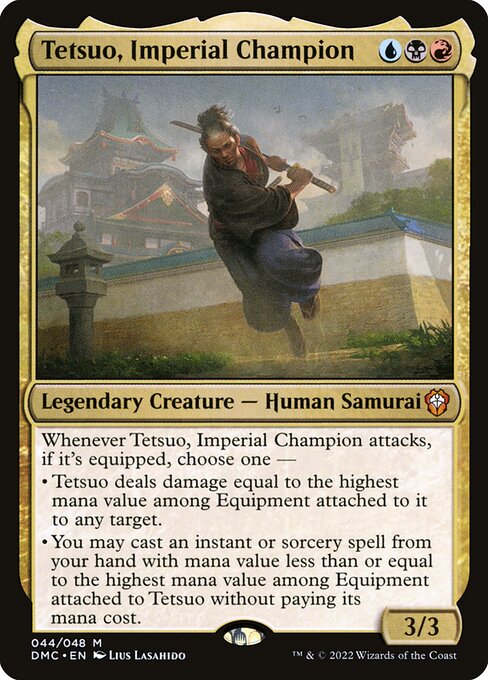
Tetsuo, Imperial Champion | Illustration by Lius Lasahido
Tetsuo turns oversized Equipment into either removal or free spells. Whenever it attacks while equipped, you can deal damage equal to your most expensive Equipment's mana value or cast an instant or sorcery with a matching mana value without paying for it.
That makes Kaldra Compleat and Argentum Armor
AI-generated article, published by an ElderDecks editor.
more than clunky finishers. They become fuel for Tetsuo's attack trigger, potentially letting you cast something as dramatic as
Blasphemous Act
for free. The catch is that you are building two packages at once, and the wrong half of the deck can leave you holding a very expensive sword with nothing useful to cast.
Best for: Players who enjoy Grixis control and unusual Equipment decks.
Main weakness: Tetsuo must attack while equipped, and the split Equipment-and-spells construction is less consistent than dedicated Voltron.
#19. Chishiro, the Shattered Blade
Chishiro, the Shattered Blade | Illustration by Lius Lasahido
Chishiro creates a 2/2 Spirit with menace whenever an Aura or Equipment enters under your control, then places a +1/+1 counter on every modified creature at your end step.
The smart build is not one enormous Samurai. It uses cheap Equipment as creature production and lets Chishiro grow the whole board. Kodama of the West Tree is especially nasty: Chishiro supplies modified creatures, while Kodama gives them trample and turns combat damage into ramp.
Best for: Players who want Equipment to behave like a go-wide counters deck.
High-synergy cards: Kodama of the West Tree, Sword of the Animist, Goldvein Pick, Uncivil Unrest and Champion of Lambholt.
Main weakness: Chishiro does not draw cards or reduce equip costs.
#18. Barret, Avalanche Leader
Barret, Avalanche Leader | Illustration by Jana Schirmer & Matthias Verhasselt
Barret makes a 2/2 Rebel whenever an Equipment enters under your control. At the beginning of combat, it can attach one Equipment to a Rebel for free.
That wording makes living weapon and For Mirrodin! Equipment excellent. The Equipment supplies its own body, Barret creates another, and combat moves the best weapon to whichever Rebel can use it most effectively. Treat Equipment as token generators instead of simply assembling one enormous attacker.
Best for: Gruul players who want to go wide with artifact-backed creature tokens.
High-synergy cards: Parallel Lives, Skullclamp, Sword of the Animist, Nettlecyst and Bladehold War-Whip.
Main weakness: The free attachment only works with Rebels, and Barret provides no card draw.
#17. Dwalin, Weaponmaster
Dwalin, Weaponmaster | Illustration by Marco Teixeira
Dwalin adds a hone counter to every Equipment you control when it enters or attacks. Each counter gives the equipped creature another +1/+0, turning even utility gear into a growing damage engine.
The counters stay on the Equipment, so another creature can inherit the sharpened weapon if Dwalin is removed. Roaming Throne naming Dwarf doubles both relevant triggers, while Sword of Hearth and Home can blink Dwalin for another round of counters.
Best for: Boros players who enjoy permanent progression and a table full of increasingly dangerous weapons.
High-synergy cards: Roaming Throne, Sword of Hearth and Home, Teleportation Circle, Hexplate Wallbreaker and Fighter Class.
Main weakness: Hone counters do not pay equip costs or draw cards.
#16. Syr Gwyn, Hero of Ashvale
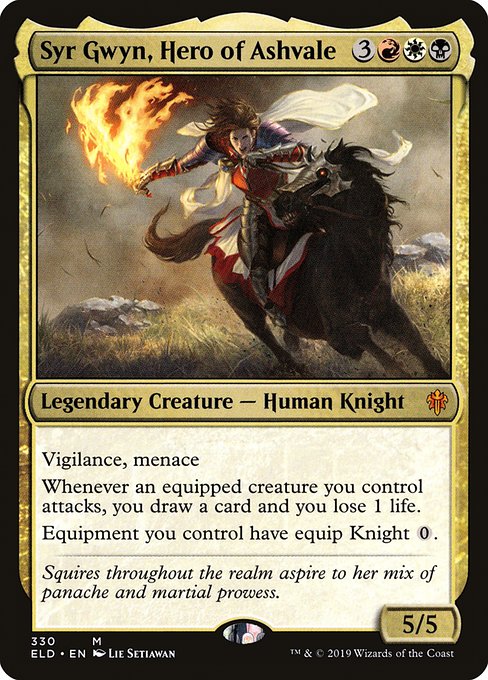
Syr Gwyn, Hero of Ashvale | Illustration by Lie Setiawan
Syr Gwyn lets you equip Knights for zero mana and draws a card whenever an equipped creature attacks, at the cost of one life. Three equipped Knights attacking means three new cards.
The restriction is easy to overlook: only Knights receive the free equips. That pushes the deck toward a genuine Knight-and-Equipment hybrid. Fortunately, Fervent Champion, Kinsbaile Cavalier and Puresteel Paladin fit naturally, and Colossus Hammer is frightening on a double-striking Knight.
Best for: Players who want tribal Knights without giving up the Equipment plan.
Main weakness: Six mana is a lot for a commander that still needs attackers and Equipment in play.
#15. Sram, Senior Edificer
Sram, Senior Edificer | Illustration by Chris Rahn
Sram remains one of the cleanest engines ever printed: cast an Aura, Equipment or Vehicle and draw a card. At two mana, it lands early and turns cheap Equipment into a steady stream of replacements.
Remember that Sram cares about casting the spell. Reanimating, blinking or creating Equipment tokens will not trigger it. Sram also offers no built-in protection or help attaching all the cards it draws.
Best for: Budget-conscious players and anyone who values a simple, reliable engine.
High-synergy cards: Bone Saw, Paradise Mantle, Shadowspear, Puresteel Paladin and Sigarda's Aid.
Main weakness: Sram draws the tools but does not equip them, protect the carrier or close the game.
#14. Bruenor Battlehammer
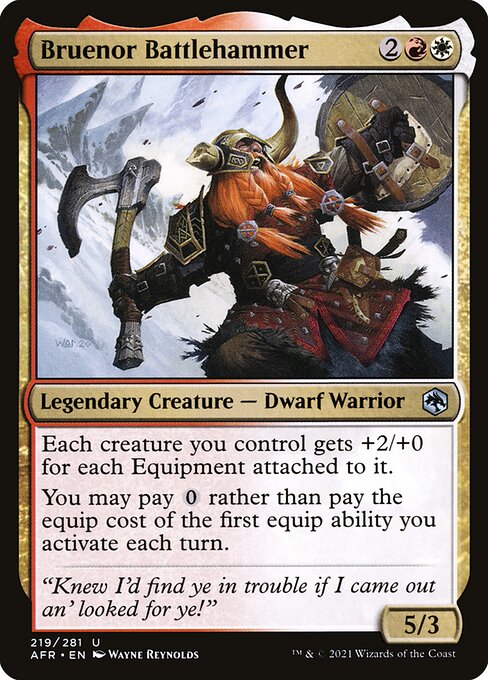
Bruenor Battlehammer | Illustration by Wayne Reynolds
Bruenor gives a creature +2/+0 for each Equipment attached to it and lets you pay zero for the first equip ability you activate each turn.
That makes Colossus Hammer and Argentum Armor much easier to use, while the extra power turns utility pieces into meaningful damage. Bruenor is direct, explosive and admirably uninterested in subtlety. It also supplies neither cards nor protection, so one removal spell can leave a smoking crater where your game plan used to be.
Best for: Players who want straightforward Boros Voltron with spectacular damage totals.
High-synergy cards: Colossus Hammer, Argentum Armor, Kaldra Compleat, Fighter Class and Robe of Stars.
Main weakness: Repeated removal is brutal unless the deck devotes enough room to protection and recovery.
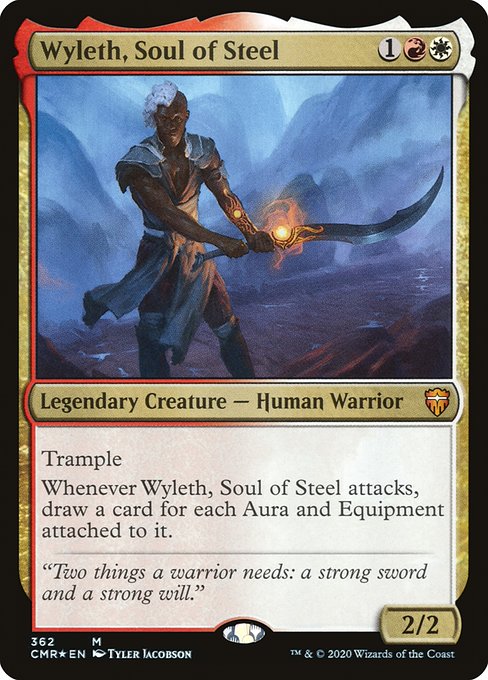
#13. Wyleth, Soul of Steel
Wyleth, Soul of Steel | Illustration by Tyler Jacobson
Wyleth draws one card for every Aura and Equipment attached to it whenever it attacks. Two pieces draw two cards; five pieces draw five.
Trample helps convert those buffs into actual damage, and Mantle of the Ancients can rebuild a graveyard full of attachments in one shot. Still, the deck must attack before receiving any cards, and Wyleth tends to collect every valuable permanent you own in one extremely removable location.
Best for: Players who want Voltron combat backed by enormous attack-trigger draw.
High-synergy cards: Blackblade Reforged, Mantle of the Ancients, Swiftfoot Boots, Robe of Stars and Mask of Memory.
Main weakness: The engine is vulnerable before combat and encourages overcommitting to one creature.
#12. Kellan, the Fae-Blooded
Kellan, the Fae-Blooded | Illustration by Anna Steinbauer
Kellan, the Fae-Blooded's adventure, Birthright Boon, searches for an Aura or Equipment. Once Kellan reaches the battlefield, it has double strike and boosts your other creatures according to the number of attachments on it.
The tutor provides welcome consistency. Find Colossus Hammer when the table is open, Fighter Class when efficiency matters, or a protective Aura when removal is waiting. Loading up Kellan also improves the rest of your army instead of forcing every point of damage through one attacker.
Best for: Players who like Voltron but want their other creatures to remain relevant.
Main weakness: Casting the adventure and then Kellan takes time and mana.
#11. Danitha, Sword of Hope
Danitha, Sword of Hope | Illustration by Bryan Sola
Danitha draws whenever you cast an Equipment spell or cast a spell targeting one of your creatures, although the ability triggers only once each turn.
That restriction encourages interaction. Cast an Equipment on your turn, then use Loran's Escape or Blacksmith's Skill on an opponent's turn to protect a creature and draw again. Equipping is an activated ability, though, and putting Equipment directly onto the battlefield will not trigger Danitha.
Best for: Mono-white players who want an interactive Equipment deck instead of pure all-in Voltron.
High-synergy cards: Loran's Escape, Blacksmith's Skill, Sheltered by Ghosts, Sword of the Animist and Puresteel Paladin.
Main weakness: The once-per-turn cap limits the ceiling, and Danitha does not reduce equip costs.
#10. The Mighty Thor, Jane Foster
The Mighty Thor, Jane Foster | Illustration by Victor Adame Minguez
Jane Foster draws whenever an Equipment enters under your control. It does not matter whether you cast it, blink it or put it into play through another effect.
When Jane attacks, you can exile another nontoken artifact or creature and return it tapped. That can recycle Stoneforge Mystic, retrigger living-weapon Equipment or temporarily remove a blocker. The flexibility is excellent, but Jane never reduces an equip cost or attaches anything for free.
Best for: Azorius players who prefer blink value and artifact tricks over conventional Boros aggression.
High-synergy cards: Stoneforge Mystic, Kaldra Compleat, Sword of Hearth and Home, Assimilation Aegis and Batterskull.
Main weakness: Jane generates resources but does not solve the mana-intensive job of moving Equipment.
#9. Captain America, First Avenger
Captain America, First Avenger | Illustration by Carmen Carnero & Alejandro Sánchez
At the beginning of combat, Captain America's Catch ability attaches one Equipment for free. Throw pays three mana, unattaches an Equipment and divides damage equal to its mana value among as many as three targets.
Throwing the shield does not destroy it. The Equipment stays on the battlefield, ready to be caught again next combat. That creates an unusual incentive to run expensive weapons such as Kaldra Compleat and Argentum Armor.
Best for: Players who want repeatable removal and Jeskai interaction in their Equipment deck.
High-synergy cards: Kaldra Compleat, Argentum Armor, Sunforger, Hammer of Nazahn and Sigarda's Aid.
Main weakness: Expensive Equipment can clog your hand, and each Throw activation costs three mana.
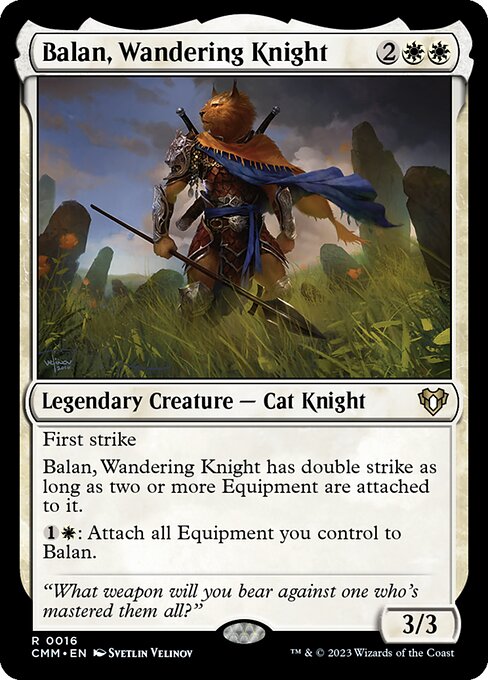
#8. Balan, Wandering Knight
Balan, Wandering Knight | Illustration by Svetlin Velinov
For two mana, Balan attaches every Equipment you control to itself. If at least two are attached, it gains double strike.
That is about as honest as Voltron gets. Deploy your gear, wait for an opening, move the entire arsenal onto Balan and knock somebody out. Colossus Hammer supplies twenty additional damage across two strikes, while Robe of Stars offers an escape hatch when the table points removal at your enormous Cat Knight.
Best for: Dedicated Voltron players who want a compact win condition in the command zone.
High-synergy cards: Colossus Hammer, Shadowspear, Blackblade Reforged, Mask of Memory and Robe of Stars.
Main weakness: Bounce, exile and forced sacrifice can erase a huge investment.
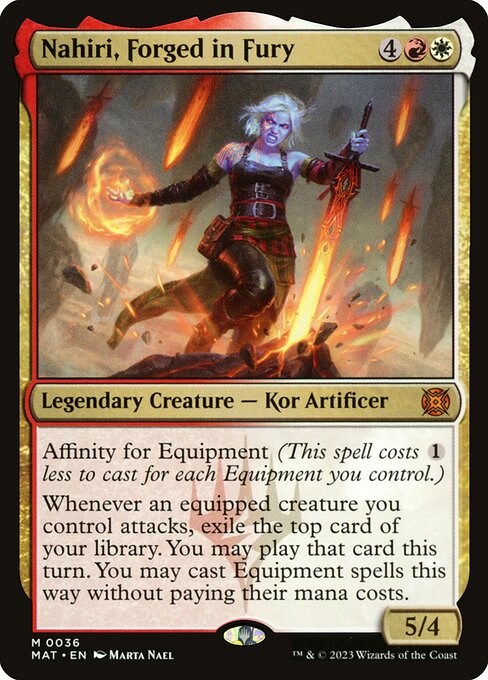
#7. Nahiri, Forged in Fury
Nahiri, Forged in Fury | Illustration by Marta Nael
Nahiri has affinity for Equipment, so every Equipment reduces its initial cost and future commander tax. Whenever an equipped creature attacks, Nahiri exiles the top card of your library. You can play it that turn, and Equipment spells exiled this way are free.
The trigger applies to each equipped attacker. A board of three armed creatures produces three cards, making Nahiri much more of a go-wide commander than its eight-mana sticker suggests. Living-weapon and For Mirrodin! gear help cast Nahiri and provide equipped attackers after creature removal.
Best for: Boros players who want to attack with a squad rather than one Voltron creature.
High-synergy cards: Bladehold War-Whip, Hexplate Wallbreaker, Sword of Forge and Frontier, Rabbit Battery and Nettlecyst.
Main weakness: Nahiri needs an established board to become affordable, and unused exiled cards disappear at end of turn.
#6. Tony Stark // The Invincible Iron Man
Tony Stark | Illustration by Alexander Lozano
Tony Stark's front face digs through the top four cards for an artifact. After an expensive transformation, The Invincible Iron Man can put an artifact from your hand onto the battlefield at the beginning of combat. Equipment arrives already attached.
Once transformed, Tony can cheat Kaldra Compleat, Argentum Armor or another oversized artifact into play every combat. Blue also provides excellent artifact protection and card selection. The problem is the runway: casting Tony, transforming at sorcery speed and surviving until combat is a large investment.
Best for: Players who want a high-ceiling Izzet artifact deck carrying very large weapons.
High-synergy cards: Training Grounds, Kaldra Compleat, Argentum Armor, Darksteel Forge and Padeem, Consul of Innovation.
Main weakness: The transformation requires substantial mana and time, and removal can force you to start over.
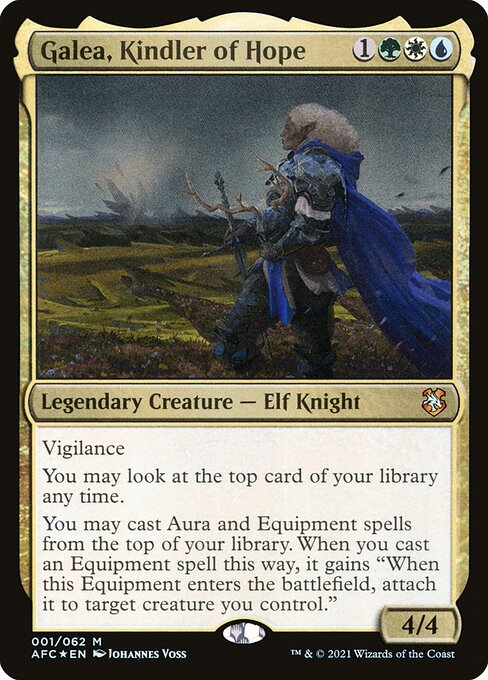
#5. Galea, Kindler of Hope
Galea, Kindler of Hope | Illustration by Johannes Voss
Galea lets you look at the top card of your library and cast Aura and Equipment spells from there. Equipment cast this way attaches to a creature automatically.
That combines card advantage with free attachment while opening the excellent Bant color identity. Green provides ramp, blue fixes the top of the library, and white supplies the strongest Equipment tutors. Sensei's Divining Top, Scroll Rack and [Brainstorm](https://www.elderdecks.com/cards/search?q=Brainstorm) turn Galea from good-when-lucky into a reliable engine.
Best for: Players who enjoy top-deck manipulation and want Equipment, Auras and value creatures together.
Main weakness: A land or unrelated spell on top can stall the engine.
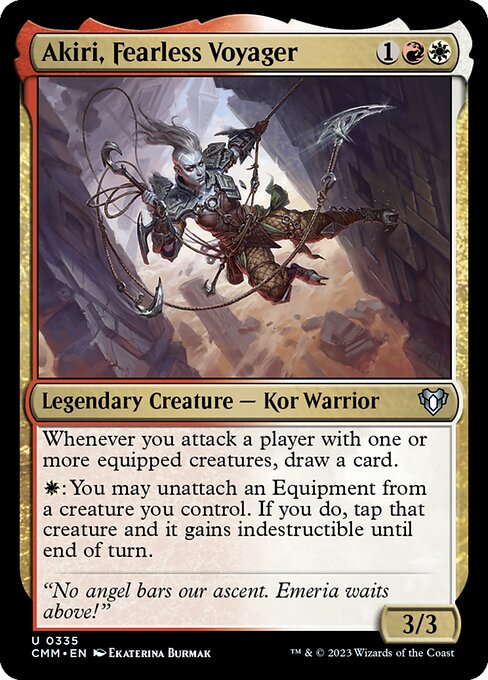
#4. Akiri, Fearless Voyager
Akiri, Fearless Voyager | Illustration by Ekaterina Burmak
Akiri draws a card the first time one or more equipped creatures attack each player. Spread the attacks across three opponents and you can draw three cards in one combat.
Its second ability pays one white mana to unattach an Equipment and give a creature indestructible. Akiri therefore wants several equipped attackers rather than one enormous commander. Living-weapon and For Mirrodin! Equipment provide bodies, and [Skullclamp](https://www.elderdecks.com/cards/search?q=Skullclamp) turns inevitable casualties into even more cards.
Best for: Players who want resilient, go-wide Boros Equipment.
High-synergy cards:Skullclamp, Sword of Hearth and Home, Puresteel Paladin, Sigarda's Aid and Bladehold War-Whip.
Main weakness: Akiri needs several attackers and pieces of Equipment, while indestructible does not stop exile or sacrifice.
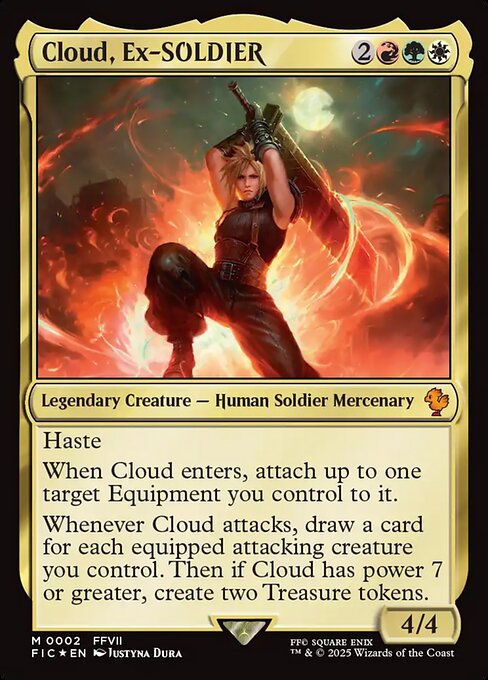
#3. Cloud, Ex-SOLDIER
Cloud, Ex-SOLDIER | Illustration by Justyna Dura
Cloud enters with haste and immediately attaches one of your Equipment to itself. Whenever it attacks, you draw a card for each equipped attacking creature. If Cloud's power is at least seven, you also create two Treasure tokens.
The important words are each equipped attacking creature. Arm three attackers, send them into combat and draw three cards. Naya supplies ramp, combat support and artifact tutors, while The Reaver Cleaver conveniently pushes Cloud toward seven power and produces even more mana.
Best for: Players who want Naya Equipment with both Voltron and go-wide routes to victory.
High-synergy cards: Sword of the Animist, The Reaver Cleaver, Captain's Claws, Nettlecyst and Hexplate Wallbreaker.
Main weakness: Five mana is significant, and Cloud lacks native protection or evasion beyond haste.
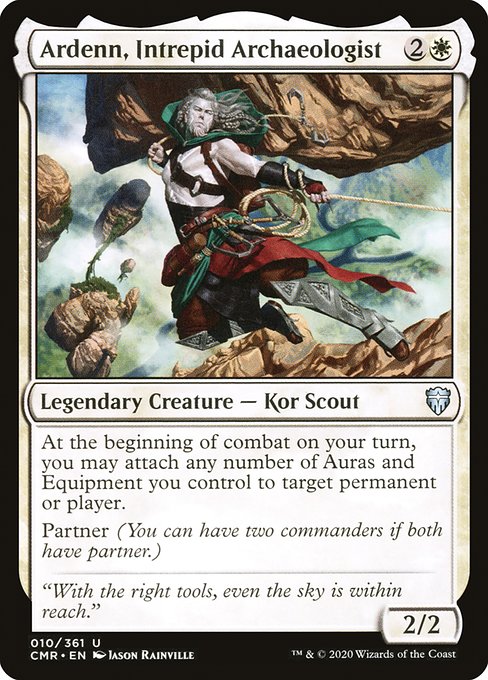
#2. Ardenn, Intrepid Archaeologist
Ardenn, Intrepid Archaeologist | Illustration by Jason Rainville
At the beginning of combat, Ardenn can attach any number of Auras and Equipment you control to a permanent or player. There is no equip payment and no limit on how much gear moves.
Colossus Hammer, Argentum Armor and Helm of the Host become much easier to justify. You can even move the entire arsenal to an unblocked creature after opponents make their combat plans. This ranking assumes you pair Ardenn with a partner: Rograkh supplies a free Voltron body, Kediss spreads damage, Kraum adds blue and cards, and Tana opens a go-wide Naya build.
Best for: Brewers who want to choose their colors and win condition around the strongest free-attach ability available.
High-synergy cards: Colossus Hammer, Argentum Armor, Helm of the Host, Sword of Feast and Famine and Robe of Stars.
Main weakness: Ardenn neither draws cards nor protects itself, and its power depends heavily on the partner.
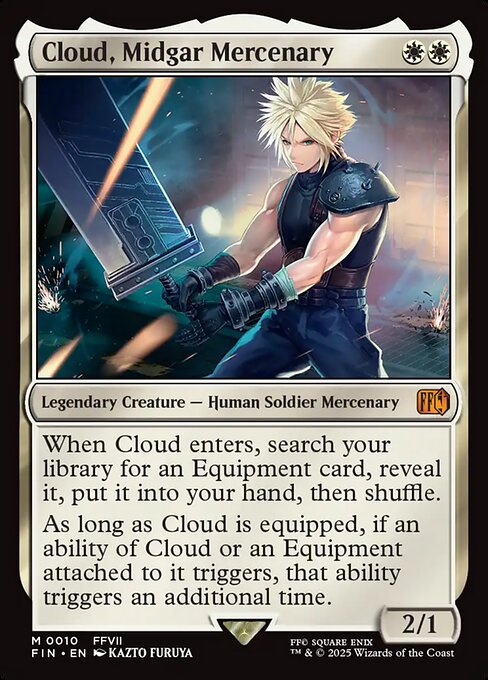
#1. Cloud, Midgar Mercenary
Cloud, Midgar Mercenary | Illustration by Kazto Furuya
Cloud, Midgar Mercenary is the best Equipment commander because it solves two of the archetype's biggest problems at once: finding the right weapon and extracting enough value from it.
When Cloud enters, you search for any Equipment and put it into your hand. While Cloud is equipped, triggered abilities belonging to Cloud and the attached Equipment trigger an additional time. Sword of the Animist finds two basic lands. Sword of Fire and Ice draws twice and deals four total damage. Mask of Memory draws four before you discard two. Sword of Feast and Famine can make each opponent discard twice and untap your lands twice.
Cloud normally will not double its own enter-the-battlefield tutor because it is not yet equipped as that trigger occurs. Mono-white is narrower than Ardenn's partner builds or Cloud, Ex-SOLDIER's Naya identity, but low cost, immediate tutoring and doubled Equipment triggers are too efficient to place anywhere else.
Best for: Players who want the most consistent Equipment engine available from the command zone.
High-synergy cards: Sword of the Animist, Sword of Feast and Famine, Sword of Fire and Ice, Mask of Memory and Hammer of Nazahn.
Main weakness: Cloud is a fragile 2/1, and mono-white provides fewer options for stack interaction and artifact recursion.
Frequently Asked Questions
What is the best Equipment commander in MTG?
Cloud, Midgar Mercenary is the best overall Equipment commander. It arrives early, tutors the best Equipment for the situation and doubles the triggered abilities of attached weapons. Ardenn, Intrepid Archaeologist is the better choice if you value color flexibility.
What is the best budget Equipment commander?
Sram, Senior Edificer and Bruenor Battlehammer are excellent starting points. Both work with inexpensive Equipment and do not require a collection of premium Swords. Sram is better at drawing cards; Bruenor is better at immediate damage.
How many Equipment should a Commander deck play?
A reasonable starting range is 12 to 18 Equipment. Dedicated Voltron decks often use roughly 10 to 15 carefully selected pieces, supported by tutors and protection. Modified, token and tribal hybrids may run fewer because they need more creatures and payoff cards.
What is the difference between Equipment and Voltron?
Equipment describes the card type and broader archetype. Voltron describes a strategy that concentrates enhancements on one creature, usually to win through commander damage. An Equipment deck can play Voltron, but it can also arm multiple creatures, create tokens or exploit artifact synergies.
What are the best colors for an Equipment deck?
White has the strongest tutors, attachment effects and protection. Red adds haste, combat manipulation and additional Equipment payoffs. Blue supplies artifact interaction and card selection, green adds ramp and creature support, and black contributes recursion and sacrifice synergies.
Final Thoughts
The best Equipment commander is the one whose bad games you can tolerate.
Choose Cloud, Midgar Mercenary for maximum consistency, Ardenn for color flexibility, Akiri for a wider battlefield, Galea for top-deck value, or Cloud, Ex-SOLDIER for Naya combat backed by serious card advantage.
Whatever you choose, resist the urge to fill the deck with nothing but spectacular weapons. Equipment decks still need mana, creatures, protection and recovery. A sword can win combat; it cannot rescue an opening hand containing five swords and two Plains.
Cloud, Midgar Mercenary is the best Equipment commander in MTG right now. It costs only two mana, finds any Equipment when it enters, and doubles the triggered abilities of both Cloud and the Equipment attached to it.
That is a ridiculous amount of consistency for a commander that can arrive before most decks have finished setting up. Ardenn, Intrepid Archaeologist remains the most flexible choice thanks to partner, while Cloud, Ex-SOLDIER is the stronger option for players who would rather arm an entire party than stack six swords onto one creature.
Cloud, Midgar Mercenary | Illustration by Kazto Furuya
Equipment decks and Voltron decks overlap, but they are not interchangeable. Voltron decks concentrate their resources on one creature and usually aim to win through commander damage. Equipment decks can do that, but they can also spread weapons across multiple attackers, create creature tokens, grind through removal, and turn Equipment triggers into a value engine.
Every commander below is Commander-legal as of October 24, 2026.
How I Ranked the Best Equipment Commanders
The ranking considers card advantage, equip efficiency, resilience, consistency, color access, flexibility, and how well the commander functions from behind. Popularity was not a deciding factor. A commander does not move up the list just because it appears in more decks.
Tetsuo, Imperial Champion | Illustration by Lius Lasahido
Tetsuo turns oversized Equipment into either removal or free spells. Whenever it attacks while equipped, you can deal damage equal to your most expensive Equipment's mana value or cast an instant or sorcery with a matching mana value without paying for it.
That makes Kaldra Compleat and Argentum Armor more than clunky finishers. They become fuel for Tetsuo's attack trigger, potentially letting you cast something as dramatic as Blasphemous Act for free. The catch is that you are building two packages at once, and the wrong half of the deck can leave you holding a very expensive sword with nothing useful to cast.
Best for: Players who enjoy Grixis control and unusual Equipment decks.
Chishiro, the Shattered Blade | Illustration by Lius Lasahido
Chishiro creates a 2/2 Spirit with menace whenever an Aura or Equipment enters under your control, then places a +1/+1 counter on every modified creature at your end step.
The smart build is not one enormous Samurai. It uses cheap Equipment as creature production and lets Chishiro grow the whole board. Kodama of the West Tree is especially nasty: Chishiro supplies modified creatures, while Kodama gives them trample and turns combat damage into ramp.
Best for: Players who want Equipment to behave like a go-wide counters deck.
Barret, Avalanche Leader | Illustration by Jana Schirmer & Matthias Verhasselt
Barret makes a 2/2 Rebel whenever an Equipment enters under your control. At the beginning of combat, it can attach one Equipment to a Rebel for free.
That wording makes living weapon and For Mirrodin! Equipment excellent. The Equipment supplies its own body, Barret creates another, and combat moves the best weapon to whichever Rebel can use it most effectively. Treat Equipment as token generators instead of simply assembling one enormous attacker.
Best for: Gruul players who want to go wide with artifact-backed creature tokens.
Dwalin, Weaponmaster | Illustration by Marco Teixeira
Dwalin adds a hone counter to every Equipment you control when it enters or attacks. Each counter gives the equipped creature another +1/+0, turning even utility gear into a growing damage engine.
The counters stay on the Equipment, so another creature can inherit the sharpened weapon if Dwalin is removed. Roaming Throne naming Dwarf doubles both relevant triggers, while Sword of Hearth and Home can blink Dwalin for another round of counters.
Best for: Boros players who enjoy permanent progression and a table full of increasingly dangerous weapons.
Syr Gwyn, Hero of Ashvale | Illustration by Lie Setiawan
Syr Gwyn lets you equip Knights for zero mana and draws a card whenever an equipped creature attacks, at the cost of one life. Three equipped Knights attacking means three new cards.
The restriction is easy to overlook: only Knights receive the free equips. That pushes the deck toward a genuine Knight-and-Equipment hybrid. Fortunately, Fervent Champion, Kinsbaile Cavalier and Puresteel Paladin fit naturally, and Colossus Hammer is frightening on a double-striking Knight.
Best for: Players who want tribal Knights without giving up the Equipment plan.
Sram, Senior Edificer | Illustration by Chris Rahn
Sram remains one of the cleanest engines ever printed: cast an Aura, Equipment or Vehicle and draw a card. At two mana, it lands early and turns cheap Equipment into a steady stream of replacements.
Remember that Sram cares about casting the spell. Reanimating, blinking or creating Equipment tokens will not trigger it. Sram also offers no built-in protection or help attaching all the cards it draws.
Best for: Budget-conscious players and anyone who values a simple, reliable engine.
Bruenor Battlehammer | Illustration by Wayne Reynolds
Bruenor gives a creature +2/+0 for each Equipment attached to it and lets you pay zero for the first equip ability you activate each turn.
That makes Colossus Hammer and Argentum Armor much easier to use, while the extra power turns utility pieces into meaningful damage. Bruenor is direct, explosive and admirably uninterested in subtlety. It also supplies neither cards nor protection, so one removal spell can leave a smoking crater where your game plan used to be.
Best for: Players who want straightforward Boros Voltron with spectacular damage totals.
Wyleth, Soul of Steel | Illustration by Tyler Jacobson
Wyleth draws one card for every Aura and Equipment attached to it whenever it attacks. Two pieces draw two cards; five pieces draw five.
Trample helps convert those buffs into actual damage, and Mantle of the Ancients can rebuild a graveyard full of attachments in one shot. Still, the deck must attack before receiving any cards, and Wyleth tends to collect every valuable permanent you own in one extremely removable location.
Best for: Players who want Voltron combat backed by enormous attack-trigger draw.
Main weakness: The engine is vulnerable before combat and encourages overcommitting to one creature.
#12. Kellan, the Fae-Blooded
Kellan, the Fae-Blooded | Illustration by Anna Steinbauer
Kellan, the Fae-Blooded's adventure, Birthright Boon, searches for an Aura or Equipment. Once Kellan reaches the battlefield, it has double strike and boosts your other creatures according to the number of attachments on it.
The tutor provides welcome consistency. Find Colossus Hammer when the table is open, Fighter Class when efficiency matters, or a protective Aura when removal is waiting. Loading up Kellan also improves the rest of your army instead of forcing every point of damage through one attacker.
Best for: Players who like Voltron but want their other creatures to remain relevant.
Danitha, Sword of Hope | Illustration by Bryan Sola
Danitha draws whenever you cast an Equipment spell or cast a spell targeting one of your creatures, although the ability triggers only once each turn.
That restriction encourages interaction. Cast an Equipment on your turn, then use Loran's Escape or Blacksmith's Skill on an opponent's turn to protect a creature and draw again. Equipping is an activated ability, though, and putting Equipment directly onto the battlefield will not trigger Danitha.
Best for: Mono-white players who want an interactive Equipment deck instead of pure all-in Voltron.
The Mighty Thor, Jane Foster | Illustration by Victor Adame Minguez
Jane Foster draws whenever an Equipment enters under your control. It does not matter whether you cast it, blink it or put it into play through another effect.
When Jane attacks, you can exile another nontoken artifact or creature and return it tapped. That can recycle Stoneforge Mystic, retrigger living-weapon Equipment or temporarily remove a blocker. The flexibility is excellent, but Jane never reduces an equip cost or attaches anything for free.
Best for: Azorius players who prefer blink value and artifact tricks over conventional Boros aggression.
Captain America, First Avenger | Illustration by Carmen Carnero & Alejandro Sánchez
At the beginning of combat, Captain America's Catch ability attaches one Equipment for free. Throw pays three mana, unattaches an Equipment and divides damage equal to its mana value among as many as three targets.
Throwing the shield does not destroy it. The Equipment stays on the battlefield, ready to be caught again next combat. That creates an unusual incentive to run expensive weapons such as Kaldra Compleat and Argentum Armor.
Best for: Players who want repeatable removal and Jeskai interaction in their Equipment deck.
Balan, Wandering Knight | Illustration by Svetlin Velinov
For two mana, Balan attaches every Equipment you control to itself. If at least two are attached, it gains double strike.
That is about as honest as Voltron gets. Deploy your gear, wait for an opening, move the entire arsenal onto Balan and knock somebody out. Colossus Hammer supplies twenty additional damage across two strikes, while Robe of Stars offers an escape hatch when the table points removal at your enormous Cat Knight.
Best for: Dedicated Voltron players who want a compact win condition in the command zone.
Nahiri, Forged in Fury | Illustration by Marta Nael
Nahiri has affinity for Equipment, so every Equipment reduces its initial cost and future commander tax. Whenever an equipped creature attacks, Nahiri exiles the top card of your library. You can play it that turn, and Equipment spells exiled this way are free.
The trigger applies to each equipped attacker. A board of three armed creatures produces three cards, making Nahiri much more of a go-wide commander than its eight-mana sticker suggests. Living-weapon and For Mirrodin! gear help cast Nahiri and provide equipped attackers after creature removal.
Best for: Boros players who want to attack with a squad rather than one Voltron creature.
Tony Stark's front face digs through the top four cards for an artifact. After an expensive transformation, The Invincible Iron Man can put an artifact from your hand onto the battlefield at the beginning of combat. Equipment arrives already attached.
Once transformed, Tony can cheat Kaldra Compleat, Argentum Armor or another oversized artifact into play every combat. Blue also provides excellent artifact protection and card selection. The problem is the runway: casting Tony, transforming at sorcery speed and surviving until combat is a large investment.
Best for: Players who want a high-ceiling Izzet artifact deck carrying very large weapons.
Galea, Kindler of Hope | Illustration by Johannes Voss
Galea lets you look at the top card of your library and cast Aura and Equipment spells from there. Equipment cast this way attaches to a creature automatically.
That combines card advantage with free attachment while opening the excellent Bant color identity. Green provides ramp, blue fixes the top of the library, and white supplies the strongest Equipment tutors. Sensei's Divining Top, Scroll Rack and [Brainstorm](https://www.elderdecks.com/cards/search?q=Brainstorm) turn Galea from good-when-lucky into a reliable engine.
Best for: Players who enjoy top-deck manipulation and want Equipment, Auras and value creatures together.
Akiri, Fearless Voyager | Illustration by Ekaterina Burmak
Akiri draws a card the first time one or more equipped creatures attack each player. Spread the attacks across three opponents and you can draw three cards in one combat.
Its second ability pays one white mana to unattach an Equipment and give a creature indestructible. Akiri therefore wants several equipped attackers rather than one enormous commander. Living-weapon and For Mirrodin! Equipment provide bodies, and [Skullclamp](https://www.elderdecks.com/cards/search?q=Skullclamp) turns inevitable casualties into even more cards.
Best for: Players who want resilient, go-wide Boros Equipment.
Cloud enters with haste and immediately attaches one of your Equipment to itself. Whenever it attacks, you draw a card for each equipped attacking creature. If Cloud's power is at least seven, you also create two Treasure tokens.
The important words are each equipped attacking creature. Arm three attackers, send them into combat and draw three cards. Naya supplies ramp, combat support and artifact tutors, while The Reaver Cleaver conveniently pushes Cloud toward seven power and produces even more mana.
Best for: Players who want Naya Equipment with both Voltron and go-wide routes to victory.
Ardenn, Intrepid Archaeologist | Illustration by Jason Rainville
At the beginning of combat, Ardenn can attach any number of Auras and Equipment you control to a permanent or player. There is no equip payment and no limit on how much gear moves.
Colossus Hammer, Argentum Armor and Helm of the Host become much easier to justify. You can even move the entire arsenal to an unblocked creature after opponents make their combat plans. This ranking assumes you pair Ardenn with a partner: Rograkh supplies a free Voltron body, Kediss spreads damage, Kraum adds blue and cards, and Tana opens a go-wide Naya build.
Best for: Brewers who want to choose their colors and win condition around the strongest free-attach ability available.
Cloud, Midgar Mercenary | Illustration by Kazto Furuya
Cloud, Midgar Mercenary is the best Equipment commander because it solves two of the archetype's biggest problems at once: finding the right weapon and extracting enough value from it.
When Cloud enters, you search for any Equipment and put it into your hand. While Cloud is equipped, triggered abilities belonging to Cloud and the attached Equipment trigger an additional time. Sword of the Animist finds two basic lands. Sword of Fire and Ice draws twice and deals four total damage. Mask of Memory draws four before you discard two. Sword of Feast and Famine can make each opponent discard twice and untap your lands twice.
Cloud normally will not double its own enter-the-battlefield tutor because it is not yet equipped as that trigger occurs. Mono-white is narrower than Ardenn's partner builds or Cloud, Ex-SOLDIER's Naya identity, but low cost, immediate tutoring and doubled Equipment triggers are too efficient to place anywhere else.
Best for: Players who want the most consistent Equipment engine available from the command zone.
Main weakness: Cloud is a fragile 2/1, and mono-white provides fewer options for stack interaction and artifact recursion.
Frequently Asked Questions
What is the best Equipment commander in MTG?
Cloud, Midgar Mercenary is the best overall Equipment commander. It arrives early, tutors the best Equipment for the situation and doubles the triggered abilities of attached weapons. Ardenn, Intrepid Archaeologist is the better choice if you value color flexibility.
What is the best budget Equipment commander?
Sram, Senior Edificer and Bruenor Battlehammer are excellent starting points. Both work with inexpensive Equipment and do not require a collection of premium Swords. Sram is better at drawing cards; Bruenor is better at immediate damage.
How many Equipment should a Commander deck play?
A reasonable starting range is 12 to 18 Equipment. Dedicated Voltron decks often use roughly 10 to 15 carefully selected pieces, supported by tutors and protection. Modified, token and tribal hybrids may run fewer because they need more creatures and payoff cards.
What is the difference between Equipment and Voltron?
Equipment describes the card type and broader archetype. Voltron describes a strategy that concentrates enhancements on one creature, usually to win through commander damage. An Equipment deck can play Voltron, but it can also arm multiple creatures, create tokens or exploit artifact synergies.
What are the best colors for an Equipment deck?
White has the strongest tutors, attachment effects and protection. Red adds haste, combat manipulation and additional Equipment payoffs. Blue supplies artifact interaction and card selection, green adds ramp and creature support, and black contributes recursion and sacrifice synergies.
Final Thoughts
The best Equipment commander is the one whose bad games you can tolerate.
Choose Cloud, Midgar Mercenary for maximum consistency, Ardenn for color flexibility, Akiri for a wider battlefield, Galea for top-deck value, or Cloud, Ex-SOLDIER for Naya combat backed by serious card advantage.
Whatever you choose, resist the urge to fill the deck with nothing but spectacular weapons. Equipment decks still need mana, creatures, protection and recovery. A sword can win combat; it cannot rescue an opening hand containing five swords and two Plains.