By ElderArticles · Updated 11/6/2026 · 29 min read
Explore the 20 best Orzhov commanders, ranked with black-white strategies, powerful card synergies, honest drawbacks, and practical MTG deckbuilding advice.
Table of contents
Your opponent casts a board wipe. Everyone else starts planning a rebuild. You're counting death triggers.
That is the appeal of Orzhov: a creature can attack, gain life, draw cards, and become sacrifice fodder without ever feeling wasted. But black-white has more to offer than another pile of Blood Artist effects. There are haunted Vehicles, political bargains, cursed Auras, and a Dragon who treats your life total like a line of credit.
Which of these plans deserves your next deck? This countdown ranks 20 of the best Orzhov commanders, with the cards that make each one work—and the catches worth knowing before you commit.
Godless Shrine | Illustration by Cliff Childs
How We Ranked the Best Orzhov Commanders
Orzhov means white-black, so “Orzhov commanders” and “black-white commanders” refer to the same color identity. Every ranked card has exactly those two colors in its identity and was listed as Commander-legal by Scryfall when checked on November 5, 2026. Preview-only cards that were not yet legal were excluded.
This is an editorial ranking for multiplayer deckbuilding, not a tournament leaderboard. We weigh the commander's engine, mana efficiency, ability to recover, multiplayer reach, and depth of useful supporting cards. A powerful plan that needs several fragile pieces loses ground to one that works with cards you wanted to play anyway. The top spot also rewards a particularly complete expression of what black-white does well.
Scope matters: Tymna is evaluated as the leader of a black-white deck, not given credit for the extra colors an off-color partner could add. Combo lines are identified where relevant; including one is a deckbuilding choice, not a requirement. Check your group's expectations before turning a value engine into a deterministic loop. All four synergy suggestions in each entry fit that commander's color identity.
The list starts with specialized strategies and works toward the most adaptable engines. Let's collect a few debts.
#20. Eriette of the Charmed Apple
AI-generated article, published by an ElderDecks editor.
Eriette of the Charmed Apple | Illustration by Magali Villeneuve
Eriette makes putting Auras on somebody else's creatures feel much less charitable. Those creatures cannot attack you or your planeswalkers, and every Aura you control contributes to her end-step drain. Three opponents can lose life while you keep your own creatures out of combat.
That protection is tied to Eriette, though. Remove her and your carefully enchanted neighbors may suddenly remember where you live.
High-synergy cards
- Darksteel Mutation strips a troublesome creature of its abilities while leaving an Aura behind for Eriette's count. It does not, by itself, stop the creature from attacking.
- Parasitic Impetus encourages another player's creature to attack elsewhere and pays you life when it attacks.
- Mesa Enchantress turns enchantment casts into cards, preventing the deck from spending its whole hand on restraints.
- Sram, Senior Edificer is another draw engine for your Auras and arrives a turn before Eriette.
The catch: Sweepers can remove both enchanted creatures and the Auras attached to them. You also need answers to noncombat wins; stopping attackers is not stopping a combo.
Play Eriette if you enjoy negotiation, enchantment sequencing, and winning without personally delivering the punches.
Breena, the Demagogue | Illustration by Simon Dominic
Breena offers a wonderfully suspicious deal: attack the right opponent and draw a card. You receive two +1/+1 counters on one of your creatures. If you make the qualifying attack yourself, you get both rewards.
The attacked opponent must have more life than another of your opponents. Watching life totals is part of piloting the deck, and a few cheap evasive creatures can turn that condition into reliable pressure. Counters on an early attacker make Breena much more than a group-hug commander.
High-synergy cards
- Esper Sentinel becomes harder to pay for as Breena increases its power.
- Dauthi Voidwalker supplies an evasive attacker and disrupts opposing graveyards while you develop.
- Duelist's Heritage gives double strike to a key attacker—yours or an opponent's—making political offers consequential.
- Reconnaissance lets you pull your attackers out of bad blocks. Activating during the end-of-combat step can untap surviving attackers after damage.
The catch: Breena helps opponents draw too. Her condition also stops working when only one opponent remains, because there is no other opponent's life total to compare.
Play Breena if you want combat, counters, and decisions about whom to encourage rather than another sacrifice engine.
Clavileño, First of the Blessed | Illustration by Chun Lo
Clavileño gives your Vampires an exit package: attack, become a Demon, then eventually die into a card and a tapped 4/3 flying Vampire Demon. The granted death ability stays on that creature while it remains on the battlefield; you do not have to sacrifice it immediately.
This makes a modest attacker worth investing in. It can trade, be sacrificed, or survive until a later turn without losing the promise of a replacement.
High-synergy cards
- Viscera Seer is a Vampire and a free sacrifice outlet. It lets you cash in a marked attacker when doing so actually benefits you.
- Cordial Vampire grows your Vampire team whenever creatures die, including opposing creatures.
- Indulgent Aristocrat supplies another Vampire outlet, trading mana and a creature for team-wide counters.
- Skullclamp draws cards from small bodies and adds another death-trigger reward to creatures Clavileño has marked.
The catch: Only an attacking Vampire that is not already a Demon can receive the ability. The 4/3 replacement tokens therefore cannot be processed through the same trigger again, and exile removal skips the death reward.
Play Clavileño if you want Vampire combat with a built-in recovery plan, not a generic lifegain pile.
Victor, Valgavoth's Seneschal | Illustration by Ashley Mackenzie
Victor is a sequencing puzzle with an excellent third act. His first eerie resolution in a turn surveils two, the second makes each opponent discard, and the third puts a creature from any graveyard onto your battlefield. A cheap enchantment can therefore be worth much more than its printed effect.
The important word is third. Fourth and later resolutions that turn do not repeat the reanimation reward. You want a plan for reaching three efficiently, not an endless stack of enchantments with nothing left to earn.
High-synergy cards
- Flickering Ward can return to your hand and be cast again, letting spare white mana buy additional enchantment entries.
- Seal of Cleansing advances the count while holding an answer to an artifact or enchantment.
- Grim Guardian adds table-wide life loss to the same enchantment entries, so setup still advances a win.
- Animate Dead is an enchantment that reanimates a creature itself; it makes the route to Victor's third trigger productive.
The catch: Casting three enchantments in one turn takes mana and cards. Graveyard hate can also erase your best payoff after you have paid for the setup.
Play Victor if you enjoy building a turn in the right order and stealing the best thing everybody else discarded.
Greasefang, Okiba Boss | Illustration by Victor Adame Minguez
Greasefang does not ask you to pay eight mana for Parhelion II. She asks you to put it in the graveyard, reach combat, and find a driver. That is a substantially more interesting financing arrangement.
At the beginning of your combat, she returns a Vehicle with haste. You still have to make it a creature before it can attack. If it remains on the battlefield, it goes to its owner's hand at your next end step, so discard outlets are part of the engine rather than optional cleanup.
High-synergy cards
- Parhelion II creates two attacking 4/4 Angels when it attacks. Those Angels remain after the Vehicle goes back to hand.
- Smuggler's Copter provides repeatable looting on attacks or blocks, putting expensive Vehicles where Greasefang wants them.
- Peacewalker Colossus animates another Vehicle for two mana when your crew is missing or you want to keep creatures untapped.
- Currency Converter loots and can turn discarded cards into resources. Its exile is optional: do not exile the Vehicle you need Greasefang to target.
The catch: A graveyard answer in response to Greasefang's trigger can leave the entire combat plan parked. You need early pilots and a way to win when the biggest Vehicle stays grounded.
Play Greasefang if you like artifact decks that attack early and reuse enormous threats.
Zoraline, Cosmos Caller | Illustration by Justin Gerard
Zoraline looks like a Bat commander until you read the recursion line. Whenever she enters or attacks, two mana and two life can return any nonland permanent with mana value three or less from your graveyard. The Bat lifegain helps fund the habit, but the deck does not need to be full of Bats.
That range is the attraction: protection, removal, draw engines, and small utility creatures can all come back. Zoraline turns a low curve into a toolbox.
High-synergy cards
- Selfless Spirit can sacrifice itself to protect your creatures, then be recovered by Zoraline.
- Skyclave Apparition turns recursion into another exile effect. Its eventual Illusion token is a real drawback, but the original permanent stays exiled.
- Soul Warden helps replace the life you spend and gives you a useful one-mana recovery target.
- Solemnity prevents finality counters from being placed on returning creatures, artifacts, and enchantments, allowing them to reach the graveyard normally afterward. It also shuts down your own counter plans.
The catch: Without a workaround, a permanent with a finality counter is exiled if it would go from the battlefield to the graveyard. Zoraline's ability also costs mana every time; returning a two-drop is not free just because the commander costs three.
Play Zoraline if you like resilient small-permanent decks and want your graveyard to remain a useful toolbox.
Elas il-Kor, Sadistic Pilgrim | Illustration by G-host Lee
Sometimes the cleanest commander is the one that leaves the fewest missing pieces. Elas gives you a lifegain trigger for your other creatures entering and a drain trigger for your other creatures dying, all for two mana.
A sacrifice deck still needs bodies and an outlet, but its payoff is already waiting in the command zone. Deathtouch also makes Elas a respectable deterrent rather than a creature you must hide behind the rest of the board.
High-synergy cards
- Ophiomancer can supply a Snake on each upkeep if you keep sacrificing the previous one before the next trigger checks.
- Viscera Seer provides the free outlet and scries toward the next useful piece.
- Reassembling Skeleton gives you reusable fodder, with a two-mana activation that keeps the loop honest unless another engine pays for it.
- Pitiless Plunderer makes Treasure when your other creatures die, helping fund recursion and future turns.
The catch: Elas does not draw cards, and its death ability does not trigger for Elas itself. A hand full of drain effects still needs creatures to sacrifice and ways to replenish them.
Play Elas if you are learning aristocrats—the strategy of sacrificing creatures for profit—or want a straightforward engine with very little command-zone overhead.
Thalisse, Reverent Medium | Illustration by Heonhwa
Thalisse sees a Treasure and imagines a flying Spirit. She counts all tokens you created that turn, not just creatures, then makes that many Spirits at each end step. Tokens you already sacrificed still count.
This makes ordinary resource generation into air power. You can spend Treasure to cast spells and still collect the Spirits later. Her trigger does not loop with itself: the Spirits it creates do not cause the same end-step ability to trigger again.
High-synergy cards
- Smothering Tithe can create Treasure on opponents' turns, setting up Spirits at their end steps as well as your own.
- Monologue Tax offers another route to off-turn Treasure when opponents cast a second spell.
- Anointed Procession doubles the original token production and separately doubles the Spirits Thalisse creates.
- Skullclamp converts unbuffed 1/1 Spirits into cards, turning excess air power into the next wave.
The catch: Five mana is a substantial investment for a commander that needs a separate token source. If Thalisse is removed before the end step begins, there is no conversion that turn.
Play Thalisse if you want a token deck in which Treasures and other utility tokens contribute to combat as much as your creature makers do.
Karlov of the Ghost Council | Illustration by Volkan Baǵa
Karlov cares how often you gain life, not how impressive each gain looks. Three separate one-life events put six counters on him. A single ten-life event adds only two. Build for frequent triggers and this two-mana Spirit becomes both a threat and a source of creature exile.
The interesting choice comes afterward: keep the counters to threaten commander damage, or spend six of them and two mana to remove the creature most likely to ruin your turn.
High-synergy cards
- Soul Warden supplies a trigger whenever another creature enters, including opposing creatures.
- Soul's Attendant adds a second independent trigger to those same entries; the optional ability is worth remembering in digital play.
- Authority of the Consuls gains life from opposing creatures while making those creatures enter tapped.
- Mother of Runes can protect Karlov from a targeted answer or help a large attacker get past colored blockers.
The catch: Karlov has no built-in evasion or protection. Removal resets the counters, and choosing a large lifegain spell over several small triggers can leave him less threatening than the life total suggests.
Play Karlov if you want lifegain to produce immediate board control and a plausible combat finish.
Liesa, Shroud of Dusk | Illustration by Slawomir Maniak
Liesa changes the arithmetic of a Commander game. Every spell costs its caster two life, whether it is a setup piece, removal spell, or desperate attempt to recover. A 5/5 flying lifelinker helps you withstand your own tax while keeping opponents under pressure.
Her unusual commander-tax replacement matters too: recasting her still requires the normal five mana, but previous command-zone casts add life payments instead of the usual extra mana. Killing her once does not necessarily buy the table a long break.
High-synergy cards
- Kambal, Consul of Allocation adds another drain when opponents cast noncreature spells.
- Blind Obedience slows opposing artifacts and creatures while extort can offset some of the life spent casting your own spells.
- Authority of the Consuls replenishes life against creature-heavy tables and removes fresh blockers for a turn.
- Dawn of Hope offers a way to spend mana on cards and lifelink tokens through activated abilities, which do not trigger Liesa's spell tax.
The catch: Liesa taxes you too, and her lifelink does not matter if she cannot connect. Players can also finish through activated abilities or combat without casting a long chain of spells.
Play Liesa if you want a proactive life-total squeeze and are comfortable being the reason everyone starts counting their spells.
Niv-Mizzet, Ghost Counsel | Illustration by Brian Valeza
Niv-Mizzet has found a very Orzhov use for lifegain: spend it immediately on cards. Whenever you gain life, you may pay that amount to draw that many. A steady stream of small gains becomes steady draw; one large gain can refill a hand in a hurry.
This is not a partial-payment menu. If an event gains eight life, you choose whether to pay eight for eight cards. His tap ability, meanwhile, gains you only one life even when all three opponents lose one.
High-synergy cards
- Soul Warden turns creature entries into optional one-card purchases once Niv-Mizzet is present.
- Disciple of Bolas converts another creature into life and cards, then Niv-Mizzet can turn the gained life into an additional batch of cards.
- Exquisite Blood supplies life whenever an opponent loses it. Niv-Mizzet can spend those gains on cards; these two cards alone are not an infinite combo.
- Bolas's Citadel gives your accumulated life another job and lets you cast from the library while draw effects can move unwanted top cards.
The catch: Six mana, including four colored symbols, makes Niv-Mizzet expensive to deploy and replace. A gain engine without him may be slow; a hand full of payoffs without life to spend is worse.
Play Niv-Mizzet if you want lifegain to support a sprawling resource engine and do not mind paying for a high-impact commander.
Elenda, the Dusk Rose | Illustration by Richard Kane Ferguson
Elenda grows whenever another creature dies, regardless of who controlled it. When she dies, her last known power determines how many lifelink Vampires arrive to continue the business. A creature that starts as a 1/1 can therefore become a sizeable second army.
The real skill is deciding when to cash her in. Wait forever and an exile spell can erase the investment. Sacrifice too early and you may get a handful of tokens when you needed a battlefield full of them.
High-synergy cards
- Viscera Seer gives you control over Elenda's timing and provides a use for the resulting Vampires.
- Pitiless Plunderer makes Treasure from other creatures dying, helping fund your next round of rebuilding.
- Skullclamp turns unbuffed Vampire tokens into cards, giving the second army a useful noncombat role.
- Anointed Procession doubles the number of Vampires Elenda's death trigger creates.
The catch: Elenda needs creatures to die before she becomes a substantial payout. If she dies alongside other creatures, their simultaneous deaths do not first increase her last known power. You also need an outlet ready when exile removal appears.
Play Elenda if you enjoy building a threat that can split into an army and care about when—not merely whether—your commander dies.
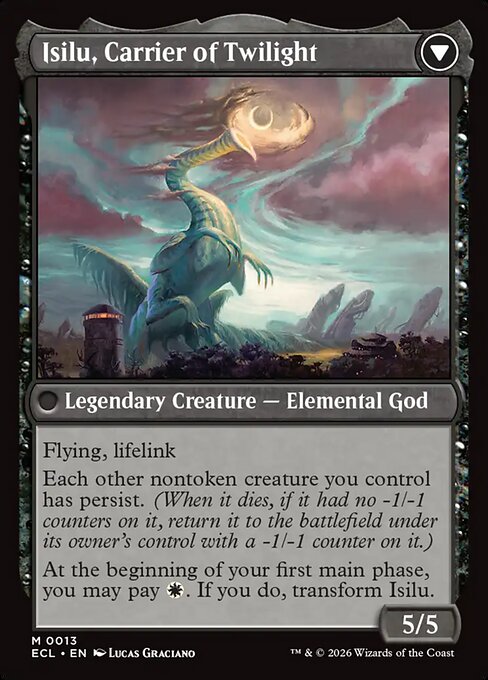
#8. Eirdu, Carrier of Dawn // Isilu, Carrier of Twilight
Eirdu, Carrier of Dawn | Illustration by Lucas GracianoIsilu, Carrier of Twilight | Illustration by Lucas Graciano
Eirdu offers two different working shifts. The front face gives your creature spells convoke, letting an existing board help pay for a larger one. On the reverse, Isilu gives your other nontoken creatures persist, so an ordinary death can become a return trip with a -1/-1 counter.
You change shifts through a trigger at the beginning of your first main phase. This is not an instant-speed transformation you can hold up in response to a board wipe. You have to decide what the next stretch of the game is likely to demand.
High-synergy cards
- Ophiomancer supplies expendable bodies that can help convoke creature spells on the front-face plan.
- Viscera Seer lets you deliberately use the persist granted by Isilu rather than waiting for combat or removal.
- Vizier of Remedies prevents the single -1/-1 counter persist would put on a returning creature, opening repeatable sacrifice loops while Isilu is present.
- Cruel Celebrant converts those deaths into life loss for every opponent and gains for you.
The catch: Isilu does not grant persist to itself or to tokens. The commander costs five mana, transformation takes scheduling, and exile-based answers bypass the death-and-return plan.
Combo warning: Isilu, Vizier, a free outlet, and suitable nontoken fodder can repeat deaths; a drain payoff can turn that into a win. Leave out the counter workaround if your group wants a fairer recursion deck.
Play Eirdu if you want creature development and sacrifice resilience on the same commander, with deliberate choices about when each matters.
Carmen, Cruel Skymarcher | Illustration by Randy Vargas
Carmen notices every permanent sacrificed by every player. A Treasure, fetch land, Food, or creature can add a counter and gain you a life. When she attacks, her growing power determines the mana value of a permanent she can return from your graveyard.
That last word matters: permanent. You can recover a land, an artifact engine, or an enchantment as well as a creature. Sacrifice effects become both a way to grow Carmen and a way to stock her next attack.
High-synergy cards
- Plaguecrafter asks each player to sacrifice a creature or planeswalker, supplying multiple Carmen triggers when the table can comply.
- Fleshbag Marauder performs a similar job with creatures and can sacrifice itself, becoming a future reanimation target.
- Pitiless Plunderer produces Treasures from your other creatures' deaths; sacrificing those Treasures feeds Carmen again.
- Malakir Rebirth can return Carmen after she dies. It does not preserve her counters, but it can spare you a command-zone recast.
The catch: Carmen costs five mana and must attack to deliver the recursion. She has no haste or built-in protection, so a table that removes her before combat can keep denying the payoff.
Play Carmen if you want an assertive reanimator deck that profits from opponents' resource use as well as its own sacrifice plan.
Lurrus of the Dream-Den | Illustration by Slawomir Maniak
Lurrus is much easier to build around than its companion paragraph makes it look. As your commander, it does not require every permanent in your deck to cost two or less. That restriction applies when you choose it as your companion.
What you get from choosing Lurrus as commander is access to a reusable engine: while it is on the battlefield, it lets you cast one permanent spell with mana value two or less from your graveyard during each of your turns. Cheap interaction and small value pieces stop being disposable. Normal timing rules and costs still apply.
High-synergy cards
- Mishra's Bauble can be recast for zero mana, then sacrificed to arrange a card draw at the next turn's upkeep.
- Seal of Cleansing becomes repeatable artifact or enchantment removal when Lurrus keeps bringing it back.
- Soul-Guide Lantern can repeatedly exile a graveyard card on entry or sacrifice for broader graveyard interaction or a card.
- Animate Dead is a two-mana permanent spell that can return a much larger creature. Lurrus limits the Aura's mana value, not the creature it reanimates.
The catch: The permission normally gives you one graveyard cast each turn; resetting Lurrus as a new object or using a separate permission is a different case. Graveyard exile and removal aimed at Lurrus can shut off the engine, so your other 99 cards still need to function independently.
Play Lurrus if you enjoy making efficient exchanges, then buying back the exact tool the next turn needs.
Kambal, Profiteering Mayor | Illustration by Andreas Zafiratos
Kambal turns other players' token production into your business opportunity. The first qualifying batch of opposing tokens each turn gives you tapped copies. Separately, every event in which one or more of your own tokens enter drains each opponent for one and gains you one life.
That second ability is why the deck should make its own tokens rather than sit around waiting for an opponent to cooperate. A dozen tokens entering together produce one drain trigger; a dozen separate entries can produce twelve.
High-synergy cards
- Ophiomancer can make a Snake on successive upkeeps, spreading token entries across the turn cycle when you have a sacrifice outlet.
- Pitiless Plunderer supplies separate Treasure-making triggers as your other creatures die, giving Kambal a productive aristocrats engine.
- Akroan Horse gives its new controller's opponents Soldiers each upkeep, creating opportunities for Kambal to copy opposing tokens as well as drain from your own.
- Wedding Ring gives an opponent a token copy when you cast it. If Kambal's copy trigger is still available that turn, he can copy that token too.
The catch: The opponent-copying ability triggers only once each turn. Opponents can lead with an unimpressive token before making the one you actually wanted. Copies also enter tapped, which matters for Treasures and other artifacts with tap costs.
Play Kambal if you want tokens, politics, and life drain in a compact three-mana engine.
Ratadrabik of Urborg | Illustration by Anna Pavleeva
Ratadrabik makes removing your legendary creatures a less satisfying experience. When another legend you control dies, you receive a nonlegendary 2/2 Zombie copy. Its size changes, but the useful rules text remains, allowing a fallen engine to keep working without creating a legend-rule conflict.
This rewards a deck full of legends whose abilities matter more than their printed power. It also creates unusually intricate sacrifice lines, which is either the selling point or the warning label.
High-synergy cards
- Teysa Karlov doubles Ratadrabik's death-triggered ability, producing two copies of the fallen legend.
- Mondrak, Glory Dominus doubles the tokens you create, including the replacement legends that are no longer legendary.
- Elenda, the Dusk Rose leaves her Vampires behind while Ratadrabik creates a new copy that can begin growing again.
- Boromir, Warden of the Tower protects your team by sacrificing himself and introduces a potent Ring-based loop.
Combo warning: When Boromir is sacrificed, resolve Ratadrabik's trigger to make the copy before Boromir's ability resolves. The Ring can then make that token your legendary Ring-bearer. Sacrificing it can repeat the process. You still need a payoff to convert the loop into a win.
The catch: Ratadrabik does not copy himself, and exile removal avoids the trigger. An expensive collection of legends can also leave you with a slow opening hand.
Play Ratadrabik if you enjoy legendary-creature engines and are willing to manage a battlefield full of tokens with very different abilities.
Ketramose, the New Dawn | Illustration by Florian Bertmer
Ketramose gives black-white an engine that actively wants cards to leave the graveyard. During your turn, an event that exiles cards from a graveyard or the battlefield draws you a card and costs you a life. Removal, blink, and graveyard interaction can all become part of the draw package.
Seven cards in exile unlock his ability to attack and block, but they are not needed for the draw trigger. That distinction lets you get useful work from him immediately instead of treating the opening turns as a waiting room.
High-synergy cards
- Relic of Progenitus can exile a graveyard card with its tap ability during your turn, creating a repeatable draw opportunity.
- Dauthi Voidwalker replaces opposing cards going to graveyards with exile. Your own-turn interaction can therefore trigger Ketramose while denying recursion.
- Ephemerate exiles and returns a creature you control, adding Ketramose's draw to the creature's enter-the-battlefield value.
- Touch the Spirit Realm can exile an opposing artifact or creature, or use its channel ability for temporary exile and a return later.
The catch: Only your turn counts. Exiling a whole graveyard in one event is one trigger, not a card for every card exiled. Indestructible is useful protection, but it does not stop exile, bounce, or toughness reduction.
Play Ketramose if you want a low-cost card engine built around interaction and blink rather than conventional death triggers. Be deliberate about graveyard hate: cards such as Rest in Peace also switch off your own reanimation.
Tymna asks a wonderfully modest question: did you get combat damage through to more than one opponent? If so, your postcombat main phase can turn that work into several cards, paid for with life instead of additional mana.
The number of opponents damaged matters, not the amount of damage or the number of creatures that connected. In an ordinary four-player game, one point to each opponent can mean three cards. Tymna does not need to be the creature that hit anyone. Damaging just one opponent still lets you pay one life to draw one card.
High-synergy cards
- Changeling Outcast cannot be blocked, providing a cheap way to mark one opponent as damaged.
- Gingerbrute can attack immediately and has an inexpensive evasion ability when the relevant blockers lack haste.
- Dauthi Voidwalker combines shadow-based evasion with disruptive graveyard text, so it does more than deliver one attack.
- Mother of Runes protects a key creature or provides protection that can help an attacker get past blockers of the chosen color.
The catch: A draw engine still needs a win condition. Creature sweepers and attack taxes can deny Tymna the combat she needs, and spreading attackers can expose you to a dangerous return attack.
Play Tymna if you want efficient draw supporting an interactive black-white creature deck. Partner is optional; this placement does not assume access to a stronger three- or four-color pairing.
Teysa turns an already functional sacrifice deck into something much harder to keep up with. If a creature dying causes an ability of one of your permanents to trigger, that ability triggers an additional time. Drain, Treasure, card draw, and replacement bodies can all increase together.
The attraction is not one particular combo. It is that so many useful Orzhov cards get better without asking you to change the plan. Her token vigilance and lifelink also give leftover creatures worthwhile combat jobs between sacrifice turns.
High-synergy cards
- Zulaport Cutthroat drains each opponent twice for each qualifying death while Teysa is present.
- Pitiless Plunderer produces two Treasure-making triggers when another creature you control dies, helping pay for rebuilding or recursion.
- Skullclamp triggers twice when the equipped creature dies, drawing four cards in total if both triggers resolve.
- Pawn of Ulamog produces an additional Spawn-making trigger for each qualifying nontoken creature death, leaving more sacrifice fodder and potential mana.
The catch: Teysa supplies neither bodies nor an outlet by herself. A hand full of multipliers is a hand that does nothing until another piece arrives. She also does not double mana from Ashnod's Altar: that is an activated ability, not a death-triggered ability. Nor does she double an ability that triggers on sacrificing a creature rather than on that creature dying.
Why she takes #1: For this ranking's combination of synergy depth, multiplayer reach, and deckbuilding flexibility, Teysa makes the strongest overall case. You can build fair token attrition, recursive aristocrats, or an explicitly combo-focused deck around the same clear engine. She is our best all-around Orzhov recommendation, not a claim that every Teysa deck beats every other entry.
Play Teysa if you want the fullest version of black-white's central promise: nothing dies without earning its keep.
Before adding the fifth drain effect, check whether you can consistently make the first one work. A sacrifice deck needs a supply of creatures, outlets, rewards, and card draw. A lifegain deck needs ways to turn life into cards, removal, or a win. A recursion deck needs useful early plays that happen to be worth returning later.
A sensible first draft can start around 36–38 lands, then adjust for the mana curve, reliable ramp, modal lands, and opening-hand testing. That is a starting point, not a quota. A five- or six-mana commander asks more of your mana than Karlov or Elas does.
Look for cards that fill two jobs. Selfless Spirit can protect your board and become a recursion target. Skullclamp can convert fodder into cards. A sacrifice outlet that costs no mana is particularly valuable when you need to respond to exile removal, but it is not a substitute for drawing enough creatures to use it.
Finally, decide how the deck wins. A huge life total is not a finish, and recurring the same utility creature for ten turns is not one either. Choose combat, drain, or an agreed-upon combo, then make sure your draw and interaction support that route.
Frequently Asked Questions
What is the best Orzhov commander overall?
Our pick is Teysa Karlov for the depth of her sacrifice synergies and the range of decks she can support. Tymna the Weaver is an excellent choice when efficient combat-based draw is the priority, while Ketramose, the New Dawn rewards a more interaction-heavy exile and blink plan. The right choice depends on how you want your deck to earn resources and close games.
Which black-white commander is easiest for beginners?
Elas il-Kor, Sadistic Pilgrim gives a new aristocrats player a clear plan: play creatures, sacrifice them for value, and drain opponents. Its low casting cost also makes mistakes less punishing than losing a six-mana commander. Begin with visible, repeatable value before adding complicated loops.
Does lifegain win through commander damage?
No. A player loses to 21 combat damage from the same commander, not to life loss caused by that commander's abilities. Karlov can threaten that combat-damage threshold. Drain from Elas, Kambal, or Liesa reduces life totals but does not count as commander damage.
Can Lurrus lead a deck with expensive permanents?
Yes. Its companion restriction does not apply when it is your commander. Its graveyard-casting ability still limits the permanent spell you cast through that ability to mana value two or less. It also does not let you play lands from your graveyard.
Do tokens and commanders trigger death abilities?
A creature token can die and trigger the appropriate abilities before it ceases to exist. A commander can also die and then move from the graveyard to the command zone, allowing a death trigger such as Elenda's to occur. Exile replacement effects are different: if a creature goes to exile instead of the graveyard, it did not die.
Why is Eirdu an Orzhov commander if the front costs only white mana?
Color identity includes the relevant mana symbols and both faces of a double-faced card, not just the front face's casting cost. Eirdu's black transformation cost is already enough to make its identity white-black. Hybrid costs also count as both colors: paying only black mana for Lurrus does not make it a mono-black commander.
Final Verdict
Orzhov is at its best when resources do more than one job. A token attacks, gains life, gets sacrificed, draws cards, and leaves something behind. A life-gain trigger becomes removal or another card. A creature in the graveyard becomes tomorrow's best play.
Start with the part of that cycle you actually enjoy. Teysa is the strongest all-around recommendation here, but a player who loves Vehicles will get more from learning Greasefang than from forcing an aristocrats deck they do not want to pilot.
Pick a commander, add the four synergy cards that serve its plan, then fill the less glamorous gaps: mana, draw, protection, and ways to interact. You can start sketching the result in the ElderDecks Commander deck builder.
Card names, current Oracle text, color identities, and Commander legality were checked against Scryfall on November 5, 2026. Each ranked entry includes a direct Oracle reference. Supporting-card text was also checked against Scryfall; rankings and deckbuilding recommendations are original editorial judgments, not measured win rates or claims of playtesting.
By ElderArticles · Updated 11/6/2026 · 29 min read
Explore the 20 best Orzhov commanders, ranked with black-white strategies, powerful card synergies, honest drawbacks, and practical MTG deckbuilding advice.
Your opponent casts a board wipe. Everyone else starts planning a rebuild. You're counting death triggers.
That is the appeal of Orzhov: a creature can attack, gain life, draw cards, and become sacrifice fodder without ever feeling wasted. But black-white has more to offer than another pile of Blood Artist effects. There are haunted Vehicles, political bargains, cursed Auras, and a Dragon who treats your life total like a line of credit.
Which of these plans deserves your next deck? This countdown ranks 20 of the best Orzhov commanders, with the cards that make each one work—and the catches worth knowing before you commit.
Godless Shrine | Illustration by Cliff Childs
How We Ranked the Best Orzhov Commanders
Orzhov means white-black, so “Orzhov commanders” and “black-white commanders” refer to the same color identity. Every ranked card has exactly those two colors in its identity and was listed as Commander-legal by Scryfall when checked on November 5, 2026. Preview-only cards that were not yet legal were excluded.
This is an editorial ranking for multiplayer deckbuilding, not a tournament leaderboard. We weigh the commander's engine, mana efficiency, ability to recover, multiplayer reach, and depth of useful supporting cards. A powerful plan that needs several fragile pieces loses ground to one that works with cards you wanted to play anyway. The top spot also rewards a particularly complete expression of what black-white does well.
Scope matters: Tymna is evaluated as the leader of a black-white deck, not given credit for the extra colors an off-color partner could add. Combo lines are identified where relevant; including one is a deckbuilding choice, not a requirement. Check your group's expectations before turning a value engine into a deterministic loop. All four synergy suggestions in each entry fit that commander's color identity.
The list starts with specialized strategies and works toward the most adaptable engines. Let's collect a few debts.
Eriette makes putting Auras on somebody else's creatures feel much less charitable. Those creatures cannot attack you or your planeswalkers, and every Aura you control contributes to her end-step drain. Three opponents can lose life while you keep your own creatures out of combat.
That protection is tied to Eriette, though. Remove her and your carefully enchanted neighbors may suddenly remember where you live.
High-synergy cards
- Darksteel Mutation strips a troublesome creature of its abilities while leaving an Aura behind for Eriette's count. It does not, by itself, stop the creature from attacking.
- Parasitic Impetus encourages another player's creature to attack elsewhere and pays you life when it attacks.
- Mesa Enchantress turns enchantment casts into cards, preventing the deck from spending its whole hand on restraints.
- Sram, Senior Edificer is another draw engine for your Auras and arrives a turn before Eriette.
The catch: Sweepers can remove both enchanted creatures and the Auras attached to them. You also need answers to noncombat wins; stopping attackers is not stopping a combo.
Play Eriette if you enjoy negotiation, enchantment sequencing, and winning without personally delivering the punches.
Breena offers a wonderfully suspicious deal: attack the right opponent and draw a card. You receive two +1/+1 counters on one of your creatures. If you make the qualifying attack yourself, you get both rewards.
The attacked opponent must have more life than another of your opponents. Watching life totals is part of piloting the deck, and a few cheap evasive creatures can turn that condition into reliable pressure. Counters on an early attacker make Breena much more than a group-hug commander.
High-synergy cards
- Esper Sentinel becomes harder to pay for as Breena increases its power.
- Dauthi Voidwalker supplies an evasive attacker and disrupts opposing graveyards while you develop.
- Duelist's Heritage gives double strike to a key attacker—yours or an opponent's—making political offers consequential.
- Reconnaissance lets you pull your attackers out of bad blocks. Activating during the end-of-combat step can untap surviving attackers after damage.
The catch: Breena helps opponents draw too. Her condition also stops working when only one opponent remains, because there is no other opponent's life total to compare.
Play Breena if you want combat, counters, and decisions about whom to encourage rather than another sacrifice engine.
Clavileño gives your Vampires an exit package: attack, become a Demon, then eventually die into a card and a tapped 4/3 flying Vampire Demon. The granted death ability stays on that creature while it remains on the battlefield; you do not have to sacrifice it immediately.
This makes a modest attacker worth investing in. It can trade, be sacrificed, or survive until a later turn without losing the promise of a replacement.
High-synergy cards
- Viscera Seer is a Vampire and a free sacrifice outlet. It lets you cash in a marked attacker when doing so actually benefits you.
- Cordial Vampire grows your Vampire team whenever creatures die, including opposing creatures.
- Indulgent Aristocrat supplies another Vampire outlet, trading mana and a creature for team-wide counters.
- Skullclamp draws cards from small bodies and adds another death-trigger reward to creatures Clavileño has marked.
The catch: Only an attacking Vampire that is not already a Demon can receive the ability. The 4/3 replacement tokens therefore cannot be processed through the same trigger again, and exile removal skips the death reward.
Play Clavileño if you want Vampire combat with a built-in recovery plan, not a generic lifegain pile.
Victor is a sequencing puzzle with an excellent third act. His first eerie resolution in a turn surveils two, the second makes each opponent discard, and the third puts a creature from any graveyard onto your battlefield. A cheap enchantment can therefore be worth much more than its printed effect.
The important word is third. Fourth and later resolutions that turn do not repeat the reanimation reward. You want a plan for reaching three efficiently, not an endless stack of enchantments with nothing left to earn.
High-synergy cards
- Flickering Ward can return to your hand and be cast again, letting spare white mana buy additional enchantment entries.
- Seal of Cleansing advances the count while holding an answer to an artifact or enchantment.
- Grim Guardian adds table-wide life loss to the same enchantment entries, so setup still advances a win.
- Animate Dead is an enchantment that reanimates a creature itself; it makes the route to Victor's third trigger productive.
The catch: Casting three enchantments in one turn takes mana and cards. Graveyard hate can also erase your best payoff after you have paid for the setup.
Play Victor if you enjoy building a turn in the right order and stealing the best thing everybody else discarded.
Greasefang does not ask you to pay eight mana for Parhelion II. She asks you to put it in the graveyard, reach combat, and find a driver. That is a substantially more interesting financing arrangement.
At the beginning of your combat, she returns a Vehicle with haste. You still have to make it a creature before it can attack. If it remains on the battlefield, it goes to its owner's hand at your next end step, so discard outlets are part of the engine rather than optional cleanup.
High-synergy cards
- Parhelion II creates two attacking 4/4 Angels when it attacks. Those Angels remain after the Vehicle goes back to hand.
- Smuggler's Copter provides repeatable looting on attacks or blocks, putting expensive Vehicles where Greasefang wants them.
- Peacewalker Colossus animates another Vehicle for two mana when your crew is missing or you want to keep creatures untapped.
- Currency Converter loots and can turn discarded cards into resources. Its exile is optional: do not exile the Vehicle you need Greasefang to target.
The catch: A graveyard answer in response to Greasefang's trigger can leave the entire combat plan parked. You need early pilots and a way to win when the biggest Vehicle stays grounded.
Play Greasefang if you like artifact decks that attack early and reuse enormous threats.
Zoraline looks like a Bat commander until you read the recursion line. Whenever she enters or attacks, two mana and two life can return any nonland permanent with mana value three or less from your graveyard. The Bat lifegain helps fund the habit, but the deck does not need to be full of Bats.
That range is the attraction: protection, removal, draw engines, and small utility creatures can all come back. Zoraline turns a low curve into a toolbox.
High-synergy cards
- Selfless Spirit can sacrifice itself to protect your creatures, then be recovered by Zoraline.
- Skyclave Apparition turns recursion into another exile effect. Its eventual Illusion token is a real drawback, but the original permanent stays exiled.
- Soul Warden helps replace the life you spend and gives you a useful one-mana recovery target.
- Solemnity prevents finality counters from being placed on returning creatures, artifacts, and enchantments, allowing them to reach the graveyard normally afterward. It also shuts down your own counter plans.
The catch: Without a workaround, a permanent with a finality counter is exiled if it would go from the battlefield to the graveyard. Zoraline's ability also costs mana every time; returning a two-drop is not free just because the commander costs three.
Play Zoraline if you like resilient small-permanent decks and want your graveyard to remain a useful toolbox.
Sometimes the cleanest commander is the one that leaves the fewest missing pieces. Elas gives you a lifegain trigger for your other creatures entering and a drain trigger for your other creatures dying, all for two mana.
A sacrifice deck still needs bodies and an outlet, but its payoff is already waiting in the command zone. Deathtouch also makes Elas a respectable deterrent rather than a creature you must hide behind the rest of the board.
High-synergy cards
- Ophiomancer can supply a Snake on each upkeep if you keep sacrificing the previous one before the next trigger checks.
- Viscera Seer provides the free outlet and scries toward the next useful piece.
- Reassembling Skeleton gives you reusable fodder, with a two-mana activation that keeps the loop honest unless another engine pays for it.
- Pitiless Plunderer makes Treasure when your other creatures die, helping fund recursion and future turns.
The catch: Elas does not draw cards, and its death ability does not trigger for Elas itself. A hand full of drain effects still needs creatures to sacrifice and ways to replenish them.
Play Elas if you are learning aristocrats—the strategy of sacrificing creatures for profit—or want a straightforward engine with very little command-zone overhead.
Thalisse sees a Treasure and imagines a flying Spirit. She counts all tokens you created that turn, not just creatures, then makes that many Spirits at each end step. Tokens you already sacrificed still count.
This makes ordinary resource generation into air power. You can spend Treasure to cast spells and still collect the Spirits later. Her trigger does not loop with itself: the Spirits it creates do not cause the same end-step ability to trigger again.
High-synergy cards
- Smothering Tithe can create Treasure on opponents' turns, setting up Spirits at their end steps as well as your own.
- Monologue Tax offers another route to off-turn Treasure when opponents cast a second spell.
- Anointed Procession doubles the original token production and separately doubles the Spirits Thalisse creates.
- Skullclamp converts unbuffed 1/1 Spirits into cards, turning excess air power into the next wave.
The catch: Five mana is a substantial investment for a commander that needs a separate token source. If Thalisse is removed before the end step begins, there is no conversion that turn.
Play Thalisse if you want a token deck in which Treasures and other utility tokens contribute to combat as much as your creature makers do.
Karlov cares how often you gain life, not how impressive each gain looks. Three separate one-life events put six counters on him. A single ten-life event adds only two. Build for frequent triggers and this two-mana Spirit becomes both a threat and a source of creature exile.
The interesting choice comes afterward: keep the counters to threaten commander damage, or spend six of them and two mana to remove the creature most likely to ruin your turn.
High-synergy cards
- Soul Warden supplies a trigger whenever another creature enters, including opposing creatures.
- Soul's Attendant adds a second independent trigger to those same entries; the optional ability is worth remembering in digital play.
- Authority of the Consuls gains life from opposing creatures while making those creatures enter tapped.
- Mother of Runes can protect Karlov from a targeted answer or help a large attacker get past colored blockers.
The catch: Karlov has no built-in evasion or protection. Removal resets the counters, and choosing a large lifegain spell over several small triggers can leave him less threatening than the life total suggests.
Play Karlov if you want lifegain to produce immediate board control and a plausible combat finish.
Liesa changes the arithmetic of a Commander game. Every spell costs its caster two life, whether it is a setup piece, removal spell, or desperate attempt to recover. A 5/5 flying lifelinker helps you withstand your own tax while keeping opponents under pressure.
Her unusual commander-tax replacement matters too: recasting her still requires the normal five mana, but previous command-zone casts add life payments instead of the usual extra mana. Killing her once does not necessarily buy the table a long break.
High-synergy cards
- Kambal, Consul of Allocation adds another drain when opponents cast noncreature spells.
- Blind Obedience slows opposing artifacts and creatures while extort can offset some of the life spent casting your own spells.
- Authority of the Consuls replenishes life against creature-heavy tables and removes fresh blockers for a turn.
- Dawn of Hope offers a way to spend mana on cards and lifelink tokens through activated abilities, which do not trigger Liesa's spell tax.
The catch: Liesa taxes you too, and her lifelink does not matter if she cannot connect. Players can also finish through activated abilities or combat without casting a long chain of spells.
Play Liesa if you want a proactive life-total squeeze and are comfortable being the reason everyone starts counting their spells.
Niv-Mizzet has found a very Orzhov use for lifegain: spend it immediately on cards. Whenever you gain life, you may pay that amount to draw that many. A steady stream of small gains becomes steady draw; one large gain can refill a hand in a hurry.
This is not a partial-payment menu. If an event gains eight life, you choose whether to pay eight for eight cards. His tap ability, meanwhile, gains you only one life even when all three opponents lose one.
High-synergy cards
- Soul Warden turns creature entries into optional one-card purchases once Niv-Mizzet is present.
- Disciple of Bolas converts another creature into life and cards, then Niv-Mizzet can turn the gained life into an additional batch of cards.
- Exquisite Blood supplies life whenever an opponent loses it. Niv-Mizzet can spend those gains on cards; these two cards alone are not an infinite combo.
- Bolas's Citadel gives your accumulated life another job and lets you cast from the library while draw effects can move unwanted top cards.
The catch: Six mana, including four colored symbols, makes Niv-Mizzet expensive to deploy and replace. A gain engine without him may be slow; a hand full of payoffs without life to spend is worse.
Play Niv-Mizzet if you want lifegain to support a sprawling resource engine and do not mind paying for a high-impact commander.
Elenda grows whenever another creature dies, regardless of who controlled it. When she dies, her last known power determines how many lifelink Vampires arrive to continue the business. A creature that starts as a 1/1 can therefore become a sizeable second army.
The real skill is deciding when to cash her in. Wait forever and an exile spell can erase the investment. Sacrifice too early and you may get a handful of tokens when you needed a battlefield full of them.
High-synergy cards
- Viscera Seer gives you control over Elenda's timing and provides a use for the resulting Vampires.
- Pitiless Plunderer makes Treasure from other creatures dying, helping fund your next round of rebuilding.
- Skullclamp turns unbuffed Vampire tokens into cards, giving the second army a useful noncombat role.
- Anointed Procession doubles the number of Vampires Elenda's death trigger creates.
The catch: Elenda needs creatures to die before she becomes a substantial payout. If she dies alongside other creatures, their simultaneous deaths do not first increase her last known power. You also need an outlet ready when exile removal appears.
Play Elenda if you enjoy building a threat that can split into an army and care about when—not merely whether—your commander dies.
Eirdu, Carrier of Dawn | Illustration by Lucas GracianoIsilu, Carrier of Twilight | Illustration by Lucas Graciano
Eirdu offers two different working shifts. The front face gives your creature spells convoke, letting an existing board help pay for a larger one. On the reverse, Isilu gives your other nontoken creatures persist, so an ordinary death can become a return trip with a -1/-1 counter.
You change shifts through a trigger at the beginning of your first main phase. This is not an instant-speed transformation you can hold up in response to a board wipe. You have to decide what the next stretch of the game is likely to demand.
High-synergy cards
- Ophiomancer supplies expendable bodies that can help convoke creature spells on the front-face plan.
- Viscera Seer lets you deliberately use the persist granted by Isilu rather than waiting for combat or removal.
- Vizier of Remedies prevents the single -1/-1 counter persist would put on a returning creature, opening repeatable sacrifice loops while Isilu is present.
- Cruel Celebrant converts those deaths into life loss for every opponent and gains for you.
The catch: Isilu does not grant persist to itself or to tokens. The commander costs five mana, transformation takes scheduling, and exile-based answers bypass the death-and-return plan.
Combo warning: Isilu, Vizier, a free outlet, and suitable nontoken fodder can repeat deaths; a drain payoff can turn that into a win. Leave out the counter workaround if your group wants a fairer recursion deck.
Play Eirdu if you want creature development and sacrifice resilience on the same commander, with deliberate choices about when each matters.
Carmen notices every permanent sacrificed by every player. A Treasure, fetch land, Food, or creature can add a counter and gain you a life. When she attacks, her growing power determines the mana value of a permanent she can return from your graveyard.
That last word matters: permanent. You can recover a land, an artifact engine, or an enchantment as well as a creature. Sacrifice effects become both a way to grow Carmen and a way to stock her next attack.
High-synergy cards
- Plaguecrafter asks each player to sacrifice a creature or planeswalker, supplying multiple Carmen triggers when the table can comply.
- Fleshbag Marauder performs a similar job with creatures and can sacrifice itself, becoming a future reanimation target.
- Pitiless Plunderer produces Treasures from your other creatures' deaths; sacrificing those Treasures feeds Carmen again.
- Malakir Rebirth can return Carmen after she dies. It does not preserve her counters, but it can spare you a command-zone recast.
The catch: Carmen costs five mana and must attack to deliver the recursion. She has no haste or built-in protection, so a table that removes her before combat can keep denying the payoff.
Play Carmen if you want an assertive reanimator deck that profits from opponents' resource use as well as its own sacrifice plan.
Lurrus is much easier to build around than its companion paragraph makes it look. As your commander, it does not require every permanent in your deck to cost two or less. That restriction applies when you choose it as your companion.
What you get from choosing Lurrus as commander is access to a reusable engine: while it is on the battlefield, it lets you cast one permanent spell with mana value two or less from your graveyard during each of your turns. Cheap interaction and small value pieces stop being disposable. Normal timing rules and costs still apply.
High-synergy cards
- Mishra's Bauble can be recast for zero mana, then sacrificed to arrange a card draw at the next turn's upkeep.
- Seal of Cleansing becomes repeatable artifact or enchantment removal when Lurrus keeps bringing it back.
- Soul-Guide Lantern can repeatedly exile a graveyard card on entry or sacrifice for broader graveyard interaction or a card.
- Animate Dead is a two-mana permanent spell that can return a much larger creature. Lurrus limits the Aura's mana value, not the creature it reanimates.
The catch: The permission normally gives you one graveyard cast each turn; resetting Lurrus as a new object or using a separate permission is a different case. Graveyard exile and removal aimed at Lurrus can shut off the engine, so your other 99 cards still need to function independently.
Play Lurrus if you enjoy making efficient exchanges, then buying back the exact tool the next turn needs.
Kambal turns other players' token production into your business opportunity. The first qualifying batch of opposing tokens each turn gives you tapped copies. Separately, every event in which one or more of your own tokens enter drains each opponent for one and gains you one life.
That second ability is why the deck should make its own tokens rather than sit around waiting for an opponent to cooperate. A dozen tokens entering together produce one drain trigger; a dozen separate entries can produce twelve.
High-synergy cards
- Ophiomancer can make a Snake on successive upkeeps, spreading token entries across the turn cycle when you have a sacrifice outlet.
- Pitiless Plunderer supplies separate Treasure-making triggers as your other creatures die, giving Kambal a productive aristocrats engine.
- Akroan Horse gives its new controller's opponents Soldiers each upkeep, creating opportunities for Kambal to copy opposing tokens as well as drain from your own.
- Wedding Ring gives an opponent a token copy when you cast it. If Kambal's copy trigger is still available that turn, he can copy that token too.
The catch: The opponent-copying ability triggers only once each turn. Opponents can lead with an unimpressive token before making the one you actually wanted. Copies also enter tapped, which matters for Treasures and other artifacts with tap costs.
Play Kambal if you want tokens, politics, and life drain in a compact three-mana engine.
Ratadrabik makes removing your legendary creatures a less satisfying experience. When another legend you control dies, you receive a nonlegendary 2/2 Zombie copy. Its size changes, but the useful rules text remains, allowing a fallen engine to keep working without creating a legend-rule conflict.
This rewards a deck full of legends whose abilities matter more than their printed power. It also creates unusually intricate sacrifice lines, which is either the selling point or the warning label.
High-synergy cards
- Teysa Karlov doubles Ratadrabik's death-triggered ability, producing two copies of the fallen legend.
- Mondrak, Glory Dominus doubles the tokens you create, including the replacement legends that are no longer legendary.
- Elenda, the Dusk Rose leaves her Vampires behind while Ratadrabik creates a new copy that can begin growing again.
- Boromir, Warden of the Tower protects your team by sacrificing himself and introduces a potent Ring-based loop.
Combo warning: When Boromir is sacrificed, resolve Ratadrabik's trigger to make the copy before Boromir's ability resolves. The Ring can then make that token your legendary Ring-bearer. Sacrificing it can repeat the process. You still need a payoff to convert the loop into a win.
The catch: Ratadrabik does not copy himself, and exile removal avoids the trigger. An expensive collection of legends can also leave you with a slow opening hand.
Play Ratadrabik if you enjoy legendary-creature engines and are willing to manage a battlefield full of tokens with very different abilities.
Ketramose gives black-white an engine that actively wants cards to leave the graveyard. During your turn, an event that exiles cards from a graveyard or the battlefield draws you a card and costs you a life. Removal, blink, and graveyard interaction can all become part of the draw package.
Seven cards in exile unlock his ability to attack and block, but they are not needed for the draw trigger. That distinction lets you get useful work from him immediately instead of treating the opening turns as a waiting room.
High-synergy cards
- Relic of Progenitus can exile a graveyard card with its tap ability during your turn, creating a repeatable draw opportunity.
- Dauthi Voidwalker replaces opposing cards going to graveyards with exile. Your own-turn interaction can therefore trigger Ketramose while denying recursion.
- Ephemerate exiles and returns a creature you control, adding Ketramose's draw to the creature's enter-the-battlefield value.
- Touch the Spirit Realm can exile an opposing artifact or creature, or use its channel ability for temporary exile and a return later.
The catch: Only your turn counts. Exiling a whole graveyard in one event is one trigger, not a card for every card exiled. Indestructible is useful protection, but it does not stop exile, bounce, or toughness reduction.
Play Ketramose if you want a low-cost card engine built around interaction and blink rather than conventional death triggers. Be deliberate about graveyard hate: cards such as Rest in Peace also switch off your own reanimation.
Tymna asks a wonderfully modest question: did you get combat damage through to more than one opponent? If so, your postcombat main phase can turn that work into several cards, paid for with life instead of additional mana.
The number of opponents damaged matters, not the amount of damage or the number of creatures that connected. In an ordinary four-player game, one point to each opponent can mean three cards. Tymna does not need to be the creature that hit anyone. Damaging just one opponent still lets you pay one life to draw one card.
High-synergy cards
- Changeling Outcast cannot be blocked, providing a cheap way to mark one opponent as damaged.
- Gingerbrute can attack immediately and has an inexpensive evasion ability when the relevant blockers lack haste.
- Dauthi Voidwalker combines shadow-based evasion with disruptive graveyard text, so it does more than deliver one attack.
- Mother of Runes protects a key creature or provides protection that can help an attacker get past blockers of the chosen color.
The catch: A draw engine still needs a win condition. Creature sweepers and attack taxes can deny Tymna the combat she needs, and spreading attackers can expose you to a dangerous return attack.
Play Tymna if you want efficient draw supporting an interactive black-white creature deck. Partner is optional; this placement does not assume access to a stronger three- or four-color pairing.
Teysa turns an already functional sacrifice deck into something much harder to keep up with. If a creature dying causes an ability of one of your permanents to trigger, that ability triggers an additional time. Drain, Treasure, card draw, and replacement bodies can all increase together.
The attraction is not one particular combo. It is that so many useful Orzhov cards get better without asking you to change the plan. Her token vigilance and lifelink also give leftover creatures worthwhile combat jobs between sacrifice turns.
High-synergy cards
- Zulaport Cutthroat drains each opponent twice for each qualifying death while Teysa is present.
- Pitiless Plunderer produces two Treasure-making triggers when another creature you control dies, helping pay for rebuilding or recursion.
- Skullclamp triggers twice when the equipped creature dies, drawing four cards in total if both triggers resolve.
- Pawn of Ulamog produces an additional Spawn-making trigger for each qualifying nontoken creature death, leaving more sacrifice fodder and potential mana.
The catch: Teysa supplies neither bodies nor an outlet by herself. A hand full of multipliers is a hand that does nothing until another piece arrives. She also does not double mana from Ashnod's Altar: that is an activated ability, not a death-triggered ability. Nor does she double an ability that triggers on sacrificing a creature rather than on that creature dying.
Why she takes #1: For this ranking's combination of synergy depth, multiplayer reach, and deckbuilding flexibility, Teysa makes the strongest overall case. You can build fair token attrition, recursive aristocrats, or an explicitly combo-focused deck around the same clear engine. She is our best all-around Orzhov recommendation, not a claim that every Teysa deck beats every other entry.
Play Teysa if you want the fullest version of black-white's central promise: nothing dies without earning its keep.
Before adding the fifth drain effect, check whether you can consistently make the first one work. A sacrifice deck needs a supply of creatures, outlets, rewards, and card draw. A lifegain deck needs ways to turn life into cards, removal, or a win. A recursion deck needs useful early plays that happen to be worth returning later.
A sensible first draft can start around 36–38 lands, then adjust for the mana curve, reliable ramp, modal lands, and opening-hand testing. That is a starting point, not a quota. A five- or six-mana commander asks more of your mana than Karlov or Elas does.
Look for cards that fill two jobs. Selfless Spirit can protect your board and become a recursion target. Skullclamp can convert fodder into cards. A sacrifice outlet that costs no mana is particularly valuable when you need to respond to exile removal, but it is not a substitute for drawing enough creatures to use it.
Finally, decide how the deck wins. A huge life total is not a finish, and recurring the same utility creature for ten turns is not one either. Choose combat, drain, or an agreed-upon combo, then make sure your draw and interaction support that route.
Frequently Asked Questions
What is the best Orzhov commander overall?
Our pick is Teysa Karlov for the depth of her sacrifice synergies and the range of decks she can support. Tymna the Weaver is an excellent choice when efficient combat-based draw is the priority, while Ketramose, the New Dawn rewards a more interaction-heavy exile and blink plan. The right choice depends on how you want your deck to earn resources and close games.
Which black-white commander is easiest for beginners?
Elas il-Kor, Sadistic Pilgrim gives a new aristocrats player a clear plan: play creatures, sacrifice them for value, and drain opponents. Its low casting cost also makes mistakes less punishing than losing a six-mana commander. Begin with visible, repeatable value before adding complicated loops.
Does lifegain win through commander damage?
No. A player loses to 21 combat damage from the same commander, not to life loss caused by that commander's abilities. Karlov can threaten that combat-damage threshold. Drain from Elas, Kambal, or Liesa reduces life totals but does not count as commander damage.
Can Lurrus lead a deck with expensive permanents?
Yes. Its companion restriction does not apply when it is your commander. Its graveyard-casting ability still limits the permanent spell you cast through that ability to mana value two or less. It also does not let you play lands from your graveyard.
Do tokens and commanders trigger death abilities?
A creature token can die and trigger the appropriate abilities before it ceases to exist. A commander can also die and then move from the graveyard to the command zone, allowing a death trigger such as Elenda's to occur. Exile replacement effects are different: if a creature goes to exile instead of the graveyard, it did not die.
Why is Eirdu an Orzhov commander if the front costs only white mana?
Color identity includes the relevant mana symbols and both faces of a double-faced card, not just the front face's casting cost. Eirdu's black transformation cost is already enough to make its identity white-black. Hybrid costs also count as both colors: paying only black mana for Lurrus does not make it a mono-black commander.
Final Verdict
Orzhov is at its best when resources do more than one job. A token attacks, gains life, gets sacrificed, draws cards, and leaves something behind. A life-gain trigger becomes removal or another card. A creature in the graveyard becomes tomorrow's best play.
Start with the part of that cycle you actually enjoy. Teysa is the strongest all-around recommendation here, but a player who loves Vehicles will get more from learning Greasefang than from forcing an aristocrats deck they do not want to pilot.
Pick a commander, add the four synergy cards that serve its plan, then fill the less glamorous gaps: mana, draw, protection, and ways to interact. You can start sketching the result in the ElderDecks Commander deck builder.
Card names, current Oracle text, color identities, and Commander legality were checked against Scryfall on November 5, 2026. Each ranked entry includes a direct Oracle reference. Supporting-card text was also checked against Scryfall; rankings and deckbuilding recommendations are original editorial judgments, not measured win rates or claims of playtesting.