By ElderArticles · Updated 11/2/2026 · 23 min read
Discover the 20 best Golgari commanders in MTG, ranked with black-green strategies, specific synergies, drawbacks, and practical deckbuilding advice.
Table of contents
Golgari Rot Farm | Illustration by Donato Giancola
Black-green can make a dead creature more useful than a living one. It can also bury the table in Elves, turn every creature into Food, or make a swarm pay for enormous spells. Choosing a Golgari commander means choosing which engine you want to maintain and which weaknesses you are willing to accept.
These are our 20 best Golgari commanders for multiplayer Commander, counting down from specialized build-arounds to the strongest all-round recommendation. Each entry explains the plan, the cards that make it work, and a limitation that should influence your 99.
How we ranked the best Golgari commanders
We gave the most weight to a reliable source of cards, mana, creatures, or recursion; the amount of setup required; and the ability to keep functioning after interaction. Room to customize and a clear route to victory also matter. A spectacular ceiling needs enough support to be practical.
The order reflects our editorial judgment for four-player Commander. Highly tuned combo decks can produce a different order from an ordinary multiplayer recommendation, and a focused lower-ranked build can be stronger than a relaxed higher-ranked one. EDHREC helped establish the candidate pool; its popularity order did not determine these rankings.
All 20 selections have exactly black-green color identity and were checked against Scryfall's Commander legality data and Wizards' current banned list on November 2, 2026. The list covers individual commanders, including Grist's rules-based eligibility, rather than partner combinations. It includes newer options from Lorwyn Eclipsed, Secrets of Strixhaven, and Marvel Super Heroes alongside established favorites.
#20. Jarad, Golgari Lich Lord
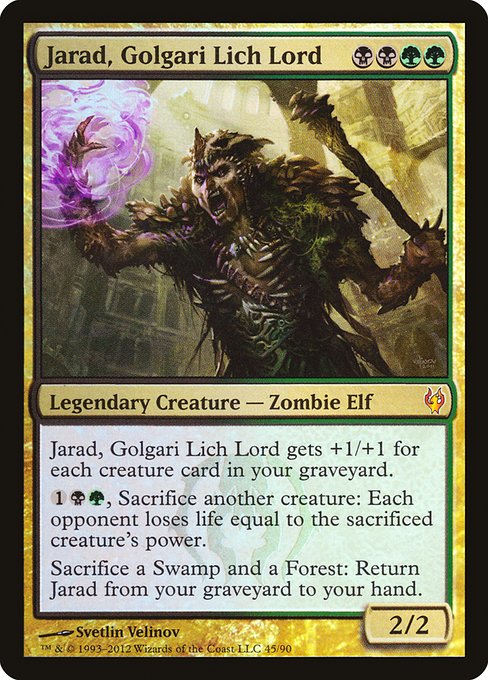
Jarad, Golgari Lich Lord | Illustration by Svetlin Velinov
AI-generated article, published by an ElderDecks editor.
game. Pay three mana, sacrifice another creature, and every opponent loses life equal to that creature's power.
Lord of Extinction
is an obvious partner because it counts cards in every graveyard. One sufficiently large sacrifice can threaten the entire table.
Jarad also grows with the creature cards in your own graveyard, giving self-mill a second job. Brawn adds a combat route when it is in your graveyard and you control a Forest, so the deck can pressure life totals before the sacrifice finish.
He starts our countdown because the payoff is powerful but requires several resources at once: a worthwhile creature, an outlet activation, and a way to recover afterward. Jarad supplies the outlet, but he does not draw the next hand or create the next threat. Include recursion before adding another enormous creature.
#19. Old Stickfingers
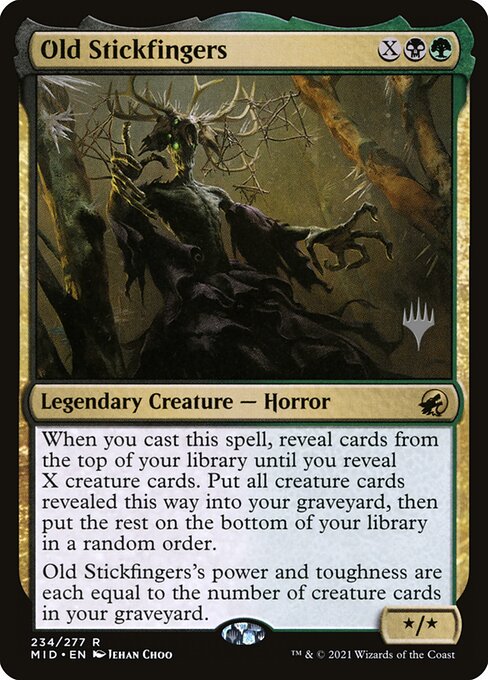
Old Stickfingers | Illustration by Jehan Choo
Old Stickfingers makes the number of creature cards in your deck a meaningful design choice. Cast it with X equal to three and its cast trigger reveals cards until it finds three creatures, then puts those creatures into your graveyard. The other revealed cards go to the bottom of your library. This is controlled creature stocking rather than ordinary self-mill.
Reanimate, Animate Dead, and Victimize let you use what you found. A low creature count makes the results more predictable, while a conventional creature deck gets a less precise graveyard refill. Even a counterspell aimed at Old Stickfingers does not remove a cast trigger already on the stack.
That access earns a place here, but it also explains the relatively low general-purpose ranking. Every extra utility creature changes what the trigger can find, and the commander itself mainly offers a large body. Choose it when you enjoy designing the creature package as carefully as the reanimation spells.
#18. Rendmaw, Creaking Nest
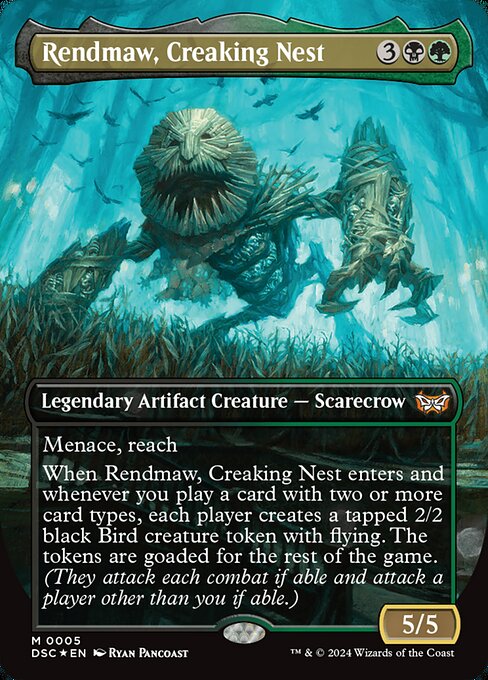
Rendmaw, Creaking Nest | Illustration by Ryan Pancoast
Rendmaw, Creaking Nest turns a deckbuilding restriction into a table-wide argument. It gives every player a tapped, flying Bird when it enters and whenever you play a card with at least two card types. Those Birds are goaded for the rest of the game, encouraging opponents to spend their growing armies on one another.
Ornithopter of Paradise and Haywire Mite qualify as artifact creatures while doing useful work. Grim Guardian qualifies as an enchantment creature and rewards other enchantments entering. Artifact lands also count when played. The distinction is important: returning an artifact creature from your graveyard does not mean you played that card, so it does not trigger the play-card ability.
The political pressure is unusual enough to justify building around. However, opponents receive real flying creatures, and goad offers much less protection once only one opponent remains. Plan how your own Birds will win that final fight before handing out another flock.
#17. Dina, Essence Brewer
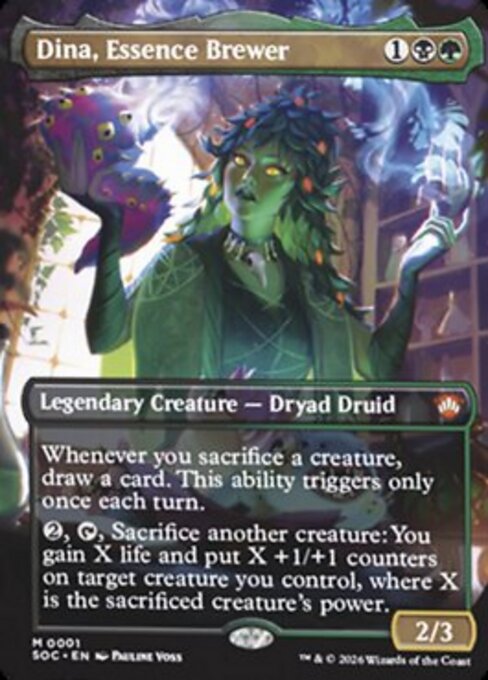
Dina, Essence Brewer | Illustration by Pauline Voss
Dina, Essence Brewer provides the card draw that sacrifice decks often have to find separately. Sacrifice a creature and draw a card, with a limit of once each turn. A free outlet such as Viscera Seer lets you use that allowance during opponents' turns as well as your own, provided you have enough creatures to spend.
Her activated ability adds another purpose for a large expendable creature: pay two mana, tap Dina, and sacrifice another creature to gain life and put counters on a creature you control equal to the sacrificed creature's power. That can move the strength of one threat onto another while also triggering her draw ability.
The limit keeps this from becoming a card for every creature in a mass-sacrifice turn. Her own outlet also needs mana and a tap. Dina earns this position as a compact, flexible engine, but the rest of the deck should supply another outlet and recurring creatures if it wants to work around the whole table.
#16. The Mycotyrant
The Mycotyrant | Illustration by Andy Brase
The Mycotyrant turns the permanent cards you put into your graveyard into a Fungus army at your end step. Its own size grows with your Fungi and Saprolings, and trample helps convert that size into damage. A single commander therefore rewards both filling the graveyard and keeping a board.
Stitcher's Supplier can add several permanent cards across its entry and death triggers. Satyr Wayfinder helps find a land while putting the remaining revealed cards into the graveyard, and Perpetual Timepiece supplies repeatable milling with a separate recovery option. Favor permanent cards that also perform jobs your deck needs.
Count permanent cards, not everything that goes to the graveyard. Instants and sorceries do not increase descend, and dying tokens are not cards. The generated Fungi also cannot block. Those restrictions keep the commander below more flexible engines, but the combination of graveyard development and a growing attacker gives it a very coherent plan.
#15. Slimefoot, the Stowaway
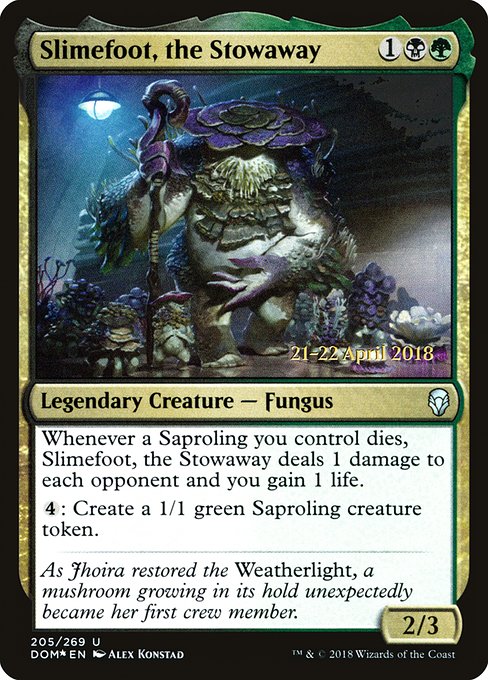
Slimefoot, the Stowaway | Illustration by Alex Konstad
Slimefoot, the Stowaway gives Saprolings a purpose beyond attacking. Whenever one you control dies, Slimefoot deals one damage to each opponent and you gain one life. Its four-mana token ability ensures that spare mana can become another Saproling, though dedicated token makers are a better way to build a substantial army.
Saproling Migration gets multiple bodies onto the battlefield, while Tendershoot Dryad adds one during every upkeep and can make the team much larger. Psychotrope Thallid lets you pay a mana and sacrifice a Saproling for a card, producing both Slimefoot's damage trigger and a replacement resource.
The appeal is clarity: make Saprolings, get useful work from them, and make their deaths matter. The limitation is that Slimefoot's own production is slow, and unrelated creature tokens will not trigger its damage ability. It ranks here as an approachable, cohesive commander whose strongest turns come from balancing production and sacrifice rather than simply adding more death payoffs.
#14. Baba Lysaga, Night Witch
Baba Lysaga, Night Witch | Illustration by Slawomir Maniak
Baba Lysaga, Night Witch asks you to count card types instead of bodies. Tap her and sacrifice up to three permanents; if the sacrificed group contains at least three card types, each opponent loses three life, you gain three life, and you draw three cards. An artifact land such as Tree of Tales plus an expendable creature already supplies artifact, land, and creature.
Ichor Wellspring rewards being sacrificed with another card, while Dryad Arbor contributes both land and creature. The useful question is which permanents can do their ordinary jobs before you feed them to the ability. Multitype cards reduce the number of objects you have to lose.
Drawing three repeatedly is a serious engine, and the life loss gives it a route toward a finish. The construction cost is real, though: sacrificing lands too freely can leave you unable to cast those new cards. She also needs to tap. Baba belongs this high for rewarding careful resource management, with a lower floor when the required types fail to line up.
#13. Hapatra, Vizier of Poisons
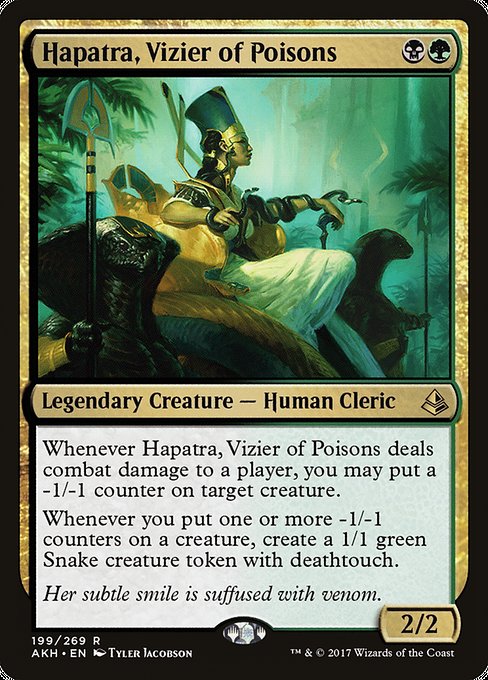
Hapatra, Vizier of Poisons | Illustration by Tyler Jacobson
Hapatra, Vizier of Poisons can turn a -1/-1 counter into a deathtouch Snake, giving a removal theme both a board and a deterrent to attacks. Her combat-damage ability supplies an initial way to place a counter, but a dedicated deck wants other ways to keep doing it.
Devoted Druid puts counters on itself as the cost of untapping, which also produces Hapatra triggers. Nest of Scarabs adds Insects, and Blowfly Infestation can move the pressure to another creature when a creature with a -1/-1 counter dies. These pieces make a small counter engine affect a much larger battlefield.
Read the token quantities carefully. Putting several counters on one creature in a single event makes one Snake through Hapatra, while Nest of Scarabs counts the counters. Her ranking reflects the efficiency of a two-mana commander that turns interaction into creatures. She still needs suitable enablers, and Blowfly Infestation's mandatory targeted trigger demands careful sequencing when the board becomes small.
#12. The Serpent Society
The Serpent Society | Illustration by Rimas Valeikis
The Serpent Society makes a deathtouch creature useful even when nobody blocks it. Whenever another deathtouch creature you control dies, every opponent sacrifices a nontoken creature of their choice. A cheap creature token can therefore force three opponents to lose actual cards from their boards.
Hapatra, Vizier of Poisons supplies deathtouch Snakes, and Viscera Seer lets you choose when to sacrifice one. That combination turns expendable bodies into repeated pressure without needing to attack. The Society's own ward cost, getting five poison counters, can make a targeted answer an uncomfortable decision.
This is a potent controlling commander, which earns it a place above several engines that need more setup. It also has clear limits: opponents choose their sacrifices, the Society does not trigger from its own death, and ward does not prevent an untargeted sweeper. Keep producing deathtouch creatures rather than relying on the commander to be the whole board.
#11. Beledros Witherbloom
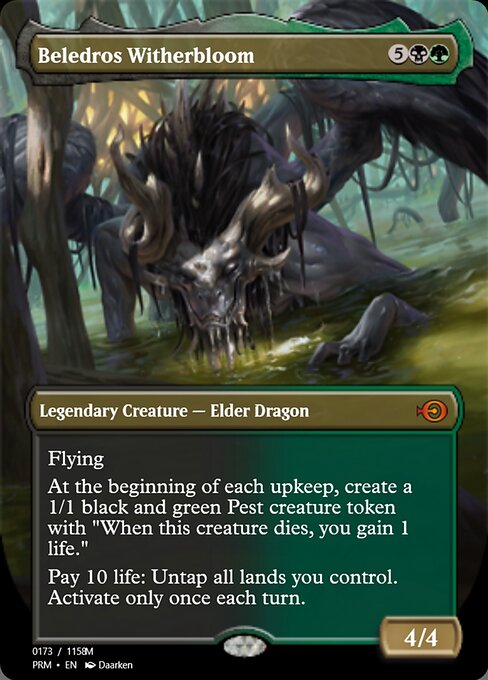
Beledros Witherbloom | Illustration by Daarken
Beledros Witherbloom gives you a Pest during every upkeep, creating a steady supply of creatures that gain life when they die. More dramatically, paying ten life untaps all your lands. Float mana first and that untap can help fund a much larger spell in the same turn.
Exsanguinate provides an obvious destination for that mana and a way to replenish life. Essence Warden rewards the continuing Pest arrivals, while Skullclamp turns the small tokens into cards. Those pieces make the token ability relevant even before you are ready for a major mana turn.
Seven mana is why Beledros sits outside the top ten. Your deck needs to establish resources before the commander arrives, and ten life is a substantial payment when opponents can attack. The untap is limited to once each turn, so it cannot simply repeat within the same turn. Beledros is excellent for players who want an expensive commander to take over a developed game.
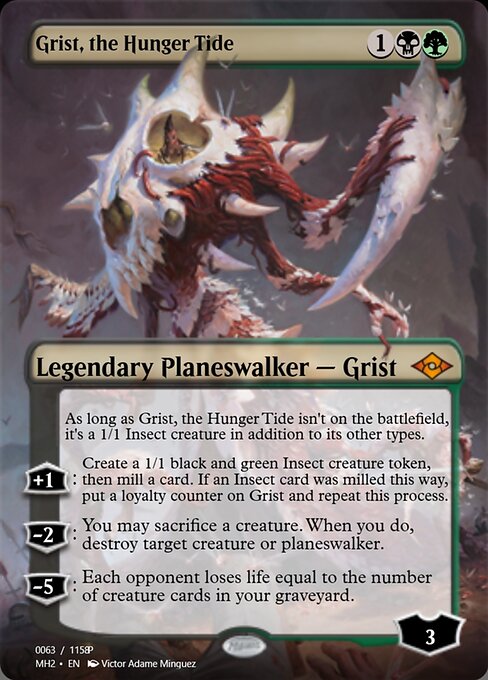
#10. Grist, the Hunger Tide
Grist, the Hunger Tide | Illustration by Victor Adame Minguez
Grist, the Hunger Tide compresses several useful jobs into three mana: create an Insect, mill a card, and threaten creature or planeswalker removal through the sacrifice ability. Its ultimate can turn a stocked creature graveyard into life loss for every opponent. It supports the setup and the payoff of a graveyard deck from one command-zone slot.
Stitcher's Supplier contributes creatures to sacrifice and cards to the graveyard. Victimize can turn a spare Insect into two returned creatures, and Skullclamp converts those 1/1 Insects into cards. You can lean into Insect cards for extra loyalty-building opportunities or keep the creature package broader.
Grist can legally lead the deck because its own ability makes it a legendary creature outside the battlefield, including in the command zone. Once on the battlefield, it is normally a planeswalker and needs protection from attacks. That vulnerability keeps it below the most dependable creature engines, but its combination of development and interaction is unusually efficient.
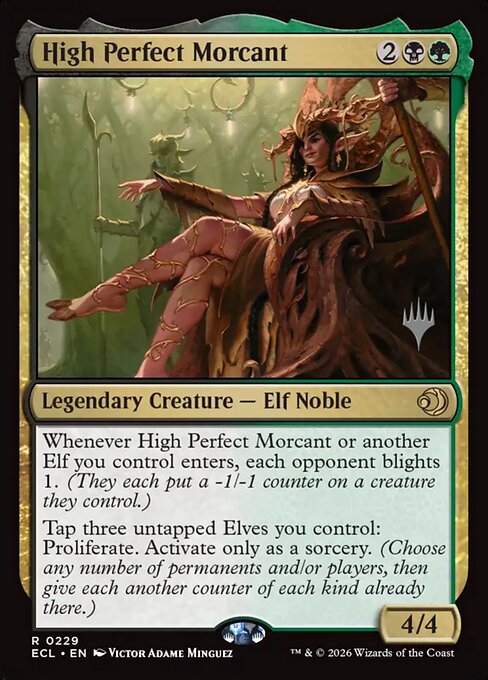
#9. High Perfect Morcant
High Perfect Morcant | Illustration by Victor Adame Minguez
High Perfect Morcant gives an Elf deck an interactive plan that starts before combat. Every Elf entering under your control, including Morcant, makes each opponent blight one. Each affected opponent chooses a creature they control to receive a -1/-1 counter. Repeated Elf entries can make maintaining a small creature board difficult for the rest of the table.
Elvish Warmaster and Lys Alana Huntmaster turn normal Elf development into additional bodies and additional entry triggers. Tapping three untapped Elves to proliferate can then increase counters that are already present. Newly entered Elves can help pay that tap-three cost, though the ability still has sorcery timing.
Morcant earns ninth for connecting your board development to pressure on opposing creatures. The limits matter: opponents choose their blight recipients, and proliferate cannot create the first counter. Also, blight has the opponent put the counter on their creature; that does not automatically trigger Hapatra, Vizier of Poisons, which requires you to put counters on creatures.
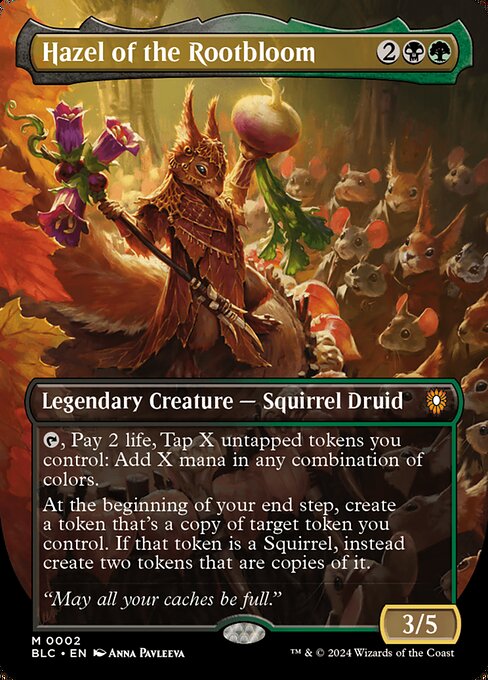
#8. Hazel of the Rootbloom
Hazel of the Rootbloom | Illustration by Anna Pavleeva
Hazel of the Rootbloom treats tokens as renewable mana sources. Tap Hazel, pay two life, and tap any number of untapped tokens you control to make that much mana in any combination of colors. Those tokens can include artifacts, and paying the ability does not require sacrificing them.
At your end step, Hazel also copies a token you control, making two copies instead if the target is a Squirrel. Second Harvest expands a mixed token board, while Chatterstorm supplies Squirrels that work with both halves of the commander. Academy Manufactor is useful when your deck actually creates Clues, Foods, or Treasures; it does not multiply ordinary Squirrel production by itself.
The combination of mana and copying gives Hazel considerable room to customize. Her weakness is needing an existing token board and time to use a tap ability. She ranks eighth because she can make a functioning token strategy far more productive, while still asking the deck to supply the first wave of resources.
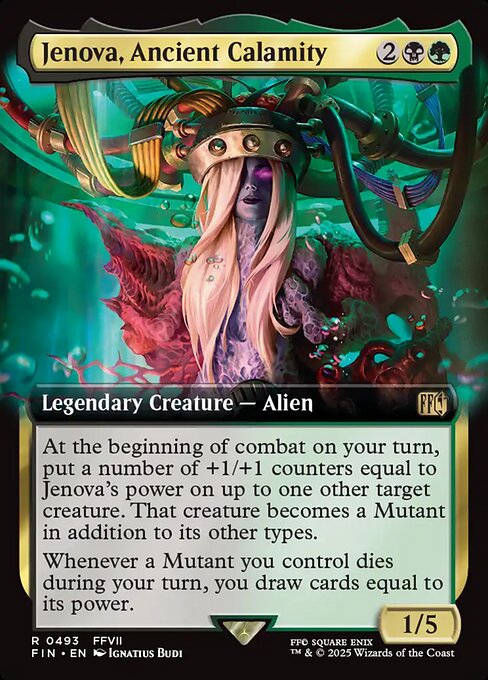
#7. Jenova, Ancient Calamity
Jenova, Ancient Calamity | Illustration by Ignatius Budi
Jenova, Ancient Calamity can make an expendable creature worth an entire new hand. At the beginning of combat on your turn, another creature can receive counters equal to Jenova's power and become a Mutant. When a Mutant you control dies during your turn, you draw cards equal to its power.
Increasing Jenova's own power improves the number of counters she distributes. Rancor is a simple way to increase that number, while Winding Constrictor improves the counters placed on the recipient. Viscera Seer lets you sacrifice a large Mutant while the draw ability can still trigger, rather than hoping an opponent cooperates in combat.
Seventh place reflects a powerful connection between creature growth and refilling your hand. However, the timing restriction is substantial: losing a Mutant during an opponent's turn will not produce the same draw trigger. Jenova also needs another creature to enhance and a way to use that power. Preserve the engine rather than treating every large Mutant as a permanent fixture.
#6. Lathril, Blade of the Elves
Lathril, Blade of the Elves | Illustration by Magali Villeneuve
Lathril, Blade of the Elves gives an Elf army two complementary routes to victory. Combat damage from the commander makes that many Elf Warriors, and the activated ability turns ten other untapped Elves into ten life lost by each opponent and ten life gained by you. A crowded battlefield can become useful even when attacking is awkward.
Elvish Archdruid supplies mana and a power boost. Elvish Warmaster helps maintain numbers, while Seedborn Muse can untap your permanents during other players' untap steps so the life-loss ability is available again. Beastmaster Ascension gives a wide army another combat finish.
Lathril ranks sixth for supplying both production and a payoff in a well-supported creature type. She does need to connect to make her own tokens, and the ten-Elf activation takes a substantial board. Lathril herself must be able to use her tap symbol; the other Elves tapped to pay the additional cost can be newly entered creatures. Keep independent card draw so one sweeper does not empty your game plan.
#5. Witherbloom, the Balancer
Witherbloom, the Balancer | Illustration by Chris Rahn
Witherbloom, the Balancer turns a creature board into a discount engine for spells. Affinity for creatures reduces the Dragon's own generic cost, and its static ability gives that affinity to your instants and sorceries. Six creatures can reduce its printed eight-mana cost to just black-green, before accounting for any other cost changes.
Chatterstorm supplies more creatures, and Shamanic Revelation can become much easier to cast while refilling your hand. With an X spell such as Torment of Hailfire, you choose X and then apply the cost reduction to the spell's generic cost. Creature tokens count just as much as nontoken creatures for affinity.
That ability to convert one resource into another gives Witherbloom the highest placement among the newer additions in this selection. Colored costs still have to be paid, and losing the creature board removes the discounts. Include ways to rebuild rather than filling the list with spells that are only practical while the entire engine survives.
#4. Ygra, Eater of All
Ygra, Eater of All | Illustration by Chris Rahn
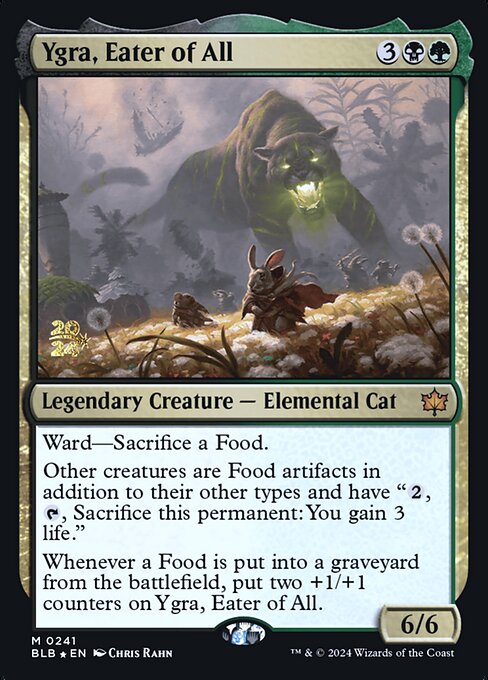
Ygra, Eater of All changes the meaning of artifact removal. Every other creature becomes a Food artifact in addition to its existing types, so Reclamation Sage can destroy an opposing creature. Seeds of Innocence can destroy all those converted creatures at once, while each Food going to the graveyard makes Ygra larger.
That sweep is symmetrical: your other creatures are artifacts too, and Seeds of Innocence gives the controllers life for the artifacts it destroys. Cauldron Familiar offers a different direction, returning from your graveyard when you sacrifice a Food and rewarding its arrival with life loss for each opponent.
Ygra ranks fourth because it opens several strong approaches while making otherwise narrow cards much more flexible. The commander also turns your own army into a target for artifact sweepers. Its ward cost can be paid by sacrificing a Food, and Ygra gives opposing creatures the Food type, so opponents may already have something suitable to sacrifice. Build with that symmetry in mind.
#3. The Gitrog Monster
The Gitrog Monster | Illustration by Jason Kang
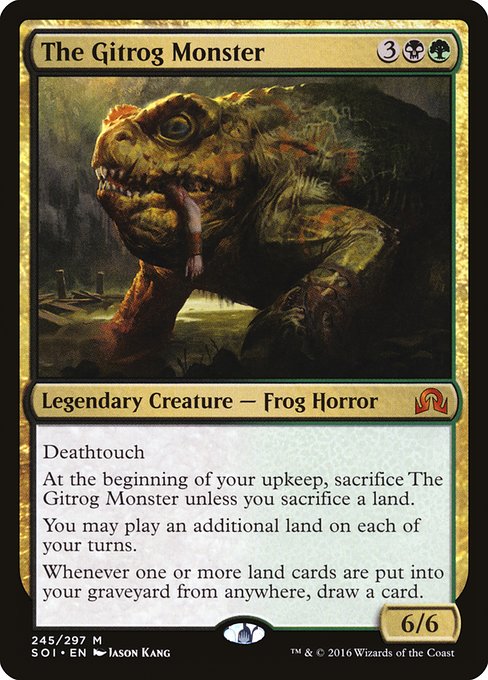
The Gitrog Monster makes lands into an ongoing source of cards. It permits an extra land play, asks you to sacrifice a land during your upkeep if you want to keep it, and draws a card when one or more land cards reach your graveyard from anywhere. A supposed drawback becomes a resource engine when the deck is built to use it.
Life from the Loam recovers lands and supports repeated dredging. Crop Rotation sacrifices a land as part of finding a useful replacement. Dakmor Salvage and a discard outlet such as Skirge Familiar can support intricate dredge engines, but complete combo lines also need a plan for milling, reshuffling, and actually winning.
The ceiling earns third place; the sequencing burden keeps it from being our first general recommendation. Remember that several lands entering the graveyard in the same event produce one draw trigger. Gitrog rewards precise play, and graveyard disruption can interrupt the engine. Start with a coherent lands plan before adding the most complicated loops.
#2. Chatterfang, Squirrel General
Chatterfang, Squirrel General | Illustration by Milivoj Ćeran
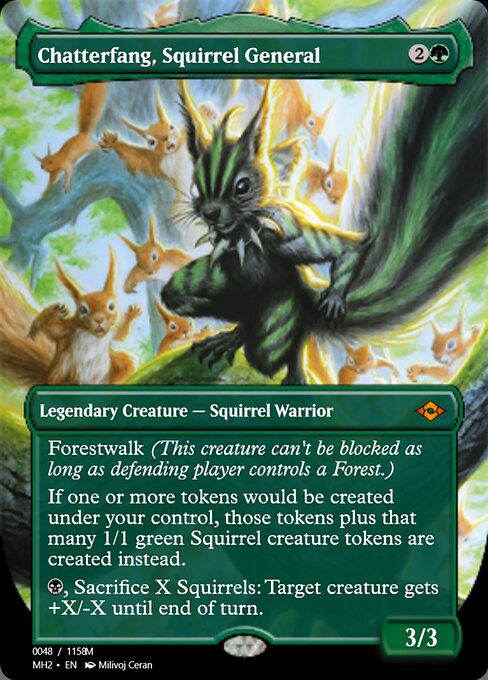
Chatterfang, Squirrel General makes almost any token production advance a creature plan. Whenever you would create tokens, you create that many additional Squirrels alongside them. A Treasure stays a Treasure; the commander adds a Squirrel rather than turning it into two Treasures. That breadth lets the deck draw on token makers that do much more than create attackers.
With Pitiless Plunderer, a dying Squirrel produces a Treasure and a replacement Squirrel. Zulaport Cutthroat rewards the deaths, and Chatterfang's black-mana sacrifice ability can convert Squirrels into creature removal. Second Harvest can also produce a dramatic increase in both your original tokens and the extra Squirrels.
Three mana, broad compatibility, and a built-in outlet earn second place. Chatterfang still depends on other cards to make the first tokens and does not directly draw cards. Its replacement effect can accelerate a deck into repeatable sacrifice engines, so choose the intended finish deliberately and explain it to your playgroup.
#1. Meren of Clan Nel Toth
Meren of Clan Nel Toth | Illustration by Mark Winters
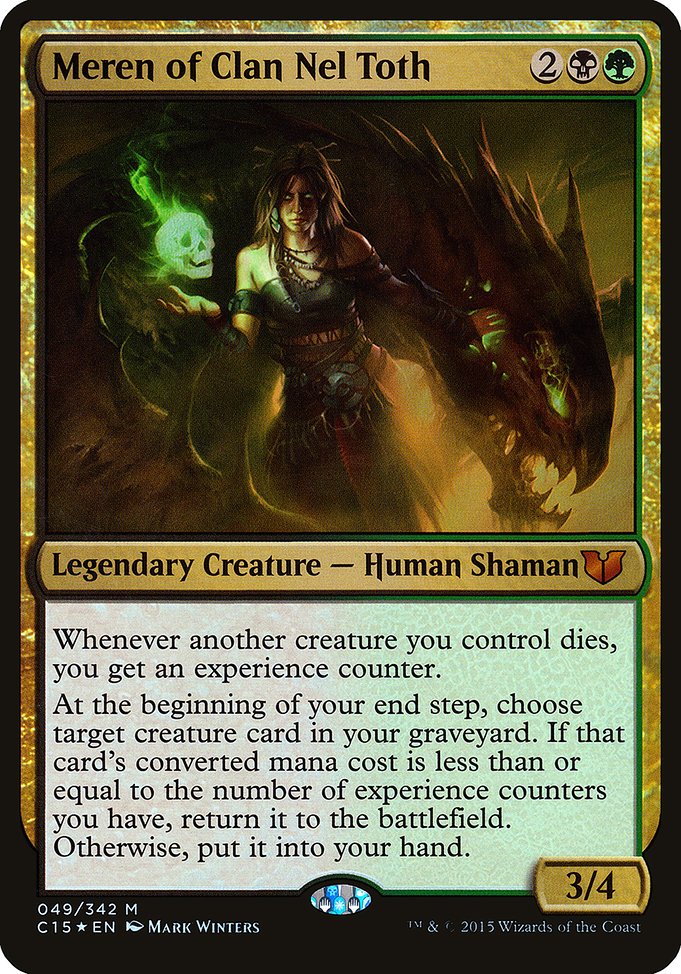
Meren of Clan Nel Toth takes first because the useful creatures in your deck become a repeatable engine with very little extra construction. While she is on the battlefield, another creature you control dying gives you an experience counter. At your end step, a creature from your graveyard can return to the battlefield if its mana value is no greater than your experience-counter total, or to your hand otherwise.
Sakura-Tribe Elder can find a basic land, provide an experience counter, and become a target to reuse. Plaguecrafter puts pressure on opposing boards when brought back, while Spore Frog lets you choose a turn to prevent combat damage. Experience counters belong to you, so removing Meren does not reset that accumulated resource.
The end-step timing is a genuine limit. Meren does not bring a creature back during every opponent's end step, and reusing Spore Frog once per round does not automatically protect every combat. Graveyard exile remains a serious answer. Even so, her combination of recovery, flexibility, and rewards for creatures you already want to play makes her our strongest all-round recommendation for a Golgari deck.
Building a Golgari deck that survives removal
Give every engine a complete support package
Write down the action your commander rewards before choosing the exciting payoffs. Meren needs useful creatures to recur and reliable ways for them to die. Hazel needs tokens already on the battlefield. Hapatra needs ways to place -1/-1 counters. Drawing three payoffs without an enabler will not make any of those decks function.
Favor overlap where it serves the actual plan. Sakura-Tribe Elder develops lands and can later be reused in a recursion deck. Satyr Wayfinder helps a graveyard strategy find land while stocking the graveyard. A card earns its place by performing the job your particular list needs, rather than simply sharing the commander's colors.
Choose a finish before adding more value
Tokens, life, and cards are resources. Decide how they become a win. An army can use Overwhelming Stampede to gain power and trample. A deck producing substantial mana can build toward Exsanguinate. A sacrifice deck can convert creature deaths into life loss with Zulaport Cutthroat. Choose enough support for your finish that it can happen through ordinary play.
If the sacrifice plan is the part you enjoy most, our Rakdos sacrifice commander ranking explores another color pair built around those decisions. The important comparison is what your commander supplies and what the rest of the deck still needs to find.
Keep recovery and graveyard interaction in the list
A removal spell aimed at your commander should leave you with something productive to do. Keep independent card draw, mana development, and a second useful engine. Land-based ramp such as Rampant Growth or Nature's Lore can help a creature deck retain mana after a sweeper, although the best balance depends on how much your commander rewards creatures.
Your graveyard can also become a vulnerability. Avoid committing every recovery option to it at once, and include interaction for other players' graveyards. Soul-Guide Lantern can exile each opponent's graveyard without clearing your own. Know whether a graveyard-hate effect is targeted or affects the whole graveyard before choosing your response.
Frequently asked questions
What colors are Golgari in MTG?
Golgari is black and green. A Golgari Commander deck uses a commander with black-green color identity and cards whose color identities fit within those colors. Colorless cards are also allowed. Color identity considers relevant mana symbols in rules text as well as the mana cost, along with the other color-identity rules.
Why is Chatterfang a Golgari commander when it costs only green mana?
Chatterfang's activated ability has a black mana symbol in its cost. That gives the card black-green color identity, even though its casting cost contains only generic and green mana. It can lead a Golgari deck and cannot be included in a deck restricted to green color identity.
Can Grist, the Hunger Tide legally be your commander?
Yes. Grist's ability makes it a 1/1 Insect creature in addition to its other types while it is outside the battlefield. Because it is a legendary creature in the command zone, it qualifies as a commander. This is specific to its text; other planeswalkers need their own permission or qualifying rules to lead a Commander deck.
Should an Elf deck use Lathril or High Perfect Morcant?
Lathril, Blade of the Elves | Illustration by Magali VilleneuveHigh Perfect Morcant | Illustration by Victor Adame Minguez
Choose Lathril, Blade of the Elves if you want combat to create an army and a command-zone ability that turns that army into life loss. Choose High Perfect Morcant if you want Elf entries to weaken opposing creatures and want access to proliferate. Lathril supplies a direct payoff for reaching a large Elf count; Morcant puts more emphasis on controlling the battlefield as the army develops. Both still need independent card draw and recovery.
Does a higher-ranked commander always make a stronger deck?
No. The other 99 cards determine consistency, interaction, speed, and the presence of combos. A carefully optimized Old Stickfingers list can be far more demanding than a relaxed Meren list. Use the ranking to find an engine you want to build, then describe the actual deck and its win conditions when choosing a game.
Which Golgari commander should you build?
Our first recommendation is Meren of Clan Nel Toth if you want useful creatures to keep returning and enough flexibility to change the deck over time. Chatterfang rewards players who enjoy making several kinds of tokens, The Gitrog Monster offers a more technical lands engine, and Lathril gives an Elf army a clear payoff beyond combat.
Choose the play pattern you want to repeat over a whole game. Then use the commander buttons beside the ranked entries, or open the ElderDecks Commander deck builder, and fill the missing jobs before adding another impressive finisher.
Sources and editorial notes
Card text, color identity, and Commander legality were checked on November 2, 2026. Each ranked entry links to its Scryfall card record. Support-card records were also checked against Scryfall's Oracle data. The article's recommendations and ranking order are original editorial judgments; they are not reported win rates or claims of personal playtesting.
Golgari Rot Farm | Illustration by Donato Giancola
Black-green can make a dead creature more useful than a living one. It can also bury the table in Elves, turn every creature into Food, or make a swarm pay for enormous spells. Choosing a Golgari commander means choosing which engine you want to maintain and which weaknesses you are willing to accept.
These are our 20 best Golgari commanders for multiplayer Commander, counting down from specialized build-arounds to the strongest all-round recommendation. Each entry explains the plan, the cards that make it work, and a limitation that should influence your 99.
How we ranked the best Golgari commanders
We gave the most weight to a reliable source of cards, mana, creatures, or recursion; the amount of setup required; and the ability to keep functioning after interaction. Room to customize and a clear route to victory also matter. A spectacular ceiling needs enough support to be practical.
The order reflects our editorial judgment for four-player Commander. Highly tuned combo decks can produce a different order from an ordinary multiplayer recommendation, and a focused lower-ranked build can be stronger than a relaxed higher-ranked one. EDHREC helped establish the candidate pool; its popularity order did not determine these rankings.
All 20 selections have exactly black-green color identity and were checked against Scryfall's Commander legality data and Wizards' current banned list on November 2, 2026. The list covers individual commanders, including Grist's rules-based eligibility, rather than partner combinations. It includes newer options from Lorwyn Eclipsed, Secrets of Strixhaven, and Marvel Super Heroes alongside established favorites.
A large creature does not have to connect in combat to end a Jarad, Golgari Lich Lord game. Pay three mana, sacrifice another creature, and every opponent loses life equal to that creature's power. Lord of Extinction is an obvious partner because it counts cards in every graveyard. One sufficiently large sacrifice can threaten the entire table.
Jarad also grows with the creature cards in your own graveyard, giving self-mill a second job. Brawn adds a combat route when it is in your graveyard and you control a Forest, so the deck can pressure life totals before the sacrifice finish.
He starts our countdown because the payoff is powerful but requires several resources at once: a worthwhile creature, an outlet activation, and a way to recover afterward. Jarad supplies the outlet, but he does not draw the next hand or create the next threat. Include recursion before adding another enormous creature.
Old Stickfingers makes the number of creature cards in your deck a meaningful design choice. Cast it with X equal to three and its cast trigger reveals cards until it finds three creatures, then puts those creatures into your graveyard. The other revealed cards go to the bottom of your library. This is controlled creature stocking rather than ordinary self-mill.
Reanimate, Animate Dead, and Victimize let you use what you found. A low creature count makes the results more predictable, while a conventional creature deck gets a less precise graveyard refill. Even a counterspell aimed at Old Stickfingers does not remove a cast trigger already on the stack.
That access earns a place here, but it also explains the relatively low general-purpose ranking. Every extra utility creature changes what the trigger can find, and the commander itself mainly offers a large body. Choose it when you enjoy designing the creature package as carefully as the reanimation spells.
Rendmaw, Creaking Nest turns a deckbuilding restriction into a table-wide argument. It gives every player a tapped, flying Bird when it enters and whenever you play a card with at least two card types. Those Birds are goaded for the rest of the game, encouraging opponents to spend their growing armies on one another.
Ornithopter of Paradise and Haywire Mite qualify as artifact creatures while doing useful work. Grim Guardian qualifies as an enchantment creature and rewards other enchantments entering. Artifact lands also count when played. The distinction is important: returning an artifact creature from your graveyard does not mean you played that card, so it does not trigger the play-card ability.
The political pressure is unusual enough to justify building around. However, opponents receive real flying creatures, and goad offers much less protection once only one opponent remains. Plan how your own Birds will win that final fight before handing out another flock.
Dina, Essence Brewer provides the card draw that sacrifice decks often have to find separately. Sacrifice a creature and draw a card, with a limit of once each turn. A free outlet such as Viscera Seer lets you use that allowance during opponents' turns as well as your own, provided you have enough creatures to spend.
Her activated ability adds another purpose for a large expendable creature: pay two mana, tap Dina, and sacrifice another creature to gain life and put counters on a creature you control equal to the sacrificed creature's power. That can move the strength of one threat onto another while also triggering her draw ability.
The limit keeps this from becoming a card for every creature in a mass-sacrifice turn. Her own outlet also needs mana and a tap. Dina earns this position as a compact, flexible engine, but the rest of the deck should supply another outlet and recurring creatures if it wants to work around the whole table.
The Mycotyrant turns the permanent cards you put into your graveyard into a Fungus army at your end step. Its own size grows with your Fungi and Saprolings, and trample helps convert that size into damage. A single commander therefore rewards both filling the graveyard and keeping a board.
Stitcher's Supplier can add several permanent cards across its entry and death triggers. Satyr Wayfinder helps find a land while putting the remaining revealed cards into the graveyard, and Perpetual Timepiece supplies repeatable milling with a separate recovery option. Favor permanent cards that also perform jobs your deck needs.
Count permanent cards, not everything that goes to the graveyard. Instants and sorceries do not increase descend, and dying tokens are not cards. The generated Fungi also cannot block. Those restrictions keep the commander below more flexible engines, but the combination of graveyard development and a growing attacker gives it a very coherent plan.
Slimefoot, the Stowaway gives Saprolings a purpose beyond attacking. Whenever one you control dies, Slimefoot deals one damage to each opponent and you gain one life. Its four-mana token ability ensures that spare mana can become another Saproling, though dedicated token makers are a better way to build a substantial army.
Saproling Migration gets multiple bodies onto the battlefield, while Tendershoot Dryad adds one during every upkeep and can make the team much larger. Psychotrope Thallid lets you pay a mana and sacrifice a Saproling for a card, producing both Slimefoot's damage trigger and a replacement resource.
The appeal is clarity: make Saprolings, get useful work from them, and make their deaths matter. The limitation is that Slimefoot's own production is slow, and unrelated creature tokens will not trigger its damage ability. It ranks here as an approachable, cohesive commander whose strongest turns come from balancing production and sacrifice rather than simply adding more death payoffs.
Baba Lysaga, Night Witch asks you to count card types instead of bodies. Tap her and sacrifice up to three permanents; if the sacrificed group contains at least three card types, each opponent loses three life, you gain three life, and you draw three cards. An artifact land such as Tree of Tales plus an expendable creature already supplies artifact, land, and creature.
Ichor Wellspring rewards being sacrificed with another card, while Dryad Arbor contributes both land and creature. The useful question is which permanents can do their ordinary jobs before you feed them to the ability. Multitype cards reduce the number of objects you have to lose.
Drawing three repeatedly is a serious engine, and the life loss gives it a route toward a finish. The construction cost is real, though: sacrificing lands too freely can leave you unable to cast those new cards. She also needs to tap. Baba belongs this high for rewarding careful resource management, with a lower floor when the required types fail to line up.
Hapatra, Vizier of Poisons can turn a -1/-1 counter into a deathtouch Snake, giving a removal theme both a board and a deterrent to attacks. Her combat-damage ability supplies an initial way to place a counter, but a dedicated deck wants other ways to keep doing it.
Devoted Druid puts counters on itself as the cost of untapping, which also produces Hapatra triggers. Nest of Scarabs adds Insects, and Blowfly Infestation can move the pressure to another creature when a creature with a -1/-1 counter dies. These pieces make a small counter engine affect a much larger battlefield.
Read the token quantities carefully. Putting several counters on one creature in a single event makes one Snake through Hapatra, while Nest of Scarabs counts the counters. Her ranking reflects the efficiency of a two-mana commander that turns interaction into creatures. She still needs suitable enablers, and Blowfly Infestation's mandatory targeted trigger demands careful sequencing when the board becomes small.
The Serpent Society makes a deathtouch creature useful even when nobody blocks it. Whenever another deathtouch creature you control dies, every opponent sacrifices a nontoken creature of their choice. A cheap creature token can therefore force three opponents to lose actual cards from their boards.
Hapatra, Vizier of Poisons supplies deathtouch Snakes, and Viscera Seer lets you choose when to sacrifice one. That combination turns expendable bodies into repeated pressure without needing to attack. The Society's own ward cost, getting five poison counters, can make a targeted answer an uncomfortable decision.
This is a potent controlling commander, which earns it a place above several engines that need more setup. It also has clear limits: opponents choose their sacrifices, the Society does not trigger from its own death, and ward does not prevent an untargeted sweeper. Keep producing deathtouch creatures rather than relying on the commander to be the whole board.
Beledros Witherbloom gives you a Pest during every upkeep, creating a steady supply of creatures that gain life when they die. More dramatically, paying ten life untaps all your lands. Float mana first and that untap can help fund a much larger spell in the same turn.
Exsanguinate provides an obvious destination for that mana and a way to replenish life. Essence Warden rewards the continuing Pest arrivals, while Skullclamp turns the small tokens into cards. Those pieces make the token ability relevant even before you are ready for a major mana turn.
Seven mana is why Beledros sits outside the top ten. Your deck needs to establish resources before the commander arrives, and ten life is a substantial payment when opponents can attack. The untap is limited to once each turn, so it cannot simply repeat within the same turn. Beledros is excellent for players who want an expensive commander to take over a developed game.
Grist, the Hunger Tide | Illustration by Victor Adame Minguez
Grist, the Hunger Tide compresses several useful jobs into three mana: create an Insect, mill a card, and threaten creature or planeswalker removal through the sacrifice ability. Its ultimate can turn a stocked creature graveyard into life loss for every opponent. It supports the setup and the payoff of a graveyard deck from one command-zone slot.
Stitcher's Supplier contributes creatures to sacrifice and cards to the graveyard. Victimize can turn a spare Insect into two returned creatures, and Skullclamp converts those 1/1 Insects into cards. You can lean into Insect cards for extra loyalty-building opportunities or keep the creature package broader.
Grist can legally lead the deck because its own ability makes it a legendary creature outside the battlefield, including in the command zone. Once on the battlefield, it is normally a planeswalker and needs protection from attacks. That vulnerability keeps it below the most dependable creature engines, but its combination of development and interaction is unusually efficient.
High Perfect Morcant gives an Elf deck an interactive plan that starts before combat. Every Elf entering under your control, including Morcant, makes each opponent blight one. Each affected opponent chooses a creature they control to receive a -1/-1 counter. Repeated Elf entries can make maintaining a small creature board difficult for the rest of the table.
Elvish Warmaster and Lys Alana Huntmaster turn normal Elf development into additional bodies and additional entry triggers. Tapping three untapped Elves to proliferate can then increase counters that are already present. Newly entered Elves can help pay that tap-three cost, though the ability still has sorcery timing.
Morcant earns ninth for connecting your board development to pressure on opposing creatures. The limits matter: opponents choose their blight recipients, and proliferate cannot create the first counter. Also, blight has the opponent put the counter on their creature; that does not automatically trigger Hapatra, Vizier of Poisons, which requires you to put counters on creatures.
Hazel of the Rootbloom treats tokens as renewable mana sources. Tap Hazel, pay two life, and tap any number of untapped tokens you control to make that much mana in any combination of colors. Those tokens can include artifacts, and paying the ability does not require sacrificing them.
At your end step, Hazel also copies a token you control, making two copies instead if the target is a Squirrel. Second Harvest expands a mixed token board, while Chatterstorm supplies Squirrels that work with both halves of the commander. Academy Manufactor is useful when your deck actually creates Clues, Foods, or Treasures; it does not multiply ordinary Squirrel production by itself.
The combination of mana and copying gives Hazel considerable room to customize. Her weakness is needing an existing token board and time to use a tap ability. She ranks eighth because she can make a functioning token strategy far more productive, while still asking the deck to supply the first wave of resources.
Jenova, Ancient Calamity can make an expendable creature worth an entire new hand. At the beginning of combat on your turn, another creature can receive counters equal to Jenova's power and become a Mutant. When a Mutant you control dies during your turn, you draw cards equal to its power.
Increasing Jenova's own power improves the number of counters she distributes. Rancor is a simple way to increase that number, while Winding Constrictor improves the counters placed on the recipient. Viscera Seer lets you sacrifice a large Mutant while the draw ability can still trigger, rather than hoping an opponent cooperates in combat.
Seventh place reflects a powerful connection between creature growth and refilling your hand. However, the timing restriction is substantial: losing a Mutant during an opponent's turn will not produce the same draw trigger. Jenova also needs another creature to enhance and a way to use that power. Preserve the engine rather than treating every large Mutant as a permanent fixture.
Lathril, Blade of the Elves gives an Elf army two complementary routes to victory. Combat damage from the commander makes that many Elf Warriors, and the activated ability turns ten other untapped Elves into ten life lost by each opponent and ten life gained by you. A crowded battlefield can become useful even when attacking is awkward.
Elvish Archdruid supplies mana and a power boost. Elvish Warmaster helps maintain numbers, while Seedborn Muse can untap your permanents during other players' untap steps so the life-loss ability is available again. Beastmaster Ascension gives a wide army another combat finish.
Lathril ranks sixth for supplying both production and a payoff in a well-supported creature type. She does need to connect to make her own tokens, and the ten-Elf activation takes a substantial board. Lathril herself must be able to use her tap symbol; the other Elves tapped to pay the additional cost can be newly entered creatures. Keep independent card draw so one sweeper does not empty your game plan.
Witherbloom, the Balancer turns a creature board into a discount engine for spells. Affinity for creatures reduces the Dragon's own generic cost, and its static ability gives that affinity to your instants and sorceries. Six creatures can reduce its printed eight-mana cost to just black-green, before accounting for any other cost changes.
Chatterstorm supplies more creatures, and Shamanic Revelation can become much easier to cast while refilling your hand. With an X spell such as Torment of Hailfire, you choose X and then apply the cost reduction to the spell's generic cost. Creature tokens count just as much as nontoken creatures for affinity.
That ability to convert one resource into another gives Witherbloom the highest placement among the newer additions in this selection. Colored costs still have to be paid, and losing the creature board removes the discounts. Include ways to rebuild rather than filling the list with spells that are only practical while the entire engine survives.
Ygra, Eater of All changes the meaning of artifact removal. Every other creature becomes a Food artifact in addition to its existing types, so Reclamation Sage can destroy an opposing creature. Seeds of Innocence can destroy all those converted creatures at once, while each Food going to the graveyard makes Ygra larger.
That sweep is symmetrical: your other creatures are artifacts too, and Seeds of Innocence gives the controllers life for the artifacts it destroys. Cauldron Familiar offers a different direction, returning from your graveyard when you sacrifice a Food and rewarding its arrival with life loss for each opponent.
Ygra ranks fourth because it opens several strong approaches while making otherwise narrow cards much more flexible. The commander also turns your own army into a target for artifact sweepers. Its ward cost can be paid by sacrificing a Food, and Ygra gives opposing creatures the Food type, so opponents may already have something suitable to sacrifice. Build with that symmetry in mind.
The Gitrog Monster makes lands into an ongoing source of cards. It permits an extra land play, asks you to sacrifice a land during your upkeep if you want to keep it, and draws a card when one or more land cards reach your graveyard from anywhere. A supposed drawback becomes a resource engine when the deck is built to use it.
Life from the Loam recovers lands and supports repeated dredging. Crop Rotation sacrifices a land as part of finding a useful replacement. Dakmor Salvage and a discard outlet such as Skirge Familiar can support intricate dredge engines, but complete combo lines also need a plan for milling, reshuffling, and actually winning.
The ceiling earns third place; the sequencing burden keeps it from being our first general recommendation. Remember that several lands entering the graveyard in the same event produce one draw trigger. Gitrog rewards precise play, and graveyard disruption can interrupt the engine. Start with a coherent lands plan before adding the most complicated loops.
Chatterfang, Squirrel General makes almost any token production advance a creature plan. Whenever you would create tokens, you create that many additional Squirrels alongside them. A Treasure stays a Treasure; the commander adds a Squirrel rather than turning it into two Treasures. That breadth lets the deck draw on token makers that do much more than create attackers.
With Pitiless Plunderer, a dying Squirrel produces a Treasure and a replacement Squirrel. Zulaport Cutthroat rewards the deaths, and Chatterfang's black-mana sacrifice ability can convert Squirrels into creature removal. Second Harvest can also produce a dramatic increase in both your original tokens and the extra Squirrels.
Three mana, broad compatibility, and a built-in outlet earn second place. Chatterfang still depends on other cards to make the first tokens and does not directly draw cards. Its replacement effect can accelerate a deck into repeatable sacrifice engines, so choose the intended finish deliberately and explain it to your playgroup.
Meren of Clan Nel Toth takes first because the useful creatures in your deck become a repeatable engine with very little extra construction. While she is on the battlefield, another creature you control dying gives you an experience counter. At your end step, a creature from your graveyard can return to the battlefield if its mana value is no greater than your experience-counter total, or to your hand otherwise.
Sakura-Tribe Elder can find a basic land, provide an experience counter, and become a target to reuse. Plaguecrafter puts pressure on opposing boards when brought back, while Spore Frog lets you choose a turn to prevent combat damage. Experience counters belong to you, so removing Meren does not reset that accumulated resource.
The end-step timing is a genuine limit. Meren does not bring a creature back during every opponent's end step, and reusing Spore Frog once per round does not automatically protect every combat. Graveyard exile remains a serious answer. Even so, her combination of recovery, flexibility, and rewards for creatures you already want to play makes her our strongest all-round recommendation for a Golgari deck.
Building a Golgari deck that survives removal
Give every engine a complete support package
Write down the action your commander rewards before choosing the exciting payoffs. Meren needs useful creatures to recur and reliable ways for them to die. Hazel needs tokens already on the battlefield. Hapatra needs ways to place -1/-1 counters. Drawing three payoffs without an enabler will not make any of those decks function.
Favor overlap where it serves the actual plan. Sakura-Tribe Elder develops lands and can later be reused in a recursion deck. Satyr Wayfinder helps a graveyard strategy find land while stocking the graveyard. A card earns its place by performing the job your particular list needs, rather than simply sharing the commander's colors.
Choose a finish before adding more value
Tokens, life, and cards are resources. Decide how they become a win. An army can use Overwhelming Stampede to gain power and trample. A deck producing substantial mana can build toward Exsanguinate. A sacrifice deck can convert creature deaths into life loss with Zulaport Cutthroat. Choose enough support for your finish that it can happen through ordinary play.
If the sacrifice plan is the part you enjoy most, our Rakdos sacrifice commander ranking explores another color pair built around those decisions. The important comparison is what your commander supplies and what the rest of the deck still needs to find.
Keep recovery and graveyard interaction in the list
A removal spell aimed at your commander should leave you with something productive to do. Keep independent card draw, mana development, and a second useful engine. Land-based ramp such as Rampant Growth or Nature's Lore can help a creature deck retain mana after a sweeper, although the best balance depends on how much your commander rewards creatures.
Your graveyard can also become a vulnerability. Avoid committing every recovery option to it at once, and include interaction for other players' graveyards. Soul-Guide Lantern can exile each opponent's graveyard without clearing your own. Know whether a graveyard-hate effect is targeted or affects the whole graveyard before choosing your response.
Frequently asked questions
What colors are Golgari in MTG?
Golgari is black and green. A Golgari Commander deck uses a commander with black-green color identity and cards whose color identities fit within those colors. Colorless cards are also allowed. Color identity considers relevant mana symbols in rules text as well as the mana cost, along with the other color-identity rules.
Why is Chatterfang a Golgari commander when it costs only green mana?
Chatterfang's activated ability has a black mana symbol in its cost. That gives the card black-green color identity, even though its casting cost contains only generic and green mana. It can lead a Golgari deck and cannot be included in a deck restricted to green color identity.
Yes. Grist's ability makes it a 1/1 Insect creature in addition to its other types while it is outside the battlefield. Because it is a legendary creature in the command zone, it qualifies as a commander. This is specific to its text; other planeswalkers need their own permission or qualifying rules to lead a Commander deck.
Lathril, Blade of the Elves | Illustration by Magali VilleneuveHigh Perfect Morcant | Illustration by Victor Adame Minguez
Choose Lathril, Blade of the Elves if you want combat to create an army and a command-zone ability that turns that army into life loss. Choose High Perfect Morcant if you want Elf entries to weaken opposing creatures and want access to proliferate. Lathril supplies a direct payoff for reaching a large Elf count; Morcant puts more emphasis on controlling the battlefield as the army develops. Both still need independent card draw and recovery.
Does a higher-ranked commander always make a stronger deck?
No. The other 99 cards determine consistency, interaction, speed, and the presence of combos. A carefully optimized Old Stickfingers list can be far more demanding than a relaxed Meren list. Use the ranking to find an engine you want to build, then describe the actual deck and its win conditions when choosing a game.
Which Golgari commander should you build?
Our first recommendation is Meren of Clan Nel Toth if you want useful creatures to keep returning and enough flexibility to change the deck over time. Chatterfang rewards players who enjoy making several kinds of tokens, The Gitrog Monster offers a more technical lands engine, and Lathril gives an Elf army a clear payoff beyond combat.
Choose the play pattern you want to repeat over a whole game. Then use the commander buttons beside the ranked entries, or open the ElderDecks Commander deck builder, and fill the missing jobs before adding another impressive finisher.
Sources and editorial notes
Card text, color identity, and Commander legality were checked on November 2, 2026. Each ranked entry links to its Scryfall card record. Support-card records were also checked against Scryfall's Oracle data. The article's recommendations and ranking order are original editorial judgments; they are not reported win rates or claims of personal playtesting.