By ElderArticles · Updated 10/28/2026 · 22 min read
Discover the 20 best Naya commanders in MTG, ranked for power, consistency, strategy, drawbacks, deckbuilding flexibility, and key synergies.
Table of contents
Naya Charm | Illustration by Jesper Ejsing
Naya has never had trouble making a battlefield look dangerous. The red-green-white color identity gives you green's mana and creatures, white's protection and token support, and red's speed. The harder question is what happens after the first board wipe, or when a table full of blockers makes another giant creature feel less impressive than advertised.
The best Naya commanders solve that problem from the command zone. Some turn spare tokens into cards. Others tutor the exact creature you need, reward you for cracking Eggs, or make nine harmless bodies hit like a collapsing building. This list ranks 20 red-green-white commanders by how reliably they create a plan, how much support that plan needs, and whether the commander still matters when the first attack fails.
We are counting down from #20 to #1. The winner is at the bottom, because Naya may be straightforward in combat, but a ranking does not need to hand over its best card before the first draw step.
What Does Naya Mean in MTG?
Naya is Magic's red-green-white color combination. The name comes from one of the shards of Alara, although a commander does not need a connection to Alara to be described as Naya. Under the official Commander rules, every card in the deck must fit inside the commander's color identity, which includes colored mana symbols in both the mana cost and rules text.
That matters for cards such as Samut, Voice of Dissent. Samut costs red and green mana, but her white activated ability gives her a red-green-white color identity. Every commander ranked here has exactly Naya identity and was listed as Commander-legal in Scryfall when checked on October 28, 2026.
This is an editorial ranking for multiplayer Commander, not a list of measured win rates. Popularity helped identify commanders players are actively building, but it did not decide the order.
We prioritized five things:
AI-generated article, published by an ElderDecks editor.
- Consistency: Does the commander make its plan happen repeatedly, or only when several unrelated pieces line up?
- Resources: Can it produce cards, mana, tokens, or meaningful virtual advantage?
- Resilience: Does the deck recover when the commander or battlefield is removed?
- Deckbuilding range: Can the commander support more than one interesting version without becoming a pile of generic staples?
- Ceiling: How threatening can a focused list become without pretending every reader wants a tournament combo deck?
A lower-ranked commander can absolutely beat a higher-ranked one. The other 99 cards, the pilot, the table's intended bracket, and the opening hand matter more than a number beside a heading. Think of the order as a guide to dependable engines, not a promise about who wins Friday night.
Quick Naya Picks by Play Style
- Creature tokens: Jetmir, Nexus of Revels; Baylen, the Haymaker; or Jinnie Fay, Jetmir's Second
- Dinosaurs: Pantlaza, Sun-Favored; Gishath, Sun's Avatar; or Zacama, Primal Calamity
- Equipment and Auras: Cloud, Ex-SOLDIER or Dogmeat, Ever Loyal
- Counters: Shalai and Hallar or Voja, Jaws of the Conclave
- Politics and forced combat: Marisi, Breaker of the Coil or Rocco, Street Chef
- Creature toolboxes: Atla Palani, Nest Tender or Rocco, Cabaretti Caterer
- Something genuinely unusual: Toph, the First Metalbender; Sigurd, Jarl of Ravensthorpe; or Ghired, Mirror of the Wilds
The Top 20 Naya Commanders
#20. Rith, Liberated Primeval
Rith, Liberated Primeval | Illustration by Victor Adame Minguez
Best for: Dragon midrange decks that want removal to generate more Dragons.
Rith is less interested in how many Dragons you already control than in whether something took more damage than it could handle. If an opposing creature or planeswalker was dealt excess damage, Rith creates a 4/4 flying Dragon at your end step. That turns burn spells, fight effects, and oversized blockers into a steady threat engine.
Flying and ward {2} make Rith respectable on her own, and giving every other Dragon ward {2} helps an expensive creature type survive targeted removal. The catch is that she does not draw cards, and the end-step trigger still needs an opposing permanent to damage. A creature-light table can leave the engine idling.
High-synergy cards: Blasphemous Act, Dragon Tempest, Lathliss, Dragon Queen, and Neyith of the Dire Hunt.
#19. Sigurd, Jarl of Ravensthorpe
Sigurd, Jarl of Ravensthorpe | Illustration by Alexander Gering
Best for: Saga decks that want to control chapter timing instead of simply waiting.
Sigurd has an excellent keyword package for three mana, but the reason to build him is the one-mana boast ability. Moving a lore counter forward can reach a chapter early; removing one can repeat the chapter you actually care about. Every lore counter you add also grows another creature.
The deck becomes much better when its Sagas are useful at multiple chapters rather than existing for one flashy finale. Sigurd must attack before boasting, so pillow-fort boards and cheap removal can interrupt the plan. He rewards careful sequencing more than raw Naya muscle.
High-synergy cards: Satsuki, the Living Lore, Weaver of Harmony, Historian's Boon, and Three Blind Mice.
#18. Dogmeat, Ever Loyal
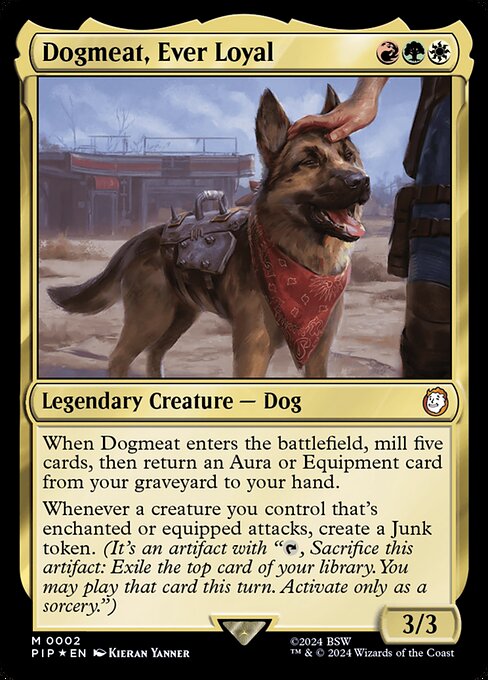
Dogmeat, Ever Loyal | Illustration by Kieran Yanner
Best for: Voltron decks split between Auras and Equipment.
Dogmeat mills five cards when he enters and returns an Aura or Equipment from the graveyard to your hand. That is a small but useful safety net for a strategy that normally hates losing its expensive attachments. Once the team attacks while enchanted or equipped, Dogmeat produces Junk tokens that turn into temporary access to more cards.
He is flexible, flavorful, and easy to understand, but he does not attach the recovered card or protect the creature wearing it. Junk also works only at sorcery speed. Dogmeat is best for players who want a resilient, value-oriented Voltron deck rather than the fastest possible commander-damage clock.
High-synergy cards: Mantle of the Ancients, Puresteel Paladin, Colossus Hammer, and Open the Armory.
#17. Huatli, Poet of Unity
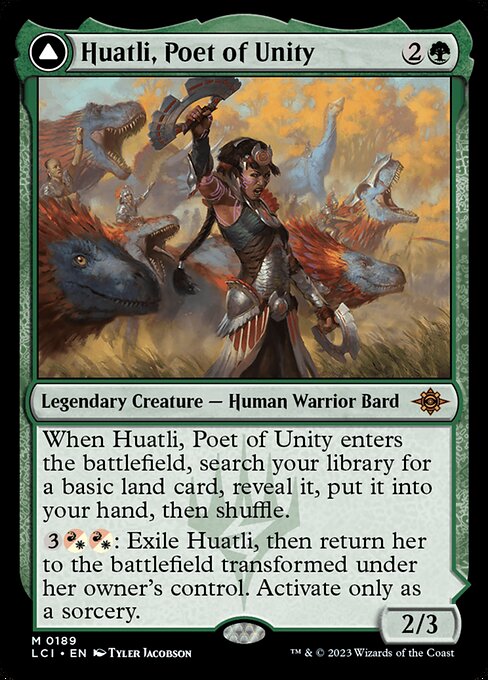
Huatli, Poet of Unity | Illustration by Tyler Jacobson
Best for: Dinosaur decks that prefer a scripted engine to one enormous attack trigger.
Huatli's front face replaces itself with a basic land, then transforms for five mana into Roar of the Fifth People. The Saga makes two Dinosaurs, teaches your creatures to tap for Naya mana, tutors a Dinosaur, and finally gives the tribe double strike and trample. It is practically a four-turn game plan printed on one card.
The issue is tempo. Casting Huatli and transforming her requires eight total mana across two actions, and removal before the transformation can make that investment feel glacial. She is a strong choice for battlecruiser tables where a slower, reliable setup is more valuable than immediate pressure.
Ghired, Mirror of the Wilds | Illustration by Diego Gisbert
Best for: Token-copy decks built around temporary or unusually valuable tokens.
Ghired gives every nontoken creature you control the ability to tap and copy a token that entered this turn. One fresh Rhino, Dragon, or copy token can become an assembly line if you already have several creatures waiting. Because Ghired has haste, he can help start the copying immediately.
The phrase ‘entered this turn’ is the entire puzzle. Old tokens cannot be copied, and filling the deck with only token producers leaves too few nontoken creatures to activate Ghired's ability. The commander is spectacular when the ratios are right and surprisingly quiet when they are not.
Marisi, Breaker of the Coil | Illustration by Rudy Siswanto
Best for: Political combat decks that want opponents attacking each other.
Marisi prevents opponents from casting spells during combat, then goads every creature controlled by a player you hit. Sending one evasive attacker at each opponent can redirect most of the table for a full turn cycle while making combat tricks and removal far harder to use against you.
This is control by way of combat, not a conventional card engine. Marisi needs creatures that can connect, and an opponent with no useful attackers does not care much about being goaded. Choose him if you enjoy steering a table and making deals, not if you want to goldfish the same sequence every game.
High-synergy cards: Reconnaissance, Dolmen Gate, Professional Face-Breaker, and Ohran Frostfang.
#14. Rocco, Street Chef
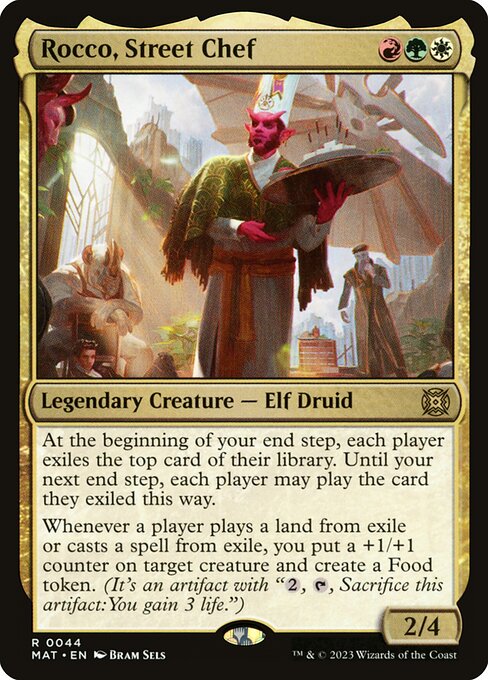
Rocco, Street Chef | Illustration by Bram Sels
Best for: Exile-matters decks that mix group resources with incremental growth.
At each of your end steps, Rocco gives every player a card they may play from exile until your next end step. Whenever anyone plays a land or casts a spell from exile, you place a +1/+1 counter and make a Food. Your opponents receive options, but you receive the counters and artifacts when they use them.
Rocco can produce an absurd amount of cardboard without looking threatening at first. That generosity is also the weakness. You are handing three opponents live cards, and the wrong free answer can undo your board. Build more ways to cast from your own exile so the deck does not depend on everyone else's cooperation.
High-synergy cards: Wrenn's Resolve, Pia Nalaar, Consul of Revival, Laelia, the Blade Reforged, and Faldorn, Dread Wolf Herald.
#13. Toph, the First Metalbender
Toph, the First Metalbender | Illustration by Eilene Cherie
Best for: Artifact-land engines and players who enjoy unusual rules interactions.
Toph makes every nontoken artifact you control a land in addition to its other types, then earthbends a land at each end step. Earthbending an artifact-land turns it into a hasty creature with counters. If it dies or is exiled, it returns tapped, ready to be used again as an artifact under Toph.
She creates lines that no other Naya commander offers, especially with artifacts that reward entering, dying, or being sacrificed. She also exposes those permanents to artifact, land, and creature interaction once they are animated. Toph is powerful, but the deck asks its pilot to keep track of types and replacement effects without getting lost in the metalwork.
Jinnie Fay, Jetmir's Second | Illustration by David Gaillet
Best for: Token decks that want every token maker to produce combat-ready creatures.
Jinnie Fay can replace any tokens you would create with the same number of 2/2 Cats with haste or 3/1 Dogs with vigilance. Treasure, Food, Clues, creature tokens, and stranger game pieces can all become whichever attacker fits the moment. At three mana, the commander arrives before most of the deck's major token engines.
The replacement is optional, which keeps useful Treasure from turning into a Dog by accident. Still, Jinnie does not double tokens, draw cards, or protect the army. The other 99 must supply those jobs. She is best when the deck produces several different token types and treats conversion as a tactical choice rather than a gimmick.
High-synergy cards: Academy Manufactor, Peregrin Took, Mondrak, Glory Dominus, and Bootleggers' Stash.
#11. Tifa, Martial Artist
Tifa, Martial Artist | Illustration by Yumi Yaoshida
Best for: Big-creature combat decks that want repeatable extra-combat pressure.
Tifa has melee and rewards any creature with power seven or greater connecting with a player. When that happens, she untaps your entire team and, during the first combat of the turn, creates another combat phase. Naya already excels at making creatures enormous, so the requirement is easier than it looks.
Power is not the same as access. A 12/12 staring at three blockers will not earn another combat, and fogs or instant-speed removal can strand the whole plan. Tifa belongs with trample, protection, and several independent high-power threats, not a pile that relies on one heroic attacker.
High-synergy cards: Quartzwood Crasher, Ghalta, Primal Hunger, Aurelia, the Warleader, and Garruk's Uprising.
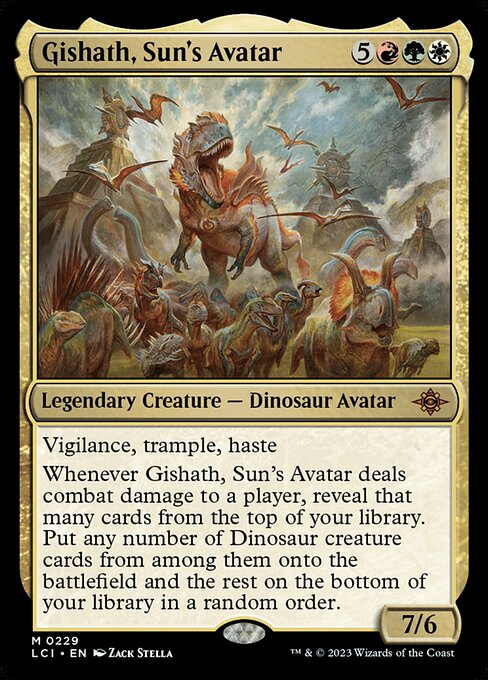
#10. Gishath, Sun's Avatar
Gishath, Sun's Avatar | Illustration by Zack Stella
Best for: Classic Dinosaur typal and players who want one attack to reshape the battlefield.
Gishath is the Naya battlecruiser dream: an 8-mana 7/6 with vigilance, trample, and haste that converts combat damage into Dinosaurs from the top of your library. Connecting for seven can turn an empty battlefield into a prehistoric problem before the defending player untaps.
That ceiling demands a high Dinosaur count, serious ramp, and protection against removal before damage. Drawing too many eight-drops is a real deckbuilding cost. Gishath ranks here because the payoff is enormous and immediate, but cheaper commanders below can begin producing value several turns sooner.
High-synergy cards: Cream of the Crop, Otepec Huntmaster, Garruk's Uprising, and Trumpeting Carnosaur.
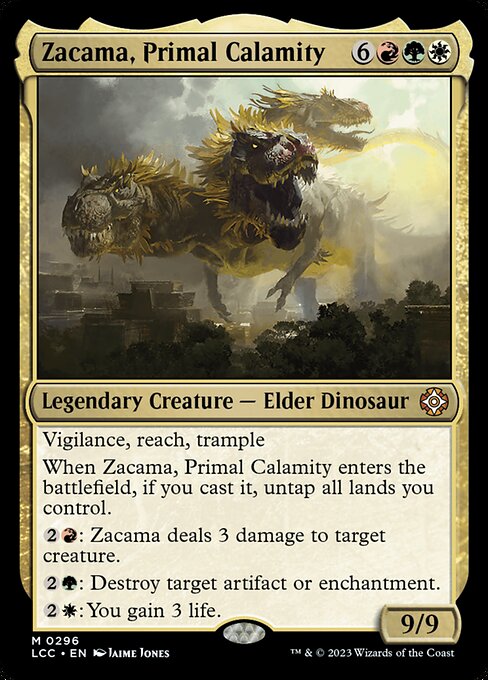
#9. Zacama, Primal Calamity
Zacama, Primal Calamity | Illustration by Jaime Jones
Best for: Land-ramp decks that want their commander to stabilize almost any board.
Zacama costs nine, but casting it untaps every land you control. If your mana base produced enough mana efficiently, the Dinosaur effectively refunds much of its own price. Its three activated abilities remove creatures, destroy artifacts or enchantments, and gain life, all attached to a vigilant trampling 9/9.
The untap trigger works only when Zacama was cast, so blinking or reanimating it will not produce the refund. Mana rocks also stay tapped. The deck wants land-based ramp and enough mana left to respond if Zacama is removed. This is the strongest Naya commander for players who enjoy turning an absurd mana engine into a toolbox.
High-synergy cards: Mirari's Wake, Mana Reflection, Temur Sabertooth, and Selvala, Heart of the Wilds.
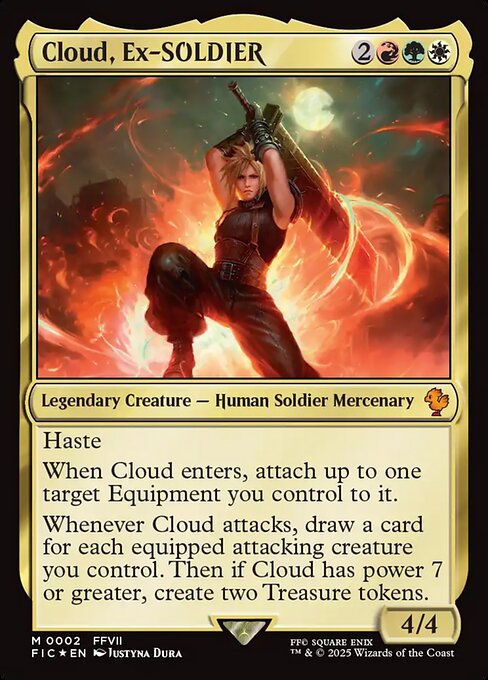
#8. Cloud, Ex-SOLDIER
Cloud, Ex-SOLDIER | Illustration by Justyna Dura
Best for: Equipment decks that want card draw spread across an attacking team.
Cloud enters with haste and immediately attaches one Equipment you already control. When he attacks, you draw for every equipped attacking creature, then make two Treasures if Cloud has at least seven power. That is the rare Equipment commander that rewards suiting up the whole squad instead of putting fifteen cards on one creature.
Five mana is not cheap, and Cloud needs both Equipment and creatures before the attack trigger becomes impressive. A sweeper can take the wielders while leaving an awkward pile of swords behind. Build a real creature curve, use low equip costs, and let Cloud refill the hand instead of asking him to carry everything alone.
High-synergy cards: Puresteel Paladin, Fighter Class, Astor, Bearer of Blades, and Sword of the Animist. For more options, see our ranked Equipment commanders guide.
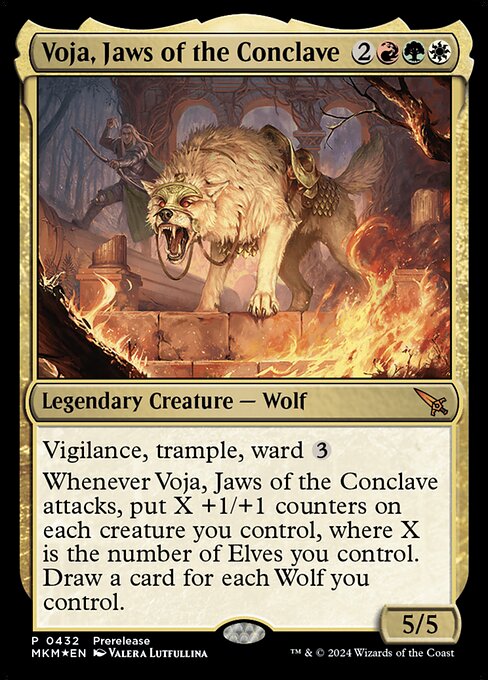
#7. Voja, Jaws of the Conclave
Voja, Jaws of the Conclave | Illustration by Valera Lutfullina
Best for: Elf-and-Wolf decks with a taste for enormous attack triggers.
Whenever Voja attacks, every creature you control receives a +1/+1 counter for each Elf you control, then you draw a card for each Wolf. Mana Elves build toward the attack, Wolves reload the hand, and Voja arrives with vigilance, trample, and ward {3}. The first clean swing can make the second one lethal.
Voja asks for two creature types, a five-mana commander, and an attack step. Losing the commander before combat leaves a collection of Elves and Wolves that may not share another payoff. The deck is brutally effective when focused, but its reputation means opponents rarely let Voja wander around unchallenged.
High-synergy cards: Maskwood Nexus, Elvish Archdruid, Tolsimir, Friend to Wolves, and Roaming Throne.
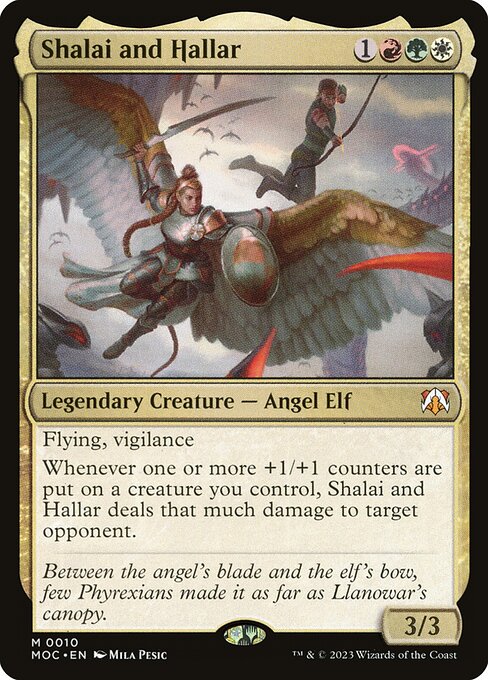
#6. Shalai and Hallar
Shalai and Hallar | Illustration by Mila Pesic
Best for: +1/+1 counter decks that want their growth to damage opponents directly.
Shalai and Hallar turn every batch of +1/+1 counters placed on your creatures into that much damage to an opponent. The counters still make your board larger, but now they also bypass blockers and threaten players who thought a fog would save them. Flying and vigilance make the commander a reasonable attacker too.
The ability says ‘one or more,’ so a single effect placing counters across several creatures can produce separate triggers when the counters are placed as separate events, while one batch on one creature produces one trigger. The commander is a removal magnet and supports compact infinite combinations, so establish the intended power level before the game.
High-synergy cards: Hardened Scales, Kami of Whispered Hopes, Cathars' Crusade, and The Red Terror. The Red Terror can form a lethal loop with the commander.
#5. Baylen, the Haymaker
Baylen, the Haymaker | Illustration by Ryan Pancoast
Best for: Token decks that want their tokens to function as mana, cards, and a win condition.
Baylen turns any untapped tokens into resources. Two make mana, three draw a card, and four place three counters on Baylen while granting trample. The tokens do not have to be creatures, so Treasure, Food, Clues, and creature tokens all help operate the engine.
Because the tap is part of Baylen's ability rather than an ability printed on those tokens, freshly created creature tokens can help pay the cost despite summoning sickness. That makes the commander frighteningly explosive. The weakness is dependency: Baylen does not create tokens, and an empty board turns the Rabbit into a plain 4/3.
High-synergy cards: Awakening Zone, Scute Swarm, Jolene, the Plunder Queen, and Mondrak, Glory Dominus.
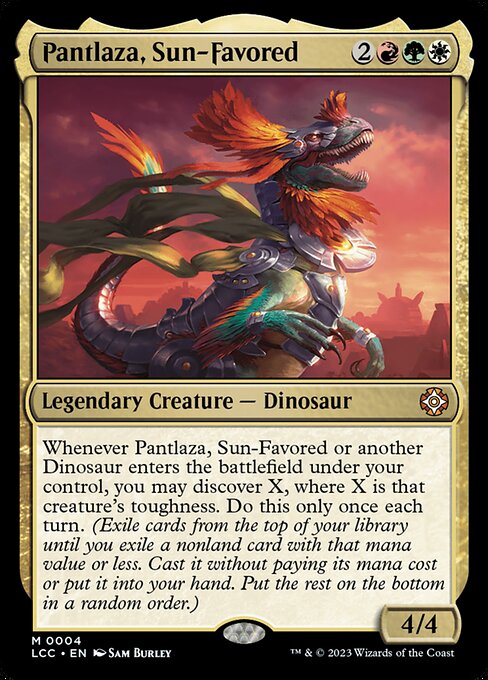
#4. Pantlaza, Sun-Favored
Pantlaza, Sun-Favored | Illustration by Sam Burley
Best for: Dinosaur value decks and blink engines that prefer consistency over one giant hit.
Pantlaza discovers whenever it or another Dinosaur enters, using that creature's toughness to set the limit. A routine five-toughness Dinosaur can cast a meaningful spell for free or put it into your hand. Unlike Gishath, the trigger does not need combat damage and starts at five mana.
The ability works only once each turn, not once each round. Blinking a Dinosaur on an opponent's turn can therefore produce another trigger, while blinking three times during your own turn cannot. Pantlaza needs a carefully built curve because expensive hits are exciting and X spells are miserable discovers. It is the best Naya Dinosaur engine for players who value steady cards over spectacle.
High-synergy cards: Emiel the Blessed, Teleportation Circle, Cream of the Crop, and Etali, Primal Conqueror.
#3. Jetmir, Nexus of Revels
Jetmir, Nexus of Revels | Illustration by Ryan Pancoast
Best for: Wide creature-token decks that want the commander to be the finishing spell.
Jetmir asks for three, six, and finally nine creatures. At those thresholds, the team gains escalating power plus vigilance, trample, and double strike. Nine unimpressive tokens suddenly attack as vigilant, trampling double strikers. Because the abilities are static, Jetmir can arrive after blockers look manageable and change the math immediately.
He does not make a token or draw a card. If the army disappears, Jetmir is a 5/4 waiting for reinforcements. That clear weakness is why he stops short of the top two, but few commanders convert an ordinary board into lethal damage with so little ceremony.
High-synergy cards: Secure the Wastes, Tendershoot Dryad, Adeline, Resplendent Cathar, and Grand Crescendo.
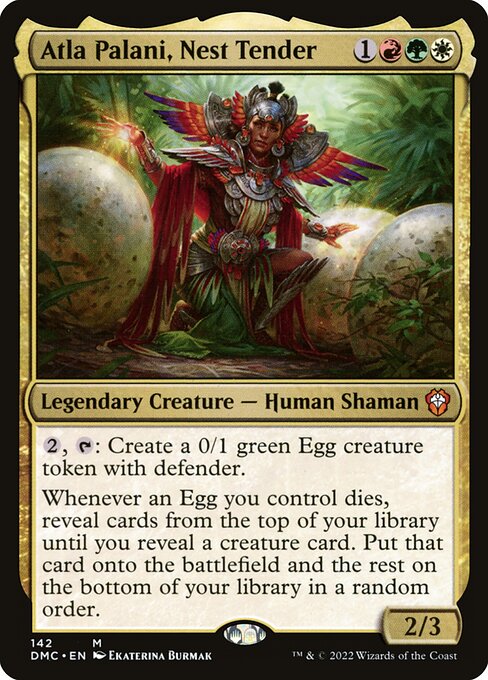
#2. Atla Palani, Nest Tender
Atla Palani, Nest Tender | Illustration by Ekaterina Burmak
Best for: Creature-cheat decks, sacrifice engines, and players comfortable with high variance.
Atla creates 0/1 Eggs, and every Egg that dies reveals cards until a creature appears, then puts that creature directly onto the battlefield. A list containing only a handful of outrageous creatures can make each cracked Egg produce an Eldrazi, Dinosaur, or other game-ending threat.
Mirror Entity can make every creature you control an Egg, while free sacrifice outlets decide exactly when the hatching begins. That ceiling is enormous, but Atla is a fragile 2/3 that needs mana, a tap, an Egg, and a way to kill it. Tuned lists are powerful and repetitive; relaxed lists are chaotic in the most entertaining way.
Rocco, Cabaretti Caterer | Illustration by Chris Seaman
Best for: Creature toolboxes and combo decks that want a tutor in the command zone.
Rocco is our best Naya commander because the commander is also the card you need next. Cast Rocco with X set to the mana value of a creature, and that creature moves from the library directly onto the battlefield. It can be ramp, removal, protection, a draw engine, or the missing half of a win condition. The same commander supports a fair toolbox at one table and a highly optimized combo list at another.
The flexibility is paid for in mana. Finding a three-mana creature costs six before commander tax, and every recast makes the calculation worse. Rocco decks therefore need disciplined ramp and creatures that solve several problems at once. No other commander on this list offers the same consistency, customization, and ability to turn one command-zone card into an entire strategy.
High-synergy cards: Food Chain, Squee, the Immortal, Kiki-Jiki, Mirror Breaker, and Village Bell-Ringer. Food Chain plus a repeatable creature from exile can generate creature mana, while Kiki-Jiki and Village Bell-Ringer offer a compact creature-based finish.
How to Build a Better Naya Commander Deck
Give the Deck Cards, Not Just Power
Naya can make enormous creatures with almost no effort. That does not mean your deck can skip card advantage. A hand of two pump spells and no creatures is still empty. Commanders such as Baylen, Cloud, Pantlaza, Voja, and Rocco help solve the problem themselves. Other leaders need engines such as Beast Whisperer, Welcoming Vampire, Garruk's Uprising, Tocasia's Welcome, or repeatable impulse draw.
Aim for several sources that work with the deck's normal actions. A Dinosaur list wants cards for casting or landing Dinosaurs. A token deck wants cards for creating, sacrificing, or connecting with tokens. The engine should reward the plan instead of asking you to pause it.
Use Ramp That Matches the Commander
A three-mana commander does not require the same ramp package as Zacama. Cheap leaders can usually develop with one- and two-mana ramp, while Gishath and Zacama need a much larger commitment to land acceleration. Zacama specifically rewards lands because her cast trigger untaps lands, not artifacts.
Three-color mana also needs discipline. Prioritize green ramp that finds the colors you are missing, and count colored sources rather than assuming 36 lands automatically cast a commander with three different pips.
Protect the Turn That Matters
Most Naya decks reveal their plan on the battlefield. Everyone can see Jetmir approaching nine creatures or Atla preparing an Egg and a sacrifice outlet. Grand Crescendo, Heroic Intervention, Flawless Maneuver, Boros Charm, and clever timing can matter more than another payoff.
Protection does not always mean making the entire board indestructible. Reconnaissance can rescue attackers. A haste enabler can shorten the window for sorcery-speed removal. Holding two creatures after a sweeper can keep Jetmir from becoming a four-mana spectator.
Include a Finish That Works Through a Stalled Board
Trample is the obvious Naya answer, but it is not the only one. Shalai and Hallar convert counters into direct damage. Marisi sends blockers elsewhere. Cloud draws into more resources. Atla can put a threat directly onto the battlefield. A good finish should either break parity or rebuild quickly after someone stops the first attempt.
Naya Commander FAQ
Who Is the Best Naya Commander Overall?
Rocco, Cabaretti Caterer is our best overall Naya commander. A creature tutor in the command zone provides exceptional consistency and can support fair toolbox decks, themed creature lists, or high-powered combo builds. The mana investment keeps Rocco from being effortless, but no other option offers the same range of answers and win conditions.
Is Naya Good for Beginner Commander Players?
Yes. Naya's creature, token, and combat plans are easy to understand at the table, and the colors provide ramp, removal, and protection. Pantlaza is a particularly welcoming value commander if the player likes Dinosaurs. Jetmir is simple to read but requires better judgment about when to commit more creatures to the board.
Is Pantlaza or Gishath the Better Dinosaur Commander?
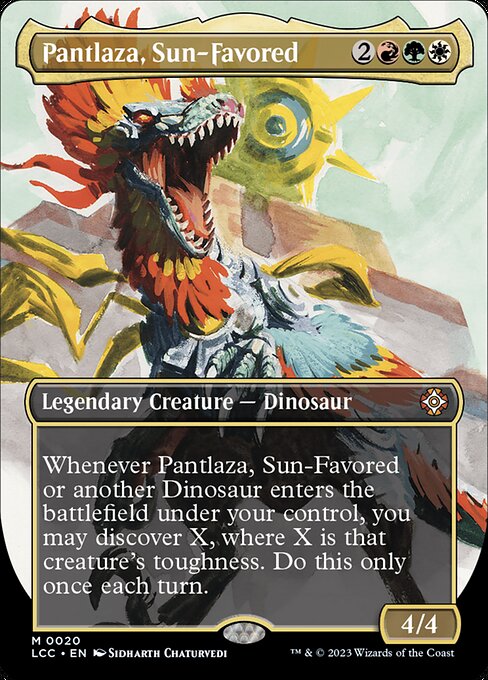
Pantlaza, Sun-Favored | Illustration by Sidharth ChaturvediGishath, Sun's Avatar | Illustration by Sidharth Chaturvedi
Pantlaza is the more consistent engine because it begins producing value at five mana and does not need to deal combat damage. Gishath has the more dramatic attack trigger and is better for players who want the deck's biggest moment to involve revealing a fistful of Dinosaurs. Choose Pantlaza for steady discover and blink play; choose Gishath for battlecruiser spectacle.
Is Jetmir or Baylen Better for Tokens?
Jetmir, Nexus of Revels | Illustration by Julie DillonBaylen, the Haymaker | Illustration by Stan Sakai
Jetmir is the better finisher. Baylen is the better engine. If your deck reliably makes nine creatures and wants to end the game in combat, Jetmir supplies the keywords and power. If you want Treasure, Food, Clues, and creature tokens to become mana and cards before the final attack, Baylen provides more flexibility.
Which Naya Commander Is Best for a Budget Deck?
Jinnie Fay, Rocco, Street Chef, and Marisi can all function with inexpensive support because their plans care more about card roles than premium individual threats. Gishath and Zacama can be built cheaply, but high mana values demand a stable ramp and land package. Always price the complete 99 rather than judging affordability from the commander's card price.
Can Naya Play Control?
Naya lacks blue counterspells and black's broad creature removal, but it can still control a multiplayer game. Marisi controls combat through goad, Zacama repeatedly removes creatures and noncreature permanents, and Rocco can tutor silver-bullet creatures. Naya control usually develops permanents while answering the table instead of holding seven cards and passing.
Are Partner Combinations Included in This Ranking?
No. This list focuses on individual cards that can legally lead a Naya deck on their own. Partner and background combinations can create additional red-green-white commanders, but comparing dozens of pairs against single-card commanders would make the ranking much less useful.
Final Verdict
The best Naya commanders do more than make creatures large. They give those creatures a reason to exist after the first attack, turn tokens into cards, transform combat into removal, or put the exact creature you need directly onto the battlefield.
Pick the engine that matches the part of Naya you actually enjoy. Jetmir is a closing argument. Pantlaza is a value machine wearing a Dinosaur costume. Atla is a slot machine with an Egg on the handle. Rocco is a toolbox that happens to sit in the command zone. Once that choice is clear, the other 99 stop looking like a stack of good red, green, and white cards and start behaving like a deck.
Build your choice in the ElderDecks Commander deck builder, then make sure the ramp, card advantage, protection, and finish all support the same plan.
Commander names, Oracle text, color identities, and legality were checked against Scryfall on October 28, 2026. The ranking is original editorial judgment. It does not claim measured win rates or guaranteed performance, and it should not replace a pregame discussion about deck power and Commander brackets.
Naya has never had trouble making a battlefield look dangerous. The red-green-white color identity gives you green's mana and creatures, white's protection and token support, and red's speed. The harder question is what happens after the first board wipe, or when a table full of blockers makes another giant creature feel less impressive than advertised.
The best Naya commanders solve that problem from the command zone. Some turn spare tokens into cards. Others tutor the exact creature you need, reward you for cracking Eggs, or make nine harmless bodies hit like a collapsing building. This list ranks 20 red-green-white commanders by how reliably they create a plan, how much support that plan needs, and whether the commander still matters when the first attack fails.
We are counting down from #20 to #1. The winner is at the bottom, because Naya may be straightforward in combat, but a ranking does not need to hand over its best card before the first draw step.
What Does Naya Mean in MTG?
Naya is Magic's red-green-white color combination. The name comes from one of the shards of Alara, although a commander does not need a connection to Alara to be described as Naya. Under the official Commander rules, every card in the deck must fit inside the commander's color identity, which includes colored mana symbols in both the mana cost and rules text.
That matters for cards such as Samut, Voice of Dissent. Samut costs red and green mana, but her white activated ability gives her a red-green-white color identity. Every commander ranked here has exactly Naya identity and was listed as Commander-legal in Scryfall when checked on October 28, 2026.
This is an editorial ranking for multiplayer Commander, not a list of measured win rates. Popularity helped identify commanders players are actively building, but it did not decide the order.
We prioritized five things:
- Consistency: Does the commander make its plan happen repeatedly, or only when several unrelated pieces line up?
- Resources: Can it produce cards, mana, tokens, or meaningful virtual advantage?
- Resilience: Does the deck recover when the commander or battlefield is removed?
- Deckbuilding range: Can the commander support more than one interesting version without becoming a pile of generic staples?
- Ceiling: How threatening can a focused list become without pretending every reader wants a tournament combo deck?
A lower-ranked commander can absolutely beat a higher-ranked one. The other 99 cards, the pilot, the table's intended bracket, and the opening hand matter more than a number beside a heading. Think of the order as a guide to dependable engines, not a promise about who wins Friday night.
Best for: Dragon midrange decks that want removal to generate more Dragons.
Rith is less interested in how many Dragons you already control than in whether something took more damage than it could handle. If an opposing creature or planeswalker was dealt excess damage, Rith creates a 4/4 flying Dragon at your end step. That turns burn spells, fight effects, and oversized blockers into a steady threat engine.
Flying and ward {2} make Rith respectable on her own, and giving every other Dragon ward {2} helps an expensive creature type survive targeted removal. The catch is that she does not draw cards, and the end-step trigger still needs an opposing permanent to damage. A creature-light table can leave the engine idling.
Best for: Saga decks that want to control chapter timing instead of simply waiting.
Sigurd has an excellent keyword package for three mana, but the reason to build him is the one-mana boast ability. Moving a lore counter forward can reach a chapter early; removing one can repeat the chapter you actually care about. Every lore counter you add also grows another creature.
The deck becomes much better when its Sagas are useful at multiple chapters rather than existing for one flashy finale. Sigurd must attack before boasting, so pillow-fort boards and cheap removal can interrupt the plan. He rewards careful sequencing more than raw Naya muscle.
Best for: Voltron decks split between Auras and Equipment.
Dogmeat mills five cards when he enters and returns an Aura or Equipment from the graveyard to your hand. That is a small but useful safety net for a strategy that normally hates losing its expensive attachments. Once the team attacks while enchanted or equipped, Dogmeat produces Junk tokens that turn into temporary access to more cards.
He is flexible, flavorful, and easy to understand, but he does not attach the recovered card or protect the creature wearing it. Junk also works only at sorcery speed. Dogmeat is best for players who want a resilient, value-oriented Voltron deck rather than the fastest possible commander-damage clock.
Huatli, Poet of Unity | Illustration by Tyler Jacobson
Best for: Dinosaur decks that prefer a scripted engine to one enormous attack trigger.
Huatli's front face replaces itself with a basic land, then transforms for five mana into Roar of the Fifth People. The Saga makes two Dinosaurs, teaches your creatures to tap for Naya mana, tutors a Dinosaur, and finally gives the tribe double strike and trample. It is practically a four-turn game plan printed on one card.
The issue is tempo. Casting Huatli and transforming her requires eight total mana across two actions, and removal before the transformation can make that investment feel glacial. She is a strong choice for battlecruiser tables where a slower, reliable setup is more valuable than immediate pressure.
Best for: Token-copy decks built around temporary or unusually valuable tokens.
Ghired gives every nontoken creature you control the ability to tap and copy a token that entered this turn. One fresh Rhino, Dragon, or copy token can become an assembly line if you already have several creatures waiting. Because Ghired has haste, he can help start the copying immediately.
The phrase ‘entered this turn’ is the entire puzzle. Old tokens cannot be copied, and filling the deck with only token producers leaves too few nontoken creatures to activate Ghired's ability. The commander is spectacular when the ratios are right and surprisingly quiet when they are not.
Best for: Political combat decks that want opponents attacking each other.
Marisi prevents opponents from casting spells during combat, then goads every creature controlled by a player you hit. Sending one evasive attacker at each opponent can redirect most of the table for a full turn cycle while making combat tricks and removal far harder to use against you.
This is control by way of combat, not a conventional card engine. Marisi needs creatures that can connect, and an opponent with no useful attackers does not care much about being goaded. Choose him if you enjoy steering a table and making deals, not if you want to goldfish the same sequence every game.
Best for: Exile-matters decks that mix group resources with incremental growth.
At each of your end steps, Rocco gives every player a card they may play from exile until your next end step. Whenever anyone plays a land or casts a spell from exile, you place a +1/+1 counter and make a Food. Your opponents receive options, but you receive the counters and artifacts when they use them.
Rocco can produce an absurd amount of cardboard without looking threatening at first. That generosity is also the weakness. You are handing three opponents live cards, and the wrong free answer can undo your board. Build more ways to cast from your own exile so the deck does not depend on everyone else's cooperation.
Best for: Artifact-land engines and players who enjoy unusual rules interactions.
Toph makes every nontoken artifact you control a land in addition to its other types, then earthbends a land at each end step. Earthbending an artifact-land turns it into a hasty creature with counters. If it dies or is exiled, it returns tapped, ready to be used again as an artifact under Toph.
She creates lines that no other Naya commander offers, especially with artifacts that reward entering, dying, or being sacrificed. She also exposes those permanents to artifact, land, and creature interaction once they are animated. Toph is powerful, but the deck asks its pilot to keep track of types and replacement effects without getting lost in the metalwork.
Best for: Token decks that want every token maker to produce combat-ready creatures.
Jinnie Fay can replace any tokens you would create with the same number of 2/2 Cats with haste or 3/1 Dogs with vigilance. Treasure, Food, Clues, creature tokens, and stranger game pieces can all become whichever attacker fits the moment. At three mana, the commander arrives before most of the deck's major token engines.
The replacement is optional, which keeps useful Treasure from turning into a Dog by accident. Still, Jinnie does not double tokens, draw cards, or protect the army. The other 99 must supply those jobs. She is best when the deck produces several different token types and treats conversion as a tactical choice rather than a gimmick.
Best for: Big-creature combat decks that want repeatable extra-combat pressure.
Tifa has melee and rewards any creature with power seven or greater connecting with a player. When that happens, she untaps your entire team and, during the first combat of the turn, creates another combat phase. Naya already excels at making creatures enormous, so the requirement is easier than it looks.
Power is not the same as access. A 12/12 staring at three blockers will not earn another combat, and fogs or instant-speed removal can strand the whole plan. Tifa belongs with trample, protection, and several independent high-power threats, not a pile that relies on one heroic attacker.
Best for: Classic Dinosaur typal and players who want one attack to reshape the battlefield.
Gishath is the Naya battlecruiser dream: an 8-mana 7/6 with vigilance, trample, and haste that converts combat damage into Dinosaurs from the top of your library. Connecting for seven can turn an empty battlefield into a prehistoric problem before the defending player untaps.
That ceiling demands a high Dinosaur count, serious ramp, and protection against removal before damage. Drawing too many eight-drops is a real deckbuilding cost. Gishath ranks here because the payoff is enormous and immediate, but cheaper commanders below can begin producing value several turns sooner.
Best for: Land-ramp decks that want their commander to stabilize almost any board.
Zacama costs nine, but casting it untaps every land you control. If your mana base produced enough mana efficiently, the Dinosaur effectively refunds much of its own price. Its three activated abilities remove creatures, destroy artifacts or enchantments, and gain life, all attached to a vigilant trampling 9/9.
The untap trigger works only when Zacama was cast, so blinking or reanimating it will not produce the refund. Mana rocks also stay tapped. The deck wants land-based ramp and enough mana left to respond if Zacama is removed. This is the strongest Naya commander for players who enjoy turning an absurd mana engine into a toolbox.
Best for: Equipment decks that want card draw spread across an attacking team.
Cloud enters with haste and immediately attaches one Equipment you already control. When he attacks, you draw for every equipped attacking creature, then make two Treasures if Cloud has at least seven power. That is the rare Equipment commander that rewards suiting up the whole squad instead of putting fifteen cards on one creature.
Five mana is not cheap, and Cloud needs both Equipment and creatures before the attack trigger becomes impressive. A sweeper can take the wielders while leaving an awkward pile of swords behind. Build a real creature curve, use low equip costs, and let Cloud refill the hand instead of asking him to carry everything alone.
Best for: Elf-and-Wolf decks with a taste for enormous attack triggers.
Whenever Voja attacks, every creature you control receives a +1/+1 counter for each Elf you control, then you draw a card for each Wolf. Mana Elves build toward the attack, Wolves reload the hand, and Voja arrives with vigilance, trample, and ward {3}. The first clean swing can make the second one lethal.
Voja asks for two creature types, a five-mana commander, and an attack step. Losing the commander before combat leaves a collection of Elves and Wolves that may not share another payoff. The deck is brutally effective when focused, but its reputation means opponents rarely let Voja wander around unchallenged.
Best for: +1/+1 counter decks that want their growth to damage opponents directly.
Shalai and Hallar turn every batch of +1/+1 counters placed on your creatures into that much damage to an opponent. The counters still make your board larger, but now they also bypass blockers and threaten players who thought a fog would save them. Flying and vigilance make the commander a reasonable attacker too.
The ability says ‘one or more,’ so a single effect placing counters across several creatures can produce separate triggers when the counters are placed as separate events, while one batch on one creature produces one trigger. The commander is a removal magnet and supports compact infinite combinations, so establish the intended power level before the game.
Best for: Token decks that want their tokens to function as mana, cards, and a win condition.
Baylen turns any untapped tokens into resources. Two make mana, three draw a card, and four place three counters on Baylen while granting trample. The tokens do not have to be creatures, so Treasure, Food, Clues, and creature tokens all help operate the engine.
Because the tap is part of Baylen's ability rather than an ability printed on those tokens, freshly created creature tokens can help pay the cost despite summoning sickness. That makes the commander frighteningly explosive. The weakness is dependency: Baylen does not create tokens, and an empty board turns the Rabbit into a plain 4/3.
Best for: Dinosaur value decks and blink engines that prefer consistency over one giant hit.
Pantlaza discovers whenever it or another Dinosaur enters, using that creature's toughness to set the limit. A routine five-toughness Dinosaur can cast a meaningful spell for free or put it into your hand. Unlike Gishath, the trigger does not need combat damage and starts at five mana.
The ability works only once each turn, not once each round. Blinking a Dinosaur on an opponent's turn can therefore produce another trigger, while blinking three times during your own turn cannot. Pantlaza needs a carefully built curve because expensive hits are exciting and X spells are miserable discovers. It is the best Naya Dinosaur engine for players who value steady cards over spectacle.
Best for: Wide creature-token decks that want the commander to be the finishing spell.
Jetmir asks for three, six, and finally nine creatures. At those thresholds, the team gains escalating power plus vigilance, trample, and double strike. Nine unimpressive tokens suddenly attack as vigilant, trampling double strikers. Because the abilities are static, Jetmir can arrive after blockers look manageable and change the math immediately.
He does not make a token or draw a card. If the army disappears, Jetmir is a 5/4 waiting for reinforcements. That clear weakness is why he stops short of the top two, but few commanders convert an ordinary board into lethal damage with so little ceremony.
Best for: Creature-cheat decks, sacrifice engines, and players comfortable with high variance.
Atla creates 0/1 Eggs, and every Egg that dies reveals cards until a creature appears, then puts that creature directly onto the battlefield. A list containing only a handful of outrageous creatures can make each cracked Egg produce an Eldrazi, Dinosaur, or other game-ending threat.
Mirror Entity can make every creature you control an Egg, while free sacrifice outlets decide exactly when the hatching begins. That ceiling is enormous, but Atla is a fragile 2/3 that needs mana, a tap, an Egg, and a way to kill it. Tuned lists are powerful and repetitive; relaxed lists are chaotic in the most entertaining way.
Best for: Creature toolboxes and combo decks that want a tutor in the command zone.
Rocco is our best Naya commander because the commander is also the card you need next. Cast Rocco with X set to the mana value of a creature, and that creature moves from the library directly onto the battlefield. It can be ramp, removal, protection, a draw engine, or the missing half of a win condition. The same commander supports a fair toolbox at one table and a highly optimized combo list at another.
The flexibility is paid for in mana. Finding a three-mana creature costs six before commander tax, and every recast makes the calculation worse. Rocco decks therefore need disciplined ramp and creatures that solve several problems at once. No other commander on this list offers the same consistency, customization, and ability to turn one command-zone card into an entire strategy.
Naya can make enormous creatures with almost no effort. That does not mean your deck can skip card advantage. A hand of two pump spells and no creatures is still empty. Commanders such as Baylen, Cloud, Pantlaza, Voja, and Rocco help solve the problem themselves. Other leaders need engines such as Beast Whisperer, Welcoming Vampire, Garruk's Uprising, Tocasia's Welcome, or repeatable impulse draw.
Aim for several sources that work with the deck's normal actions. A Dinosaur list wants cards for casting or landing Dinosaurs. A token deck wants cards for creating, sacrificing, or connecting with tokens. The engine should reward the plan instead of asking you to pause it.
Use Ramp That Matches the Commander
A three-mana commander does not require the same ramp package as Zacama. Cheap leaders can usually develop with one- and two-mana ramp, while Gishath and Zacama need a much larger commitment to land acceleration. Zacama specifically rewards lands because her cast trigger untaps lands, not artifacts.
Three-color mana also needs discipline. Prioritize green ramp that finds the colors you are missing, and count colored sources rather than assuming 36 lands automatically cast a commander with three different pips.
Protect the Turn That Matters
Most Naya decks reveal their plan on the battlefield. Everyone can see Jetmir approaching nine creatures or Atla preparing an Egg and a sacrifice outlet. Grand Crescendo, Heroic Intervention, Flawless Maneuver, Boros Charm, and clever timing can matter more than another payoff.
Protection does not always mean making the entire board indestructible. Reconnaissance can rescue attackers. A haste enabler can shorten the window for sorcery-speed removal. Holding two creatures after a sweeper can keep Jetmir from becoming a four-mana spectator.
Include a Finish That Works Through a Stalled Board
Trample is the obvious Naya answer, but it is not the only one. Shalai and Hallar convert counters into direct damage. Marisi sends blockers elsewhere. Cloud draws into more resources. Atla can put a threat directly onto the battlefield. A good finish should either break parity or rebuild quickly after someone stops the first attempt.
Naya Commander FAQ
Who Is the Best Naya Commander Overall?
Rocco, Cabaretti Caterer is our best overall Naya commander. A creature tutor in the command zone provides exceptional consistency and can support fair toolbox decks, themed creature lists, or high-powered combo builds. The mana investment keeps Rocco from being effortless, but no other option offers the same range of answers and win conditions.
Is Naya Good for Beginner Commander Players?
Yes. Naya's creature, token, and combat plans are easy to understand at the table, and the colors provide ramp, removal, and protection. Pantlaza is a particularly welcoming value commander if the player likes Dinosaurs. Jetmir is simple to read but requires better judgment about when to commit more creatures to the board.
Is Pantlaza or Gishath the Better Dinosaur Commander?
Pantlaza, Sun-Favored | Illustration by Sidharth ChaturvediGishath, Sun's Avatar | Illustration by Sidharth Chaturvedi
Pantlaza is the more consistent engine because it begins producing value at five mana and does not need to deal combat damage. Gishath has the more dramatic attack trigger and is better for players who want the deck's biggest moment to involve revealing a fistful of Dinosaurs. Choose Pantlaza for steady discover and blink play; choose Gishath for battlecruiser spectacle.
Is Jetmir or Baylen Better for Tokens?
Jetmir, Nexus of Revels | Illustration by Julie DillonBaylen, the Haymaker | Illustration by Stan Sakai
Jetmir is the better finisher. Baylen is the better engine. If your deck reliably makes nine creatures and wants to end the game in combat, Jetmir supplies the keywords and power. If you want Treasure, Food, Clues, and creature tokens to become mana and cards before the final attack, Baylen provides more flexibility.
Which Naya Commander Is Best for a Budget Deck?
Jinnie Fay, Rocco, Street Chef, and Marisi can all function with inexpensive support because their plans care more about card roles than premium individual threats. Gishath and Zacama can be built cheaply, but high mana values demand a stable ramp and land package. Always price the complete 99 rather than judging affordability from the commander's card price.
Can Naya Play Control?
Naya lacks blue counterspells and black's broad creature removal, but it can still control a multiplayer game. Marisi controls combat through goad, Zacama repeatedly removes creatures and noncreature permanents, and Rocco can tutor silver-bullet creatures. Naya control usually develops permanents while answering the table instead of holding seven cards and passing.
Are Partner Combinations Included in This Ranking?
No. This list focuses on individual cards that can legally lead a Naya deck on their own. Partner and background combinations can create additional red-green-white commanders, but comparing dozens of pairs against single-card commanders would make the ranking much less useful.
Final Verdict
The best Naya commanders do more than make creatures large. They give those creatures a reason to exist after the first attack, turn tokens into cards, transform combat into removal, or put the exact creature you need directly onto the battlefield.
Pick the engine that matches the part of Naya you actually enjoy. Jetmir is a closing argument. Pantlaza is a value machine wearing a Dinosaur costume. Atla is a slot machine with an Egg on the handle. Rocco is a toolbox that happens to sit in the command zone. Once that choice is clear, the other 99 stop looking like a stack of good red, green, and white cards and start behaving like a deck.
Build your choice in the ElderDecks Commander deck builder, then make sure the ramp, card advantage, protection, and finish all support the same plan.
Commander names, Oracle text, color identities, and legality were checked against Scryfall on October 28, 2026. The ranking is original editorial judgment. It does not claim measured win rates or guaranteed performance, and it should not replace a pregame discussion about deck power and Commander brackets.
AI-generated article, published by an ElderDecks editor.