By ElderArticles · Updated 11/10/2026 · 30 min read
Explore the 20 best Esper commanders in MTG, ranked with white-blue-black strategies, four synergy cards per pick, key rules tips, and honest drawbacks.
Table of contents
Esper has a reputation: counter the spell, kill the creature, and make everyone ask whether they can finally resolve something.
But white-blue-black can also swarm the table with flying tokens, resurrect an army of Knights, turn discarded monsters into Zombies, or borrow the best creature an opponent brought to the game. The colors are the same. The games don't have to be.
The best Esper commanders give those powerful support cards a coherent job. This countdown covers 20 leaders worth building around, with four specific synergy cards for each, the rules details that matter, and the weaknesses you should know before committing to a deck.
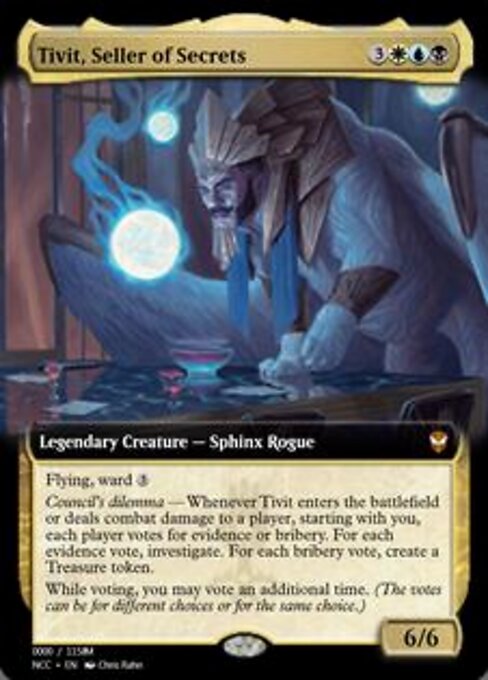
Tivit, Seller of Secrets | Illustration by Chris Rahn
How We Ranked the Best Esper Commanders
This is an editorial ranking for multiplayer Commander, from focused casual decks through higher-powered builds. It is not a tournament tier list, a popularity chart, or a claim that every commander belongs at the same table.
We prioritized engine quality, consistency, mana efficiency, resilience, and useful deckbuilding flexibility. Getting value immediately matters. So does functioning without three other expensive permanents already in play. A high ceiling earns credit, but a commander doesn't get a free pass for a combo that its average draw cannot support.
Every ranked entry is a single commander with exactly white-blue-black color identity. Partner combinations are outside this list's scope. Card text, color identities, and Commander legality were checked against Scryfall on November 10, 2026, with Wizards' format information and banned list used as additional references. Newer cards are evaluated from their text and interactions; no playtesting record or established metagame performance is implied.
The four synergy recommendations under each entry are a starting package, not a requirement to buy all four. Some deliberately support different builds, and the accompanying notes flag tensions or higher-power lines.
#20. Merieke Ri Berit
AI-generated article, published by an ElderDecks editor.
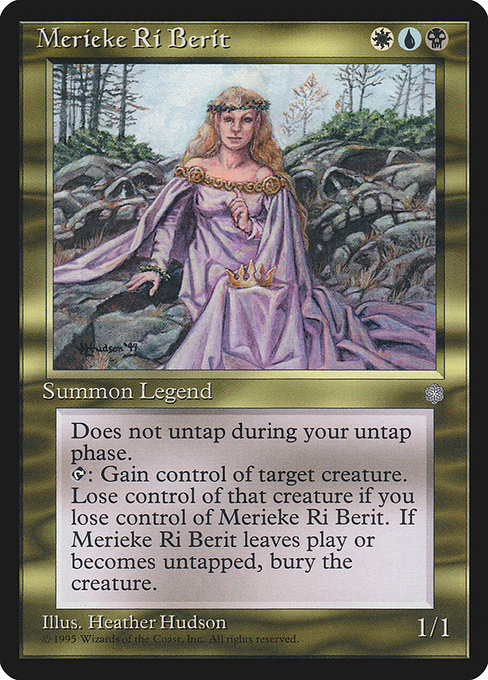
Merieke Ri Berit | Illustration by Heather Hudson
Why spend seven mana on a monster when someone else has already done the shopping? Merieke taps to take a creature, turning an opponent's best threat into your blocker, attacker, or bargaining chip.
The catch is deliciously awkward: she doesn't untap normally, and untapping her destroys the creature she took. That makes an untap effect removal as well as a reset button. You aren't building a conventional creature deck; you're building a small control machine that runs on everyone else's creatures.
Four cards that make the plan work:
- Thousand-Year Elixir lets Merieke use her tap ability immediately and provides an untap activation. It doesn't grant haste for attacking.
- Magewright's Stone is a compact way to untap her after you've finished borrowing something.
- Freed from the Real turns spare blue mana into repeatable untaps, letting you dismantle creature boards one theft at a time.
- High Market sacrifices a borrowed creature on your schedule. It can also dispose of an indestructible creature that Merieke's destroy trigger cannot kill.
The drawback: She is fragile, needs additional pieces, and accomplishes little against a deck that wins without meaningful creatures. Stealing somebody's commander also puts a very real target on you. Pick Merieke if you enjoy reactive play and careful timing, not if you want your commander to generate value on an empty board.
The Queen doesn't ask whether your opponents would like to share. When she enters or attacks, one opponent's library supplies a creature to assimilate. Your artifact creatures also get +2/+2, so the stolen body arrives with a +1/+1 counter and immediately benefits from the anthem.
That is a substantial battlefield swing, but seven mana is still seven mana. Her place here reflects that tension: a self-contained threat with spectacular repeat triggers, held back by the work required to cast and protect her. This is a card-text assessment of a new commander, not a claim of established tournament results.
Four cards that make the plan work:
- Panharmonicon adds another assimilation trigger when the Queen enters. It does not double her attack trigger.
- Ephemerate blinks your own Queen for another trigger, with rebound offering another trip on your next upkeep.
- Teleportation Circle repeats that entrance at your end step. Blink the Queen, not an opponent-owned assimilated creature that would return to its owner.
- Lightning Greaves provides haste for an immediate attack and shroud for protection. Move the boots before targeting her with your own blink spell.
The drawback: Your haul depends on the chosen opponent's creature pool, and repeated commander tax gets painful quickly. Choose her for artifact-creature combat and theft with a Star Trek identity. Our We Are the Borg precon guide covers the ready-made starting point.
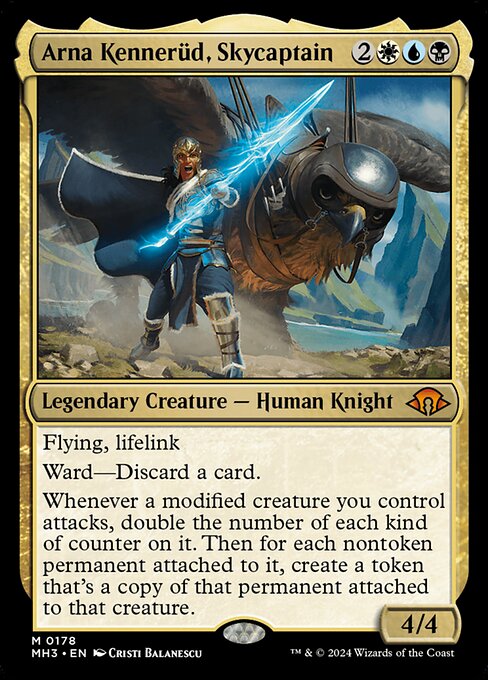
Arna Kennerüd, Skycaptain | Illustration by Cristi Balanescu
Arna is what happens when one Equipment is good, but a second copy would be much funnier. Whenever one of your modified creatures attacks, she doubles its counters and copies each nontoken permanent attached to it, attaching the new tokens to that attacker.
The original attachments can produce fresh copies on later attacks. The token attachments don't themselves get copied by Arna, so don't mistake this for an automatically exponential pile of Equipment. Counters, however, really can grow very quickly.
Four cards that make the plan work:
- All That Glitters becomes especially threatening as copied Auras and Equipment increase your artifact and enchantment count.
- Cranial Plating turns that expanding artifact count into damage; its black attachment ability is legal in Esper.
- Sword of the Animist gives a modified attacker a land-search trigger and produces another Sword through Arna. The new copy wasn't present when attackers were declared, so it won't trigger on that same attack.
- Luminarch Aspirant adds a counter before attackers are declared, setting up Arna's doubling without an equip bill.
The drawback: Arna costs five and wants a developed battlefield. Removal aimed at a heavily loaded attacker can erase several turns of work. Play her if you like turning an ordinary combat step into a logistical problem, but include protection and enough cheap creatures to avoid staking the game on one body.
Sphinx decks rarely struggle to find an expensive creature they want to cast. They struggle to cast enough of them before the game gets away. The Ur-Sphinx addresses that immediately: eminence reduces your other Sphinx spells by one generic mana while it is in the command zone or on the battlefield.
Once the nine-mana commander actually lands, attacking Sphinxes mill cards from every player's library and let you cast a card milled this way from each player without paying its mana cost. That's an enormous ceiling, but not a reason to fill the deck exclusively with seven-drops.
Four cards that make the plan work:
- Unesh, Criosphinx Sovereign provides a further Sphinx discount and turns Sphinx entrances into card selection.
- Herald's Horn adds another generic-mana reduction and a recurring chance to put a Sphinx into your hand.
- Sphinx of Uthuun replenishes resources on entry rather than asking you to untap with it first.
- Sphinx of Enlightenment draws you three cards while giving one opponent a card—a reasonable political concession for refilling your hand.
The drawback: The attack payoff requires the commander on the battlefield. Eminence alone won't rescue a top-heavy opening hand. This is the pick for players who genuinely want Sphinxes, discounts, and splashy stolen spells; keep the support package cheap enough that the deck functions before its headline creature arrives.
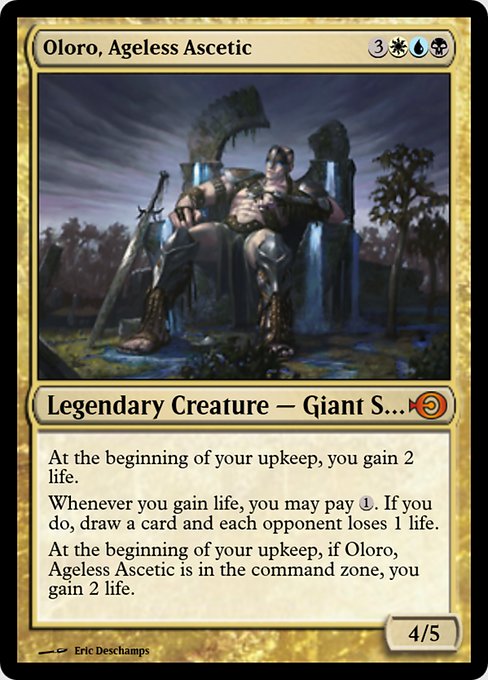
Oloro, Ageless Ascetic | Illustration by Eric Deschamps
Oloro can do his first job without leaving the command zone. Two life on your upkeep is modest in isolation; attach a few payoffs and it becomes a dependable source of cards, bodies, or damage.
That reliability is his appeal. You can spend the early turns establishing your deck instead of racing to resolve a six-mana commander. When you eventually cast him, his separate life-gain trigger lets you pay one mana to draw a card and drain each opponent. That ability does not function from the command zone.
Four cards that make the plan work:
- Well of Lost Dreams can turn the upkeep's two life into up to two cards if you pay the mana.
- Crested Sunmare rewards that life gain with a 5/5 Horse at your end step. Additional life gain on opponents' turns opens more opportunities.
- Dawn of Hope offers another mana-for-cards outlet, plus lifelink tokens when you need something to do with excess mana.
- Vito, Thorn of the Dusk Rose makes life gain pressure an opponent rather than merely extending your own clock.
The drawback: A large life total is not a winning plan. Commander damage, combo finishes, and a stalled hand full of expensive payoffs don't care that you're at 70. Choose Oloro for patient lifegain decks, then give those life-gain triggers a specific way to end the game.
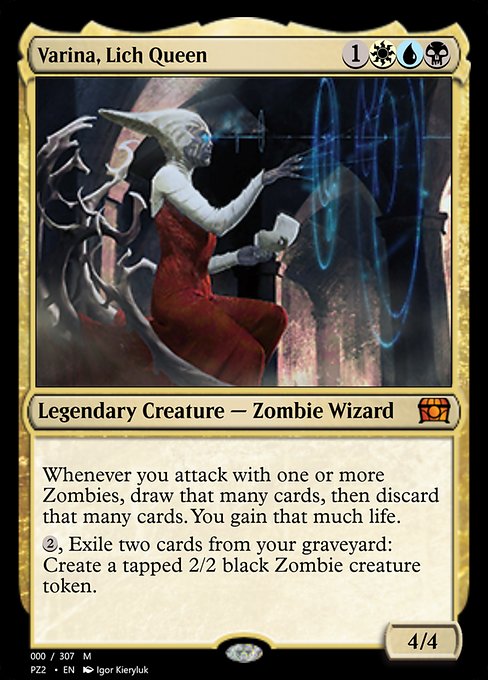
Varina, Lich Queen | Illustration by Igor Kieryluk
Varina turns a Zombie attack into a hand renovation. Attack with three Zombies and you draw three, discard three, and gain three life. You haven't gained cards in raw quantity, but you've replaced the least useful ones, stocked the graveyard, and moved toward a much better next turn.
Her token-making ability gives otherwise expendable graveyard cards a second job. Be selective about what you exile: the creature you want to reanimate next turn shouldn't fund today's extra 2/2.
Four cards that make the plan work:
- Cryptbreaker supplies early Zombies, a discard outlet, and card draw from three untapped Zombies when attacking isn't attractive.
- Archfiend of Ifnir turns each discarded card into a -1/-1 counter on every opposing creature. A large Varina trigger can clear blockers before combat damage.
- Bone Miser rewards different discarded card types with Zombies, mana, or cards. Its mana arrives during combat, so plan how to spend it before that step ends.
- Diregraf Captain strengthens the army and makes other Zombies dying cost an opponent life.
The drawback: Varina needs Zombies to attack; an empty battlefield means an idle engine. Keep enough cheap bodies and recovery spells rather than stuffing the list with expensive Zombie lords. She's an excellent fit if you want combat, discard, and graveyard decisions in the same deck—not just a parade of creatures with matching types.
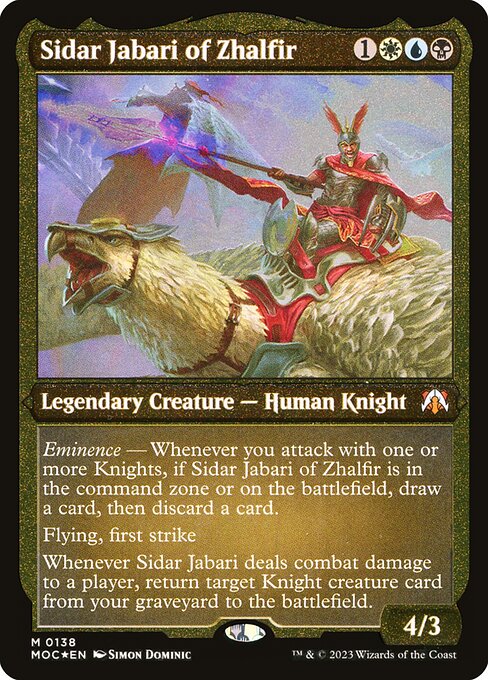
Sidar Jabari of Zhalfir | Illustration by Simon Dominic
Sidar makes the first little Knight matter. Attacking with one or more Knights lets you draw and discard through eminence, even while he is in the command zone. That smooths early draws and puts a useful Knight in the graveyard for later.
Once Sidar is on the battlefield, connecting with an opponent returns a Knight creature card directly to play. Flying and first strike help, but they aren't a guarantee of a clean hit. The strongest builds treat reliable access to combat damage as part of the engine, not an optional luxury.
Four cards that make the plan work:
- Haakon, Stromgald Scourge wants to be discarded: you can cast him from the graveyard, and he then lets you cast Knight spells from there too.
- Knight Exemplar grants your other Knights a boost and indestructible. She doesn't protect herself from destruction.
- Herald of Hoofbeats gives the team horsemanship, making ordinary flying blockers irrelevant to Sidar's route through combat.
- Buried Alive places three chosen creature cards in your graveyard, preparing reanimation targets rather than hoping to draw and discard the right ones.
The drawback: Creature-type restrictions narrow your options, and graveyard exile can undo a carefully prepared handoff. Sidar ranks here because his setup starts before you cast him. Choose him if you want an aggressive deck that keeps bringing its best Knights back, with meaningful decisions beyond simply curving out.
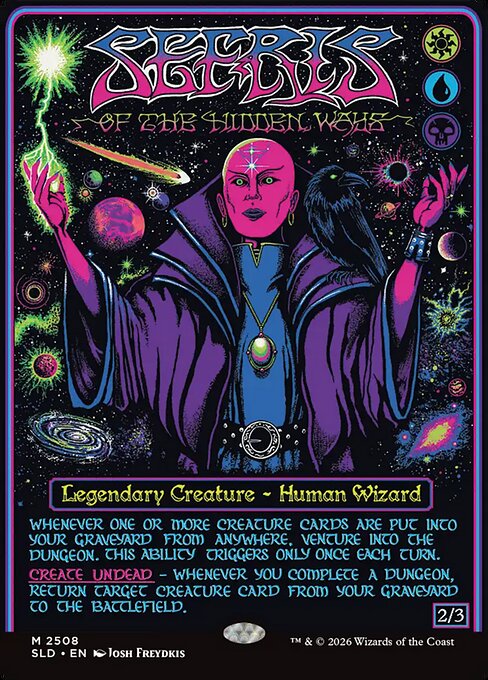
Sefris of the Hidden Ways | Illustration by Josh Freydkis
The important words on Sefris are “each turn.” Her graveyard trigger happens only once per turn, not once per round. A creature card hitting your graveyard on each opponent's turn can move you through a dungeon far faster than dumping a dozen creatures there during your own main phase.
Completing a dungeon reanimates a creature. That makes a humble looter part of a much bigger engine: discard, advance, finish, return a threat. Tokens dying won't trigger Sefris because they aren't creature cards.
Four cards that make the plan work:
- Tortured Existence exchanges a creature in hand for one in the graveyard at instant speed, giving you control over when Sefris triggers.
- Merfolk Looter offers repeatable draw-and-discard without spending mana on the activation, although it must be able to tap.
- Radiant Solar supplies additional ventures when your nontoken creatures enter. Discarding it through its own ability also puts a creature card into the graveyard.
- Victimize returns two creatures while sacrificing another, helping rebuild your battlefield and potentially advancing Sefris that turn.
The drawback: The deck requires more tracking than a straightforward reanimator list, and graveyard hate attacks both its setup and reward. Play Sefris if you enjoy having something useful to do during other players' turns. If you regularly pass with every land tapped and no way to discard, you're leaving much of her value unused.
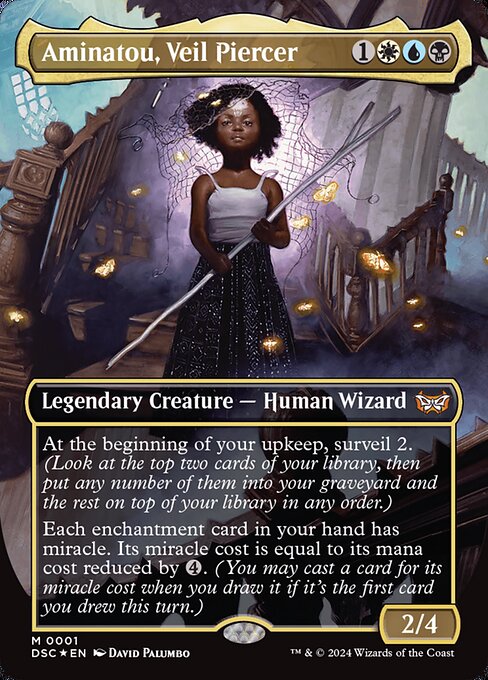
Aminatou, Veil Piercer | Illustration by David Palumbo
Aminatou makes expensive enchantments look suspiciously affordable. She gives enchantment cards in your hand miracle with a four-generic-mana reduction, while her upkeep surveil helps arrange the draw that follows.
The real deckbuilding puzzle is putting an enchantment on top and drawing it as your first card that turn. You can do this on an opponent's turn too. What you cannot do is draw three cards, find the enchantment last, and decide that one was your miracle.
Four cards that make the plan work:
- Brainstorm puts expensive enchantments from your hand back on top, preparing a future turn's first draw. Its second and third drawn cards don't qualify for miracle.
- Scroll Rack exchanges cards without drawing them, arranging your next draw without using up the turn's first-draw opportunity.
- Soothsaying turns spare mana into top-of-library selection before the draw you want to matter.
- One with the Multiverse is a powerful payoff: Aminatou can reduce its miracle cost to four mana, while its ongoing permission gives you more ways to use your library.
The drawback: The plan is considerably less impressive without Aminatou, and generic reductions don't remove colored mana requirements. Pack enchantments you can reasonably cast when she is absent. Choose her for big-enchantment sequencing and topdeck manipulation, especially if you enjoy planning a turn before it begins.
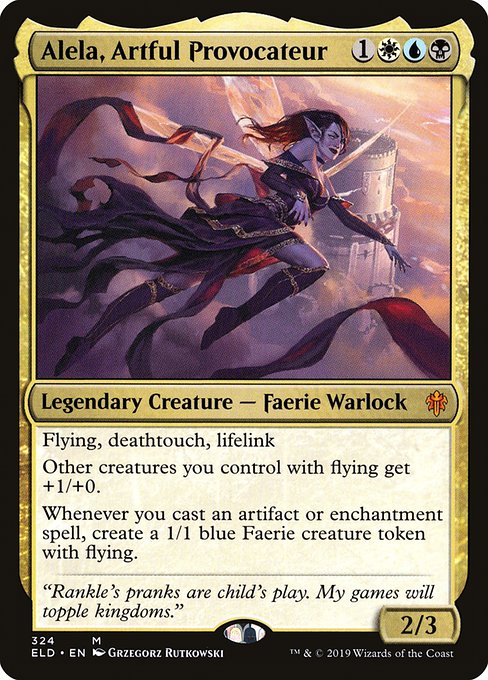
Alela, Artful Provocateur | Illustration by Grzegorz Rutkowski
Alela gives ordinary infrastructure a combat role. Cast an artifact or enchantment and she supplies a flying Faerie; her anthem adds power to your other flyers. Suddenly your mana rocks, removal enchantments, and card-draw engines are also building an air force.
That overlap is why she earns a place above several narrower options. The deck doesn't need to abandon useful interaction to make creatures. But the trigger is about casting: blinking an artifact or putting one directly onto the battlefield doesn't produce a Faerie.
Four cards that make the plan work:
- Bident of Thassa is an artifact enchantment that triggers Alela once when cast, then turns your evasive attackers into card draw.
- Skullclamp converts her normally one-toughness tokens into cards. Alela raises their power, not their toughness.
- Favorable Winds increases the aerial clock and helps tokens survive small damage effects. It also means Skullclamp won't automatically kill those tokens anymore.
- Efficient Construction adds a Thopter whenever you cast an artifact, giving artifact-heavy builds another source of flying bodies.
The drawback: Token production stops when Alela leaves, and a sweeper can erase the battlefield you've spent turns accumulating. Favor cards that remain useful without her. She's a strong choice for players who want an interactive Esper deck that actually attacks rather than spending every turn protecting an eventual combo.
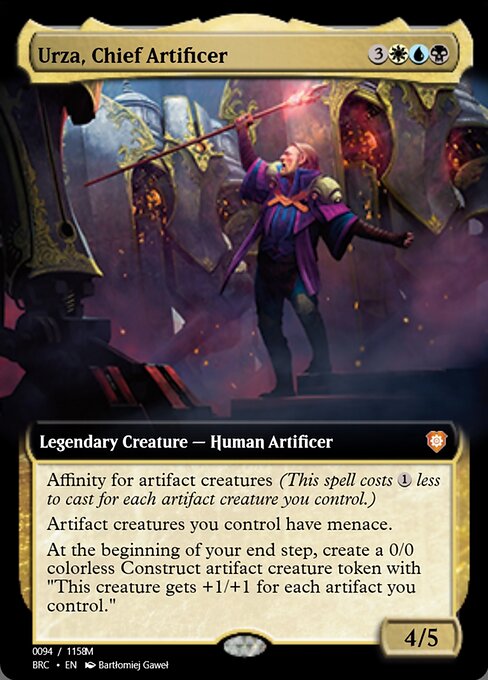
Urza, Chief Artificer | Illustration by Bartłomiej Gaweł
Urza rewards the sort of battlefield that looks harmless until you count the artifacts. He gets cheaper for each artifact creature you control, gives your artifact creatures menace, and creates a Construct at your end step that grows with your total artifact count.
Notice the two different counts. A Treasure increases a Construct's size, but it doesn't reduce Urza's cost unless it is also a creature. Cheap artifact bodies therefore matter early; the broader artifact pile matters once the Constructs start arriving.
Four cards that make the plan work:
- Sai, Master Thopterist turns artifact casts into artifact creatures, helping both the discount and your future Construct sizes.
- Myr Battlesphere brings four Myr with it, making a large contribution to artifact count and providing several attackers or blockers.
- Thought Monitor uses affinity for all artifacts to become cheaper, draws two cards on entry, and leaves an evasive artifact body behind.
- Organic Extinction clears nonartifact creatures while your artifact army survives. Urza himself is not an artifact creature, so he normally dies too.
The drawback: Artifact sweepers hit almost everything you care about, and a few oversized Constructs can still struggle to close through defensive boards. His ranking comes from making mana development and combat point in the same direction. Choose Urza when you want an artifact deck with a visible battlefield win condition rather than a stack of disconnected combo pieces.
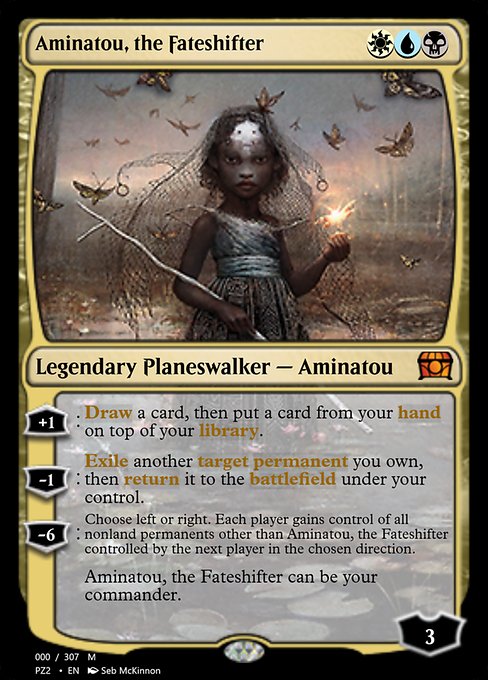
Aminatou, the Fateshifter | Illustration by Seb McKinnon
Three mana buys an unusually flexible command zone. Aminatou can arrange the top of your library or blink another permanent you own, resetting enters abilities and helping you extract more work from cards you've already cast.
Her minus ability says “own,” not merely “control.” Don't assume she can blink every creature you stole. That restriction matters; so does the fact that she is a planeswalker opponents can attack directly. Fortunately, the same enters-the-battlefield creatures you want to reuse can help protect her.
Four cards that make the plan work:
- Baleful Strix draws again when blinked and discourages attacks with flying and deathtouch.
- Oath of Teferi permits two loyalty activations per planeswalker each turn, opening more flexible combinations of setup and blinking.
- Felidar Guardian can blink Aminatou, returning her as a new object that can activate a loyalty ability again.
- Altar of the Brood turns repeated permanent entrances into milling each opponent.
Combo warning: Aminatou, Felidar Guardian, and Altar can form a repeatable blink-and-mill loop: use her minus ability on Guardian, then Guardian's entrance on Aminatou, and repeat. Milling a library is not automatically a win against every deck, and opponents can interact with the loop.
The drawback: Her strongest lines can overshadow a casual value plan. Pick her for blink puzzles and precise sequencing, but decide up front whether you're building an incremental engine or a combo deck.
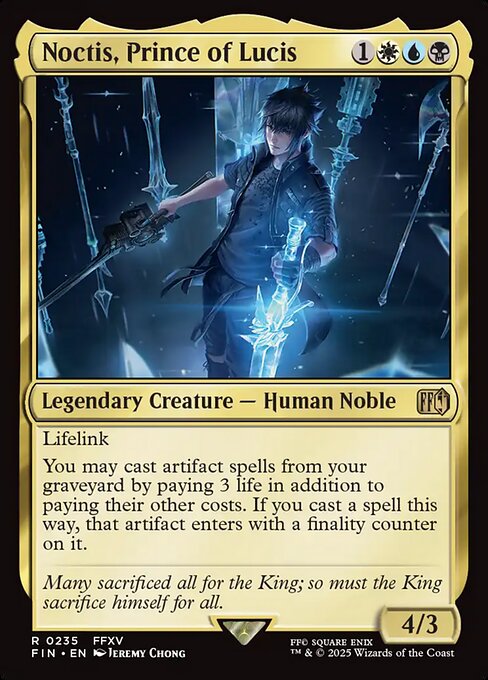
Noctis, Prince of Lucis | Illustration by Jeremy Chong
Noctis turns the artifact section of your graveyard into an extension of your hand. Pay three life in addition to a spell's other costs and you can cast it from there. That is powerful access, not free mana: you still pay the normal costs and obey timing restrictions.
The finality counter is the important brake. An artifact brought back this way is exiled instead if it would go from the battlefield to a graveyard. A sacrificed artifact isn't automatically available for another lap.
Four cards that make the plan work:
- Executioner's Capsule gives you removal you can cast from the graveyard, although its target must be nonblack and a finality-marked Capsule is normally exiled when sacrificed.
- Soul-Guide Lantern provides graveyard interaction or a draw option, keeping a utility role useful after its first sacrifice.
- Power Conduit can remove a finality counter as part of its activation cost, letting that artifact reach the graveyard normally later. Its tap cost keeps this from resetting everything at once.
- Mystic Forge opens another source of artifact casts from the top of your library, complementing Noctis rather than relying entirely on the graveyard.
The drawback: Life payments accumulate, graveyard hate shuts off the main engine, and the artifacts still cost mana. Noctis earns his rank through broad access and recovery, not because every returned trinket is an infinite loop. Choose him for artifact-toolbox play with room to tune the power level.
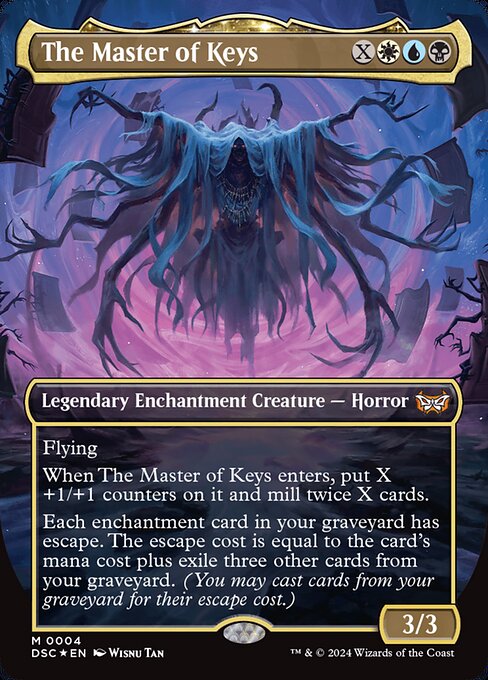
The Master of Keys treats destroyed enchantments as future spells. It gives enchantment cards in your graveyard escape for their mana costs plus three other cards exiled from your graveyard. Its entrance also mills twice the X you paid, stocking the cupboard while making the commander larger.
You don't have to wait until X is huge. Casting it for three mana with X equal to zero still turns on escape. The question is whether you have enough graveyard fuel to make that permission useful.
Four cards that make the plan work:
- Mesmeric Orb stocks your graveyard as permanents untap, but also fills opponents' graveyards. Account for what you're feeding them.
- Animate Dead becomes a reanimation spell you can cast again from the graveyard, provided you can pay its escape cost.
- Seal of Cleansing is a reusable artifact-or-enchantment answer when the Master and sufficient graveyard fuel are available.
- Doomwake Giant turns enchantment entrances into temporary -1/-1 effects across opposing creatures, helping an enchantment engine manage the board.
The drawback: Three other cards per escaped spell is a serious appetite, and graveyard exile can strand the whole plan. Escape doesn't generally exile the escaped permanent when it later dies, but you must pay the fuel cost again to recast it. Choose the Master if you like enchantments that keep coming back and can build enough self-mill without helping opponents more than yourself.
Hashaton, Scarab's Fist | Illustration by Wisnu Tan
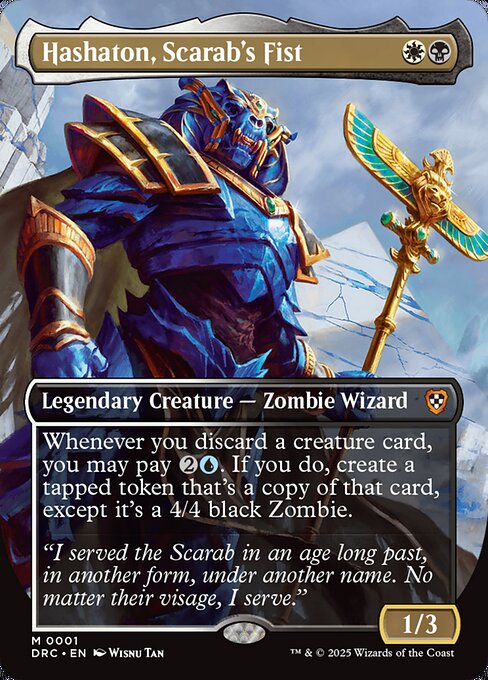
Hashaton changes what an expensive creature in your opening hand means. Instead of waiting to cast it, discard it and pay three mana to make a tapped 4/4 black Zombie copy. The original stays available in the graveyard, while the token retains the copied card's other relevant abilities.
That is a startling rate for a two-mana commander, but the setup isn't free: you need a discard effect, a creature worth copying, and the mana to pay for each trigger. Hashaton's blue payment also gives him Esper color identity despite the white-black mana cost.
Four cards that make the plan work:
- Careful Study is a cheap way to draw and discard two cards. Copying two discarded creatures still requires paying for two Hashaton triggers.
- Frantic Search untaps lands before the resulting Hashaton triggers resolve, helping pay for the creatures you just discarded.
- Toxrill, the Corrosive keeps its punishing slime-counter abilities on a 4/4 Zombie body. This is a high-power, table-sensitive choice, not a friendly default.
- Sphinx of the Second Sun keeps its additional-beginning-phase ability, providing a major reward without paying its printed eight-mana cost.
The drawback: Discard enablers and expensive targets can look dreadful when Hashaton is repeatedly removed. Keep interaction and a backup graveyard plan. His triggered ability isn't an activated ability, so cost reducers that only affect activated abilities won't reduce the three-mana payment. Choose him for explosive creature engines with a clear tolerance for being the table's early problem.
Y'shtola, Night's Blessed | Illustration by Magali Villeneuve
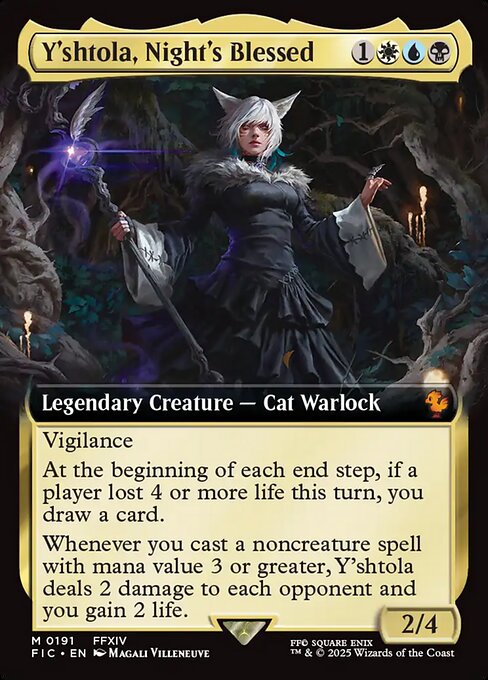
Y'shtola makes interaction hurt. Cast a noncreature spell with mana value three or greater and she deals two damage to each opponent while gaining you two life. Answering a threat can therefore advance your own clock instead of merely keeping someone else from winning.
Her end-step draw checks whether a player lost at least four life that turn. One player must meet the threshold; you can't add two life lost by one opponent to two lost by another. It checks every end step, giving instant-speed play a real reward.
Four cards that make the plan work:
- Syphon Mind pressures opposing hands and draws you cards while also qualifying for Y'shtola's damage trigger.
- Snuff Out still has mana value four when you pay life instead of mana. If its alternative cost is available, the four life you pay also meets her end-step life-loss threshold, even if you gain life later.
- Soul Shatter makes every opponent sacrifice a qualifying creature or planeswalker, combining multiplayer interaction with a qualifying cast trigger.
- Frantic Search qualifies at mana value three, filters your hand, and untaps lands for more interaction.
The drawback: Packing too many expensive spells to satisfy her trigger can make the deck slow, and her damage alone takes time to finish a full table. Keep cheap protection even when it doesn't trigger her. Pick Y'shtola for a spellslinger deck that can win through steady pressure while still playing a genuinely interactive game.
Raffine, Scheming Seer | Illustration by Johannes Voss
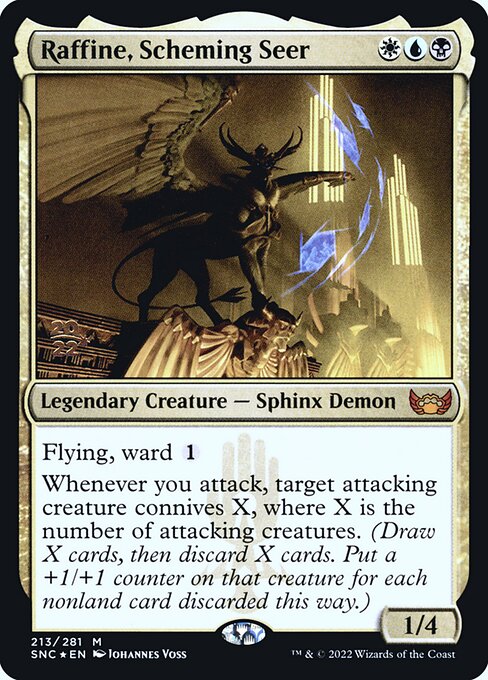
Raffine asks for something wonderfully ordinary: attack with creatures. In return, one attacking creature connives for the number of attackers, filtering cards and picking up counters for the nonland cards discarded.
She doesn't need to attack herself, so cheap creatures already on the battlefield can start the engine on the turn you cast her. Three mana, evasion, and ward make that engine relatively easy to establish, while the discarded cards can support an entirely separate reanimation plan.
Four cards that make the plan work:
- Faerie Seer gives you a cheap evasive attacker and helps set up early draws.
- Reconnaissance lets you remove attackers from combat and untap them after attack triggers have done their work, making attacks less costly. If you remove Raffine's targeted creature before her ability resolves, that target is no longer a legal attacking creature, so sequence carefully.
- Ledger Shredder adds an evasive body and another source of connive as players cast their second spells.
- Reanimate turns a creature discarded to connive into a threat for one mana, with life loss as the additional practical cost.
The drawback: Connive is filtering, not a net increase in hand size, and sweepers can erase both your attackers and your counter investment. Raffine ranks highly because her setup is cheap and her support cards can be useful independently. Choose her for tempo, evasive aggression, and graveyard flexibility—not for a deck that intends to sit behind blockers indefinitely.
Zur turns an attack into the enchantment you need right now. He searches for an enchantment with mana value three or less and puts it directly onto the battlefield. He doesn't need to connect, and the searched card doesn't need to pass through your hand.
That repeatable selection is the reason for his position. A narrow deck can use him to assemble the same line every game; a toolbox can fetch protection, cards, or a specific answer. Both approaches are powerful, but they produce very different experiences for the table.
Four cards that make the plan work:
- Necropotence provides a potent life-for-cards engine that Zur can fetch without paying its triple-black mana cost. It puts cards into your hand rather than drawing them.
- Darksteel Mutation neutralizes many creature-based engines. Since Zur puts the Aura directly onto the battlefield, attaching it this way doesn't target, though the attachment must still be legal.
- Grasp of Fate can temporarily exile a nonland permanent from each opponent, offering a much broader answer than one-for-one removal.
- Diplomatic Immunity gives Zur shroud and has shroud itself. It protects him from your own targeted spells too.
The drawback: Zur must survive until an attack, and repeated searching can make games feel scripted. He's also unlikely to be mistaken for an innocent four-drop. Choose him if you value precise answers and consistency, and explain whether your toolbox contains casual value pieces or hard lock and combo plans before the game.
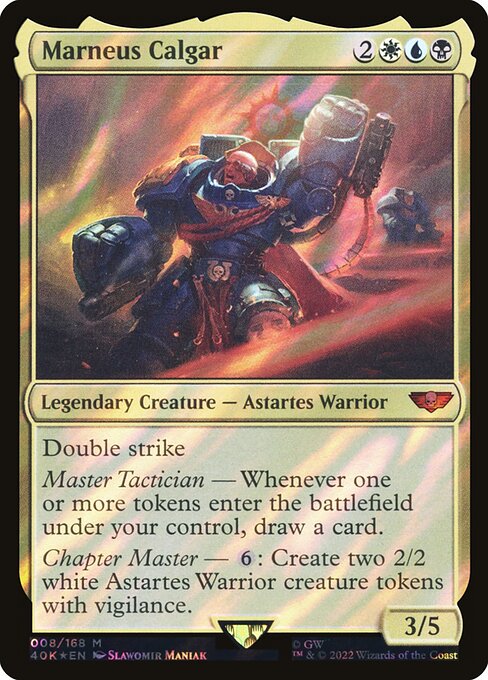
Marneus makes a token deck much harder to exhaust. Whenever one or more tokens you control enter, you draw a card. Those tokens can be creatures, Treasures, Clues, or something else; the important part is the entry event.
Two tokens entering together produce one draw trigger, not two. His own six-mana activation creates two bodies as one event. The best support therefore supplies useful tokens repeatedly rather than expecting one enormous batch to draw an enormous hand.
Four cards that make the plan work:
- Bitterblossom supplies a flying token on your upkeep, turning an ongoing army into an ongoing source of cards.
- Smothering Tithe can make Treasures throughout a round, with each separate unpaid trigger providing another opportunity to draw through Marneus.
- Ophiomancer checks every upkeep, but you must control no Snakes. A sacrifice outlet can clear the previous Snake to keep the engine working.
- Academy Manufactor upgrades a Clue, Food, or Treasure creation into one of each. Those three entering together still give Marneus just one draw trigger.
The drawback: Five mana is a meaningful investment, and the deck can draw plenty of cards without establishing a finish. Keep token makers that function before he arrives and identify whether combat, sacrifice payoffs, or a deliberate combo will end the game. Marneus is our runner-up because he rewards so many useful token strategies while solving the resource problem that often limits them.
Tivit, Seller of Secrets | Illustration by Chris Rahn
Tivit wins this ranking because resolving the commander already does a substantial amount of the work. Its entrance produces votes, votes produce Clues or Treasures, and its additional vote means you aren't entirely at the mercy of the table's choices.
In an ordinary four-player game with no other voting modifications, that's five votes and therefore five artifacts from one trigger. The split between Clues and Treasures affects your next move, but either result gives you real resources. Flying and ward three then make Tivit a credible way to repeat the process through combat.
Four cards that make the plan work:
- Time Sieve can sacrifice five artifacts for an extra turn. Tivit's entrance supplies the initial five in the four-player situation above; subsequent successful combat-damage triggers can replenish them.
- Displacer Kitten blinks Tivit when you cast noncreature spells, producing another entrance trigger without requiring combat damage.
- Academy Manufactor replaces each Clue or Treasure creation with a Clue, Food, and Treasure, greatly increasing the resources from the vote.
- Cyberdrive Awakener turns your noncreature artifact stockpile into flying 4/4 attackers for the turn. Newly arrived artifacts still need haste or enough time under your control to attack.
The drawback: Six mana demands a real ramp plan, and the Time Sieve line is not unconditional. Fewer players mean fewer votes; blockers, removal, and artifact interaction can interrupt the sequence. Extra-turn loops also deserve a clear pregame conversation.
Tivit takes first for the combination of immediate resources, repeatable payoff, built-in protection, and multiple routes to victory. You can build a blink-and-artifact value deck or intentionally pursue a combo finish. Neither requires pretending the commander is merely a large flying creature.
Building an Esper Deck That Actually Does Something
Access to excellent answers can become a trap. If every slot is another removal spell, draw spell, or clever engine, you may reach turn ten with a full hand and no credible way to win.
Give the deck a primary job
Choose the thing your commander rewards most reliably: attacking, casting artifacts, making tokens, discarding creatures, or recurring enchantments. Start there. Add a secondary plan only when it shares enough cards with the first to justify the space.
An artifact token that helps cast your commander, increases your attackers' size, and provides a sacrifice resource is doing several jobs. An expensive enchantment included solely because it is powerful may be doing none of the jobs your particular deck needs.
Budget for the commander being removed
Look at a sample hand and imagine your commander costs four more mana than printed. Can the deck still draw cards, develop mana, and interact? If the answer is no, replace some commander-dependent payoffs with cards that function on their own.
This matters especially for the seven- and nine-mana options. Cost reduction, cheap development, and ways to reuse an existing commander are more helpful than another spectacular card you cannot yet cast.
Keep enough mana for your engine
A spell that draws cards isn't useful if you can never afford the spells you draw. Esper needs early color fixing as well as acceleration. Test whether your mana sources actually provide the colors required by your early spells instead of treating every mana rock as interchangeable.
Activated abilities, escape costs, and trigger payments also compete with the cards in your hand. A deck that repeatedly pays three mana for Hashaton or holds mana for interaction needs a different curve from one that mostly taps out for creatures.
Decide how the game ends
Combat decks need ways to connect and recover from sweepers. Engine decks need a payoff that converts resources into a finish. Combo decks need a clearly understood sequence and an honest pregame description.
Extra turns, repeated theft, and recursive combo lines are not interchangeable with a precon's ordinary value engine. Being legal in Commander does not mean a card or loop fits every group's expectations.
Esper is white, blue, and black. Commander deckbuilding uses color identity, which includes relevant colored mana symbols in a card's rules text as well as its mana cost. That is why Hashaton, Scarab's Fist is an Esper commander despite costing only white and black mana to cast.
Can Aminatou, the Fateshifter be a commander?
Yes. Her card explicitly permits it. Planeswalkers are not generally eligible to be commanders just because they are legendary; the specific permission matters.
Can Esper decks win through combat?
Absolutely. This list includes flying tokens, artifact armies, Knights, Zombies, and modified attackers. White-blue-black is a color identity, not an instruction to avoid the combat phase.
Which Esper commander is a good starting point?
Urza, Chief Artificer offers a clear artifact-creature plan with an obvious combat payoff. Alela, Artful Provocateur rewards casting useful artifacts and enchantments, then attacking with the resulting flyers. Pick the strategy you find intuitive, and keep the first version focused rather than adding every available subtheme.
Does Oloro draw cards from the command zone?
No. His command-zone ability gives you two life at the beginning of your upkeep. His separate pay-one-mana draw-and-drain ability normally functions only while he is on the battlefield. Other permanents can still reward the life gain he provides from the command zone.
Does Marneus Calgar draw one card for every token?
No. His ability triggers when one or more tokens you control enter. A batch entering together produces one trigger; separate entry events can produce separate triggers. Token doublers increase the tokens, but don't automatically multiply his card draw from a single event.
Is The Borg Queen legal in Commander?
Scryfall lists The Borg Queen as Commander-legal as of this article's November 10 check, and Wizards' Star Trek release notes identify new TRC cards as permitted in Commander. The card's white-blue-black identity makes it eligible to lead an Esper deck. Card availability and a format's legality are separate questions.
Is this a budget ranking or a cEDH ranking?
Neither. The order reflects our assessment of multiplayer engines and deckbuilding potential, not a price ceiling or tournament results. Expensive synergy cards are not mandatory, and several entries can be tuned far above an ordinary casual table. Discuss the actual list and its strongest lines, not just the commander's name.
Pick the Engine You Want to Play
Tivit takes the top spot for producing meaningful resources immediately and converting them into several different winning plans. But the right commander for your next hundred cards is the one whose decisions you want to make repeatedly.
Do you want to squeeze value from every token? Turn combat into card selection? Rebuild from the graveyard? Or make an opponent's best creature your problem to solve—and then your creature to attack with?
Pick that experience first. Build the support around it. Esper has enough tools; the interesting part is deciding what you want those tools to build.
Sources and Verification
Card names in the synergy packages open interactive card previews. Each ranked entry also links to its Scryfall card page for Oracle text and rulings.
Rankings and strategic recommendations are ElderDecks editorial judgments. No card prices, search-volume estimates, personal testing results, or guaranteed performance claims are used in this article.
By ElderArticles · Updated 11/10/2026 · 30 min read
Explore the 20 best Esper commanders in MTG, ranked with white-blue-black strategies, four synergy cards per pick, key rules tips, and honest drawbacks.
Esper has a reputation: counter the spell, kill the creature, and make everyone ask whether they can finally resolve something.
But white-blue-black can also swarm the table with flying tokens, resurrect an army of Knights, turn discarded monsters into Zombies, or borrow the best creature an opponent brought to the game. The colors are the same. The games don't have to be.
The best Esper commanders give those powerful support cards a coherent job. This countdown covers 20 leaders worth building around, with four specific synergy cards for each, the rules details that matter, and the weaknesses you should know before committing to a deck.
Tivit, Seller of Secrets | Illustration by Chris Rahn
How We Ranked the Best Esper Commanders
This is an editorial ranking for multiplayer Commander, from focused casual decks through higher-powered builds. It is not a tournament tier list, a popularity chart, or a claim that every commander belongs at the same table.
We prioritized engine quality, consistency, mana efficiency, resilience, and useful deckbuilding flexibility. Getting value immediately matters. So does functioning without three other expensive permanents already in play. A high ceiling earns credit, but a commander doesn't get a free pass for a combo that its average draw cannot support.
Every ranked entry is a single commander with exactly white-blue-black color identity. Partner combinations are outside this list's scope. Card text, color identities, and Commander legality were checked against Scryfall on November 10, 2026, with Wizards' format information and banned list used as additional references. Newer cards are evaluated from their text and interactions; no playtesting record or established metagame performance is implied.
The four synergy recommendations under each entry are a starting package, not a requirement to buy all four. Some deliberately support different builds, and the accompanying notes flag tensions or higher-power lines.
Why spend seven mana on a monster when someone else has already done the shopping? Merieke taps to take a creature, turning an opponent's best threat into your blocker, attacker, or bargaining chip.
The catch is deliciously awkward: she doesn't untap normally, and untapping her destroys the creature she took. That makes an untap effect removal as well as a reset button. You aren't building a conventional creature deck; you're building a small control machine that runs on everyone else's creatures.
Four cards that make the plan work:
- Thousand-Year Elixir lets Merieke use her tap ability immediately and provides an untap activation. It doesn't grant haste for attacking.
- Magewright's Stone is a compact way to untap her after you've finished borrowing something.
- Freed from the Real turns spare blue mana into repeatable untaps, letting you dismantle creature boards one theft at a time.
- High Market sacrifices a borrowed creature on your schedule. It can also dispose of an indestructible creature that Merieke's destroy trigger cannot kill.
The drawback: She is fragile, needs additional pieces, and accomplishes little against a deck that wins without meaningful creatures. Stealing somebody's commander also puts a very real target on you. Pick Merieke if you enjoy reactive play and careful timing, not if you want your commander to generate value on an empty board.
The Queen doesn't ask whether your opponents would like to share. When she enters or attacks, one opponent's library supplies a creature to assimilate. Your artifact creatures also get +2/+2, so the stolen body arrives with a +1/+1 counter and immediately benefits from the anthem.
That is a substantial battlefield swing, but seven mana is still seven mana. Her place here reflects that tension: a self-contained threat with spectacular repeat triggers, held back by the work required to cast and protect her. This is a card-text assessment of a new commander, not a claim of established tournament results.
Four cards that make the plan work:
- Panharmonicon adds another assimilation trigger when the Queen enters. It does not double her attack trigger.
- Ephemerate blinks your own Queen for another trigger, with rebound offering another trip on your next upkeep.
- Teleportation Circle repeats that entrance at your end step. Blink the Queen, not an opponent-owned assimilated creature that would return to its owner.
- Lightning Greaves provides haste for an immediate attack and shroud for protection. Move the boots before targeting her with your own blink spell.
The drawback: Your haul depends on the chosen opponent's creature pool, and repeated commander tax gets painful quickly. Choose her for artifact-creature combat and theft with a Star Trek identity. Our We Are the Borg precon guide covers the ready-made starting point.
Arna is what happens when one Equipment is good, but a second copy would be much funnier. Whenever one of your modified creatures attacks, she doubles its counters and copies each nontoken permanent attached to it, attaching the new tokens to that attacker.
The original attachments can produce fresh copies on later attacks. The token attachments don't themselves get copied by Arna, so don't mistake this for an automatically exponential pile of Equipment. Counters, however, really can grow very quickly.
Four cards that make the plan work:
- All That Glitters becomes especially threatening as copied Auras and Equipment increase your artifact and enchantment count.
- Cranial Plating turns that expanding artifact count into damage; its black attachment ability is legal in Esper.
- Sword of the Animist gives a modified attacker a land-search trigger and produces another Sword through Arna. The new copy wasn't present when attackers were declared, so it won't trigger on that same attack.
- Luminarch Aspirant adds a counter before attackers are declared, setting up Arna's doubling without an equip bill.
The drawback: Arna costs five and wants a developed battlefield. Removal aimed at a heavily loaded attacker can erase several turns of work. Play her if you like turning an ordinary combat step into a logistical problem, but include protection and enough cheap creatures to avoid staking the game on one body.
Sphinx decks rarely struggle to find an expensive creature they want to cast. They struggle to cast enough of them before the game gets away. The Ur-Sphinx addresses that immediately: eminence reduces your other Sphinx spells by one generic mana while it is in the command zone or on the battlefield.
Once the nine-mana commander actually lands, attacking Sphinxes mill cards from every player's library and let you cast a card milled this way from each player without paying its mana cost. That's an enormous ceiling, but not a reason to fill the deck exclusively with seven-drops.
Four cards that make the plan work:
- Unesh, Criosphinx Sovereign provides a further Sphinx discount and turns Sphinx entrances into card selection.
- Herald's Horn adds another generic-mana reduction and a recurring chance to put a Sphinx into your hand.
- Sphinx of Uthuun replenishes resources on entry rather than asking you to untap with it first.
- Sphinx of Enlightenment draws you three cards while giving one opponent a card—a reasonable political concession for refilling your hand.
The drawback: The attack payoff requires the commander on the battlefield. Eminence alone won't rescue a top-heavy opening hand. This is the pick for players who genuinely want Sphinxes, discounts, and splashy stolen spells; keep the support package cheap enough that the deck functions before its headline creature arrives.
Oloro can do his first job without leaving the command zone. Two life on your upkeep is modest in isolation; attach a few payoffs and it becomes a dependable source of cards, bodies, or damage.
That reliability is his appeal. You can spend the early turns establishing your deck instead of racing to resolve a six-mana commander. When you eventually cast him, his separate life-gain trigger lets you pay one mana to draw a card and drain each opponent. That ability does not function from the command zone.
Four cards that make the plan work:
- Well of Lost Dreams can turn the upkeep's two life into up to two cards if you pay the mana.
- Crested Sunmare rewards that life gain with a 5/5 Horse at your end step. Additional life gain on opponents' turns opens more opportunities.
- Dawn of Hope offers another mana-for-cards outlet, plus lifelink tokens when you need something to do with excess mana.
- Vito, Thorn of the Dusk Rose makes life gain pressure an opponent rather than merely extending your own clock.
The drawback: A large life total is not a winning plan. Commander damage, combo finishes, and a stalled hand full of expensive payoffs don't care that you're at 70. Choose Oloro for patient lifegain decks, then give those life-gain triggers a specific way to end the game.
Varina turns a Zombie attack into a hand renovation. Attack with three Zombies and you draw three, discard three, and gain three life. You haven't gained cards in raw quantity, but you've replaced the least useful ones, stocked the graveyard, and moved toward a much better next turn.
Her token-making ability gives otherwise expendable graveyard cards a second job. Be selective about what you exile: the creature you want to reanimate next turn shouldn't fund today's extra 2/2.
Four cards that make the plan work:
- Cryptbreaker supplies early Zombies, a discard outlet, and card draw from three untapped Zombies when attacking isn't attractive.
- Archfiend of Ifnir turns each discarded card into a -1/-1 counter on every opposing creature. A large Varina trigger can clear blockers before combat damage.
- Bone Miser rewards different discarded card types with Zombies, mana, or cards. Its mana arrives during combat, so plan how to spend it before that step ends.
- Diregraf Captain strengthens the army and makes other Zombies dying cost an opponent life.
The drawback: Varina needs Zombies to attack; an empty battlefield means an idle engine. Keep enough cheap bodies and recovery spells rather than stuffing the list with expensive Zombie lords. She's an excellent fit if you want combat, discard, and graveyard decisions in the same deck—not just a parade of creatures with matching types.
Sidar makes the first little Knight matter. Attacking with one or more Knights lets you draw and discard through eminence, even while he is in the command zone. That smooths early draws and puts a useful Knight in the graveyard for later.
Once Sidar is on the battlefield, connecting with an opponent returns a Knight creature card directly to play. Flying and first strike help, but they aren't a guarantee of a clean hit. The strongest builds treat reliable access to combat damage as part of the engine, not an optional luxury.
Four cards that make the plan work:
- Haakon, Stromgald Scourge wants to be discarded: you can cast him from the graveyard, and he then lets you cast Knight spells from there too.
- Knight Exemplar grants your other Knights a boost and indestructible. She doesn't protect herself from destruction.
- Herald of Hoofbeats gives the team horsemanship, making ordinary flying blockers irrelevant to Sidar's route through combat.
- Buried Alive places three chosen creature cards in your graveyard, preparing reanimation targets rather than hoping to draw and discard the right ones.
The drawback: Creature-type restrictions narrow your options, and graveyard exile can undo a carefully prepared handoff. Sidar ranks here because his setup starts before you cast him. Choose him if you want an aggressive deck that keeps bringing its best Knights back, with meaningful decisions beyond simply curving out.
The important words on Sefris are “each turn.” Her graveyard trigger happens only once per turn, not once per round. A creature card hitting your graveyard on each opponent's turn can move you through a dungeon far faster than dumping a dozen creatures there during your own main phase.
Completing a dungeon reanimates a creature. That makes a humble looter part of a much bigger engine: discard, advance, finish, return a threat. Tokens dying won't trigger Sefris because they aren't creature cards.
Four cards that make the plan work:
- Tortured Existence exchanges a creature in hand for one in the graveyard at instant speed, giving you control over when Sefris triggers.
- Merfolk Looter offers repeatable draw-and-discard without spending mana on the activation, although it must be able to tap.
- Radiant Solar supplies additional ventures when your nontoken creatures enter. Discarding it through its own ability also puts a creature card into the graveyard.
- Victimize returns two creatures while sacrificing another, helping rebuild your battlefield and potentially advancing Sefris that turn.
The drawback: The deck requires more tracking than a straightforward reanimator list, and graveyard hate attacks both its setup and reward. Play Sefris if you enjoy having something useful to do during other players' turns. If you regularly pass with every land tapped and no way to discard, you're leaving much of her value unused.
Aminatou makes expensive enchantments look suspiciously affordable. She gives enchantment cards in your hand miracle with a four-generic-mana reduction, while her upkeep surveil helps arrange the draw that follows.
The real deckbuilding puzzle is putting an enchantment on top and drawing it as your first card that turn. You can do this on an opponent's turn too. What you cannot do is draw three cards, find the enchantment last, and decide that one was your miracle.
Four cards that make the plan work:
- Brainstorm puts expensive enchantments from your hand back on top, preparing a future turn's first draw. Its second and third drawn cards don't qualify for miracle.
- Scroll Rack exchanges cards without drawing them, arranging your next draw without using up the turn's first-draw opportunity.
- Soothsaying turns spare mana into top-of-library selection before the draw you want to matter.
- One with the Multiverse is a powerful payoff: Aminatou can reduce its miracle cost to four mana, while its ongoing permission gives you more ways to use your library.
The drawback: The plan is considerably less impressive without Aminatou, and generic reductions don't remove colored mana requirements. Pack enchantments you can reasonably cast when she is absent. Choose her for big-enchantment sequencing and topdeck manipulation, especially if you enjoy planning a turn before it begins.
Alela gives ordinary infrastructure a combat role. Cast an artifact or enchantment and she supplies a flying Faerie; her anthem adds power to your other flyers. Suddenly your mana rocks, removal enchantments, and card-draw engines are also building an air force.
That overlap is why she earns a place above several narrower options. The deck doesn't need to abandon useful interaction to make creatures. But the trigger is about casting: blinking an artifact or putting one directly onto the battlefield doesn't produce a Faerie.
Four cards that make the plan work:
- Bident of Thassa is an artifact enchantment that triggers Alela once when cast, then turns your evasive attackers into card draw.
- Skullclamp converts her normally one-toughness tokens into cards. Alela raises their power, not their toughness.
- Favorable Winds increases the aerial clock and helps tokens survive small damage effects. It also means Skullclamp won't automatically kill those tokens anymore.
- Efficient Construction adds a Thopter whenever you cast an artifact, giving artifact-heavy builds another source of flying bodies.
The drawback: Token production stops when Alela leaves, and a sweeper can erase the battlefield you've spent turns accumulating. Favor cards that remain useful without her. She's a strong choice for players who want an interactive Esper deck that actually attacks rather than spending every turn protecting an eventual combo.
Urza rewards the sort of battlefield that looks harmless until you count the artifacts. He gets cheaper for each artifact creature you control, gives your artifact creatures menace, and creates a Construct at your end step that grows with your total artifact count.
Notice the two different counts. A Treasure increases a Construct's size, but it doesn't reduce Urza's cost unless it is also a creature. Cheap artifact bodies therefore matter early; the broader artifact pile matters once the Constructs start arriving.
Four cards that make the plan work:
- Sai, Master Thopterist turns artifact casts into artifact creatures, helping both the discount and your future Construct sizes.
- Myr Battlesphere brings four Myr with it, making a large contribution to artifact count and providing several attackers or blockers.
- Thought Monitor uses affinity for all artifacts to become cheaper, draws two cards on entry, and leaves an evasive artifact body behind.
- Organic Extinction clears nonartifact creatures while your artifact army survives. Urza himself is not an artifact creature, so he normally dies too.
The drawback: Artifact sweepers hit almost everything you care about, and a few oversized Constructs can still struggle to close through defensive boards. His ranking comes from making mana development and combat point in the same direction. Choose Urza when you want an artifact deck with a visible battlefield win condition rather than a stack of disconnected combo pieces.
Three mana buys an unusually flexible command zone. Aminatou can arrange the top of your library or blink another permanent you own, resetting enters abilities and helping you extract more work from cards you've already cast.
Her minus ability says “own,” not merely “control.” Don't assume she can blink every creature you stole. That restriction matters; so does the fact that she is a planeswalker opponents can attack directly. Fortunately, the same enters-the-battlefield creatures you want to reuse can help protect her.
Four cards that make the plan work:
- Baleful Strix draws again when blinked and discourages attacks with flying and deathtouch.
- Oath of Teferi permits two loyalty activations per planeswalker each turn, opening more flexible combinations of setup and blinking.
- Felidar Guardian can blink Aminatou, returning her as a new object that can activate a loyalty ability again.
- Altar of the Brood turns repeated permanent entrances into milling each opponent.
Combo warning: Aminatou, Felidar Guardian, and Altar can form a repeatable blink-and-mill loop: use her minus ability on Guardian, then Guardian's entrance on Aminatou, and repeat. Milling a library is not automatically a win against every deck, and opponents can interact with the loop.
The drawback: Her strongest lines can overshadow a casual value plan. Pick her for blink puzzles and precise sequencing, but decide up front whether you're building an incremental engine or a combo deck.
Noctis turns the artifact section of your graveyard into an extension of your hand. Pay three life in addition to a spell's other costs and you can cast it from there. That is powerful access, not free mana: you still pay the normal costs and obey timing restrictions.
The finality counter is the important brake. An artifact brought back this way is exiled instead if it would go from the battlefield to a graveyard. A sacrificed artifact isn't automatically available for another lap.
Four cards that make the plan work:
- Executioner's Capsule gives you removal you can cast from the graveyard, although its target must be nonblack and a finality-marked Capsule is normally exiled when sacrificed.
- Soul-Guide Lantern provides graveyard interaction or a draw option, keeping a utility role useful after its first sacrifice.
- Power Conduit can remove a finality counter as part of its activation cost, letting that artifact reach the graveyard normally later. Its tap cost keeps this from resetting everything at once.
- Mystic Forge opens another source of artifact casts from the top of your library, complementing Noctis rather than relying entirely on the graveyard.
The drawback: Life payments accumulate, graveyard hate shuts off the main engine, and the artifacts still cost mana. Noctis earns his rank through broad access and recovery, not because every returned trinket is an infinite loop. Choose him for artifact-toolbox play with room to tune the power level.
The Master of Keys treats destroyed enchantments as future spells. It gives enchantment cards in your graveyard escape for their mana costs plus three other cards exiled from your graveyard. Its entrance also mills twice the X you paid, stocking the cupboard while making the commander larger.
You don't have to wait until X is huge. Casting it for three mana with X equal to zero still turns on escape. The question is whether you have enough graveyard fuel to make that permission useful.
Four cards that make the plan work:
- Mesmeric Orb stocks your graveyard as permanents untap, but also fills opponents' graveyards. Account for what you're feeding them.
- Animate Dead becomes a reanimation spell you can cast again from the graveyard, provided you can pay its escape cost.
- Seal of Cleansing is a reusable artifact-or-enchantment answer when the Master and sufficient graveyard fuel are available.
- Doomwake Giant turns enchantment entrances into temporary -1/-1 effects across opposing creatures, helping an enchantment engine manage the board.
The drawback: Three other cards per escaped spell is a serious appetite, and graveyard exile can strand the whole plan. Escape doesn't generally exile the escaped permanent when it later dies, but you must pay the fuel cost again to recast it. Choose the Master if you like enchantments that keep coming back and can build enough self-mill without helping opponents more than yourself.
Hashaton changes what an expensive creature in your opening hand means. Instead of waiting to cast it, discard it and pay three mana to make a tapped 4/4 black Zombie copy. The original stays available in the graveyard, while the token retains the copied card's other relevant abilities.
That is a startling rate for a two-mana commander, but the setup isn't free: you need a discard effect, a creature worth copying, and the mana to pay for each trigger. Hashaton's blue payment also gives him Esper color identity despite the white-black mana cost.
Four cards that make the plan work:
- Careful Study is a cheap way to draw and discard two cards. Copying two discarded creatures still requires paying for two Hashaton triggers.
- Frantic Search untaps lands before the resulting Hashaton triggers resolve, helping pay for the creatures you just discarded.
- Toxrill, the Corrosive keeps its punishing slime-counter abilities on a 4/4 Zombie body. This is a high-power, table-sensitive choice, not a friendly default.
- Sphinx of the Second Sun keeps its additional-beginning-phase ability, providing a major reward without paying its printed eight-mana cost.
The drawback: Discard enablers and expensive targets can look dreadful when Hashaton is repeatedly removed. Keep interaction and a backup graveyard plan. His triggered ability isn't an activated ability, so cost reducers that only affect activated abilities won't reduce the three-mana payment. Choose him for explosive creature engines with a clear tolerance for being the table's early problem.
Y'shtola makes interaction hurt. Cast a noncreature spell with mana value three or greater and she deals two damage to each opponent while gaining you two life. Answering a threat can therefore advance your own clock instead of merely keeping someone else from winning.
Her end-step draw checks whether a player lost at least four life that turn. One player must meet the threshold; you can't add two life lost by one opponent to two lost by another. It checks every end step, giving instant-speed play a real reward.
Four cards that make the plan work:
- Syphon Mind pressures opposing hands and draws you cards while also qualifying for Y'shtola's damage trigger.
- Snuff Out still has mana value four when you pay life instead of mana. If its alternative cost is available, the four life you pay also meets her end-step life-loss threshold, even if you gain life later.
- Soul Shatter makes every opponent sacrifice a qualifying creature or planeswalker, combining multiplayer interaction with a qualifying cast trigger.
- Frantic Search qualifies at mana value three, filters your hand, and untaps lands for more interaction.
The drawback: Packing too many expensive spells to satisfy her trigger can make the deck slow, and her damage alone takes time to finish a full table. Keep cheap protection even when it doesn't trigger her. Pick Y'shtola for a spellslinger deck that can win through steady pressure while still playing a genuinely interactive game.
Raffine asks for something wonderfully ordinary: attack with creatures. In return, one attacking creature connives for the number of attackers, filtering cards and picking up counters for the nonland cards discarded.
She doesn't need to attack herself, so cheap creatures already on the battlefield can start the engine on the turn you cast her. Three mana, evasion, and ward make that engine relatively easy to establish, while the discarded cards can support an entirely separate reanimation plan.
Four cards that make the plan work:
- Faerie Seer gives you a cheap evasive attacker and helps set up early draws.
- Reconnaissance lets you remove attackers from combat and untap them after attack triggers have done their work, making attacks less costly. If you remove Raffine's targeted creature before her ability resolves, that target is no longer a legal attacking creature, so sequence carefully.
- Ledger Shredder adds an evasive body and another source of connive as players cast their second spells.
- Reanimate turns a creature discarded to connive into a threat for one mana, with life loss as the additional practical cost.
The drawback: Connive is filtering, not a net increase in hand size, and sweepers can erase both your attackers and your counter investment. Raffine ranks highly because her setup is cheap and her support cards can be useful independently. Choose her for tempo, evasive aggression, and graveyard flexibility—not for a deck that intends to sit behind blockers indefinitely.
Zur turns an attack into the enchantment you need right now. He searches for an enchantment with mana value three or less and puts it directly onto the battlefield. He doesn't need to connect, and the searched card doesn't need to pass through your hand.
That repeatable selection is the reason for his position. A narrow deck can use him to assemble the same line every game; a toolbox can fetch protection, cards, or a specific answer. Both approaches are powerful, but they produce very different experiences for the table.
Four cards that make the plan work:
- Necropotence provides a potent life-for-cards engine that Zur can fetch without paying its triple-black mana cost. It puts cards into your hand rather than drawing them.
- Darksteel Mutation neutralizes many creature-based engines. Since Zur puts the Aura directly onto the battlefield, attaching it this way doesn't target, though the attachment must still be legal.
- Grasp of Fate can temporarily exile a nonland permanent from each opponent, offering a much broader answer than one-for-one removal.
- Diplomatic Immunity gives Zur shroud and has shroud itself. It protects him from your own targeted spells too.
The drawback: Zur must survive until an attack, and repeated searching can make games feel scripted. He's also unlikely to be mistaken for an innocent four-drop. Choose him if you value precise answers and consistency, and explain whether your toolbox contains casual value pieces or hard lock and combo plans before the game.
Marneus makes a token deck much harder to exhaust. Whenever one or more tokens you control enter, you draw a card. Those tokens can be creatures, Treasures, Clues, or something else; the important part is the entry event.
Two tokens entering together produce one draw trigger, not two. His own six-mana activation creates two bodies as one event. The best support therefore supplies useful tokens repeatedly rather than expecting one enormous batch to draw an enormous hand.
Four cards that make the plan work:
- Bitterblossom supplies a flying token on your upkeep, turning an ongoing army into an ongoing source of cards.
- Smothering Tithe can make Treasures throughout a round, with each separate unpaid trigger providing another opportunity to draw through Marneus.
- Ophiomancer checks every upkeep, but you must control no Snakes. A sacrifice outlet can clear the previous Snake to keep the engine working.
- Academy Manufactor upgrades a Clue, Food, or Treasure creation into one of each. Those three entering together still give Marneus just one draw trigger.
The drawback: Five mana is a meaningful investment, and the deck can draw plenty of cards without establishing a finish. Keep token makers that function before he arrives and identify whether combat, sacrifice payoffs, or a deliberate combo will end the game. Marneus is our runner-up because he rewards so many useful token strategies while solving the resource problem that often limits them.
Tivit wins this ranking because resolving the commander already does a substantial amount of the work. Its entrance produces votes, votes produce Clues or Treasures, and its additional vote means you aren't entirely at the mercy of the table's choices.
In an ordinary four-player game with no other voting modifications, that's five votes and therefore five artifacts from one trigger. The split between Clues and Treasures affects your next move, but either result gives you real resources. Flying and ward three then make Tivit a credible way to repeat the process through combat.
Four cards that make the plan work:
- Time Sieve can sacrifice five artifacts for an extra turn. Tivit's entrance supplies the initial five in the four-player situation above; subsequent successful combat-damage triggers can replenish them.
- Displacer Kitten blinks Tivit when you cast noncreature spells, producing another entrance trigger without requiring combat damage.
- Academy Manufactor replaces each Clue or Treasure creation with a Clue, Food, and Treasure, greatly increasing the resources from the vote.
- Cyberdrive Awakener turns your noncreature artifact stockpile into flying 4/4 attackers for the turn. Newly arrived artifacts still need haste or enough time under your control to attack.
The drawback: Six mana demands a real ramp plan, and the Time Sieve line is not unconditional. Fewer players mean fewer votes; blockers, removal, and artifact interaction can interrupt the sequence. Extra-turn loops also deserve a clear pregame conversation.
Tivit takes first for the combination of immediate resources, repeatable payoff, built-in protection, and multiple routes to victory. You can build a blink-and-artifact value deck or intentionally pursue a combo finish. Neither requires pretending the commander is merely a large flying creature.
Building an Esper Deck That Actually Does Something
Access to excellent answers can become a trap. If every slot is another removal spell, draw spell, or clever engine, you may reach turn ten with a full hand and no credible way to win.
Give the deck a primary job
Choose the thing your commander rewards most reliably: attacking, casting artifacts, making tokens, discarding creatures, or recurring enchantments. Start there. Add a secondary plan only when it shares enough cards with the first to justify the space.
An artifact token that helps cast your commander, increases your attackers' size, and provides a sacrifice resource is doing several jobs. An expensive enchantment included solely because it is powerful may be doing none of the jobs your particular deck needs.
Budget for the commander being removed
Look at a sample hand and imagine your commander costs four more mana than printed. Can the deck still draw cards, develop mana, and interact? If the answer is no, replace some commander-dependent payoffs with cards that function on their own.
This matters especially for the seven- and nine-mana options. Cost reduction, cheap development, and ways to reuse an existing commander are more helpful than another spectacular card you cannot yet cast.
Keep enough mana for your engine
A spell that draws cards isn't useful if you can never afford the spells you draw. Esper needs early color fixing as well as acceleration. Test whether your mana sources actually provide the colors required by your early spells instead of treating every mana rock as interchangeable.
Activated abilities, escape costs, and trigger payments also compete with the cards in your hand. A deck that repeatedly pays three mana for Hashaton or holds mana for interaction needs a different curve from one that mostly taps out for creatures.
Decide how the game ends
Combat decks need ways to connect and recover from sweepers. Engine decks need a payoff that converts resources into a finish. Combo decks need a clearly understood sequence and an honest pregame description.
Extra turns, repeated theft, and recursive combo lines are not interchangeable with a precon's ordinary value engine. Being legal in Commander does not mean a card or loop fits every group's expectations.
Esper is white, blue, and black. Commander deckbuilding uses color identity, which includes relevant colored mana symbols in a card's rules text as well as its mana cost. That is why Hashaton, Scarab's Fist is an Esper commander despite costing only white and black mana to cast.
Yes. Her card explicitly permits it. Planeswalkers are not generally eligible to be commanders just because they are legendary; the specific permission matters.
Can Esper decks win through combat?
Absolutely. This list includes flying tokens, artifact armies, Knights, Zombies, and modified attackers. White-blue-black is a color identity, not an instruction to avoid the combat phase.
Which Esper commander is a good starting point?
Urza, Chief Artificer offers a clear artifact-creature plan with an obvious combat payoff. Alela, Artful Provocateur rewards casting useful artifacts and enchantments, then attacking with the resulting flyers. Pick the strategy you find intuitive, and keep the first version focused rather than adding every available subtheme.
Does Oloro draw cards from the command zone?
No. His command-zone ability gives you two life at the beginning of your upkeep. His separate pay-one-mana draw-and-drain ability normally functions only while he is on the battlefield. Other permanents can still reward the life gain he provides from the command zone.
No. His ability triggers when one or more tokens you control enter. A batch entering together produces one trigger; separate entry events can produce separate triggers. Token doublers increase the tokens, but don't automatically multiply his card draw from a single event.
Scryfall lists The Borg Queen as Commander-legal as of this article's November 10 check, and Wizards' Star Trek release notes identify new TRC cards as permitted in Commander. The card's white-blue-black identity makes it eligible to lead an Esper deck. Card availability and a format's legality are separate questions.
Is this a budget ranking or a cEDH ranking?
Neither. The order reflects our assessment of multiplayer engines and deckbuilding potential, not a price ceiling or tournament results. Expensive synergy cards are not mandatory, and several entries can be tuned far above an ordinary casual table. Discuss the actual list and its strongest lines, not just the commander's name.
Pick the Engine You Want to Play
Tivit takes the top spot for producing meaningful resources immediately and converting them into several different winning plans. But the right commander for your next hundred cards is the one whose decisions you want to make repeatedly.
Do you want to squeeze value from every token? Turn combat into card selection? Rebuild from the graveyard? Or make an opponent's best creature your problem to solve—and then your creature to attack with?
Pick that experience first. Build the support around it. Esper has enough tools; the interesting part is deciding what you want those tools to build.
Sources and Verification
Card names in the synergy packages open interactive card previews. Each ranked entry also links to its Scryfall card page for Oracle text and rulings.
Rankings and strategic recommendations are ElderDecks editorial judgments. No card prices, search-volume estimates, personal testing results, or guaranteed performance claims are used in this article.
AI-generated article, published by an ElderDecks editor.