By ElderArticles · Updated 11/4/2026 · 24 min read
Explore the 20 best Dimir commanders, ranked with blue-black strategies, powerful card synergies, honest drawbacks, and practical MTG deckbuilding advice.
Table of contents
Blue-black has plenty of ways to stop somebody else from winning. The harder question is what your deck does afterward.
Do you turn a counterspell into an army? Make the graveyard do the work of a second hand? Or sneak a creature through combat and make all three opponents regret leaving it unblocked?
The best Dimir commanders give those answers very different shapes. This ranking covers 20 blue-black leaders with distinct plans, from generous-looking political disasters to tightly wound Ninja engines. Each entry explains what makes the commander worth building, which cards make it work, and where the plan breaks down.
Dimir Aqueduct | Illustration by Mark Poole
How We Ranked the Best Dimir Commanders
We weighed engine efficiency, resilience, synergy depth, flexibility, and the ability to finish a multiplayer game. Cheap commanders that generate cards or useful resources quickly get credit. Expensive commanders have to justify the setup, and a spectacular ceiling does not erase a miserable opening hand.
This is an editorial ranking for multiplayer Commander, not a cEDH tier list, popularity contest, or claim about testing results. We favor coherent decks that can actually execute a plan. A lower-ranked commander may be a much better fit for your table than the strongest engine here.
Every numbered selection has an exact blue-black color identity and was listed as Commander-legal in Scryfall on November 3, 2026. That includes Toxrill, whose blue-black activated ability matters even though its casting cost is black. This list evaluates single commanders, not partner combinations. Unreleased cards, including Seven of Nine, are excluded from the numbered ranking for now.
The countdown starts with specialists and ends with the commander that most efficiently combines access, cards, and a way to end the game. No deck has to contain every synergy card we recommend; choose a package that fits your budget and your group's expectations.
#20. Jon Irenicus, Shattered One
AI-generated article, published by an ElderDecks editor.
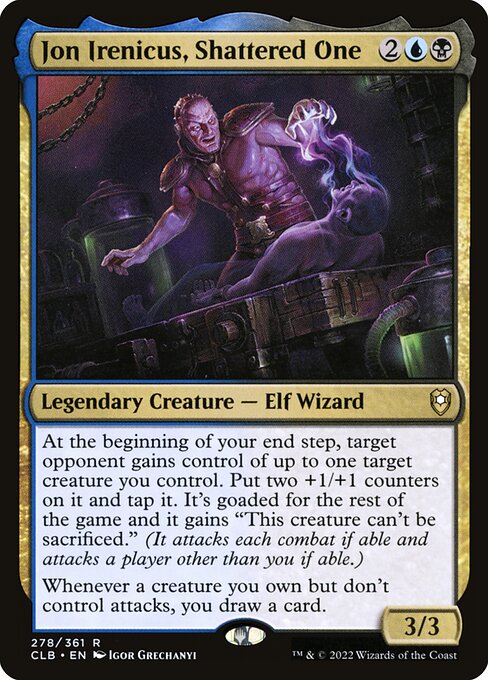
Jon Irenicus, Shattered One | Illustration by Igor Grechanyi
Jon is what happens when a gift receipt becomes a threat. At your end step he can hand an opponent one of your creatures, add two +1/+1 counters, tap it, and leave it permanently goaded and unable to be sacrificed. When a creature you own but no longer control attacks, you draw a card.
Build the bad-gift package carefully. Steel Golem restricts its new controller's creature spells. Abyssal Persecutor stops its controller from winning, but also stops that player's opponents from losing: donating it can protect you while simultaneously obstructing your own victory. Homeward Path gives you a way to reclaim the gifts. An evasive creature such as Invisible Stalker is a less oppressive donation that can keep attacking and drawing cards.
The problem is that Jon needs creatures worth giving away, an end step, and opponents who cannot remove the gifts. Goad also stops protecting you when only one opponent remains. Choose him for political mischief and unusual deck construction, not because you want the cleanest route to a win.
#19. Gisa and Geralf
Gisa and Geralf | Illustration by Karla Ortiz
The siblings make Zombies feel pleasantly disposable. They mill four when they enter, then let you cast one Zombie creature from your graveyard during each of your turns. You still pay for that spell, but an ordinary trade in combat becomes much less worrying when the creature is available again next turn.
Stitcher's Supplier stocks the graveyard twice if you can sacrifice it. Carrion Feeder supplies that outlet, Undead Augur turns Zombie deaths into cards at a life cost, and Diregraf Captain makes those deaths hurt an opponent. Gravecrawler adds a separate permission to cast itself from the graveyard while you control a Zombie; it does not need to consume the siblings' once-per-turn permission.
This is a steady engine rather than an explosive one. Graveyard exile can leave you paying four mana for a 4/4, and repeated casting still requires mana. Gisa and Geralf suit players who want recognizable Zombie gameplay with useful decisions about what to recur, without making every turn a combo demonstration.
#18. Phenax, God of Deception
Phenax, God of Deception | Illustration by Ryan Barger
Phenax looks at a high-toughness creature and sees a mill spell. Every creature you control gains a tap ability that mills a player equal to its toughness. You do not need enough devotion to turn Phenax into a creature for that grant to work.
Consuming Aberration grows as opposing graveyards fill, making its next tap more threatening. Eater of the Dead can untap by exiling creature cards from graveyards, then use Phenax's ability again. That is a repeatable engine with a finite fuel supply, not an automatic infinite combo. Dramatic Reversal refreshes the whole nonland team, while Lightning Greaves lets a new creature tap immediately.
The challenge is three libraries. Milling someone halfway can help their graveyard deck more than it helps you. Include interaction and a plan for finishing the job instead of assuming a large mill number is a win. Phenax is the specialist for players who want their defensive creatures to attack a completely different resource.
#17. Marvo, Deep Operative
Marvo, Deep Operative | Illustration by John Tedrick
Marvo's eight toughness looks defensive. The ability attached to it absolutely is not. Attacking starts a clash, and winning any clash with Marvo on the battlefield draws a card and lets you cast a spell with mana value eight or less for free.
Brainstorm and Scroll Rack put an expensive card on top before combat. Scattering Stroke supplies a clash without asking Marvo to attack, so it can also set off the reward. Aminatou's Augury is an eight-mana payoff that can turn one successful clash into a much larger turn. Note that the reward uses a spell from your hand; it is not permission to cast the card you revealed during the clash.
Five mana, an attack, a top-deck setup, and a winning reveal are several moving parts. A tied clash is not a win, and Marvo has no built-in evasion. Pick the Octopus when manipulating the top of the library sounds like the fun part of the game, not an inconvenience between free spells.
#16. Mirko, Obsessive Theorist
Mirko, Obsessive Theorist | Illustration by Heonhwa
Mirko rewards a graveyard deck for having standards. Surveil grows him, and at your end step he can return a creature with power strictly less than his own. That restriction encourages low-power creatures with oversized abilities instead of simply selecting the biggest monster in the binder.
Consider and Nightveil Sprite provide early surveil. Doom Whisperer can pay life for repeated surveil activations, growing Mirko once per activation while preparing targets. Baleful Strix is a useful small creature to recur, and Hex Parasite can remove a finality counter from something Mirko brought back. Without removing that counter, a later death sends the returned creature to exile instead of the graveyard.
Surveilling two cards is still one surveil event, so it adds one counter to Mirko, not two. Removing Mirko before the end step can also shut down the payoff. He is a great fit for players who enjoy improving their draws while slowly assembling a reusable creature toolbox.
#15. Uldaros Theorix
Uldaros Theorix | Illustration by Eugene Maslovski
Uldaros does not want the graveyard filled with twenty copies of the same job. He rewards a spread of card types, then lets you cast copies of the selected cards within a shared six-mana-value allowance. It is a six-mana commander that can bring an entire small turn along with him.
Thought Scour gets cards into the graveyard while replacing itself. Stitcher's Supplier supplies a creature, Seal of Removal supplies an enchantment, and Executioner's Capsule supplies an artifact. Those cards perform useful work before becoming material for Uldaros. Baleful Strix is another efficient card to copy when you need a blocker and a draw rather than one enormous spell.
Two restrictions do most of the balancing. Uldaros must have been cast, so ordinary blink or reanimation does not earn the reward. The six-mana-value limit is shared across all copied spells you cast, not granted separately to each one. Original cards are exiled, too. Choose him for deliberate graveyard sequencing and varied permanent types, not effortless recursion.
#14. Scientist Supreme of A.I.M.
Scientist Supreme of A.I.M. | Illustration by Gal Or
Two mana to cast the commander, then two life to copy a useful artifact ability: that is an inviting rate. Scientist Supreme can duplicate one activated or triggered ability you control from an artifact source during your turn. The attraction is not endless activations; it is making one carefully chosen artifact do twice its normal work.
Copy Ichor Wellspring's draw trigger when you need cards. Copy Mind Stone's card-draw activation after sacrificing it, not its mana ability. Myr Battlesphere can supply a second batch of four Myr from its enter trigger, while Spine of Ish Sah can destroy a second permanent. These cards already have clear jobs, so the deck does not collapse when the commander is removed.
The once-per-turn restriction and your-turn-only timing are significant. You cannot copy mana abilities, and a battlefield of cheap rocks may contain nothing worth duplicating. This is the choice for artifact players who like choosing the most profitable moment, with room to raise the deck's power through the abilities they decide to copy.
#13. Vren, the Relentless
Vren, the Relentless | Illustration by Kevin Sidharta
Vren turns removal into recruitment. Opposing creatures that would die are exiled instead, and each end step produces Rats based on the creatures exiled under opponents' control that turn. Each token grows with the number of other Rats you control, so a few productive turns can turn cleanup duty into lethal combat.
Fleshbag Marauder and Plaguecrafter pressure several opponents at once. Reality Shift exiles directly, while Pongify becomes an exile effect for the destroyed creature when Vren's replacement applies. The opponent still receives the Ape. Holding interaction for different turns can spread Rat production across the round instead of concentrating everything into one main phase.
Vren counts qualifying battlefield creatures exiled by other effects, not only his own replacement, but exiling creature cards from graveyards does not count. He also needs to survive until the end-step trigger happens. Pick Vren for interactive black-blue decks that want removal spells to create a real closing army, with the understanding that graveyard players will notice him immediately.
#12. Satoru Umezawa
Satoru Umezawa | Illustration by Anna Pavleeva
A one-mana creature that cannot be blocked is unremarkable until Satoru teaches the creature in your hand ninjutsu. Suddenly that small attacker can become an Archon of Cruelty for four mana. Satoru also turns the first ninjutsu activation each turn into a selection from the top three cards.
Triton Shorestalker and Invisible Stalker provide reliable unblocked attackers. Baleful Strix is a useful creature to pick back up when it happens to get through. Archon of Cruelty rewards entering, while Fallen Shinobi rewards connecting with the opponent. Those are the kinds of payoffs that work immediately after ninjutsu.
A creature arriving tapped and attacking did not attack, so its attack trigger will not happen that combat. You also need Satoru in play, an unblocked attacker, four mana, and a payoff in hand. Draw too many huge creatures without the setup and the hand gets ugly. Choose Satoru when you want combat tricks with genuinely alarming reveals.
#11. Nymris, Oona's Trickster
Nymris, Oona's Trickster | Illustration by Johannes Voss
Nymris is for the player who asks everyone to slow down because they still have mana open. Your first spell on each opponent's turn looks at two cards, puts one in hand, and sends the other to the graveyard. In a four-player game, three carefully timed spells can produce three extra cards and considerable selection over a round.
Counterspell answers a threat while feeding the engine. Consider gives you a cheap action when nothing needs countering. Wavebreak Hippocamp adds a draw to the same first-spell pattern, and Snapcaster Mage reuses an instant or sorcery deposited in the graveyard. Casting Nymris as your first spell on an opponent's turn will not earn a trigger, and a second spell that turn will not qualify either. Start collecting value on the next opponent's turn.
Five mana is a serious setup cost, and all that selection does not supply a win condition by itself. Include a deliberate finish and resist spending interaction just to get a trigger. Nymris rewards patient control pilots who enjoy choosing which spell matters, rather than countering everything within reach.
#10. Golbez, Crystal Collector
Golbez, Crystal Collector | Illustration by Bachzim
Golbez costs two mana, which makes it easy to start surveilling before the artifact deck gets busy. Every artifact entering under your control gives you surveil 1. Four artifacts unlock an end-step creature return to hand; eight add life loss to every opponent based on that creature card's power.
Sai, Master Thopterist turns cast artifacts into additional artifact entries and evasive bodies. Ichor Wellspring supplies cards and another surveil trigger. Emry, Lurker of the Loch reuses artifacts from the graveyard. Phyrexian Dreadnought is the sharp-edged payoff: let it sacrifice itself, then return the 12-power card with Golbez while controlling eight artifacts to drain each opponent for 12.
You still need a creature card in the graveyard for the end-step ability to have a legal target, and opponents can remove it in response. Reaching eight artifacts is also not free. Golbez suits artifact brewers who want their setup, card selection, and eventual win condition connected without needing a six-mana commander.
#9. Lord of the Nazgûl
Lord of the Nazgûl | Illustration by Anton Solovianchyk
Lord of the Nazgûl gives blue-black spellslinger decks something they often forget to include: a battlefield. Every instant or sorcery you cast produces a 3/3 Wraith with menace. Reach nine Wraiths as the trigger resolves and the team becomes 9/9 for the turn. Suddenly a harmless-looking sequence of cantrips is a combat problem.
Ponder finds the next useful spell. Frantic Search filters cards and untaps lands to keep the turn moving. Village Rites trades a spare creature for two cards while the cast trigger makes a replacement Wraith. Reconnaissance Mission rewards the tokens for connecting, helping combat refill the hand.
Five mana means the deck wants to hold something cheap to cast after its commander. Remove the Lord before the spell chain and a handful of cantrips becomes much less threatening. You do not need nine Nazgûl creature cards to make this work; the commander makes its own Wraiths. Build this when you want spells to win through an increasingly difficult-to-block army.
#8. Captain N'ghathrod
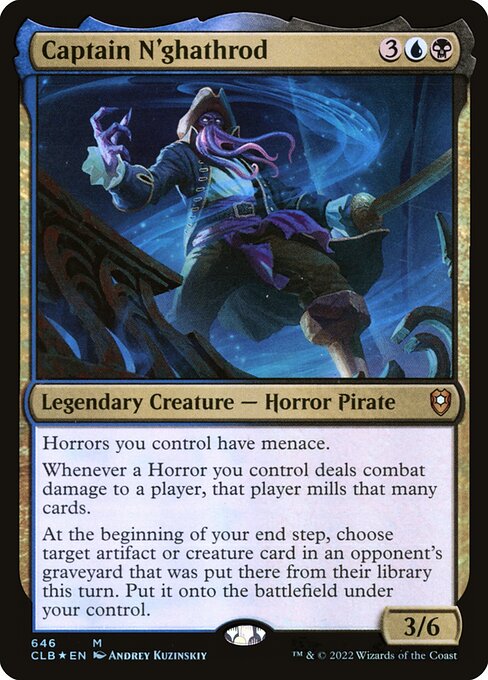
Captain N'ghathrod | Illustration by Andrey Kuzinskiy
The Captain makes Horror combat do three jobs: menace helps creatures connect, the damage mills the defending player, and your end step can recover an artifact or creature milled from an opponent's library that turn. The prize is not always the largest creature. Sometimes the best theft is the mana rock that keeps your own deck moving.
Consuming Aberration is a Horror that grows with opposing graveyards. Grell Philosopher gives the Horror team access to an opposing artifact's activated abilities. Aboleth Spawn copies useful opposing creature enter triggers, and Maddening Cacophony can prepare theft targets without combat. Altar of the Brood also stocks opposing graveyards while you develop permanents.
The Captain normally returns only one card at your end step, not one per opponent or one per Horror. He also needs the target to have entered that graveyard from the library during the current turn. Graveyard hate and creature-light opponents lower his ceiling. Pick him for a monster deck where the mill is useful even when nobody gets decked.
#7. Araumi of the Dead Tide
Araumi of the Dead Tide | Illustration by Daarken
Araumi turns one good creature in your graveyard into a multiplayer event. Tap her and exile graveyard fuel to grant encore; then pay the creature's mana cost and exile it to create a hasty copy for each opponent. The tokens must attack their assigned opponents if able and are sacrificed at the next end step.
With three opponents, encoring Mulldrifter creates three enter triggers that draw six cards. Gray Merchant of Asphodel can produce a much nastier swing because all the token copies contribute devotion while their triggers resolve. Fleshbag Marauder makes several rounds of sacrifices, and Viscera Seer lets you cash in tokens before their scheduled departure. Stitcher's Supplier supplies fuel for future activations.
That fuel matters. In a four-player game, granting encore requires three cards to exile in addition to preserving the creature you want to target. Araumi also needs to tap, and graveyard interaction can interrupt her plan. Choose her for concentrated, explosive value from ordinary creatures, not because you want a commander that operates without preparation.
#6. Alela, Cunning Conqueror
Alela, Cunning Conqueror | Illustration by Livia Prima
Alela makes playing on opponents' turns feel like building a board, because it is. The first spell you cast on each opponent's turn creates a flying Faerie Rogue. Connect with Faeries and you can goad a creature controlled by that damaged player, steering combat elsewhere while keeping your own attackers relevant.
Consider is a cheap way to make a token when no threat needs answering. Counterspell performs both jobs when there is one. Faerie Mastermind adds a flash creature and another source of cards. Oona's Blackguard puts counters on the Rogue tokens as they enter, turning their combat damage into discard, while Kindred Discovery naming Faerie rewards their arrivals and attacks.
Alela does not make tokens from spells on your own turn, and several spells on one opponent's turn still produce only one token. Sweepers can erase the accumulated army. She is an excellent fit for players who want interactive turns and political combat, with a clear plan to win that does not require assembling an infinite combo.
#5. The Scarab God
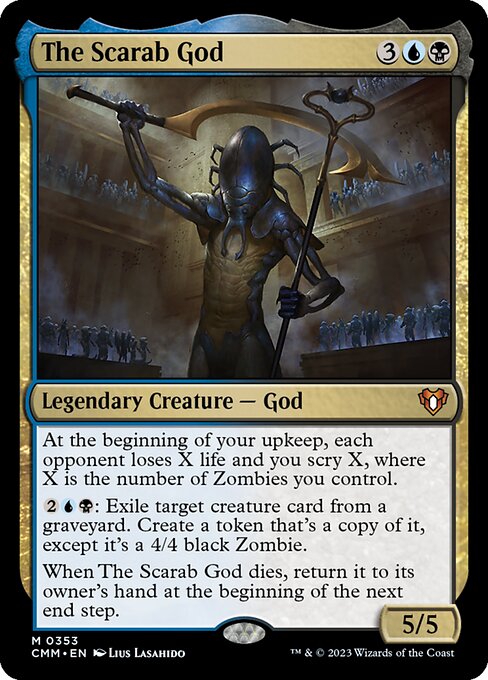
The Scarab God | Illustration by Lius Lasahido
The Scarab God is not particularly concerned about who owns the best creature in a graveyard. Its activated ability exiles a creature card from any graveyard and makes a 4/4 black Zombie copy. At your upkeep, the Zombies drain every opponent and determine how much you scry.
Training Grounds cuts the activation from four mana to blue-black. Baleful Strix becomes a larger deathtouch flier that still draws a card, and Gray Merchant of Asphodel brings its life-drain trigger with it. The token copies retain the original mana costs, which matters for devotion. Mesmeric Orb can fill multiple graveyards, although it also gives opposing graveyard decks material.
The God returns to hand at the next end step when it dies, provided it stays in the graveyard for that ability to find it. Sending it to the command zone instead gives up that return. Exile and bounce also avoid the death trigger. Choose it for flexible, patient graveyard control; it works with Zombies without requiring every creature in the deck to be one.
#4. Toxrill, the Corrosive
Toxrill, the Corrosive | Illustration by Simon Dominic
Toxrill is a seven-mana declaration that small opposing creatures have had enough time on the battlefield. Every end step adds slime counters to creatures you do not control, and each counter shrinks them. Creatures that die with slime counters leave you Slugs, which can be sacrificed for cards.
Reanimate can bypass the enormous casting cost at the expense of life. Lightning Greaves protects Toxrill from targeted answers. Contagion Clasp can proliferate existing slime counters, and Zulaport Cutthroat makes sacrificing Slugs useful beyond the cards you draw. The shrinking is not damage, and reducing toughness to zero can kill an indestructible creature.
The obvious drawback is seven mana; the less avoidable one is table reaction. A commander that steadily removes other players' creatures will become the shared problem. If Toxrill leaves, the slime counters remain but no longer cause that stat reduction without its effect. Choose it for tables comfortable with oppressive creature control, not as an unexpected addition to a gentle precon evening.
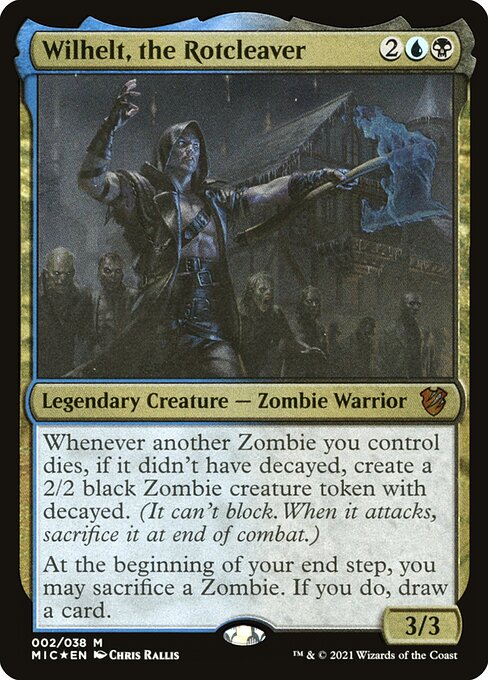
#3. Wilhelt, the Rotcleaver
Wilhelt, the Rotcleaver | Illustration by Chris Rallis
Wilhelt lets a Zombie die without leaving an empty chair. Another Zombie dying without decayed creates a replacement token with decayed, and at your end step you can sacrifice a Zombie to draw a card. That is resilience and card flow in one four-mana commander.
Carrion Feeder supplies a free sacrifice outlet. Undead Augur adds cards when Zombies die, while Diregraf Captain or Bastion of Remembrance turns a stream of deaths into life loss. Gravecrawler is a repeatable creature when another Zombie is available. Ashnod's Altar provides mana from spare bodies, but it makes colorless mana, not the black mana needed to recast Gravecrawler; do not assume those two cards alone create a self-sustaining loop.
Decayed tokens cannot block, and when they die Wilhelt does not replace them. The end-step draw also happens once, not once per sacrificed creature. Those limits leave plenty of room for a strong deck. Wilhelt is our most approachable high-ranked pick for players who want an army that keeps doing useful work after removal hits.
#2. Talion, the Kindly Lord
Talion, the Kindly Lord | Illustration by Justyna Dura
Talion charges admission to ordinary Magic. Choose a number as the Faerie enters. When an opponent casts a spell with matching mana value, power, or toughness, they lose 2 life and you draw. A creature matching the number in more than one way still produces one trigger, not several.
The correct number depends on the decks across the table; one or two are sensible numbers to consider, not a rule to follow blindly. Spark Double and Sakashima of a Thousand Faces can copy Talion without losing both to the legend rule, letting you cover additional numbers or double down on one. Sheoldred, the Apocalypse turns your extra draws into life, and Counterspell helps keep the engine alive through the removal it attracts.
Talion does not need an attack step or a crowded support package, which leaves room for interaction and a finish of your choosing. The cost is dependence on what opponents cast. Tables leaning on tokens, abilities, or expensive spells may sidestep a poorly chosen number. Pick Talion when you want the command zone to supply cards while the rest of the deck stays flexible.
#1. Yuriko, the Tiger's Shadow
Yuriko, the Tiger's Shadow | Illustration by Yongjae Choi
Yuriko takes first because the entry point, card engine, and multiplayer pressure all fit together so efficiently. Commander ninjutsu puts her onto the battlefield from your hand or command zone for blue-black by returning an unblocked attacker. That is an activated ability rather than casting her, so the commander tax does not increase that activation cost.
Every Ninja that deals combat damage to a player reveals the top card, puts it into your hand, and makes each opponent lose life equal to its mana value. You only need one player to leave an opening for the whole table to feel it. Multiple connecting Ninjas produce multiple triggers.
Slither Blade opens the door. Changeling Outcast cannot be blocked and already counts as a Ninja. Moon-Circuit Hacker adds another cheap ninjutsu threat. Brainstorm and Soothsaying arrange useful reveals. Temporal Trespass has mana value 11 even when delve makes it cheaper to cast, although extra turns and explosive life-loss reveals deserve a pregame conversation.
The deck still needs to connect. Sweepers, removal before combat damage, and a shortage of evasive bodies can stall it. Stuffing the list with expensive spells solely for reveals also ruins hands. Yuriko rewards a disciplined mix of cheap enablers, interaction, and carefully chosen high-mana-value cards. That combination of low setup, repeatable access, card advantage, and reach across three life totals earns the top spot.
Building a Dimir Deck That Does More Than Say No
Start with a complete engine
Pick the parts your commander actually needs before adding generic staples. Araumi needs creatures worth encoring, ways to fill the graveyard, and enough expendable cards to pay for activations. Alela needs cheap plays on opponents' turns and a way to turn evasive tokens into cards or damage. Satoru needs unblocked attackers as much as he needs spectacular creatures in hand.
Think in small packages. One enabler, one payoff, and one way to recover from disruption is a more useful starting point than fifteen expensive cards that all assume the commander survives.
Keep answers for the things your deck cannot race
Blue-black has good stack interaction and creature removal, but do not let those tools crowd out the plan. Counterspell stops a dangerous spell; Feed the Swarm can answer an opposing enchantment after it resolves. Soul-Guide Lantern offers selective graveyard interaction without clearing your own graveyard. Each inclusion should solve a problem you expect to encounter.
Be especially careful with symmetrical effects. Mesmeric Orb can prepare your own graveyard and the opponents' graveyards at the same time. That is welcome for The Scarab God, but not always welcome when another player is one reanimation spell away from winning.
Decide what a winning turn looks like
Drawing twelve cards is progress, not a victory condition. Decide whether your deck closes with evasive tokens, Zombie death triggers, repeated encore payoffs, a drained table, or an actual mill finish. Then check that the rest of the list helps you reach that turn.
Dimir means blue-black. A Dimir deck can use cards with blue, black, blue-black, or colorless color identities, provided they are otherwise legal. Color identity is not just the printed casting cost. Toxrill qualifies as blue-black because its rules text includes a blue mana symbol in its activated ability.
What is the best Dimir commander overall?
Yuriko, the Tiger's Shadow takes our top spot for her cheap access from the command zone, card advantage, and ability to pressure every opponent through combat with one player. That is our editorial judgment under the criteria above, not a claim that every Yuriko deck beats every other blue-black deck.
Which Dimir commander is easiest to start with?
Gisa and Geralf offer a clear recurring-Zombie plan. Wilhelt adds stronger death-trigger and card-draw engines, but requires attention to which Zombies have decayed. Either is a more straightforward starting point than a deck built around clash sequencing or layers of copied abilities. Price a finished list before treating any commander as a budget recommendation.
Is mill a good Dimir win condition?
It can be, but milling three opponents is a different job from milling one. Phenax is designed to make repeated mill activations meaningful. Captain N'ghathrod instead uses milled cards as a resource for theft. Decide whether mill is your finish or your setup; the deck should not confuse the two.
Does commander tax apply to Yuriko's commander ninjutsu?
No. Commander tax increases the cost of casting a commander from the command zone. Commander ninjutsu is an activated ability that puts Yuriko onto the battlefield. Her normal casting cost is still subject to commander tax when you cast her from the command zone.
Why is Seven of Nine not in the ranking?
As of November 3, 2026, Scryfall listed Seven of Nine as not yet Commander-legal. This ranking uses currently legal cards rather than mixing unreleased previews into the numbered list. Wizards lists the Star Trek tabletop release for November 13. Recheck the card's current legality before a future update rather than assuming the ranking's cutoff remains current forever.
Are these commanders appropriate for casual Commander?
That depends on the list and the table. Toxrill can suppress opposing creature decks, Jon can distribute severe restrictions, and Yuriko can generate large life swings. Tutors, extra turns, fast mana, and compact combos also change the experience. Describe those features before the game rather than relying on a commander name or a single power-level number.
Final Verdict
Dimir's best trick is not saying no. It is making the cards you already want to play do another useful job. An answer becomes a Faerie. A dead Zombie leaves a replacement. A creature in the graveyard becomes three hasty copies. An unblocked attacker turns into cards and pressure across the table.
Choose the version of that exchange you want to repeat. Then build for the turns when the commander is removed, not only the turn when every piece cooperates. That is where a blue-black deck becomes something more interesting than a pile of good interaction.
Sources and Editorial Notes
Card names, Oracle text, exact color identity, and Commander legality were checked against Scryfall on November 3, 2026. Support-card interactions were checked against their current text. All 20 ranked commanders were Commander-legal and blue-black at that check. Images were selected through the ElderDecks catalog, with standard English printings substituted for several special treatments. Artist credits were checked for the chosen printings.
This is original editorial analysis, not a tournament-results ranking or a claim of personal playtesting. No card prices or measured win rates are asserted. Recheck legality and new releases when updating the article.
By ElderArticles · Updated 11/4/2026 · 24 min read
Explore the 20 best Dimir commanders, ranked with blue-black strategies, powerful card synergies, honest drawbacks, and practical MTG deckbuilding advice.
Blue-black has plenty of ways to stop somebody else from winning. The harder question is what your deck does afterward.
Do you turn a counterspell into an army? Make the graveyard do the work of a second hand? Or sneak a creature through combat and make all three opponents regret leaving it unblocked?
The best Dimir commanders give those answers very different shapes. This ranking covers 20 blue-black leaders with distinct plans, from generous-looking political disasters to tightly wound Ninja engines. Each entry explains what makes the commander worth building, which cards make it work, and where the plan breaks down.
Dimir Aqueduct | Illustration by Mark Poole
How We Ranked the Best Dimir Commanders
We weighed engine efficiency, resilience, synergy depth, flexibility, and the ability to finish a multiplayer game. Cheap commanders that generate cards or useful resources quickly get credit. Expensive commanders have to justify the setup, and a spectacular ceiling does not erase a miserable opening hand.
This is an editorial ranking for multiplayer Commander, not a cEDH tier list, popularity contest, or claim about testing results. We favor coherent decks that can actually execute a plan. A lower-ranked commander may be a much better fit for your table than the strongest engine here.
Every numbered selection has an exact blue-black color identity and was listed as Commander-legal in Scryfall on November 3, 2026. That includes Toxrill, whose blue-black activated ability matters even though its casting cost is black. This list evaluates single commanders, not partner combinations. Unreleased cards, including Seven of Nine, are excluded from the numbered ranking for now.
The countdown starts with specialists and ends with the commander that most efficiently combines access, cards, and a way to end the game. No deck has to contain every synergy card we recommend; choose a package that fits your budget and your group's expectations.
Jon is what happens when a gift receipt becomes a threat. At your end step he can hand an opponent one of your creatures, add two +1/+1 counters, tap it, and leave it permanently goaded and unable to be sacrificed. When a creature you own but no longer control attacks, you draw a card.
Build the bad-gift package carefully.Steel Golem restricts its new controller's creature spells. Abyssal Persecutor stops its controller from winning, but also stops that player's opponents from losing: donating it can protect you while simultaneously obstructing your own victory. Homeward Path gives you a way to reclaim the gifts. An evasive creature such as Invisible Stalker is a less oppressive donation that can keep attacking and drawing cards.
The problem is that Jon needs creatures worth giving away, an end step, and opponents who cannot remove the gifts. Goad also stops protecting you when only one opponent remains. Choose him for political mischief and unusual deck construction, not because you want the cleanest route to a win.
The siblings make Zombies feel pleasantly disposable. They mill four when they enter, then let you cast one Zombie creature from your graveyard during each of your turns. You still pay for that spell, but an ordinary trade in combat becomes much less worrying when the creature is available again next turn.
Stitcher's Supplier stocks the graveyard twice if you can sacrifice it. Carrion Feeder supplies that outlet, Undead Augur turns Zombie deaths into cards at a life cost, and Diregraf Captain makes those deaths hurt an opponent. Gravecrawler adds a separate permission to cast itself from the graveyard while you control a Zombie; it does not need to consume the siblings' once-per-turn permission.
This is a steady engine rather than an explosive one. Graveyard exile can leave you paying four mana for a 4/4, and repeated casting still requires mana. Gisa and Geralf suit players who want recognizable Zombie gameplay with useful decisions about what to recur, without making every turn a combo demonstration.
Phenax looks at a high-toughness creature and sees a mill spell. Every creature you control gains a tap ability that mills a player equal to its toughness. You do not need enough devotion to turn Phenax into a creature for that grant to work.
Consuming Aberration grows as opposing graveyards fill, making its next tap more threatening. Eater of the Dead can untap by exiling creature cards from graveyards, then use Phenax's ability again. That is a repeatable engine with a finite fuel supply, not an automatic infinite combo. Dramatic Reversal refreshes the whole nonland team, while Lightning Greaves lets a new creature tap immediately.
The challenge is three libraries. Milling someone halfway can help their graveyard deck more than it helps you. Include interaction and a plan for finishing the job instead of assuming a large mill number is a win. Phenax is the specialist for players who want their defensive creatures to attack a completely different resource.
Marvo's eight toughness looks defensive. The ability attached to it absolutely is not. Attacking starts a clash, and winning any clash with Marvo on the battlefield draws a card and lets you cast a spell with mana value eight or less for free.
Brainstorm and Scroll Rack put an expensive card on top before combat. Scattering Stroke supplies a clash without asking Marvo to attack, so it can also set off the reward. Aminatou's Augury is an eight-mana payoff that can turn one successful clash into a much larger turn. Note that the reward uses a spell from your hand; it is not permission to cast the card you revealed during the clash.
Five mana, an attack, a top-deck setup, and a winning reveal are several moving parts. A tied clash is not a win, and Marvo has no built-in evasion. Pick the Octopus when manipulating the top of the library sounds like the fun part of the game, not an inconvenience between free spells.
Mirko rewards a graveyard deck for having standards. Surveil grows him, and at your end step he can return a creature with power strictly less than his own. That restriction encourages low-power creatures with oversized abilities instead of simply selecting the biggest monster in the binder.
Consider and Nightveil Sprite provide early surveil. Doom Whisperer can pay life for repeated surveil activations, growing Mirko once per activation while preparing targets. Baleful Strix is a useful small creature to recur, and Hex Parasite can remove a finality counter from something Mirko brought back. Without removing that counter, a later death sends the returned creature to exile instead of the graveyard.
Surveilling two cards is still one surveil event, so it adds one counter to Mirko, not two. Removing Mirko before the end step can also shut down the payoff. He is a great fit for players who enjoy improving their draws while slowly assembling a reusable creature toolbox.
Uldaros does not want the graveyard filled with twenty copies of the same job. He rewards a spread of card types, then lets you cast copies of the selected cards within a shared six-mana-value allowance. It is a six-mana commander that can bring an entire small turn along with him.
Thought Scour gets cards into the graveyard while replacing itself. Stitcher's Supplier supplies a creature, Seal of Removal supplies an enchantment, and Executioner's Capsule supplies an artifact. Those cards perform useful work before becoming material for Uldaros. Baleful Strix is another efficient card to copy when you need a blocker and a draw rather than one enormous spell.
Two restrictions do most of the balancing. Uldaros must have been cast, so ordinary blink or reanimation does not earn the reward. The six-mana-value limit is shared across all copied spells you cast, not granted separately to each one. Original cards are exiled, too. Choose him for deliberate graveyard sequencing and varied permanent types, not effortless recursion.
Two mana to cast the commander, then two life to copy a useful artifact ability: that is an inviting rate. Scientist Supreme can duplicate one activated or triggered ability you control from an artifact source during your turn. The attraction is not endless activations; it is making one carefully chosen artifact do twice its normal work.
Copy Ichor Wellspring's draw trigger when you need cards. Copy Mind Stone's card-draw activation after sacrificing it, not its mana ability. Myr Battlesphere can supply a second batch of four Myr from its enter trigger, while Spine of Ish Sah can destroy a second permanent. These cards already have clear jobs, so the deck does not collapse when the commander is removed.
The once-per-turn restriction and your-turn-only timing are significant. You cannot copy mana abilities, and a battlefield of cheap rocks may contain nothing worth duplicating. This is the choice for artifact players who like choosing the most profitable moment, with room to raise the deck's power through the abilities they decide to copy.
Vren turns removal into recruitment. Opposing creatures that would die are exiled instead, and each end step produces Rats based on the creatures exiled under opponents' control that turn. Each token grows with the number of other Rats you control, so a few productive turns can turn cleanup duty into lethal combat.
Fleshbag Marauder and Plaguecrafter pressure several opponents at once. Reality Shift exiles directly, while Pongify becomes an exile effect for the destroyed creature when Vren's replacement applies. The opponent still receives the Ape. Holding interaction for different turns can spread Rat production across the round instead of concentrating everything into one main phase.
Vren counts qualifying battlefield creatures exiled by other effects, not only his own replacement, but exiling creature cards from graveyards does not count. He also needs to survive until the end-step trigger happens. Pick Vren for interactive black-blue decks that want removal spells to create a real closing army, with the understanding that graveyard players will notice him immediately.
A one-mana creature that cannot be blocked is unremarkable until Satoru teaches the creature in your hand ninjutsu. Suddenly that small attacker can become an Archon of Cruelty for four mana. Satoru also turns the first ninjutsu activation each turn into a selection from the top three cards.
Triton Shorestalker and Invisible Stalker provide reliable unblocked attackers. Baleful Strix is a useful creature to pick back up when it happens to get through. Archon of Cruelty rewards entering, while Fallen Shinobi rewards connecting with the opponent. Those are the kinds of payoffs that work immediately after ninjutsu.
A creature arriving tapped and attacking did not attack, so its attack trigger will not happen that combat. You also need Satoru in play, an unblocked attacker, four mana, and a payoff in hand. Draw too many huge creatures without the setup and the hand gets ugly. Choose Satoru when you want combat tricks with genuinely alarming reveals.
Nymris is for the player who asks everyone to slow down because they still have mana open. Your first spell on each opponent's turn looks at two cards, puts one in hand, and sends the other to the graveyard. In a four-player game, three carefully timed spells can produce three extra cards and considerable selection over a round.
Counterspell answers a threat while feeding the engine. Consider gives you a cheap action when nothing needs countering. Wavebreak Hippocamp adds a draw to the same first-spell pattern, and Snapcaster Mage reuses an instant or sorcery deposited in the graveyard. Casting Nymris as your first spell on an opponent's turn will not earn a trigger, and a second spell that turn will not qualify either. Start collecting value on the next opponent's turn.
Five mana is a serious setup cost, and all that selection does not supply a win condition by itself. Include a deliberate finish and resist spending interaction just to get a trigger. Nymris rewards patient control pilots who enjoy choosing which spell matters, rather than countering everything within reach.
Golbez costs two mana, which makes it easy to start surveilling before the artifact deck gets busy. Every artifact entering under your control gives you surveil 1. Four artifacts unlock an end-step creature return to hand; eight add life loss to every opponent based on that creature card's power.
Sai, Master Thopterist turns cast artifacts into additional artifact entries and evasive bodies. Ichor Wellspring supplies cards and another surveil trigger. Emry, Lurker of the Loch reuses artifacts from the graveyard. Phyrexian Dreadnought is the sharp-edged payoff: let it sacrifice itself, then return the 12-power card with Golbez while controlling eight artifacts to drain each opponent for 12.
You still need a creature card in the graveyard for the end-step ability to have a legal target, and opponents can remove it in response. Reaching eight artifacts is also not free. Golbez suits artifact brewers who want their setup, card selection, and eventual win condition connected without needing a six-mana commander.
Lord of the Nazgûl gives blue-black spellslinger decks something they often forget to include: a battlefield. Every instant or sorcery you cast produces a 3/3 Wraith with menace. Reach nine Wraiths as the trigger resolves and the team becomes 9/9 for the turn. Suddenly a harmless-looking sequence of cantrips is a combat problem.
Ponder finds the next useful spell. Frantic Search filters cards and untaps lands to keep the turn moving. Village Rites trades a spare creature for two cards while the cast trigger makes a replacement Wraith. Reconnaissance Mission rewards the tokens for connecting, helping combat refill the hand.
Five mana means the deck wants to hold something cheap to cast after its commander. Remove the Lord before the spell chain and a handful of cantrips becomes much less threatening. You do not need nine Nazgûl creature cards to make this work; the commander makes its own Wraiths. Build this when you want spells to win through an increasingly difficult-to-block army.
The Captain makes Horror combat do three jobs: menace helps creatures connect, the damage mills the defending player, and your end step can recover an artifact or creature milled from an opponent's library that turn. The prize is not always the largest creature. Sometimes the best theft is the mana rock that keeps your own deck moving.
Consuming Aberration is a Horror that grows with opposing graveyards. Grell Philosopher gives the Horror team access to an opposing artifact's activated abilities. Aboleth Spawn copies useful opposing creature enter triggers, and Maddening Cacophony can prepare theft targets without combat. Altar of the Brood also stocks opposing graveyards while you develop permanents.
The Captain normally returns only one card at your end step, not one per opponent or one per Horror. He also needs the target to have entered that graveyard from the library during the current turn. Graveyard hate and creature-light opponents lower his ceiling. Pick him for a monster deck where the mill is useful even when nobody gets decked.
Araumi turns one good creature in your graveyard into a multiplayer event. Tap her and exile graveyard fuel to grant encore; then pay the creature's mana cost and exile it to create a hasty copy for each opponent. The tokens must attack their assigned opponents if able and are sacrificed at the next end step.
With three opponents, encoring Mulldrifter creates three enter triggers that draw six cards. Gray Merchant of Asphodel can produce a much nastier swing because all the token copies contribute devotion while their triggers resolve. Fleshbag Marauder makes several rounds of sacrifices, and Viscera Seer lets you cash in tokens before their scheduled departure. Stitcher's Supplier supplies fuel for future activations.
That fuel matters. In a four-player game, granting encore requires three cards to exile in addition to preserving the creature you want to target. Araumi also needs to tap, and graveyard interaction can interrupt her plan. Choose her for concentrated, explosive value from ordinary creatures, not because you want a commander that operates without preparation.
Alela makes playing on opponents' turns feel like building a board, because it is. The first spell you cast on each opponent's turn creates a flying Faerie Rogue. Connect with Faeries and you can goad a creature controlled by that damaged player, steering combat elsewhere while keeping your own attackers relevant.
Consider is a cheap way to make a token when no threat needs answering. Counterspell performs both jobs when there is one. Faerie Mastermind adds a flash creature and another source of cards. Oona's Blackguard puts counters on the Rogue tokens as they enter, turning their combat damage into discard, while Kindred Discovery naming Faerie rewards their arrivals and attacks.
Alela does not make tokens from spells on your own turn, and several spells on one opponent's turn still produce only one token. Sweepers can erase the accumulated army. She is an excellent fit for players who want interactive turns and political combat, with a clear plan to win that does not require assembling an infinite combo.
The Scarab God is not particularly concerned about who owns the best creature in a graveyard. Its activated ability exiles a creature card from any graveyard and makes a 4/4 black Zombie copy. At your upkeep, the Zombies drain every opponent and determine how much you scry.
Training Grounds cuts the activation from four mana to blue-black. Baleful Strix becomes a larger deathtouch flier that still draws a card, and Gray Merchant of Asphodel brings its life-drain trigger with it. The token copies retain the original mana costs, which matters for devotion. Mesmeric Orb can fill multiple graveyards, although it also gives opposing graveyard decks material.
The God returns to hand at the next end step when it dies, provided it stays in the graveyard for that ability to find it. Sending it to the command zone instead gives up that return. Exile and bounce also avoid the death trigger. Choose it for flexible, patient graveyard control; it works with Zombies without requiring every creature in the deck to be one.
Toxrill is a seven-mana declaration that small opposing creatures have had enough time on the battlefield. Every end step adds slime counters to creatures you do not control, and each counter shrinks them. Creatures that die with slime counters leave you Slugs, which can be sacrificed for cards.
Reanimate can bypass the enormous casting cost at the expense of life. Lightning Greaves protects Toxrill from targeted answers. Contagion Clasp can proliferate existing slime counters, and Zulaport Cutthroat makes sacrificing Slugs useful beyond the cards you draw. The shrinking is not damage, and reducing toughness to zero can kill an indestructible creature.
The obvious drawback is seven mana; the less avoidable one is table reaction. A commander that steadily removes other players' creatures will become the shared problem. If Toxrill leaves, the slime counters remain but no longer cause that stat reduction without its effect. Choose it for tables comfortable with oppressive creature control, not as an unexpected addition to a gentle precon evening.
Wilhelt lets a Zombie die without leaving an empty chair. Another Zombie dying without decayed creates a replacement token with decayed, and at your end step you can sacrifice a Zombie to draw a card. That is resilience and card flow in one four-mana commander.
Carrion Feeder supplies a free sacrifice outlet. Undead Augur adds cards when Zombies die, while Diregraf Captain or Bastion of Remembrance turns a stream of deaths into life loss. Gravecrawler is a repeatable creature when another Zombie is available. Ashnod's Altar provides mana from spare bodies, but it makes colorless mana, not the black mana needed to recast Gravecrawler; do not assume those two cards alone create a self-sustaining loop.
Decayed tokens cannot block, and when they die Wilhelt does not replace them. The end-step draw also happens once, not once per sacrificed creature. Those limits leave plenty of room for a strong deck. Wilhelt is our most approachable high-ranked pick for players who want an army that keeps doing useful work after removal hits.
Talion charges admission to ordinary Magic. Choose a number as the Faerie enters. When an opponent casts a spell with matching mana value, power, or toughness, they lose 2 life and you draw. A creature matching the number in more than one way still produces one trigger, not several.
The correct number depends on the decks across the table; one or two are sensible numbers to consider, not a rule to follow blindly. Spark Double and Sakashima of a Thousand Faces can copy Talion without losing both to the legend rule, letting you cover additional numbers or double down on one. Sheoldred, the Apocalypse turns your extra draws into life, and Counterspell helps keep the engine alive through the removal it attracts.
Talion does not need an attack step or a crowded support package, which leaves room for interaction and a finish of your choosing. The cost is dependence on what opponents cast. Tables leaning on tokens, abilities, or expensive spells may sidestep a poorly chosen number. Pick Talion when you want the command zone to supply cards while the rest of the deck stays flexible.
Yuriko takes first because the entry point, card engine, and multiplayer pressure all fit together so efficiently. Commander ninjutsu puts her onto the battlefield from your hand or command zone for blue-black by returning an unblocked attacker. That is an activated ability rather than casting her, so the commander tax does not increase that activation cost.
Every Ninja that deals combat damage to a player reveals the top card, puts it into your hand, and makes each opponent lose life equal to its mana value. You only need one player to leave an opening for the whole table to feel it. Multiple connecting Ninjas produce multiple triggers.
Slither Blade opens the door. Changeling Outcast cannot be blocked and already counts as a Ninja. Moon-Circuit Hacker adds another cheap ninjutsu threat. Brainstorm and Soothsaying arrange useful reveals. Temporal Trespass has mana value 11 even when delve makes it cheaper to cast, although extra turns and explosive life-loss reveals deserve a pregame conversation.
The deck still needs to connect. Sweepers, removal before combat damage, and a shortage of evasive bodies can stall it. Stuffing the list with expensive spells solely for reveals also ruins hands. Yuriko rewards a disciplined mix of cheap enablers, interaction, and carefully chosen high-mana-value cards. That combination of low setup, repeatable access, card advantage, and reach across three life totals earns the top spot.
Building a Dimir Deck That Does More Than Say No
Start with a complete engine
Pick the parts your commander actually needs before adding generic staples. Araumi needs creatures worth encoring, ways to fill the graveyard, and enough expendable cards to pay for activations. Alela needs cheap plays on opponents' turns and a way to turn evasive tokens into cards or damage. Satoru needs unblocked attackers as much as he needs spectacular creatures in hand.
Think in small packages. One enabler, one payoff, and one way to recover from disruption is a more useful starting point than fifteen expensive cards that all assume the commander survives.
Keep answers for the things your deck cannot race
Blue-black has good stack interaction and creature removal, but do not let those tools crowd out the plan. Counterspell stops a dangerous spell; Feed the Swarm can answer an opposing enchantment after it resolves. Soul-Guide Lantern offers selective graveyard interaction without clearing your own graveyard. Each inclusion should solve a problem you expect to encounter.
Be especially careful with symmetrical effects. Mesmeric Orb can prepare your own graveyard and the opponents' graveyards at the same time. That is welcome for The Scarab God, but not always welcome when another player is one reanimation spell away from winning.
Decide what a winning turn looks like
Drawing twelve cards is progress, not a victory condition. Decide whether your deck closes with evasive tokens, Zombie death triggers, repeated encore payoffs, a drained table, or an actual mill finish. Then check that the rest of the list helps you reach that turn.
Dimir means blue-black. A Dimir deck can use cards with blue, black, blue-black, or colorless color identities, provided they are otherwise legal. Color identity is not just the printed casting cost. Toxrill qualifies as blue-black because its rules text includes a blue mana symbol in its activated ability.
What is the best Dimir commander overall?
Yuriko, the Tiger's Shadow takes our top spot for her cheap access from the command zone, card advantage, and ability to pressure every opponent through combat with one player. That is our editorial judgment under the criteria above, not a claim that every Yuriko deck beats every other blue-black deck.
Which Dimir commander is easiest to start with?
Gisa and Geralf offer a clear recurring-Zombie plan. Wilhelt adds stronger death-trigger and card-draw engines, but requires attention to which Zombies have decayed. Either is a more straightforward starting point than a deck built around clash sequencing or layers of copied abilities. Price a finished list before treating any commander as a budget recommendation.
Is mill a good Dimir win condition?
It can be, but milling three opponents is a different job from milling one. Phenax is designed to make repeated mill activations meaningful. Captain N'ghathrod instead uses milled cards as a resource for theft. Decide whether mill is your finish or your setup; the deck should not confuse the two.
Does commander tax apply to Yuriko's commander ninjutsu?
No. Commander tax increases the cost of casting a commander from the command zone. Commander ninjutsu is an activated ability that puts Yuriko onto the battlefield. Her normal casting cost is still subject to commander tax when you cast her from the command zone.
As of November 3, 2026, Scryfall listed Seven of Nine as not yet Commander-legal. This ranking uses currently legal cards rather than mixing unreleased previews into the numbered list. Wizards lists the Star Trek tabletop release for November 13. Recheck the card's current legality before a future update rather than assuming the ranking's cutoff remains current forever.
Are these commanders appropriate for casual Commander?
That depends on the list and the table. Toxrill can suppress opposing creature decks, Jon can distribute severe restrictions, and Yuriko can generate large life swings. Tutors, extra turns, fast mana, and compact combos also change the experience. Describe those features before the game rather than relying on a commander name or a single power-level number.
Final Verdict
Dimir's best trick is not saying no. It is making the cards you already want to play do another useful job. An answer becomes a Faerie. A dead Zombie leaves a replacement. A creature in the graveyard becomes three hasty copies. An unblocked attacker turns into cards and pressure across the table.
Choose the version of that exchange you want to repeat. Then build for the turns when the commander is removed, not only the turn when every piece cooperates. That is where a blue-black deck becomes something more interesting than a pile of good interaction.
Sources and Editorial Notes
Card names, Oracle text, exact color identity, and Commander legality were checked against Scryfall on November 3, 2026. Support-card interactions were checked against their current text. All 20 ranked commanders were Commander-legal and blue-black at that check. Images were selected through the ElderDecks catalog, with standard English printings substituted for several special treatments. Artist credits were checked for the chosen printings.
This is original editorial analysis, not a tournament-results ranking or a claim of personal playtesting. No card prices or measured win rates are asserted. Recheck legality and new releases when updating the article.
AI-generated article, published by an ElderDecks editor.