By ElderArticles · Updated 10/25/2026 · 21 min read
Discover the 25 best colorless Commander staples, from mana rocks and protection to card draw, graveyard hate, and flexible utility lands for MTG decks.
Table of contents
If you want the short answer, the best colorless Commander staples are Sol Ring, Arcane Signet, Command Tower, Skullclamp, and Lightning Greaves. They are not interchangeable: one accelerates, one fixes, one gives you a nearly free land upgrade, one turns small creatures into cards, and one lets a commander get to work immediately.
“Colorless staple” does not mean “automatic include.” It means a deckbuilding tool available to every color identity. Green may not need Wayfarer's Bauble, a creature-light deck has no business running Skullclamp, and a colorless commander gets no mana from Arcane Signet. The useful question is not “Can I play this?” but “Does this solve a real problem better than a card tied to my deck's plan?”
Sol Ring | Illustration by Mark Tedin
The best colorless Commander staples at a glance
- Best mana: Sol Ring, Arcane Signet, Fellwar Stone, Mind Stone
- Best card advantage: Skullclamp, The One Ring, War Room
- Best commander protection: Lightning Greaves, Swiftfoot Boots, Mithril Coat
- Best graveyard hate: Soul-Guide Lantern, Unlicensed Hearse, Scavenger Grounds
- Best flexible utility: Command Tower, Shadowspear, Expedition Map, Oblivion Stone
If you only want a starter package, begin with Sol Ring, Arcane Signet, Command Tower in any deck with a colored commander, one protection piece if your commander matters, and one graveyard-hate card. Then stop. A deck built from thirty “staples” can be strong and still have no personality.
How I ranked the best colorless Commander cards
I ranked these cards by efficiency, versatility, opportunity cost, usefulness at different stages of the game, and how well they cover a weakness that colors sometimes struggle to solve. Popularity helped identify candidates, but it did not decide the order. A famous card that only works in one shell sits below a less flashy card that bails out a wider range of decks.
This is also not a price ranking. Expensive cards do not receive bonus points, and cheap cards are not pushed up for being cheap. For budget deckbuilding, look for a lower-ranked card that performs the same job instead of assuming the priciest option is mandatory.
AI-generated article, published by an ElderDecks editor.
Every card below was checked against current Oracle text and Commander legality on October 25, 2026. One important distinction: The One Ring is legal in Commander, but it is currently a Game Changer, which affects where it fits in the optional Commander bracket system.
#25. Demolition Field
Demolition Field | Illustration by Kamila Szutenberg
Nobody sleeves up Demolition Field hoping it will be the star of the night. That is precisely why it earns a place here: it spends most of the game as a land, then turns Gaea's Cradle, Cabal Coffers, Field of the Dead, Maze of Ith, or another troublesome nonbasic into a basic. Unlike Strip Mine, it replaces both lands, so you can answer nonsense without setting somebody back an entire mana source.
Best in: mono-color and two-color decks, land-recursion shells, and metas full of utility lands. Skip it when: your mana base is already stretched for colored sources, or you run so few basics that you cannot claim the replacement land.
#24. Scavenger Grounds
Scavenger Grounds | Illustration by Steven Belledin
Graveyards are second hands in Commander, and Scavenger Grounds makes everyone discard theirs. It costs almost nothing to include in a mana base, it can sacrifice itself because it is a Desert, and the activation works at instant speed. Holding it up can stop Living Death, Underworld Breach, or a carefully stocked reanimator turn without dedicating a spell slot to graveyard hate.
The catch is the word all: your own graveyard disappears too. Scavenger Grounds is best in decks that barely touch their graveyard, or in lists that can recur lands and time the activation after extracting their own value. Graveyard decks should use the more surgical Soul-Guide Lantern instead.
#23. Rogue's Passage
Rogue's Passage | Illustration by Christine Choi
Four mana feels clumsy until a 20/20 commander gets stonewalled by a Plant token. Rogue's Passage turns one creature unblockable, making it a clean finisher for Voltron commanders, giant creatures, and on-hit engines such as Old Gnawbone or Ancient Copper Dragon. It asks for no colored mana and hides in your land count until the turn it matters.
That convenience is also the trap. The activation effectively ties up five lands, including the Passage, and another colorless land can make opening hands awkward. Play it when one creature connecting can end the game or create a huge swing. Leave it out of go-wide decks and lists that already have dependable evasion.
#22. War Room
War Room | Illustration by Milivoj Ćeran
War Room is the land you barely notice until the table trades resources and your hand runs dry. Three mana, a tap, and life equal to the number of colors in your commander's identity buys a card. That rate is unexciting on turn four and excellent on turn ten, when keeping mana open and drawing at the last opponent's end step is exactly where you want to be.
Colorless, mono-color, and many two-color decks get the best deal. Five-color decks pay five life per card and usually have stronger engines, while aggressive mana bases may resent another land that produces only colorless. Think of War Room as flood insurance, not your primary draw engine.
#21. Soul-Guide Lantern
Soul-Guide Lantern | Illustration by Tyler Walpole
Soul-Guide Lantern is the tidy answer for players who want graveyard hate without nuking their own resources. It exiles the most dangerous card when it enters, then either clears every opponent's graveyard or cashes itself in for a card. That makes it useful before, during, and after the reanimator player starts looking suspiciously pleased.
Artifact recursion makes the Lantern especially annoying: Emry, Lurker of the Loch and Teshar, Ancestor's Apostle can reuse it, while sacrifice decks appreciate an artifact that replaces itself. Its limitation is scale. One activation is often enough, but a pod with three graveyard decks may demand repeated pressure from Unlicensed Hearse.
#20. Unlicensed Hearse
Unlicensed Hearse | Illustration by Chris Seaman
Unlicensed Hearse does two jobs and takes both seriously. It can tap the turn it arrives to exile up to two cards from one graveyard, then repeat the trick every turn without another mana payment. Once enough cards are tucked beneath it, crew 2 turns the Hearse into a genuinely threatening Vehicle. Graveyard hate that eventually runs somebody over is my kind of redundancy.
The Hearse shines in artifact decks, Vehicle decks, and any list that wants to pressure a graveyard over several turns instead of firing one emergency button. It is less appealing when your table rarely uses the yard, and instant-speed artifact removal can strand its combat plan. Still, making a Muldrotha player answer a two-mana artifact before doing anything fun is a fine exchange.
#19. Wayfarer's Bauble
Wayfarer's Bauble | Illustration by Darrell Riche
Wayfarer's Bauble is slow, honest, and still one of the few ways any color can put a basic land directly onto the battlefield. That distinction matters. A land survives most sweepers that erase mana rocks, triggers landfall, and raises your available mana on every later turn. Mono-white, mono-red, and colorless decks value the effect far more than green does.
You pay three mana across two payments and the land arrives tapped, so this is not explosive ramp. Green decks already have Rampant Growth, and optimized lists often prefer a two-mana rock. Play Bauble when durability, landfall, artifact recursion, or simply reaching your next land drop matters more than raw speed.
#18. Mind Stone
Mind Stone | Illustration by Camille Alquier
Mind Stone is what a fair mana rock should look like. It costs two, taps for colorless immediately, and turns into a fresh card when you no longer need the mana. That last line saves it from becoming dead cardboard after a topdeck war begins. Sacrifice and artifact-recursion decks can squeeze even more from the exchange with Goblin Welder, Emry, Lurker of the Loch, or Scrap Trawler.
Its only real failure is color fixing. A three-color deck with demanding costs may need Fellwar Stone or a Talisman instead. In mono-color, colorless, and artifact-heavy decks, though, Mind Stone is rarely exciting and rarely embarrassing—which is a compliment for a card you want to cast on turn two.
#17. Thought Vessel
Thought Vessel | Illustration by rk post
Thought Vessel is a two-mana rock wearing a very tempting sentence: you have no maximum hand size. In decks led by commanders such as Nezahal, Primal Tide, Jin-Gitaxias, Progress Tyrant, or The Council of Four, that sentence can preserve a dozen cards that would otherwise hit the graveyard. The rock still does its basic job even when your hand stays modest.
Do not overrate the ceiling. Most decks finish turns with seven or fewer cards, and Thought Vessel only makes colorless mana. If discarding down almost never hurts, Mind Stone's ability to cash itself in is more valuable. Play the Vessel for a real hand-size problem, not because “no maximum” looks luxurious.
#16. Fellwar Stone
Fellwar Stone | Illustration by Quinton Hoover
A four-player table quietly fixes Fellwar Stone for you. For two mana, it usually taps for at least one of your commander's colors and often for all of them once opponents develop their mana bases. That makes it a strong early play in three-, four-, and five-color decks without forcing you to pay three mana for fixing.
“Usually” is doing work. Fellwar Stone cannot make a color that no opposing land could produce, it may be awkward before opponents play the right lands, and it is poor in a truly colorless deck. Use it when your pod's mana bases are varied and your own colored requirements are forgiving. If a turn-two green or blue source is nonnegotiable, choose a rock that guarantees it.
#15. Liquimetal Torque
Liquimetal Torque | Illustration by David Astruga
Liquimetal Torque starts as a plain two-mana rock, then gets mischievous. Its second tap ability turns any nonland permanent into an artifact until end of turn. Suddenly Vandalblast, Abrade, Nature's Claim, and Goblin Welder can interact with permanents they were never meant to touch. Turning a planeswalker into an artifact and then smashing it is the sort of tiny rules crime that makes this card memorable.
The Torque only produces colorless, and tapping it for mana means you cannot use the conversion trick that turn without an untapper. It belongs in decks with meaningful artifact removal or artifact-matters synergies. Without those payoffs, Mind Stone is the cleaner generic choice.
#14. Relic of Legends
Relic of Legends | Illustration by Narendra Bintara Adi
Relic of Legends costs one more than the usual rocks, but legendary-heavy decks get paid back immediately. It taps for any color, and it lets you tap any untapped legendary creature you control for another mana—including a legend that just entered the battlefield. Because the tapping is a cost of the Relic's ability rather than an activated ability printed on the creature, summoning sickness does not stop the trick.
That makes Relic excellent in “legends matter” decks, go-wide boards full of legendary tokens, and commanders that do not need to attack. In a deck with only its commander and a few legends, it is merely a three-mana rock. Count your likely bodies before treating it like premium ramp.
#13. Solemn Simulacrum
Solemn Simulacrum | Illustration by Joseph Meehan
The Sad Robot has been power-crept, but it still understands the assignment. Solemn Simulacrum finds a basic land when it enters and draws a card when it dies, spreading value across two moments that sacrifice, blink, and reanimation decks already want to exploit. Ephemerate finds another land; Victimize turns its death into a card before bringing it back; Goblin Welder can keep the loop going.
At four mana, Solemn is no longer an automatic ramp slot. The land enters tapped, the draw requires an actual death, and exile or bounce denies the second half. Play it when your engine can reuse the body. If you plan to cast it once, block once, and hope, there are sharper options.
#12. Expedition Map
Expedition Map | Illustration by Scott Murphy
Expedition Map looks humble because it does not ramp—it spends a card and three total mana to put a land in your hand. The word any changes the calculation. Map can find Cabal Coffers, Urborg, Tomb of Yawgmoth, Gaea's Cradle, a missing combo land, a removal land, or simply War Room when the game runs long. Colorless decks especially need this access because their best effects often live in the mana base.
The Map is strongest when your lands form a toolbox and weakest when it can only fetch a basic. It also broadcasts your plan and asks you to spend mana without affecting the battlefield. Run it for specific targets, not because every deck technically has lands.
#11. Oblivion Stone
Oblivion Stone | Illustration by Sam Wood
Some colors can remove creatures all day and still stare helplessly at an enchantment, planeswalker, or artifact engine. Oblivion Stone gives every deck a reset button. Five mana and a tap sacrifices it to destroy every nonland permanent without a fate counter, while the slower four-mana ability can mark something you intend to save.
Casting and firing the Stone in one turn costs eight mana, so the table usually gets warning. Indestructible permanents survive, lands remain, and a well-timed removal spell can force an awkward activation. That makes it best in colorless decks and colors short on catch-all answers, especially with artifact recursion. Faster decks should prefer cheaper, narrower interaction over planning a dramatic cleanup.
#10. Sensei's Divining Top
Sensei's Divining Top | Illustration by Greg Staples
Sensei's Divining Top does not really draw cards; it makes sure the next ones are the right cards. One mana rearranges the top three, and the tap ability can hide the Top on your library while drawing the best card immediately. Fetch lands and other shuffle effects turn every activation into a fresh look, while Counterbalance, Bolas's Citadel, and Mystic Forge turn information into an engine.
Without shuffles or top-deck payoffs, the same three mediocre cards keep coming back. Top also consumes mana and real-world time, so quick decisions matter. Play it in decks that actively manipulate the library. Do not add it to every list and spend two minutes polishing a bad top three.
#9. The One Ring
The One Ring | Illustration by Justine Jones
The One Ring buys a turn and then threatens to bury the table in cards. If you cast it, its enters-the-battlefield trigger grants protection from everything until your next turn. After that, each tap adds a burden counter and draws cards equal to the counters on it: one card, then two, then three. Voltaic Key and Manifold Key accelerate the draw, while Sheoldred, the Apocalypse can offset the life loss.
The bill eventually arrives. Your upkeep drains life for every burden counter, removal that exiles or bounces gets around indestructible, and blinking the Ring resets the counters without granting protection unless you cast it again. Most importantly, it is Commander-legal but currently a Game Changer. Under Wizards' bracket guidance it does not belong in Brackets 1 or 2, so discuss it before dropping it into a casual deck.
#8. Mithril Coat
Mithril Coat | Illustration by Igor Krstic
Mithril Coat is a protection spell that stays on the battlefield. Flash lets you answer a destroy effect or most board wipes, and the Coat attaches itself to a legendary creature when it enters. Your commander survives, the Equipment is indestructible, and later you can pay three to move it if a better target appears. Commander-centric engines love that sequence.
Indestructible is not invincibility. Exile, sacrifice, bounce, toughness reduction, and losing all abilities still work, and the free attachment only happens on entry and only targets a legendary creature. Play Mithril Coat when keeping one legend alive is central to the deck. Creature-swarm strategies are better served by team-wide protection.
#7. Shadowspear
Shadowspear | Illustration by Yeong-Hao Han
Shadowspear is absurdly busy for a one-mana Equipment. It gives +1/+1, trample, and lifelink for an equip cost of two, allowing a giant creature to stop being chump-blocked and turn damage into breathing room. Then its activated ability strips hexproof and indestructible from opponents' permanents for the turn, letting your removal hit cards that normally shrug it off.
It does not destroy anything by itself, so the second ability needs a sweeper or targeted answer waiting. Small creatures also gain less from the combat package. Shadowspear is at its best beside high-power commanders, deathtouch, damage doublers, and removal-heavy decks that need to crack protective shields.
#6. Swiftfoot Boots
Swiftfoot Boots | Illustration by Svetlin Velinov
Swiftfoot Boots offers the comfortable version of commander protection: haste, hexproof, and an equip cost of one. Hexproof blocks opponents without stopping you from targeting the creature, so Auras, pump spells, untap effects, and other Equipment still work. Commanders with tap abilities or attack triggers effectively gain a full turn when the Boots are waiting.
The one mana to equip is small until you recast an expensive commander and need every resource. The Boots also do nothing against sweepers, sacrifice effects, or removal aimed at the Equipment. Run them when your commander must survive and act. In a deck whose commander is replaceable—or mostly sits in the command zone—the slot should advance the actual plan instead.
#5. Lightning Greaves
Lightning Greaves | Illustration by Mark Zug
Lightning Greaves trades the Boots' friendly targeting for pure speed. Two mana gets haste and shroud onto the battlefield, and equip zero lets you protect a newly cast commander even when you are tapped out. You can also move the Greaves between several creatures in one turn, giving each haste before parking them on the permanent you most need to protect.
Shroud is the awkward part. You cannot target the equipped creature with your own spells or abilities, and you cannot simply “unequip” the Greaves; you need another creature to receive them. That tension is real, but commanders with tap abilities, attack triggers, or a reputation for dying on sight still get enormous value from free equip.
#4. Skullclamp
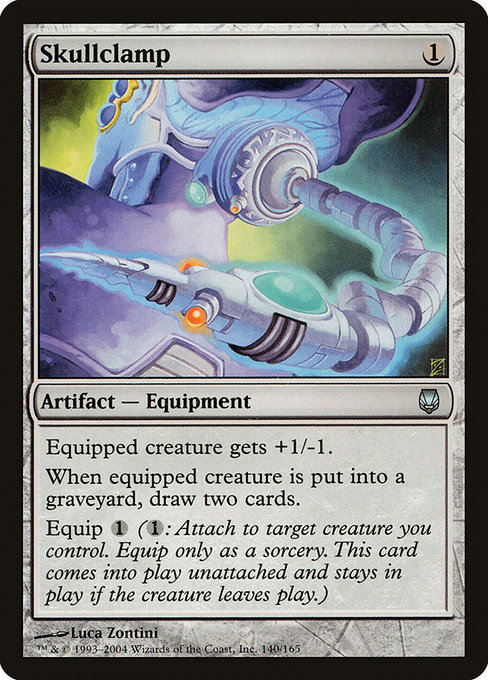
Skullclamp | Illustration by Luca Zontini
Skullclamp is not merely card draw—it is a conversion rate that feels misprinted. One mana to cast and one to equip turns a dying creature into two cards. The +1/-1 even kills your 1-toughness tokens on demand, letting Blood Artist, Ashnod's Altar, Reassembling Skeleton, and a pile of expendable creatures churn through a deck.
The card is much worse when your creatures are large, scarce, or too valuable to sacrifice. It also attracts removal once opponents see the engine. Token decks, aristocrats, creature-recursion shells, and Equipment decks should start with Skullclamp near the top of the list. Spell-heavy control decks should leave it in the binder no matter how famous it is.
#3. Command Tower
Command Tower | Illustration by Constantin Marin
Command Tower may be the least dramatic card in the ranking, which is exactly why it is this high. It enters untapped, costs no life, and produces any color in your commander's color identity. In a two- through five-color deck, replacing a basic or weaker dual with Command Tower is almost free mana-base improvement.
There are two honest limits. Mono-color decks gain little beyond an extra nonbasic land, and a commander with a colorless identity gives the Tower no color to produce. Nonbasic-land hate also exists. Everywhere else, the floor is an untapped colored source and the ceiling is perfect fixing from turn one. Boring? Yes. Cuttable? Rarely.
#2. Arcane Signet
Arcane Signet | Illustration by Dan Murayama Scott
Arcane Signet is the cleanest two-mana fixer Commander has. It taps for any color in your commander's identity, enters untapped, and asks for no life, creature, or opposing land. Multicolor decks get the most obvious benefit, but mono-color decks still appreciate jumping from two mana to four on the next turn.
Like Command Tower, it produces nothing useful for a commander with no colors. It is also an artifact, so a sweeper can erase the mana you thought was permanent; green decks may prefer land ramp for that reason. Those caveats barely dent its ranking. If your commander has a color and your curve wants a two-mana rock, Arcane Signet is the baseline every alternative must beat.
#1. Sol Ring
Sol Ring | Illustration by Mark Tedin
Sol Ring turns one mana into two every turn, including the turn you cast it. That immediate jump is the whole case. It can fund a second spell on turn one, cast a four-mana commander on turn two, or help pay commander tax later. No other broadly legal colorless staple combines that efficiency, availability, and usefulness across archetypes.
It does not fix colored mana, and a late Sol Ring is less impressive than an early one. Some themed or deliberately low-power decks may also skip fast mana on principle. Still, Wizards has kept Sol Ring legal and outside the Game Changers list as an explicit Commander exception. For raw, universal acceleration, it remains the card every other staple is chasing.
How many colorless staples should a Commander deck play?
Do not reserve twenty-five slots and work backward. Start with jobs your deck must perform, then let colorless cards fill the gaps your colors and strategy leave open. A useful pass looks like this:
1. Add the mana pieces that improve your curve or fixing rather than inflating a rock count for its own sake.
2. Protect the commander only if the deck actually depends on it staying in play.
3. Include graveyard hate that does not sabotage your own recursion plan.
4. Use utility lands only while your colored-source count remains reliable.
5. Choose card draw that works with your creature count, token production, life total, and intended bracket.
That process may leave an aristocrats deck with Skullclamp, Soul-Guide Lantern, and several sacrifice-friendly artifacts, while a spellslinger list chooses Mind Stone, War Room, and almost no Equipment. Both can be correct. Synergy should break every tie.
Are colorless cards legal in every Commander deck?
Colorless cards are allowed in Commander decks, but you still have to check color identity, not just the color of the frame or casting cost. A colorless artifact with a colored mana symbol in its rules text has that color in its identity and cannot go into every deck. The cards ranked here all have colorless identities and were Commander-legal when checked on October 25, 2026.
Does “colorless” mean “artifact”?
No. Most of this list is made of artifacts because artifacts are Magic's main source of broadly playable colorless effects, but lands such as Command Tower, War Room, and Scavenger Grounds are colorless cards too. Magic also has colorless creatures, planeswalkers, instants, and sorceries.
Can Arcane Signet and Command Tower make mana in a colorless Commander deck?
They are legal to include, but they cannot produce mana when your commander's color identity contains no colors. “Any color in your commander's color identity” offers no option in that deck. A true colorless list should use Wastes, Mind Stone, Sol Ring, and lands or rocks that explicitly add colorless mana instead.
Is The One Ring banned in Commander?
No. The One Ring is legal in Commander as of October 25, 2026. It is on the Game Changers list, which is different from the banned list. Current bracket guidance excludes Game Changers from Brackets 1 and 2, allows up to three in Bracket 3, and places no Game Changer limit on Brackets 4 and 5.
Do mana rocks replace lands?
Not one for one. A two-mana rock only helps after you have already made enough land drops to cast it, and artifact removal can erase it. Rocks can lower your curve's pressure on later land drops, but they do not excuse opening hands that fail to make mana naturally. Treat them as acceleration and fixing first, not as basic lands with different borders.
Which colorless staples should a new Commander player start with?
For a deck with a colored commander, start by testing Sol Ring, Arcane Signet, Command Tower, one two-mana rock suited to the mana base, and one graveyard-hate option such as Soul-Guide Lantern. Add Lightning Greaves or Swiftfoot Boots only if the commander needs haste or attracts removal. That small package covers common problems without crowding out the cards that make the deck yours.
Final thoughts
Sol Ring takes the top spot because no other legal, broadly playable colorless card converts so little mana into so much acceleration. Arcane Signet and Command Tower follow because reliable mana lets the rest of a deck function. After those three, there is no universal package. Skullclamp wants bodies, Lightning Greaves wants an important creature, and Scavenger Grounds wants a deck willing to lose its own graveyard.
That is the real lesson behind the best colorless Commander staples: availability is not obligation. Use these cards to repair a weakness, sharpen a synergy, or give your colors an effect they struggle to access. If a staple does none of those things, the most powerful cut is often the obvious card everyone else told you to play.
Card names, Oracle text, color identity, legality, and Game Changer status were checked on October 25, 2026. Rankings are original ElderDecks editorial judgments based on flexibility, efficiency, deckbuilding cost, and role coverage—not claimed search volume, market price, or playtest statistics.
By ElderArticles · Updated 10/25/2026 · 21 min read
Discover the 25 best colorless Commander staples, from mana rocks and protection to card draw, graveyard hate, and flexible utility lands for MTG decks.
Table of contents
AI-generated article, published by an ElderDecks editor.
If you want the short answer, the best colorless Commander staples are Sol Ring, Arcane Signet, Command Tower, Skullclamp, and Lightning Greaves. They are not interchangeable: one accelerates, one fixes, one gives you a nearly free land upgrade, one turns small creatures into cards, and one lets a commander get to work immediately.
“Colorless staple” does not mean “automatic include.” It means a deckbuilding tool available to every color identity. Green may not need Wayfarer's Bauble, a creature-light deck has no business running Skullclamp, and a colorless commander gets no mana from Arcane Signet. The useful question is not “Can I play this?” but “Does this solve a real problem better than a card tied to my deck's plan?”
If you only want a starter package, begin with Sol Ring, Arcane Signet, Command Tower in any deck with a colored commander, one protection piece if your commander matters, and one graveyard-hate card. Then stop. A deck built from thirty “staples” can be strong and still have no personality.
How I ranked the best colorless Commander cards
I ranked these cards by efficiency, versatility, opportunity cost, usefulness at different stages of the game, and how well they cover a weakness that colors sometimes struggle to solve. Popularity helped identify candidates, but it did not decide the order. A famous card that only works in one shell sits below a less flashy card that bails out a wider range of decks.
This is also not a price ranking. Expensive cards do not receive bonus points, and cheap cards are not pushed up for being cheap. For budget deckbuilding, look for a lower-ranked card that performs the same job instead of assuming the priciest option is mandatory.
Every card below was checked against current Oracle text and Commander legality on October 25, 2026. One important distinction: The One Ring is legal in Commander, but it is currently a Game Changer, which affects where it fits in the optional Commander bracket system.
Demolition Field | Illustration by Kamila Szutenberg
Nobody sleeves up Demolition Field hoping it will be the star of the night. That is precisely why it earns a place here: it spends most of the game as a land, then turns Gaea's Cradle, Cabal Coffers, Field of the Dead, Maze of Ith, or another troublesome nonbasic into a basic. Unlike Strip Mine, it replaces both lands, so you can answer nonsense without setting somebody back an entire mana source.
Best in: mono-color and two-color decks, land-recursion shells, and metas full of utility lands. Skip it when: your mana base is already stretched for colored sources, or you run so few basics that you cannot claim the replacement land.
Scavenger Grounds | Illustration by Steven Belledin
Graveyards are second hands in Commander, and Scavenger Grounds makes everyone discard theirs. It costs almost nothing to include in a mana base, it can sacrifice itself because it is a Desert, and the activation works at instant speed. Holding it up can stop Living Death, Underworld Breach, or a carefully stocked reanimator turn without dedicating a spell slot to graveyard hate.
The catch is the word all: your own graveyard disappears too. Scavenger Grounds is best in decks that barely touch their graveyard, or in lists that can recur lands and time the activation after extracting their own value. Graveyard decks should use the more surgical Soul-Guide Lantern instead.
Four mana feels clumsy until a 20/20 commander gets stonewalled by a Plant token. Rogue's Passage turns one creature unblockable, making it a clean finisher for Voltron commanders, giant creatures, and on-hit engines such as Old Gnawbone or Ancient Copper Dragon. It asks for no colored mana and hides in your land count until the turn it matters.
That convenience is also the trap. The activation effectively ties up five lands, including the Passage, and another colorless land can make opening hands awkward. Play it when one creature connecting can end the game or create a huge swing. Leave it out of go-wide decks and lists that already have dependable evasion.
War Room is the land you barely notice until the table trades resources and your hand runs dry. Three mana, a tap, and life equal to the number of colors in your commander's identity buys a card. That rate is unexciting on turn four and excellent on turn ten, when keeping mana open and drawing at the last opponent's end step is exactly where you want to be.
Colorless, mono-color, and many two-color decks get the best deal. Five-color decks pay five life per card and usually have stronger engines, while aggressive mana bases may resent another land that produces only colorless. Think of War Room as flood insurance, not your primary draw engine.
Soul-Guide Lantern | Illustration by Tyler Walpole
Soul-Guide Lantern is the tidy answer for players who want graveyard hate without nuking their own resources. It exiles the most dangerous card when it enters, then either clears every opponent's graveyard or cashes itself in for a card. That makes it useful before, during, and after the reanimator player starts looking suspiciously pleased.
Artifact recursion makes the Lantern especially annoying: Emry, Lurker of the Loch and Teshar, Ancestor's Apostle can reuse it, while sacrifice decks appreciate an artifact that replaces itself. Its limitation is scale. One activation is often enough, but a pod with three graveyard decks may demand repeated pressure from Unlicensed Hearse.
Unlicensed Hearse does two jobs and takes both seriously. It can tap the turn it arrives to exile up to two cards from one graveyard, then repeat the trick every turn without another mana payment. Once enough cards are tucked beneath it, crew 2 turns the Hearse into a genuinely threatening Vehicle. Graveyard hate that eventually runs somebody over is my kind of redundancy.
The Hearse shines in artifact decks, Vehicle decks, and any list that wants to pressure a graveyard over several turns instead of firing one emergency button. It is less appealing when your table rarely uses the yard, and instant-speed artifact removal can strand its combat plan. Still, making a Muldrotha player answer a two-mana artifact before doing anything fun is a fine exchange.
Wayfarer's Bauble is slow, honest, and still one of the few ways any color can put a basic land directly onto the battlefield. That distinction matters. A land survives most sweepers that erase mana rocks, triggers landfall, and raises your available mana on every later turn. Mono-white, mono-red, and colorless decks value the effect far more than green does.
You pay three mana across two payments and the land arrives tapped, so this is not explosive ramp. Green decks already have Rampant Growth, and optimized lists often prefer a two-mana rock. Play Bauble when durability, landfall, artifact recursion, or simply reaching your next land drop matters more than raw speed.
Mind Stone is what a fair mana rock should look like. It costs two, taps for colorless immediately, and turns into a fresh card when you no longer need the mana. That last line saves it from becoming dead cardboard after a topdeck war begins. Sacrifice and artifact-recursion decks can squeeze even more from the exchange with Goblin Welder, Emry, Lurker of the Loch, or Scrap Trawler.
Its only real failure is color fixing. A three-color deck with demanding costs may need Fellwar Stone or a Talisman instead. In mono-color, colorless, and artifact-heavy decks, though, Mind Stone is rarely exciting and rarely embarrassing—which is a compliment for a card you want to cast on turn two.
Thought Vessel is a two-mana rock wearing a very tempting sentence: you have no maximum hand size. In decks led by commanders such as Nezahal, Primal Tide, Jin-Gitaxias, Progress Tyrant, or The Council of Four, that sentence can preserve a dozen cards that would otherwise hit the graveyard. The rock still does its basic job even when your hand stays modest.
Do not overrate the ceiling. Most decks finish turns with seven or fewer cards, and Thought Vessel only makes colorless mana. If discarding down almost never hurts, Mind Stone's ability to cash itself in is more valuable. Play the Vessel for a real hand-size problem, not because “no maximum” looks luxurious.
A four-player table quietly fixes Fellwar Stone for you. For two mana, it usually taps for at least one of your commander's colors and often for all of them once opponents develop their mana bases. That makes it a strong early play in three-, four-, and five-color decks without forcing you to pay three mana for fixing.
“Usually” is doing work. Fellwar Stone cannot make a color that no opposing land could produce, it may be awkward before opponents play the right lands, and it is poor in a truly colorless deck. Use it when your pod's mana bases are varied and your own colored requirements are forgiving. If a turn-two green or blue source is nonnegotiable, choose a rock that guarantees it.
Liquimetal Torque starts as a plain two-mana rock, then gets mischievous. Its second tap ability turns any nonland permanent into an artifact until end of turn. Suddenly Vandalblast, Abrade, Nature's Claim, and Goblin Welder can interact with permanents they were never meant to touch. Turning a planeswalker into an artifact and then smashing it is the sort of tiny rules crime that makes this card memorable.
The Torque only produces colorless, and tapping it for mana means you cannot use the conversion trick that turn without an untapper. It belongs in decks with meaningful artifact removal or artifact-matters synergies. Without those payoffs, Mind Stone is the cleaner generic choice.
Relic of Legends | Illustration by Narendra Bintara Adi
Relic of Legends costs one more than the usual rocks, but legendary-heavy decks get paid back immediately. It taps for any color, and it lets you tap any untapped legendary creature you control for another mana—including a legend that just entered the battlefield. Because the tapping is a cost of the Relic's ability rather than an activated ability printed on the creature, summoning sickness does not stop the trick.
That makes Relic excellent in “legends matter” decks, go-wide boards full of legendary tokens, and commanders that do not need to attack. In a deck with only its commander and a few legends, it is merely a three-mana rock. Count your likely bodies before treating it like premium ramp.
The Sad Robot has been power-crept, but it still understands the assignment. Solemn Simulacrum finds a basic land when it enters and draws a card when it dies, spreading value across two moments that sacrifice, blink, and reanimation decks already want to exploit. Ephemerate finds another land; Victimize turns its death into a card before bringing it back; Goblin Welder can keep the loop going.
At four mana, Solemn is no longer an automatic ramp slot. The land enters tapped, the draw requires an actual death, and exile or bounce denies the second half. Play it when your engine can reuse the body. If you plan to cast it once, block once, and hope, there are sharper options.
Expedition Map looks humble because it does not ramp—it spends a card and three total mana to put a land in your hand. The word any changes the calculation. Map can find Cabal Coffers, Urborg, Tomb of Yawgmoth, Gaea's Cradle, a missing combo land, a removal land, or simply War Room when the game runs long. Colorless decks especially need this access because their best effects often live in the mana base.
The Map is strongest when your lands form a toolbox and weakest when it can only fetch a basic. It also broadcasts your plan and asks you to spend mana without affecting the battlefield. Run it for specific targets, not because every deck technically has lands.
Some colors can remove creatures all day and still stare helplessly at an enchantment, planeswalker, or artifact engine. Oblivion Stone gives every deck a reset button. Five mana and a tap sacrifices it to destroy every nonland permanent without a fate counter, while the slower four-mana ability can mark something you intend to save.
Casting and firing the Stone in one turn costs eight mana, so the table usually gets warning. Indestructible permanents survive, lands remain, and a well-timed removal spell can force an awkward activation. That makes it best in colorless decks and colors short on catch-all answers, especially with artifact recursion. Faster decks should prefer cheaper, narrower interaction over planning a dramatic cleanup.
Sensei's Divining Top | Illustration by Greg Staples
Sensei's Divining Top does not really draw cards; it makes sure the next ones are the right cards. One mana rearranges the top three, and the tap ability can hide the Top on your library while drawing the best card immediately. Fetch lands and other shuffle effects turn every activation into a fresh look, while Counterbalance, Bolas's Citadel, and Mystic Forge turn information into an engine.
Without shuffles or top-deck payoffs, the same three mediocre cards keep coming back. Top also consumes mana and real-world time, so quick decisions matter. Play it in decks that actively manipulate the library. Do not add it to every list and spend two minutes polishing a bad top three.
The One Ring buys a turn and then threatens to bury the table in cards. If you cast it, its enters-the-battlefield trigger grants protection from everything until your next turn. After that, each tap adds a burden counter and draws cards equal to the counters on it: one card, then two, then three. Voltaic Key and Manifold Key accelerate the draw, while Sheoldred, the Apocalypse can offset the life loss.
The bill eventually arrives. Your upkeep drains life for every burden counter, removal that exiles or bounces gets around indestructible, and blinking the Ring resets the counters without granting protection unless you cast it again. Most importantly, it is Commander-legal but currently a Game Changer. Under Wizards' bracket guidance it does not belong in Brackets 1 or 2, so discuss it before dropping it into a casual deck.
Mithril Coat is a protection spell that stays on the battlefield. Flash lets you answer a destroy effect or most board wipes, and the Coat attaches itself to a legendary creature when it enters. Your commander survives, the Equipment is indestructible, and later you can pay three to move it if a better target appears. Commander-centric engines love that sequence.
Indestructible is not invincibility. Exile, sacrifice, bounce, toughness reduction, and losing all abilities still work, and the free attachment only happens on entry and only targets a legendary creature. Play Mithril Coat when keeping one legend alive is central to the deck. Creature-swarm strategies are better served by team-wide protection.
#7. Shadowspear
Shadowspear | Illustration by Yeong-Hao Han
Shadowspear is absurdly busy for a one-mana Equipment. It gives +1/+1, trample, and lifelink for an equip cost of two, allowing a giant creature to stop being chump-blocked and turn damage into breathing room. Then its activated ability strips hexproof and indestructible from opponents' permanents for the turn, letting your removal hit cards that normally shrug it off.
It does not destroy anything by itself, so the second ability needs a sweeper or targeted answer waiting. Small creatures also gain less from the combat package. Shadowspear is at its best beside high-power commanders, deathtouch, damage doublers, and removal-heavy decks that need to crack protective shields.
Swiftfoot Boots offers the comfortable version of commander protection: haste, hexproof, and an equip cost of one. Hexproof blocks opponents without stopping you from targeting the creature, so Auras, pump spells, untap effects, and other Equipment still work. Commanders with tap abilities or attack triggers effectively gain a full turn when the Boots are waiting.
The one mana to equip is small until you recast an expensive commander and need every resource. The Boots also do nothing against sweepers, sacrifice effects, or removal aimed at the Equipment. Run them when your commander must survive and act. In a deck whose commander is replaceable—or mostly sits in the command zone—the slot should advance the actual plan instead.
Lightning Greaves trades the Boots' friendly targeting for pure speed. Two mana gets haste and shroud onto the battlefield, and equip zero lets you protect a newly cast commander even when you are tapped out. You can also move the Greaves between several creatures in one turn, giving each haste before parking them on the permanent you most need to protect.
Shroud is the awkward part. You cannot target the equipped creature with your own spells or abilities, and you cannot simply “unequip” the Greaves; you need another creature to receive them. That tension is real, but commanders with tap abilities, attack triggers, or a reputation for dying on sight still get enormous value from free equip.
#4. Skullclamp
Skullclamp | Illustration by Luca Zontini
Skullclamp is not merely card draw—it is a conversion rate that feels misprinted. One mana to cast and one to equip turns a dying creature into two cards. The +1/-1 even kills your 1-toughness tokens on demand, letting Blood Artist, Ashnod's Altar, Reassembling Skeleton, and a pile of expendable creatures churn through a deck.
The card is much worse when your creatures are large, scarce, or too valuable to sacrifice. It also attracts removal once opponents see the engine. Token decks, aristocrats, creature-recursion shells, and Equipment decks should start with Skullclamp near the top of the list. Spell-heavy control decks should leave it in the binder no matter how famous it is.
Command Tower may be the least dramatic card in the ranking, which is exactly why it is this high. It enters untapped, costs no life, and produces any color in your commander's color identity. In a two- through five-color deck, replacing a basic or weaker dual with Command Tower is almost free mana-base improvement.
There are two honest limits. Mono-color decks gain little beyond an extra nonbasic land, and a commander with a colorless identity gives the Tower no color to produce. Nonbasic-land hate also exists. Everywhere else, the floor is an untapped colored source and the ceiling is perfect fixing from turn one. Boring? Yes. Cuttable? Rarely.
Arcane Signet | Illustration by Dan Murayama Scott
Arcane Signet is the cleanest two-mana fixer Commander has. It taps for any color in your commander's identity, enters untapped, and asks for no life, creature, or opposing land. Multicolor decks get the most obvious benefit, but mono-color decks still appreciate jumping from two mana to four on the next turn.
Like Command Tower, it produces nothing useful for a commander with no colors. It is also an artifact, so a sweeper can erase the mana you thought was permanent; green decks may prefer land ramp for that reason. Those caveats barely dent its ranking. If your commander has a color and your curve wants a two-mana rock, Arcane Signet is the baseline every alternative must beat.
Sol Ring turns one mana into two every turn, including the turn you cast it. That immediate jump is the whole case. It can fund a second spell on turn one, cast a four-mana commander on turn two, or help pay commander tax later. No other broadly legal colorless staple combines that efficiency, availability, and usefulness across archetypes.
It does not fix colored mana, and a late Sol Ring is less impressive than an early one. Some themed or deliberately low-power decks may also skip fast mana on principle. Still, Wizards has kept Sol Ring legal and outside the Game Changers list as an explicit Commander exception. For raw, universal acceleration, it remains the card every other staple is chasing.
How many colorless staples should a Commander deck play?
Do not reserve twenty-five slots and work backward. Start with jobs your deck must perform, then let colorless cards fill the gaps your colors and strategy leave open. A useful pass looks like this:
1. Add the mana pieces that improve your curve or fixing rather than inflating a rock count for its own sake.
2. Protect the commander only if the deck actually depends on it staying in play.
3. Include graveyard hate that does not sabotage your own recursion plan.
4. Use utility lands only while your colored-source count remains reliable.
5. Choose card draw that works with your creature count, token production, life total, and intended bracket.
That process may leave an aristocrats deck with Skullclamp, Soul-Guide Lantern, and several sacrifice-friendly artifacts, while a spellslinger list chooses Mind Stone, War Room, and almost no Equipment. Both can be correct. Synergy should break every tie.
Are colorless cards legal in every Commander deck?
Colorless cards are allowed in Commander decks, but you still have to check color identity, not just the color of the frame or casting cost. A colorless artifact with a colored mana symbol in its rules text has that color in its identity and cannot go into every deck. The cards ranked here all have colorless identities and were Commander-legal when checked on October 25, 2026.
Does “colorless” mean “artifact”?
No. Most of this list is made of artifacts because artifacts are Magic's main source of broadly playable colorless effects, but lands such as Command Tower, War Room, and Scavenger Grounds are colorless cards too. Magic also has colorless creatures, planeswalkers, instants, and sorceries.
They are legal to include, but they cannot produce mana when your commander's color identity contains no colors. “Any color in your commander's color identity” offers no option in that deck. A true colorless list should use Wastes, Mind Stone, Sol Ring, and lands or rocks that explicitly add colorless mana instead.
No. The One Ring is legal in Commander as of October 25, 2026. It is on the Game Changers list, which is different from the banned list. Current bracket guidance excludes Game Changers from Brackets 1 and 2, allows up to three in Bracket 3, and places no Game Changer limit on Brackets 4 and 5.
Do mana rocks replace lands?
Not one for one. A two-mana rock only helps after you have already made enough land drops to cast it, and artifact removal can erase it. Rocks can lower your curve's pressure on later land drops, but they do not excuse opening hands that fail to make mana naturally. Treat them as acceleration and fixing first, not as basic lands with different borders.
Which colorless staples should a new Commander player start with?
For a deck with a colored commander, start by testing Sol Ring, Arcane Signet, Command Tower, one two-mana rock suited to the mana base, and one graveyard-hate option such as Soul-Guide Lantern. Add Lightning Greaves or Swiftfoot Boots only if the commander needs haste or attracts removal. That small package covers common problems without crowding out the cards that make the deck yours.
Final thoughts
Sol Ring takes the top spot because no other legal, broadly playable colorless card converts so little mana into so much acceleration. Arcane Signet and Command Tower follow because reliable mana lets the rest of a deck function. After those three, there is no universal package. Skullclamp wants bodies, Lightning Greaves wants an important creature, and Scavenger Grounds wants a deck willing to lose its own graveyard.
That is the real lesson behind the best colorless Commander staples: availability is not obligation. Use these cards to repair a weakness, sharpen a synergy, or give your colors an effect they struggle to access. If a staple does none of those things, the most powerful cut is often the obvious card everyone else told you to play.
Card names, Oracle text, color identity, legality, and Game Changer status were checked on October 25, 2026. Rankings are original ElderDecks editorial judgments based on flexibility, efficiency, deckbuilding cost, and role coverage—not claimed search volume, market price, or playtest statistics.