Best Budget Blue Card Draw for Commander: 12 Cards Under $2
By ElderArticles · Updated 10/21/2026 · 14 min read
Find 12 budget blue card draw spells for Commander under $2, with current prices, best deck fits, limitations, and smart swaps for every strategy.
Table of contents
Fact or Fiction | Illustration by Terese Nielsen
Blue has no shortage of ways to draw cards. The hard part is finding the ones that still earn their slot when the budget is tight. If you want the quick answer, Fact or Fiction is the best all-purpose budget blue draw spell under $2, Treasure Cruise has the highest ceiling in a stocked graveyard, and Reconnaissance Mission is the repeatable engine to beat when your deck attacks with evasive creatures.
This list ranks 12 Commander-legal cards that had at least one English nonfoil printing estimated at $2 or less on October 21, 2026. There is no fake one-size-fits-all winner here: the right card depends on whether your deck is filling its graveyard, making artifacts, attacking with tokens, or simply leaving mana open.
The Short Answer
For a generic blue deck, start with Fact or Fiction. Spell-heavy and self-mill lists should look hard at Treasure Cruise. Creature decks get more mileage from Reconnaissance Mission or Bident of Thassa, while artifact decks can turn Thoughtcast into one of the cleanest bargains in the format.
The mistake is treating every spell that says “draw” as interchangeable. Winged Words is efficient only with a flyer. Into the Story is excellent only after an opponent’s graveyard is stocked. Keep Watch can draw six cards in the right combat and zero in the wrong game. Context matters more than the sticker price.
How We Ranked the Best Budget Blue Card Draw
The ranking weighs four things: real card advantage, mana efficiency, flexibility, and floor. A spell climbs when it works in many decks and still does something useful from behind. Narrow cards can rank well, but only when their supported deck makes the payoff reliably exceptional.
Our budget line is simple: a card qualifies if Scryfall showed at least one English nonfoil printing at $2 or less on October 21, 2026. The price beside each entry is the cheapest estimate observed during that check, before shipping and tax. Prices move, so treat the number as a snapshot and follow the linked card page before buying.
AI-generated article, published by an ElderDecks editor.
A two-mana Divination is perfectly respectable, and that is what Winged Words becomes as soon as you control a creature with flying. The requirement is forgiving in decks led by Talrand, Sky Summoner, Alela, Artful Provocateur, or another commander that naturally keeps a flyer on the battlefield.
The problem is the unassisted version. Three mana at sorcery speed to draw two cards is playable, but hardly exciting in Commander. Winged Words also offers no graveyard value, no scaling, and no way to hold up interaction. It is good glue for a dedicated skies deck, not a blue staple wearing wings.
Behold the Multiverse trades explosive power for a pleasantly smooth floor. Scry 2 clears away the cards you do not need, then drawing two delivers the resources you do. Because it is an instant, you can keep interaction available and cast it at the end of the last opponent’s turn.
Foretell is the interesting part. Pay two mana on a quiet turn, tuck the card away, and it later costs just one generic and one blue. Vega, the Watcher turns that foretold cast into another card, while Ranar the Ever-Watchful and Cosmos Charger reward the same game plan. You are still spending four mana in total, though, so decks without foretell pay a lot for convenience.
High-synergy cards: Vega, the Watcher; Ranar the Ever-Watchful; Cosmos Charger; Dream Devourer in decks whose color identity allows it.
Best for: Draw-go decks and foretell builds that value card selection and split payments over raw rate.
Keep Watch has one of the strangest ceilings on this list because it counts every attacking creature, not only your creatures and not only creatures attacking you. Fire it after a token player sends six creatures across the table and you draw six for three mana. Your own go-wide turn works just as well.
That flexibility makes Keep Watch much better than it first appears in Kykar, Wind’s Fury, The Locust God, and other decks that can create attackers in batches. It can also punish an opponent for committing to combat while you stay out of the fight. Still, a table full of control decks can leave it stranded in hand, and one giant Voltron attacker produces only one card.
Four cards for four mana at instant speed is outstanding. Into the Story reaches that rate when an opponent has seven or more cards in their graveyard, a threshold that mill decks can hit quickly and ordinary Commander games often reach eventually.
Ruin Crab, Maddening Cacophony, and Windfall help switch on the discount instead of waiting for it. The downside is printed right in the upper corner: seven mana is a brutal fallback. A timely Soul-Guide Lantern or other graveyard reset can also raise the cost when you least want it. Run this when filling opposing graveyards is part of the plan, not because four-for-four looks pretty.
In the correct deck, Thoughtcast reads “pay one blue, draw two cards.” Affinity for artifacts reduces the generic portion of its cost, so Treasures, Clues, Thopters, Equipment, and mana rocks all help. Four artifacts are enough to leave only the blue pip.
That makes Thoughtcast excellent beside Sai, Master Thopterist, Emry, Lurker of the Loch, and Efficient Construction. It also plays nicely with Thought Monitor, giving artifact decks another payoff for doing what they already wanted to do. Outside that shell, the five-mana floor is dreadful and sorcery speed offers no rescue.
High-synergy cards: Sai, Master Thopterist; Emry, Lurker of the Loch; Thought Monitor; Efficient Construction.
Best for: Artifact commanders and Treasure, Clue, or Thopter decks that routinely control four artifacts.
#7. Thirst for Discovery
Thirst for Discovery | Illustration by Dominik Mayer
Thirst for Discovery is at its best when the word “basic” barely feels like a restriction. Draw three, discard one basic land, and the spell leaves you one card ahead overall while digging three cards deep at instant speed. That is an excellent rate for a deck with a healthy Island count.
When you cannot pitch a basic, you must discard two cards instead. That turns the spell into selection rather than true card advantage—but graveyard decks may prefer it that way. Tossing Wonder, Deep Analysis, or Echo of Eons can convert the apparent cost into future value.
High-synergy cards: Wonder; Deep Analysis; Echo of Eons; Oskar, Rubbish Reclaimer.
Best for: Basic-heavy mana bases, reanimator shells, and decks that actively want particular cards in the graveyard.
Deep Analysis is not fast, but it is stubborn. The front half draws two cards, and flashback lets you do it again from the graveyard for one generic, one blue, and three life. Over time, one cardboard rectangle becomes four new cards.
The card gets much better when you never pay four mana for the first half. Discard it to Thirst for Discovery or Frantic Search, mill it, then cash in the flashback. Secrets of the Dead even rewards the graveyard cast with another draw. Six total mana, sorcery speed, and three life make this too slow for every deck, but decks built to discard or self-mill are delighted to find it.
High-synergy cards: Thirst for Discovery; Frantic Search; Secrets of the Dead; Oskar, Rubbish Reclaimer.
Best for: Self-mill, discard, graveyard-value, and slower attrition decks.
Pull from Tomorrow turns every unused chunk of mana into fresh cards. Because it is an instant, you can pass with countermagic ready and refill only when the coast is clear. Drawing X and then discarding one is especially useful when the discard is Wonder, Deep Analysis, or another card that prefers the graveyard.
This is not a strong early play. At X equals two, you spend four mana to finish only one card ahead after the discard. The spell starts to feel powerful when X reaches three or more, and it becomes a true finisher with High Tide, Caged Sun, or Extraplanar Lens. The double-blue cost also matters in greedy multicolor mana bases.
High-synergy cards: High Tide; Caged Sun; Extraplanar Lens; Niv-Mizzet, Parun.
Best for: Draw-go control and big-mana blue decks that expect to leave five or more mana untapped.
Bident of Thassa turns each creature that connects with a player into a card. One evasive attacker replaces your draw for the turn; three or four can bury the table. Talrand, Sky Summoner, Alela, Artful Provocateur, and Malcolm, Keen-Eyed Navigator all create or reward the cheap flyers that Bident wants.
Its activated ability is easy to overlook: for one generic and one blue, you can tap Bident and make an opponent’s creatures attack that turn if able. They still choose legal attacks, but forcing combat can expose blockers or make two opponents trade resources. Four mana is a real setup cost, and removal can leave you with no return if you cannot connect immediately.
Reconnaissance Mission offers the same core promise as Bident: every creature that hits a player draws a card. The reason it ranks higher is cycling. When your board has been swept or combat is not your route to victory, paying two mana to turn Mission into a new card prevents a narrow engine from becoming a dead draw.
The best homes already produce evasive bodies through cards such as Bitterblossom, Sai, Master Thopterist, Oona, Queen of the Fae, or Talrand, Sky Summoner—provided the deck’s color identity permits them. Mission does nothing on an empty battlefield and asks you to risk creatures in combat, but its escape hatch makes that wager far easier to accept.
High-synergy cards: Sai, Master Thopterist; Oona, Queen of the Fae; Talrand, Sky Summoner; Coastal Piracy.
Best for: Blue creature decks that attack often but still want a useful fallback after a board wipe.
#2. Treasure Cruise
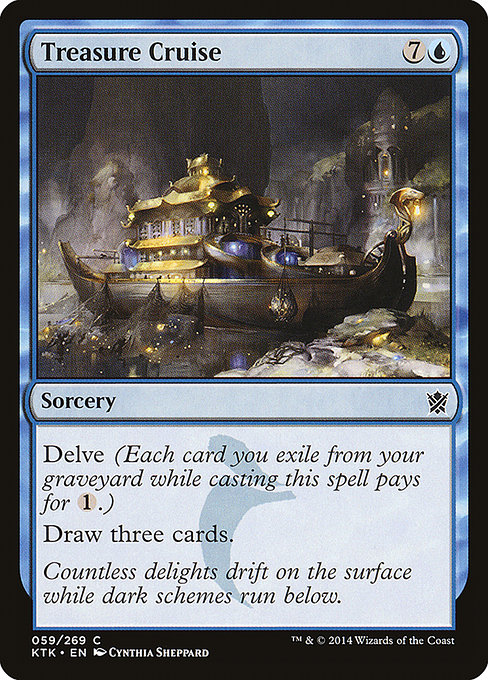
Treasure Cruise | Illustration by Cynthia Sheppard
Treasure Cruise is the ceiling play: one blue mana for three cards. Delve lets each card you exile from your graveyard pay one generic mana, so cheap instants, sorceries, fetch lands, and self-mill can turn its intimidating eight-mana cost into a bargain.
Thought Scour and Mental Note stock the graveyard while keeping the deck moving, and spell-heavy commanders such as Veyran, Voice of Duality naturally provide fuel. The tension is real, though. Every card exiled to Cruise is unavailable to Snapcaster Mage, Underworld Breach, delirium, reanimation, or a second delve spell. Treat the graveyard as a budget you are spending, not a dumpster with infinite inventory.
High-synergy cards: Thought Scour; Mental Note; Frantic Search; Veyran, Voice of Duality.
Best for: Spellslinger, self-mill, and fetch-heavy decks that fill the graveyard without needing every card back.
Fact or Fiction remains the budget benchmark because it asks almost nothing of your deck. At instant speed, you reveal the top five cards of your library. An opponent separates them into two piles; you choose one pile for your hand and put the other into your graveyard. The opponent makes the piles, but you make the final decision.
That creates better choices than “draw two” suggests. A single must-have card can force an awkward one-versus-four split. A graveyard deck may be happy with either pile. Muldrotha, the Gravetide and Kess, Dissident Mage can exploit what gets binned, while Nymris, Oona’s Trickster rewards casting the spell on an opponent’s turn. Choosing the pile-maker can even become a small piece of table politics.
Four mana is not trivial in a fast pod, and revealing five cards gives the table information about your hand and graveyard. Even so, no card below it combines this much selection, card advantage, instant-speed flexibility, and graveyard setup without demanding a specialized board.
Best for: Nearly any blue Commander deck, especially control, reanimator, and graveyard-value strategies.
Building a Better Budget Draw Package
Do not fill every draw slot with the same kind of card. A healthy package usually mixes a repeatable engine with a few immediate refills. A Talrand deck might pair Reconnaissance Mission with Fact or Fiction and Treasure Cruise. An Emry deck can lean on Thoughtcast, then add Fact or Fiction for games where the artifact count stalls.
Also count what your commander already provides. If your commander reliably draws cards, you can favor selection and situational engines. If it offers no cards at all, prioritize spells with a dependable floor. You can test those swaps in the ElderCodex Commander deck builder before buying anything.
Frequently Asked Questions
Are Brainstorm, Ponder, and Preordain card draw?
They draw cards, but in an ordinary game they replace themselves rather than leave you up a card. Their main job is card selection. Shuffle effects, miracle cards, draw triggers, or top-of-library synergies can make Brainstorm exceptional, but a cantrip should not automatically replace a true refill spell in your deckbuilding count.
How many card-draw spells should a Commander deck run?
There is no universal number. Start by counting repeatable engines, one-shot refills, and reliable card advantage from the command zone. Then watch real games: if the deck routinely empties its hand by turns five or six, add draw before adding another splashy finisher. Ten sources is a useful first audit, not a rule.
What is the best budget blue draw spell for artifact decks?
Thoughtcast is the clear specialist. With four artifacts in play, it costs one blue mana to draw two cards. If your artifact count is inconsistent, Fact or Fiction is the safer option because it needs no setup.
Which card is best for flyers or creature tokens?
Use Reconnaissance Mission when you want flexibility after a board wipe, or Bident of Thassa when its forced-combat ability matters. Winged Words is a cheap one-shot supplement, while Keep Watch has the biggest burst potential in a crowded combat.
Should I play both Reconnaissance Mission and Bident of Thassa?
Yes, if connecting with several creatures is a central plan rather than an occasional bonus. They stack, so one unblocked creature can draw a card from each permanent. If your deck attacks with only one large threat, use a one-shot spell instead.
Why are some famous blue staples missing?
This list requires at least one English nonfoil printing estimated at $2 or less on the check date. Cards above that line were excluded even if they are excellent. We also favored genuine card advantage over cantrips that mostly improve card quality.
Final Verdict
Fact or Fiction is the safest first purchase: it fits almost anywhere, rewards good decisions, and never asks you to build around it. Treasure Cruise is more explosive when the graveyard cooperates, while Reconnaissance Mission can draw far more over a full game in the right creature deck.
The real budget win is choosing the narrow card your deck can make unfair. Thoughtcast is mediocre in a random blue list and brilliant in artifacts. Keep Watch is unreliable at a quiet table and absurd when tokens start turning sideways. Spend less by matching the engine to the deck, not by buying the same “staple” twelve times.
Sources and Price Notes
Card names, Oracle text, color identity, format legality, printings, and the October 21, 2026 price snapshot were checked with Scryfall. Commander deck-construction rules were checked against the official Commander rules.
Scryfall prices are estimates rather than offers. Shipping, tax, condition, language, and seller availability can move the final checkout price above the displayed amount. Recheck each printing before publication or purchase.
Best Budget Blue Card Draw for Commander: 12 Cards Under $2
By ElderArticles · Updated 10/21/2026 · 14 min read
Find 12 budget blue card draw spells for Commander under $2, with current prices, best deck fits, limitations, and smart swaps for every strategy.
Table of contents
Fact or Fiction | Illustration by Terese Nielsen
Blue has no shortage of ways to draw cards. The hard part is finding the ones that still earn their slot when the budget is tight. If you want the quick answer, Fact or Fiction is the best all-purpose budget blue draw spell under $2, Treasure Cruise has the highest ceiling in a stocked graveyard, and Reconnaissance Mission is the repeatable engine to beat when your deck attacks with evasive creatures.
This list ranks 12 Commander-legal cards that had at least one English nonfoil printing estimated at $2 or less on October 21, 2026. There is no fake one-size-fits-all winner here: the right card depends on whether your deck is filling its graveyard, making artifacts, attacking with tokens, or simply leaving mana open.
The Short Answer
For a generic blue deck, start with Fact or Fiction. Spell-heavy and self-mill lists should look hard at Treasure Cruise. Creature decks get more mileage from Reconnaissance Mission or Bident of Thassa, while artifact decks can turn Thoughtcast into one of the cleanest bargains in the format.
The mistake is treating every spell that says “draw” as interchangeable. Winged Words is efficient only with a flyer. Into the Story is excellent only after an opponent’s graveyard is stocked. Keep Watch can draw six cards in the right combat and zero in the wrong game. Context matters more than the sticker price.
How We Ranked the Best Budget Blue Card Draw
The ranking weighs four things: real card advantage, mana efficiency, flexibility, and floor. A spell climbs when it works in many decks and still does something useful from behind. Narrow cards can rank well, but only when their supported deck makes the payoff reliably exceptional.
Our budget line is simple: a card qualifies if Scryfall showed at least one English nonfoil printing at $2 or less on October 21, 2026. The price beside each entry is the cheapest estimate observed during that check, before shipping and tax. Prices move, so treat the number as a snapshot and follow the linked card page before buying.
A two-mana Divination is perfectly respectable, and that is what Winged Words becomes as soon as you control a creature with flying. The requirement is forgiving in decks led by Talrand, Sky Summoner, Alela, Artful Provocateur, or another commander that naturally keeps a flyer on the battlefield.
The problem is the unassisted version. Three mana at sorcery speed to draw two cards is playable, but hardly exciting in Commander. Winged Words also offers no graveyard value, no scaling, and no way to hold up interaction. It is good glue for a dedicated skies deck, not a blue staple wearing wings.
Behold the Multiverse trades explosive power for a pleasantly smooth floor. Scry 2 clears away the cards you do not need, then drawing two delivers the resources you do. Because it is an instant, you can keep interaction available and cast it at the end of the last opponent’s turn.
Foretell is the interesting part. Pay two mana on a quiet turn, tuck the card away, and it later costs just one generic and one blue. Vega, the Watcher turns that foretold cast into another card, while Ranar the Ever-Watchful and Cosmos Charger reward the same game plan. You are still spending four mana in total, though, so decks without foretell pay a lot for convenience.
Keep Watch has one of the strangest ceilings on this list because it counts every attacking creature, not only your creatures and not only creatures attacking you. Fire it after a token player sends six creatures across the table and you draw six for three mana. Your own go-wide turn works just as well.
That flexibility makes Keep Watch much better than it first appears in Kykar, Wind’s Fury, The Locust God, and other decks that can create attackers in batches. It can also punish an opponent for committing to combat while you stay out of the fight. Still, a table full of control decks can leave it stranded in hand, and one giant Voltron attacker produces only one card.
Four cards for four mana at instant speed is outstanding. Into the Story reaches that rate when an opponent has seven or more cards in their graveyard, a threshold that mill decks can hit quickly and ordinary Commander games often reach eventually.
Ruin Crab, Maddening Cacophony, and Windfall help switch on the discount instead of waiting for it. The downside is printed right in the upper corner: seven mana is a brutal fallback. A timely Soul-Guide Lantern or other graveyard reset can also raise the cost when you least want it. Run this when filling opposing graveyards is part of the plan, not because four-for-four looks pretty.
In the correct deck, Thoughtcast reads “pay one blue, draw two cards.” Affinity for artifacts reduces the generic portion of its cost, so Treasures, Clues, Thopters, Equipment, and mana rocks all help. Four artifacts are enough to leave only the blue pip.
Thirst for Discovery is at its best when the word “basic” barely feels like a restriction. Draw three, discard one basic land, and the spell leaves you one card ahead overall while digging three cards deep at instant speed. That is an excellent rate for a deck with a healthy Island count.
When you cannot pitch a basic, you must discard two cards instead. That turns the spell into selection rather than true card advantage—but graveyard decks may prefer it that way. Tossing Wonder, Deep Analysis, or Echo of Eons can convert the apparent cost into future value.
Deep Analysis is not fast, but it is stubborn. The front half draws two cards, and flashback lets you do it again from the graveyard for one generic, one blue, and three life. Over time, one cardboard rectangle becomes four new cards.
The card gets much better when you never pay four mana for the first half. Discard it to Thirst for Discovery or Frantic Search, mill it, then cash in the flashback. Secrets of the Dead even rewards the graveyard cast with another draw. Six total mana, sorcery speed, and three life make this too slow for every deck, but decks built to discard or self-mill are delighted to find it.
Pull from Tomorrow turns every unused chunk of mana into fresh cards. Because it is an instant, you can pass with countermagic ready and refill only when the coast is clear. Drawing X and then discarding one is especially useful when the discard is Wonder, Deep Analysis, or another card that prefers the graveyard.
This is not a strong early play. At X equals two, you spend four mana to finish only one card ahead after the discard. The spell starts to feel powerful when X reaches three or more, and it becomes a true finisher with High Tide, Caged Sun, or Extraplanar Lens. The double-blue cost also matters in greedy multicolor mana bases.
Its activated ability is easy to overlook: for one generic and one blue, you can tap Bident and make an opponent’s creatures attack that turn if able. They still choose legal attacks, but forcing combat can expose blockers or make two opponents trade resources. Four mana is a real setup cost, and removal can leave you with no return if you cannot connect immediately.
Reconnaissance Mission offers the same core promise as Bident: every creature that hits a player draws a card. The reason it ranks higher is cycling. When your board has been swept or combat is not your route to victory, paying two mana to turn Mission into a new card prevents a narrow engine from becoming a dead draw.
The best homes already produce evasive bodies through cards such as Bitterblossom, Sai, Master Thopterist, Oona, Queen of the Fae, or Talrand, Sky Summoner—provided the deck’s color identity permits them. Mission does nothing on an empty battlefield and asks you to risk creatures in combat, but its escape hatch makes that wager far easier to accept.
Treasure Cruise is the ceiling play: one blue mana for three cards. Delve lets each card you exile from your graveyard pay one generic mana, so cheap instants, sorceries, fetch lands, and self-mill can turn its intimidating eight-mana cost into a bargain.
Thought Scour and Mental Note stock the graveyard while keeping the deck moving, and spell-heavy commanders such as Veyran, Voice of Duality naturally provide fuel. The tension is real, though. Every card exiled to Cruise is unavailable to Snapcaster Mage, Underworld Breach, delirium, reanimation, or a second delve spell. Treat the graveyard as a budget you are spending, not a dumpster with infinite inventory.
Fact or Fiction remains the budget benchmark because it asks almost nothing of your deck. At instant speed, you reveal the top five cards of your library. An opponent separates them into two piles; you choose one pile for your hand and put the other into your graveyard. The opponent makes the piles, but you make the final decision.
That creates better choices than “draw two” suggests. A single must-have card can force an awkward one-versus-four split. A graveyard deck may be happy with either pile. Muldrotha, the Gravetide and Kess, Dissident Mage can exploit what gets binned, while Nymris, Oona’s Trickster rewards casting the spell on an opponent’s turn. Choosing the pile-maker can even become a small piece of table politics.
Four mana is not trivial in a fast pod, and revealing five cards gives the table information about your hand and graveyard. Even so, no card below it combines this much selection, card advantage, instant-speed flexibility, and graveyard setup without demanding a specialized board.
Best for: Nearly any blue Commander deck, especially control, reanimator, and graveyard-value strategies.
Building a Better Budget Draw Package
Do not fill every draw slot with the same kind of card. A healthy package usually mixes a repeatable engine with a few immediate refills. A Talrand deck might pair Reconnaissance Mission with Fact or Fiction and Treasure Cruise. An Emry deck can lean on Thoughtcast, then add Fact or Fiction for games where the artifact count stalls.
Also count what your commander already provides. If your commander reliably draws cards, you can favor selection and situational engines. If it offers no cards at all, prioritize spells with a dependable floor. You can test those swaps in the ElderCodex Commander deck builder before buying anything.
Frequently Asked Questions
Are Brainstorm, Ponder, and Preordain card draw?
They draw cards, but in an ordinary game they replace themselves rather than leave you up a card. Their main job is card selection. Shuffle effects, miracle cards, draw triggers, or top-of-library synergies can make Brainstorm exceptional, but a cantrip should not automatically replace a true refill spell in your deckbuilding count.
How many card-draw spells should a Commander deck run?
There is no universal number. Start by counting repeatable engines, one-shot refills, and reliable card advantage from the command zone. Then watch real games: if the deck routinely empties its hand by turns five or six, add draw before adding another splashy finisher. Ten sources is a useful first audit, not a rule.
What is the best budget blue draw spell for artifact decks?
Thoughtcast is the clear specialist. With four artifacts in play, it costs one blue mana to draw two cards. If your artifact count is inconsistent, Fact or Fiction is the safer option because it needs no setup.
Which card is best for flyers or creature tokens?
Use Reconnaissance Mission when you want flexibility after a board wipe, or Bident of Thassa when its forced-combat ability matters. Winged Words is a cheap one-shot supplement, while Keep Watch has the biggest burst potential in a crowded combat.
Yes, if connecting with several creatures is a central plan rather than an occasional bonus. They stack, so one unblocked creature can draw a card from each permanent. If your deck attacks with only one large threat, use a one-shot spell instead.
Why are some famous blue staples missing?
This list requires at least one English nonfoil printing estimated at $2 or less on the check date. Cards above that line were excluded even if they are excellent. We also favored genuine card advantage over cantrips that mostly improve card quality.
Final Verdict
Fact or Fiction is the safest first purchase: it fits almost anywhere, rewards good decisions, and never asks you to build around it. Treasure Cruise is more explosive when the graveyard cooperates, while Reconnaissance Mission can draw far more over a full game in the right creature deck.
The real budget win is choosing the narrow card your deck can make unfair. Thoughtcast is mediocre in a random blue list and brilliant in artifacts. Keep Watch is unreliable at a quiet table and absurd when tokens start turning sideways. Spend less by matching the engine to the deck, not by buying the same “staple” twelve times.
Sources and Price Notes
Card names, Oracle text, color identity, format legality, printings, and the October 21, 2026 price snapshot were checked with Scryfall. Commander deck-construction rules were checked against the official Commander rules.
Scryfall prices are estimates rather than offers. Shipping, tax, condition, language, and seller availability can move the final checkout price above the displayed amount. Recheck each printing before publication or purchase.
AI-generated article, published by an ElderDecks editor.