Tecton, Malignant Ruin Commander Guide: Turn Sacrifices Into Cards
Build Tecton, Malignant Ruin with mono-black sacrifice synergies, graveyard setup, an optional Skeleton combo, and key rules tips in this MTG preview guide.
Table of contents
Tecton, Malignant Ruin looks like the top end of a Sea Monster deck, but its most useful partners may be a one-mana Zombie, a disposable mana rock and a Snake token.
This mono-black legendary Kraken rewards two related actions: filling your graveyard with permanent cards and sacrificing permanents after it reaches the battlefield. Build those pieces together and you can turn ordinary setup cards into a repeatable draw engine.
Preview status — November 19, 2026: Tecton is an unreleased Nauctis: The Sunken Realm card and is currently listed as not legal in Commander. This guide is preview deckbuilding based on its current card text, not a claim that the deck is legal to play today. Wizards lists Nauctis’s tabletop release as February 5, 2027.
Tecton, Malignant Ruin

Tecton is a 5/5 legendary Elemental Kraken with a printed cost of six generic mana and two black mana. Its current text gives it menace, deathtouch, a discount for each permanent card in your graveyard, and a card-draw trigger whenever you sacrifice another permanent.
The important deckbuilding connection is that a real card sacrificed early can help pay for Tecton later. Once Tecton resolves, further sacrifices can keep your hand supplied. Creatures are only part of that plan: artifacts, lands and tokens can also produce draw triggers.
Tecton does not supply a sacrifice outlet, create fodder or recur anything by itself. Your 99 must provide those jobs. A pile of sacrifice payoffs without things to sacrifice will still struggle, even with a powerful draw engine in the command zone.
How much does Tecton actually cost?
Fathomless descent counts the permanent cards currently in your graveyard. Land, creature, artifact, enchantment, planeswalker and battle cards can contribute. Instants and sorceries do not, and one card counts only once even if it has multiple permanent types.
On your first cast, six qualifying cards reduce Tecton from six generic plus two black to two black mana. The discount never removes those black requirements.
Commander tax is added before cost reductions. With one previous cast from the command zone and six permanent cards in your graveyard, you would pay two generic plus two black. With eight qualifying cards instead, that first recast can again cost two black, assuming no other cost modifiers.
This makes Tecton potentially resilient to repeated removal, but only while the graveyard remains stocked. A graveyard-exile effect can remove both your recursion targets and the discount you were relying on. Keep enough actual ramp to play through that setback.
Build the graveyard with useful cards


Stitcher’s Supplier is the cleanest starting point. It mills three cards when it enters and three more when it dies. If you sacrifice it, the Supplier itself also becomes a permanent card in your graveyard. The number of discounted mana you gain depends on what you mill; six milled cards do not automatically mean six permanent cards.
Undead Butler provides another creature-based setup piece, milling three on entry. Its death ability can recover a creature to your hand if you exile the Butler. That recovery is useful, but removing the Butler and the returned creature from your graveyard may reduce Tecton’s discount. Treat graveyard cards as resources with competing uses.
Perpetual Timepiece offers repeatable mill and an emergency way to shuffle chosen graveyard cards back into your library. Its second ability exiles the Timepiece, so it does not trigger Tecton’s sacrifice draw. The shuffle also gives up some graveyard setup in exchange for preserving cards.
Wayfarer’s Bauble develops your mana and leaves an artifact card in the graveyard when used. Evolving Wilds similarly leaves a land card behind while finding a basic land. You can use them early to help reach Tecton or later to gain a draw trigger; do not postpone needed mana development just to chase an extra card.
Balance sacrifice outlets and renewable material


Outlets that work without Tecton
Viscera Seer and Carrion Feeder let you sacrifice creatures without spending mana on the activation. Seer improves future draws through scrying; Feeder turns sacrificed creatures into counters. Both help protect your resources from exile removal by letting you sacrifice a threatened creature first, when you have priority.
Ashnod’s Altar converts a creature into two colorless mana. It supports larger turns, but cannot directly pay Tecton’s two black mana requirements. It also sacrifices creatures only, so it is not an outlet for spare artifacts or lands.
Deadly Dispute is a one-shot outlet that remains useful if Tecton is removed. Sacrifice another artifact or creature to cast it while Tecton is present and Tecton’s draw trigger goes onto the stack above the spell. If Dispute resolves, its own two cards and Treasure follow. You can later sacrifice the Treasure for another Tecton trigger.
Village Rites serves a similar role for creatures. Neither instant adds a permanent card to the graveyard itself, but their efficiency is a good reason to include some nonpermanent spells. Maximizing the discount should not mean cutting your best interaction and card draw.
Material you can keep replacing
Reassembling Skeleton returns from the graveyard tapped for one generic and one black mana. Being tapped does not stop you from sacrificing it to Seer or an Altar. It supplies repeatable material, but every return costs mana; Skeleton and a free outlet alone are not an infinite engine.
Ophiomancer can create a Snake at the beginning of each upkeep if you control no Snakes. Sacrifice the existing Snake before the next upkeep to make another one possible. You can get several tokens across a multiplayer turn cycle, but it is conditional, not four guaranteed Snakes every round.
Jadar, Ghoulcaller of Nephalia provides a decayed Zombie at your end step if you have no creature with decayed. Sacrificing that token to an outlet frees Jadar to replace it later. You can also attack with it and use the decayed sacrifice at the end of combat to trigger Tecton.
Pitiless Plunderer turns the deaths of your other creatures into Treasures. A creature sacrifice can therefore draw a card through Tecton and create an artifact that you can sacrifice later for mana and another card. This is one of the strongest ways to connect the creature and artifact halves of the deck.
Make your ramp and interaction feed the engine
Mind Stone can produce mana early, then sacrifice itself for its own draw ability. With Tecton present, that sacrifice also triggers a second draw. Solemn Simulacrum develops a basic land on entry and can provide both its own death draw and Tecton’s sacrifice draw when you sacrifice it.
Soul-Guide Lantern offers graveyard interaction without automatically clearing your own graveyard. Sacrificing it to either activated ability triggers Tecton; the mode that exiles each opponent’s graveyard is especially helpful in a deck protecting its own setup. Bojuka Bog supplies another targeted graveyard answer in a land slot.
Plaguecrafter gives the deck interaction on a creature. Tecton rewards your own qualifying sacrifice during its resolution, not the sacrifices made by opponents. Feed the Swarm provides access to enchantment removal, even though its sorcery card does not help the discount.
For recovery, Victimize can trade a spare creature for two creature cards in your graveyard. Malakir Rebirth can bring back a creature that dies after receiving its effect. These cards help the deck recover, but they are not answers to every removal spell: a death trigger does not rescue a creature that is exiled instead.
How a Tecton deck wins


Drawing more cards should lead to a finish, not merely more sacrifices. The most natural plan is to turn repeated creature deaths into life loss for the whole table.
Zulaport Cutthroat and Bastion of Remembrance reward your creatures dying with life loss for each opponent and life gain for you. They work when Tecton is absent, giving the deck a second reason to assemble recurring creatures and outlets. Artifact or land sacrifices do not trigger these creature-death payoffs unless the sacrificed permanent was also a creature.
Gray Merchant of Asphodel offers a larger burst of life loss based on devotion to black. Tecton contributes two black mana symbols while on the battlefield, and other black permanents can raise the total. Returning Merchant with Victimize or another reanimation spell can provide another entrance trigger.
Tecton can also attack. Menace and deathtouch make blocking awkward, but a 5/5 without an inherent power boost is not a quick commander-damage plan on its own. Treat combat as useful pressure while the sacrifice engine develops.
An optional Reassembling Skeleton combo
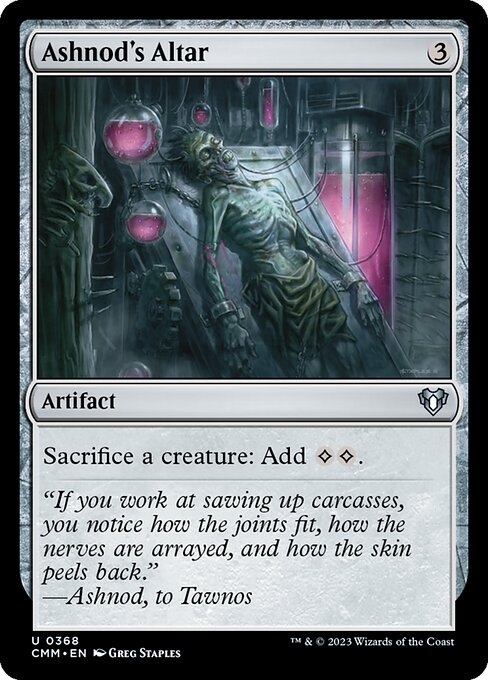

For a more combo-focused build, start with Reassembling Skeleton, Ashnod’s Altar and Pitiless Plunderer on the battlefield. Add Zulaport Cutthroat or Bastion of Remembrance as a creature-death payoff.
1. Sacrifice Skeleton to Ashnod’s Altar, adding two colorless mana. 2. Let Plunderer’s death trigger resolve to create a Treasure. Your drain payoff also triggers from Skeleton dying. 3. Sacrifice the Treasure for black mana. 4. Spend that black mana and one of the colorless mana to return Skeleton tapped. You have one colorless mana left over. 5. Repeat while the pieces remain available and the relevant abilities resolve.
Each cycle supplies another creature death and nets one colorless mana. The return being tapped does not stop the next sacrifice. This loop does not need Tecton to function.
With Tecton present, each cycle also creates two mandatory draw triggers: one for Skeleton and one for the Treasure. Do not announce an unlimited loop while ignoring your library. You need to finish before those draws empty it, or remove Tecton from the equation. Opponents can also interact with the pieces or exile Skeleton in response to its return ability. Include this package only if that combo finish fits the deck you intend to play.
A practical first draft and opening-hand plan
Begin with roughly 37 lands, then adjust after testing. Even if Tecton sometimes costs only two black, the rest of the deck still needs mana for Skeleton returns, interaction and rebuilding.
Aim for about 8–10 ramp sources, 7–9 sacrifice outlets including some instant-speed options, and 10–12 cards that produce expendable creatures or return themselves. Add reliable graveyard setup, roughly 8–10 interaction pieces, several finishers and card advantage that works without Tecton. Cards can fill multiple roles, so these categories are planning tools rather than a rigid 99-card allocation.
An opening hand should normally have enough lands or credible ramp to develop, at least one useful early play, and a plan beyond casting Tecton. Supplier, a sacrifice outlet and two Swamps are a promising beginning, but mill outcomes are uncertain; do not treat that hand as a guaranteed two-mana commander on schedule.
Early game: develop mana and use creatures or artifacts that naturally fill the graveyard. Preserve enough black sources to cast the commander.
Middle game: resolve Tecton when you can follow it with a useful sacrifice or protect it. Avoid sacrificing your entire board simply because every sacrifice draws a card.
Late game: use drain payoffs, Merchant triggers or the optional combo to close. Hold back enough material to rebuild after removal instead of relying on one uninterrupted engine turn.
Rules traps worth checking before you play
Tokens draw cards, but do not count toward fathomless descent. Sacrificing a Treasure or Snake can trigger Tecton. Tokens are not cards, so they do not increase the number of permanent cards in your graveyard.
“Another” excludes Tecton itself. Sacrificing only Tecton does not trigger its own draw ability. Also, destroying, discarding or milling a card is not sacrificing a permanent, even if the action puts a useful card into your graveyard.
The draw ability is not once per turn. Each qualifying sacrificed permanent produces a trigger. The draw is mandatory, which matters when you combine self-mill with repeated sacrifices.
The discount does not change mana value. Tecton’s mana value remains eight even when you cast it for two black. Reanimate would still make you lose eight life if you used it to return Tecton.
Check the front face of modal double-faced cards in the graveyard. Malakir Rebirth is an instant there, so the land on its back does not make it a permanent card for Tecton’s discount.
Sacrifices made before Tecton resolves do not earn its draw trigger. Spending a Treasure to help cast Tecton is useful, but Tecton is not yet on the battlefield to reward that sacrifice.
Start building Tecton on ElderDecks
Our first approach would be a mono-black sacrifice deck with useful self-mill creatures, renewable fodder and a small artifact package. Add the combo only if you want it; Tecton’s basic appeal is that ordinary value cards can support both casting the commander and keeping your hand full afterward.
Explore the pieces in the free ElderDecks Commander deck builder, keep the list marked as preview theorycraft, and revisit it when the set and final rules information are available. If you want to test an unreleased commander with friends, agree on that with the group first.
For the broader set, see our Nauctis Commander decks guide. If you would rather build around a whole army of ocean creatures, compare the approaches in our Terrors of the Abyss commanders article.
Would you build Tecton as a steady sacrifice-value deck or lean into the Skeleton combo?
Sources and verification
Tecton, Malignant Ruin — current Scryfall card text and legality
Wizards of the Coast — Nauctis: The Sunken Realm product and release information
Wizards of the Coast — The Lost Caverns of Ixalan release notes: fathomless descent
Wizards of the Coast — Commander 2018 release notes: cost reduction and commander tax
Wizards of the Coast — Current banned and restricted list
Card text, support-card color identities and current Commander legality were checked on November 19, 2026. The support cards discussed are legal within a mono-black color identity; Tecton itself remains an unreleased preview. Deckbuilding recommendations and sequencing examples are ElderDecks’ analysis of the current text.
Combo card references: Reassembling Skeleton · Ashnod's Altar · Pitiless Plunderer · Zulaport Cutthroat