Salinae, the Ocean Mother Commander Guide: Best Synergies & Traps
By ElderArticles · Updated 11/17/2026 · 15 min read
Build Salinae, the Ocean Mother with a 100-card Commander theorycraft, powerful Fish-copy synergies, a Drake combo, and the rules traps to avoid.
Table of contents
Preview deckbuilding · Updated November 17, 2026. Salinae is an officially previewed Nauctis card and is not yet released. The set’s announced tabletop release is February 5, 2027. This is an original theorycraft based on the revealed card and current rules, not a tested tournament list or a claim of current Commander legality. Official Nauctis first look.
A 1/1 Fish sounds harmless. A 1/1 Fish that untaps five lands, draws two cards, or brings an army of Elementals is a different proposition.
Salinae, the Ocean Mother rewards you for choosing creatures and artifacts whose abilities matter more than their size. Her best turns start with a useful spell and leave you with two useful permanents. Getting there is the challenge: she has an eight-mana printed cost, and a hand full of colorless artifacts does little for her devotion discount.
This Salinae Commander guide starts with that tension, then builds toward a complete 100-card starting list. The recommended direction is mono-blue creature value with a compact combo finish. It can still play a normal game when Salinae is unavailable.
Salinae, the Ocean Mother
Salinae, the Ocean Mother | Illustration by Svetlin Velinov
Salinae is a blue legendary Whale God with a printed cost of {6}{U}{U}, a 5/7 body, and trample. Blue devotion reduces the generic portion of her casting cost. Once she is on the battlefield, casting an artifact or creature spell triggers a copy, with the copy becoming a 1/1 Fish creature in addition to its other types.
The copy keeps the relevant text that made the original worth playing. This is why a small Mulldrifter is exciting and a small creature whose only attraction is a large body usually is not.
Our starting priorities: cheap blue permanents, creatures with useful enters abilities, a restrained artifact package, and enough interaction to survive the turn when the commander is removed.
For the wider set, see our Nauctis Commander decks guide. This custom Salinae build is separate from those four preconstructed products.
How devotion changes your opening turns
Devotion counts blue symbols in the mana costs of permanents you control. Islands do not supply devotion, and blue symbols in an activated ability’s text do not count. A card like Merfolk Trickster supplies two blue symbols while it remains on the battlefield. An Arcane Signet supplies none. Wizards’ devotion explanation.
Assuming no other cost changes, Salinae’s first cast costs eight mana at zero devotion, six at two devotion, four at four devotion, and {U}{U} at six or more devotion. Her discount does not pay the blue portion. Her own blue symbols do not help while she is on the stack.
Commander tax is added before reductions. After one previous command-zone cast, her cost starts at {8}{U}{U}; six devotion reduces it to {2}{U}{U}, while eight devotion reduces it to {U}{U}. The printed mana value remains eight. This follows the normal cost calculation in the Comprehensive Rules, rather than a special exemption from commander tax.
That makes your early permanents part of the mana plan. Faerie Seer followed by Merfolk Trickster can establish three devotion while providing useful effects. A collection of mana rocks might generate more mana, but it cannot replace that discount on its own.
Mulligan for a functioning first three turns. Three lands, an early blue permanent, and either ramp or interaction is a more convincing start than two lands and a collection of spectacular five-drops. Keep enough resources to cast a useful follow-up after Salinae resolves; an exposed commander and an empty hand is a fragile position.
The best Salinae synergy cards
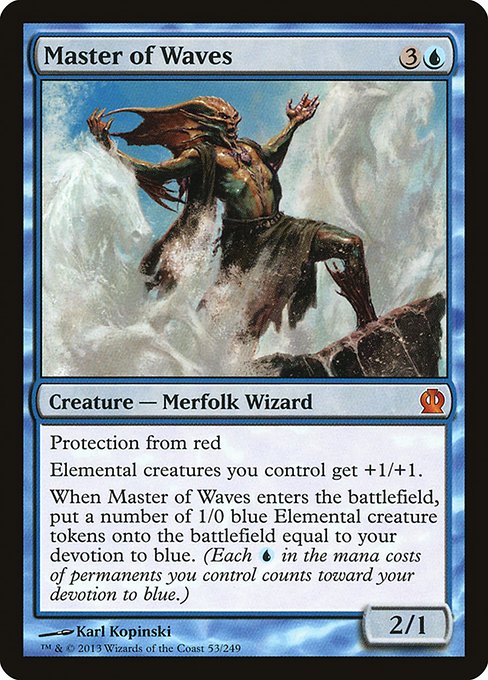
Master of Waves
Master of Waves | Illustration by Karl Kopinski
Master of Waves is the clearest reason to start with blue devotion. Salinae gives you two Masters, and each can make Elementals. Both Masters also improve those Elementals, so the payoff extends beyond doubling an enters trigger.
Here is a concrete example, assuming nothing else changes. Begin with only Salinae contributing two devotion. The Fish copy of Master enters first, bringing devotion to three and producing three Elementals. The original Master then enters, bringing devotion to four and producing four more. You end with seven Elementals, each 3/2 while both Masters remain.
The Fish copy retains Master’s blue mana symbol, so it contributes devotion despite being a token. The ordinary Elemental tokens have no mana cost and contribute none. If both Masters disappear, their unmodified 1/0 Elementals will not survive without another toughness boost.
Why it earns a slot: it turns the deck’s setup into a real combat threat. The limitation: it concentrates a lot of your board’s strength into a pair of vulnerable support creatures.
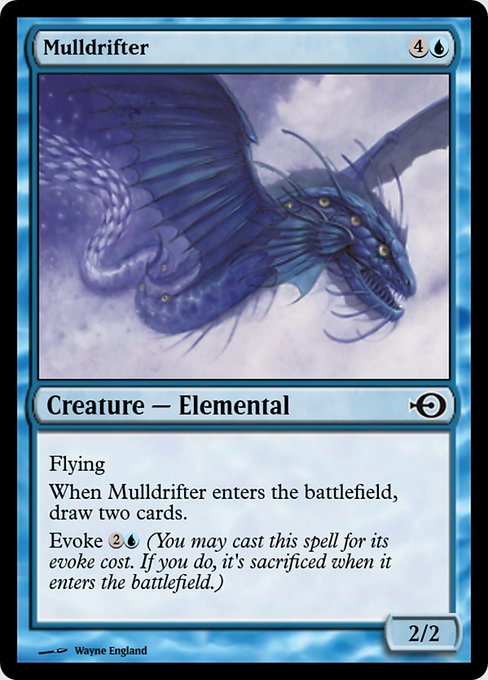
Mulldrifter
Mulldrifter | Illustration by Wayne England
Paying the normal five-mana cost gives two flying bodies and four cards, assuming both spells and their draw triggers resolve. That is an excellent recovery play after you have spent resources protecting the commander.
Evoke offers a different line: cast Mulldrifter for {2}{U}, get both draw triggers, and normally sacrifice both versions. The copied spell inherits the alternative-cost choice; the Fish does not escape the evoke sacrifice simply because you did not pay for it separately. Four cards for three mana is already useful enough.
Why it earns a slot: it works before or after Salinae. The limitation: choosing the cheaper mode does not leave a permanent army behind. The interaction applies the copied-spell rules to Mulldrifter’s documented evoke abilities.
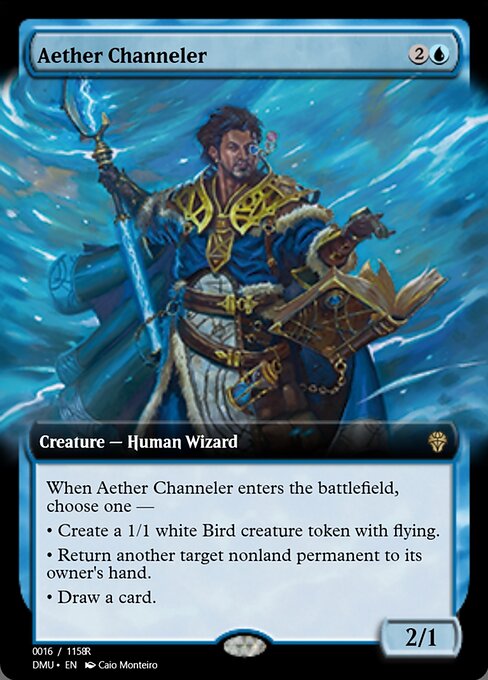
Aether Channeler
Aether Channeler | Illustration by Caio Monteiro
Channeler lets its enters ability provide a card, a flying Bird, or a bounce effect for another nonland permanent. With two Channelers entering separately, you can choose different modes and targets for their separate triggers. Returning a problem permanent with one while drawing with the other is often better than choosing the same mode twice.
This is the kind of flexible slot a commander-dependent deck needs. It buys time when you are behind, replaces itself when you are short on cards, and develops bodies when you are ahead. A returned threat can be recast, so treat the bounce as tempo rather than permanent removal.
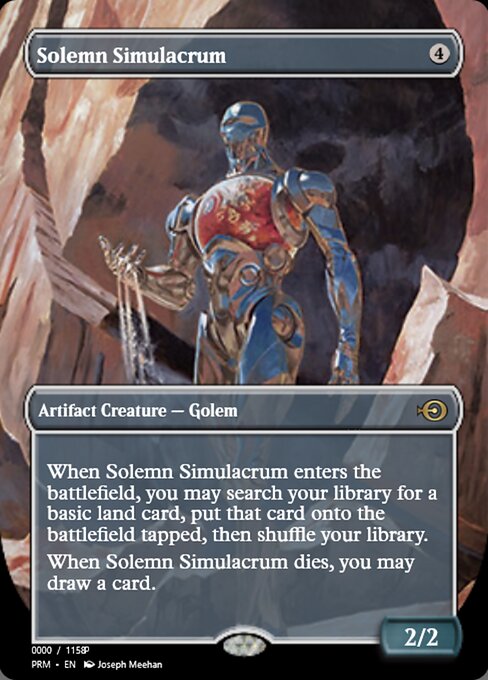
Solemn Simulacrum
Solemn Simulacrum | Illustration by Joseph Meehan
Two Solemns can find two basic lands, and each retains its own death-triggered card draw. The Fish does not need to be large to turn a later sacrifice or unfavorable block into another card.
Solemn is a useful exception to the preference for blue permanents: it supports land development and recovery, even though it contributes no devotion. Do not fill every four-mana slot with colorless value cards, but a few that solve actual problems belong here.
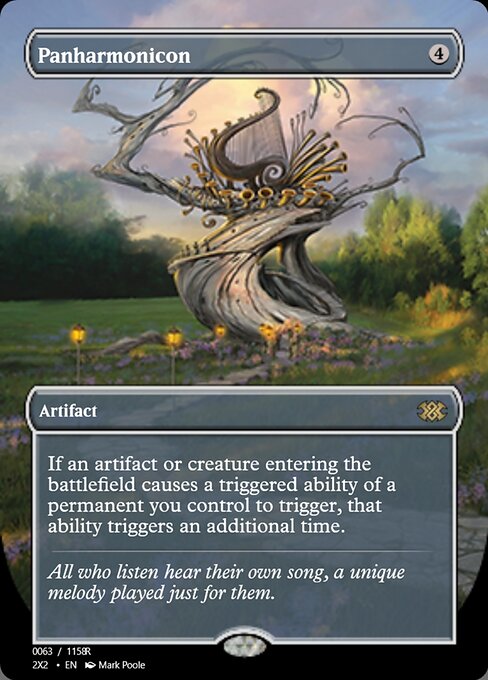
Panharmonicon
Panharmonicon | Illustration by Mark Poole
Panharmonicon increases qualifying enters triggers; it does not give Salinae another cast trigger. Casting it while Salinae is present can leave an ordinary Panharmonicon and a Fish Panharmonicon. With both in play, a qualifying ability triggers three times per entering permanent, not four.
That can make the next value creature spectacular. It also costs four mana, contributes no devotion, and needs another card to do anything useful. Keep it as an amplifier after the deck’s draw, interaction, and mana are covered. The distinction is explained in Wizards’ Panharmonicon rulings.
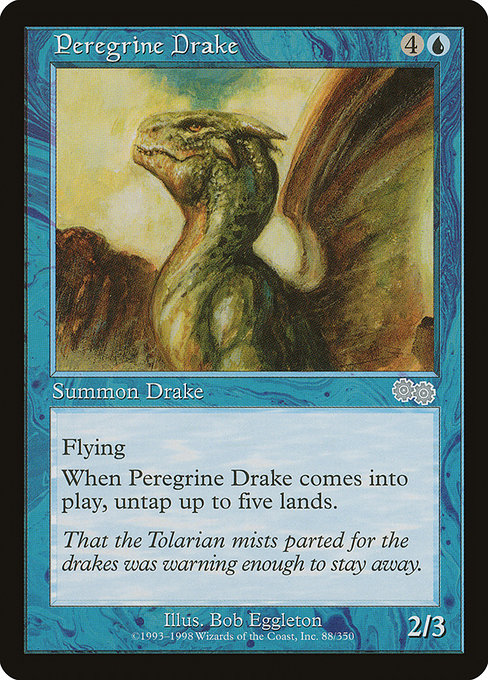
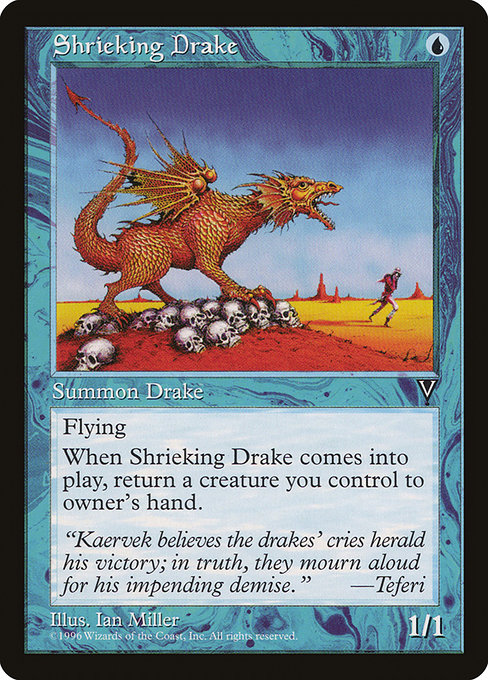
Peregrine Drake and Shrieking Drake
Peregrine Drake | Illustration by Bob EggletonShrieking Drake | Illustration by Ian Miller
Peregrine Drake is strong even without a loop: the original and its Fish copy each untap up to five lands. You can use those lands between the two enters triggers, turning one creature spell into a substantial mana swing.
Shrieking Drake has a different job. Its mandatory return ability can reuse a valuable creature, but the timing matters: the Fish copy enters before the original Shrieking Drake has resolved. That original is still a spell, so it is unavailable for the first return ability.
Together, these two Drakes give the deck an optional repeatable engine, explained below. A single Shrieking Drake and Salinae do not automatically make unlimited Fish.
A Salinae infinite-mana line, step by step
Required starting position: Salinae on the battlefield; Peregrine Drake and Shrieking Drake in hand; five untapped Islands; your main phase; no opposing effect preventing the casts, enters triggers, or untaps. No other permanents are required for this example.
1. Tap the five Islands and cast Peregrine Drake. Salinae copies it.
2. The Fish Peregrine resolves first. Its enters trigger untaps your five Islands. Tap them to float five blue mana before the original Drake resolves.
3. Let the original Peregrine resolve. Its trigger untaps those five Islands again. You now have five blue mana floating and five untapped Islands.
4. Spend one floating blue to cast Shrieking Drake. Its Fish copy enters first. Use that copy’s return ability to put the original Peregrine Drake back into your hand.
5. Let the original Shrieking Drake resolve. Use its own return ability to return itself to your hand.
6. You are back to both Drakes in hand and five untapped Islands, with four extra blue mana floating and two additional Fish tokens. Repeat the sequence during the same main phase as many times as needed.
Each completed cycle adds four blue mana and two 1/1 flying Fish in this stated setup. This is a rules-derived sequence, not a claim that opponents must let it resolve. The underlying return and untap abilities are documented in the Modern Horizons 3 and Dominaria Remastered release notes.
Where opponents can interrupt: removing Salinae stops future copies, countering a needed original Drake can break the sequence, and disabling enters abilities removes its engine. If an opponent acts after a trigger is already on the stack, that trigger still needs to be accounted for; removing the commander does not erase every pending effect.
Turning the engine into a finish
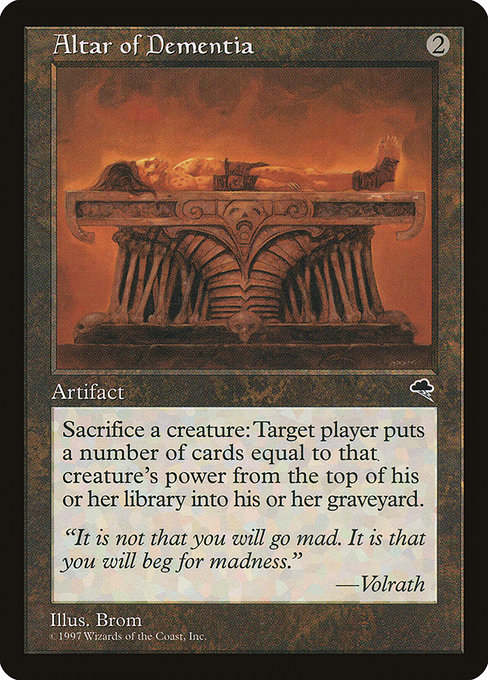
Altar of Dementia | Illustration by Brom
Altar of Dementia turns the extra Fish into milling. Its sacrifice ability has no tap-symbol cost, so the freshly arrived creatures can be sacrificed without waiting a turn. Make enough tokens to empty the opponents’ libraries, accounting for any protection or graveyard-shuffle effects they have.
An empty library is not an immediate loss. Usually the opponent must attempt to draw from it. A shuffle trigger, an alternate win condition, or a timely answer can matter. Altar provides a finish to protect, not a guarantee that the game has ended. Official Altar of Dementia notes.
Without Altar, the flying tokens can threaten combat on a later turn. Spectral Sailor can spend the mana on draws to look for interaction or a payoff. Avoid drawing through your own library accidentally.
For a version focused on combat, cut Peregrine Drake, Cloud of Faeries, Ghostly Flicker, and Altar of Dementia, replacing that package with value creatures and interaction. Cloud of Faeries can support a similar return-and-recast engine, while Ghostly Flicker enables other repeatable untap lines with Archaeomancer; removing only Altar does not remove the loops. Build toward Master of Waves, evasive bodies, and sustained card advantage instead.
Seven rules traps to avoid
1. The Fish spell is copied, not cast. It does not trigger Salinae again. An artifact creature spell also produces one Salinae trigger, not one for each card type.
2. Becoming a token is different from creating one. Replacement effects that double token creation do not multiply the Fish produced when the copied spell resolves. Ordinary token creation from a copied creature’s ability is a separate event. This distinction follows the permanent-spell-copy explanation in Wizards’ Foundations release notes.
3. A Fish mana rock is a creature. A newly arrived Fish Sol Ring cannot use its tap ability immediately without haste. The original noncreature Sol Ring can. Budget the mana you can actually spend this turn.
4. Blink does not recast a creature. Returning a real creature with Thassa, Deep-Dwelling can reuse its enters ability, but it does not trigger Salinae. Exiling a Fish token will not bring it back. Aim blink effects at the original cards.
5. Legendary status survives copying. Casting a legendary creature can produce a copy, but the legend rule normally prevents you from keeping both with the same name. Valuable enters triggers may still make the play worthwhile.
6. Do not sacrifice your functional pieces indiscriminately. An original mana rock can survive a creature wipe; its Fish copy usually cannot. A Fish can contribute devotion or supply a static ability you were counting on. Evaluate that role before treating it as disposable.
7. Devotion is not color identity. A blue-black hybrid card can add blue devotion in a game, but black in its color identity prevents its inclusion in a mono-blue Salinae deck. Choose legal blue or colorless support cards, not every card with a blue symbol.
The summoning-sickness, legend-rule, and deck-construction points above follow the current Comprehensive Rules. Specific interactions here are our application of those rules to the previewed card; check Nauctis release notes when they become available.
A complete 100-card Salinae starting list
One commander + 99 cards. The categories below are exclusive: artifact creatures and enchantment creatures appear under Creatures, and Bident of Thassa appears under Artifacts. There are 36 lands and no repeated nonbasic card names.
This is a prerelease starting point with an intentional infinite combo, not a budget-certified list, a tested performance claim, or a formal Commander bracket assignment. Salinae is unreleased as of this update. The remaining choices use blue or colorless color identities and avoid the current Commander banned list.
- 30 Island
- 1 Nykthos, Shrine to Nyx
- 1 Mystic Sanctuary
- 1 Castle Vantress
- 1 Myriad Landscape
- 1 War Room
- 1 Reliquary Tower
Budget choices and the first cuts to test
Start by pricing ordinary printings rather than chasing showcase versions. No deck total or preorder price is assumed here. These substitutions preserve a useful role while reducing reliance on premium cards; compare current prices before buying.
- Nykthos, Shrine to Nyx → Island. The deck loses explosive devotion turns but improves the reliability of an untapped blue land. Nykthos is not required for the five-Island combo example.
- Thassa, Deep-Dwelling → Nephalia Smuggler. Both can reuse a real creature’s enters ability. Smuggler needs mana, a tap, and time to become active, so it is a substantial speed downgrade.
- Sapphire Medallion → Prismatic Lens. A mana source replaces a cost reducer. Lens does not replicate Medallion’s savings across multiple blue spells, but it still helps develop your mana.
- Swan Song → Dispel. You keep a cheap answer for a counterspell exchange or instant-speed removal, while giving up coverage against enchantments and sorceries.
During testing, track the turns when you have cards but cannot afford to cast them, and the turns when you have mana but no useful follow-up. Those observations tell you more than adding another expensive engine.
If Salinae regularly sits in the command zone while your hand fills with artifacts, trim a slow colorless card for a low-cost blue permanent. If you establish devotion but repeatedly lose everything to a wipe, prioritize protection or draw instead of another payoff. Meteor Golem is an early top-end cut to test if seven mana proves too slow in your group.
How to play against Salinae
Salinae needs both setup and follow-through. Pressure her controller before the copying engine starts, and avoid spending removal on a replaceable Fish when the commander or a critical untap creature is the real problem.
Effects that stop creature enters triggers attack the value plan and the Drake loop. Creature sweepers can remove copied artifacts alongside the rest of the army. A spell limit can prevent the repeated casts a combo turn needs. Against a mostly blue board, removing the early devotion pieces before the commander is cast can also delay her arrival.
From the Salinae seat, keep interaction available and resist deploying every support piece into an obvious wipe. March of Swirling Mist offers a way to phase out selected creatures; phasing is different from exiling and returning tokens. Protection should preserve the specific permanents you need, not merely the largest number of bodies.
Is Salinae the right commander for you?
Choose Salinae if you enjoy small creatures with important jobs, sequencing enters triggers, and finding a finish inside a board that initially looks harmless. The build rewards careful mana management and gives ordinary value creatures a dramatic ceiling.
Expect more bookkeeping than a straightforward sea-monster deck: copied artifacts are creatures, token copies may contribute devotion, and not every form of doubling interacts the same way. If that puzzle appeals to you, start with the list above and change one package at a time.
Build your Salinae deck with ElderDecks, use the list as a starting point, and keep the preview status in mind while refining it. As Nauctis previews continue, prioritize cards that improve the opening turns or solve a real weakness before adding another spectacular late-game play.