10 Best Commander Protection Spells (and What They Stop)
By ElderArticles · Updated 11/16/2026 · 16 min read
Find the best Commander protection spells, learn which board wipes they stop, and avoid costly mistakes with hexproof, indestructible, phasing, and recursion.
Table of contents
You left mana open. You had protection in hand. Your creatures still disappeared.
Sometimes the problem isn't your timing. It's the word on the other player's card. Destroy, exile, sacrifice, and -X/-X ask very different questions, and a spell that laughs at one can do absolutely nothing against another.
The best Commander protection spells match both your deck and the removal you expect. This guide counts down ten useful options, with a real matchup beside every selection. We'll cover the obvious saves, the embarrassing misses, and the small rules details that decide whether you untap with an army or an apology.
Heroic Intervention | Illustration by James Ryman
Last updated: November 16, 2026.
Read the Board Wipe Before You Respond
Destroy or lethal damage: Indestructible can work. Regeneration and indestructible are different abilities; a no-regeneration clause doesn't switch indestructible off.
Exile, sacrifice, or return to hand: Indestructible doesn't address these actions. Phasing the affected permanent out before the effect resolves is one possible answer.
Toughness reduced to zero or less: Indestructible won't save the creature. Prevent the reduction, move the creature out of reach, or arrange a valid recovery plan before the spell resolves.
Targeted removal: Hexproof stops opponents from targeting the protected permanent. An effect that hits everything without targeting doesn't care about hexproof.
A spell on the stack: A suitable counterspell can stop the problem before it happens, unless the spell can't be countered. An activated or triggered ability is a different target category.
These are baseline rules, not promises that every card with a useful keyword answers every situation. Read the affected permanent types, targets, duration, and additional instructions. The official Magic rules are the reference for unusual interactions.
How We Ranked These Protection Spells
This is an editorial ranking for multiplayer Commander, not a popularity chart or a cEDH tier list. We prioritized breadth of coverage, mana efficiency, how much of your board survives, and usefulness when nobody casts a sweeper. Setup requirements and awkward failure cases count against a card.
A lower-ranked spell can still be the right inclusion. A deck built around one creature wants different insurance from a token deck or an enchantment engine. Every featured card was checked for Oracle text, color identity, and Commander legality on November 16, 2026. All ten were Commander-legal. This is not a price-ranked or exhaustive list, and no personal playtesting results are claimed.
Matchup verdicts below assume the protection resolves first, its targets remain legal, and no additional effects change the stated interaction.
#10. Malakir Rebirth
Malakir Rebirth // Malakir Mire | Illustration by Marta NaelWrath of God | Illustration by Quinton Hoover
Role: one-creature recovery. Color identity: black. Cost: B.
Sometimes the best way to keep your engine is to let it die briefly. Malakir Rebirth gives a creature a one-turn dies trigger that returns it tapped under its owner's control. You lose two life when the spell resolves. Its reverse face, Malakir Mire, is a tapped black source when your hand needs mana instead.
Against Wrath of God: yes, for the chosen nontoken creature. This isn't regeneration. The creature dies, then its trigger can bring it back. In a Meren of Clan Nel Toth deck, saving a useful supporting creature this way can also let Meren collect an experience counter from that death.
The tradeoff is real: the returned creature is a new object, so its counters disappear and its Equipment is no longer attached. A token can't come back. Exile and bounce don't trigger the ability, and graveyard hate can interrupt the return. If the creature is your commander, leave it in the graveyard rather than moving it to the command zone if you want this trigger to recover it.
Play it when preserving one engine matters more than keeping the whole battlefield intact.
Tamiyo's Safekeeping | Illustration by Evyn FongBlasphemous Act | Illustration by Daarken
Role: efficient protection for one permanent. Color identity: green. Cost: G.
One green mana is much easier to leave untapped than three. Safekeeping protects a permanent you control with hexproof and indestructible for the turn, then gains you two life. Crucially, that permanent doesn't have to be a creature. An important enchantment or mana engine is a perfectly reasonable target.
Against Blasphemous Act: yes, for one creature. Indestructible prevents lethal damage from destroying it. The rest of your team still needs a plan.
This is a good fit for a deck whose commander does most of the work, or one that can rebuild quickly as long as a particular engine survives. It can also stop an opponent's targeted exile spell through hexproof; that doesn't mean it stops a nontargeting exile sweeper.
The limit is scale. Safekeeping doesn't rescue a token army, doesn't stop sacrifice, and doesn't keep a creature alive at zero toughness. Think of it as a seat belt for your most important permanent, not a force field around your entire deck.
March of Swirling Mist | Illustration by Iris CompietFarewell | Illustration by Seb McKinnon
Role: flexible creature phasing. Color identity: blue. Cost: XU.
March lets you phase out up to X creatures, and they don't all have to be yours. That gives a defensive slot an offensive job: temporarily remove blockers, clear a troublesome creature, or hide your own engine from a wipe.
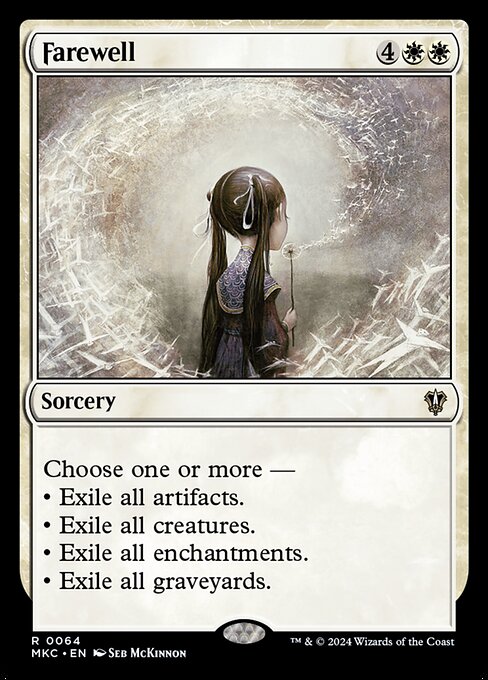
Against Farewell: yes, for the creatures you phase out. Your unattached artifacts and enchantments are still exposed to the relevant modes. Your graveyard is not protected.
The extra-cost ability lets you exile blue cards from your hand to reduce the generic cost by two per card. For example, X=2 normally costs 2U; exiling one blue card reduces that to U before other cost modifiers. It doesn't remove the blue requirement, and spending another card is a meaningful cost.
March is especially appealing when you need a few key creatures more than a sprawling army. It scales poorly if you must pay full price to save ten bodies. Also remember that phased-out blockers aren't available to defend you until they phase back in. Saving the engine is less impressive if the next opponent can simply attack you to death.
Guardian of Faith | Illustration by Brian ValezaCyclonic Rift | Illustration by Chuck Lukacs
Role: creature-based mass protection. Color identity: white. Cost: 1WW.
Guardian arrives at instant speed and phases out any number of your other target creatures. A protection effect attached to a creature is particularly useful in decks that can recover creatures from the graveyard.
Against an overloaded Cyclonic Rift: yes, for your other creatures selected by the trigger. Guardian itself remains and gets returned to your hand. That's a handy interaction: your army dodges the bounce, and your protection creature is available to cast again later.
Against a destruction wipe, Guardian usually dies instead. Sun Titan can return it on a later turn because Guardian's mana value is three, setting up another protective trigger. That is useful recursion, not a guarantee that every sweeper becomes a repeatable lock.
The word other does important work. Guardian cannot phase itself out with its own trigger, and unattached noncreature permanents remain exposed. Opponents can also respond to the enters trigger before your creatures disappear. Choose Guardian for creature-heavy white decks that value recovery and a reusable body more than protection for every permanent type.
Boros Charm | Illustration by Zoltan BorosBlasphemous Act | Illustration by Immanuela Crovius
Role: board-wide indestructible with offensive modes. Color identity: red-white. Cost: RW.
A protection spell feels better in your hand when it can also help finish the game. Boros Charm can grant your permanents indestructible, give a creature double strike, or deal four damage to a player or planeswalker.
Against Blasphemous Act: yes, for your creatures. You can even combine the two yourself: resolve Charm's indestructible mode, then cast Act to damage the whole battlefield while your creatures survive the destruction check. Other indestructible creatures and creatures tough enough to survive still remain.
The defensive mode covers permanents, not just creatures, making it useful when your plan also depends on artifacts or enchantments. But there is no hexproof here. Targeted exile still works, as do sacrifice and sufficient toughness reduction.
Feather, the Redeemed adds a useful wrinkle: Charm's double-strike mode can trigger Feather when it targets your creature. The indestructible mode doesn't target, so Feather won't recycle it on that basis. For more red-white homes, see our Boros commander guide.
Flawless Maneuver | Illustration by Chris RahnToxic Deluge | Illustration by Richard Kane Ferguson
Role: protection while tapped out. Color identity: white. Cost: 2W, or its alternative cost.
The appeal is simple: commit to the board without necessarily leaving three mana unused. If you control a commander, you may cast Flawless Maneuver without paying its mana cost. Your creatures gain indestructible for the turn.
Against Toxic Deluge: no, if the reduction brings their toughness to zero or less. Deluge doesn't destroy creatures. A free spell that answers the wrong problem is still the wrong spell.
Maneuver belongs in creature-heavy decks that expect to keep a commander on the battlefield. It preserves your attackers against destruction and lethal-damage sweepers while leaving mana available for development. It can also make blocks or attacks much less comfortable for opponents.
There are two important limits beyond exile and sacrifice. It protects creatures, not all permanents. And the alternative cost depends on controlling a commander when you cast it—not merely owning one in the command zone. Additional taxes can still require payment. Build around its efficiency, but include a different kind of protection if your group regularly uses wipes that ignore indestructible.
Swan Song | Illustration by Peter MohrbacherSupreme Verdict | Illustration by Ron Spears
Role: stop the relevant spell entirely. Color identity: blue. Cost: U.
Sometimes the cleanest protection spell never touches your creatures. Swan Song counters an enchantment, instant, or sorcery and gives its controller a flying 2/2 Bird. That covers many sweepers while keeping the mana commitment low.
Against Supreme Verdict: no. Verdict can't be countered. Swan Song can legally target it, but that doesn't make the counter instruction work—and its controller still gets the Bird. You have spent a card to improve someone else's afternoon.
Against a counterable sweeper, the upside is substantial: the spell doesn't resolve, so you can preserve your permanents without phasing away blockers or rebuilding attachments. The same card can protect a key spell from an opposing counterspell or interrupt an appropriate combo piece.
The drawback is political as well as mechanical. Countering a symmetrical wipe also saves your opponents' boards. Swan Song doesn't answer creature or artifact spells unless they are also enchantments, and it can't counter activated or triggered abilities. Play it in blue decks that want protection to double as efficient stack interaction, not as their only answer to every reset button.
Heroic Intervention | Illustration by James RymanFarewell | Illustration by Seb McKinnon
Role: broad green protection. Color identity: green. Cost: 1G.
Heroic Intervention earns its reputation by covering two common jobs at once. Your permanents gain hexproof and indestructible, protecting an established board from destruction and shielding it from opponents' targeted interaction.
Against Farewell: no. None of Farewell's modes targets, and exile isn't destruction. Both of Intervention's defensive keywords miss the problem.
Where Intervention shines is a mixed battlefield. Creature decks often also need their draw enchantment, mana artifacts, and other support pieces. Protecting all of those for two mana is a strong reason to choose it over a creature-only effect. It also lets you defend a single key permanent without needing a separate specialist card.
The practical mistake is treating it as permission to overextend into everything. It doesn't stop sacrifice, nontargeting bounce, or lethal toughness reduction. Nor does it give you, the player, hexproof. Hold it for removal it actually answers, and make room for recovery or phasing if your opponents attack from another direction.
Clever Concealment | Illustration by Alexey KruglovAll Is Dust | Illustration by Vincent Proce
Role: selective nonland protection with convoke. Color identity: white. Cost: 2WW.
Token decks have a particularly satisfying use for a threatened army: ask it to pay for its own escape. Convoke lets creatures help cast Clever Concealment, which phases out any number of your target nonland permanents.
Against All Is Dust: yes, for the nonland permanents you phase out. They aren't available to be sacrificed when the spell resolves. Lands are outside Concealment's targeting restriction, including animated lands.
Rhys the Redeemed is an appealing home. A token board can supply convoke payments, while Concealment preserves the creatures and supporting enchantments together. Summoning-sick creatures can convoke; tapped creatures cannot. You still need white mana or appropriate white creatures to cover the white requirements, so count your actual resources before announcing the spell.
Unlike an indiscriminate escape button, you choose what disappears. You can keep an appropriate resource available while hiding the pieces at risk. The price is leaving yourself potentially open to combat: Concealment doesn't freeze your life total. It also targets, so shroud or relevant protection on your own permanent can prevent you from selecting it.
Teferi's Protection | Illustration by Greg StaplesFarewell | Illustration by Seb McKinnon
Role: the broadest emergency exit in this selection. Color identity: white. Cost: 2W.
The top spot goes to the card that protects more than your battlefield. Until your next turn, your life total can't change and you gain protection from everything. All your permanents phase out, including lands, and the spell exiles itself.
Against Farewell: yes, for your battlefield. No, for cards already in your graveyard. Phasing doesn't put your permanents into exile or the graveyard, but it doesn't shelter those other zones either.
That combination is excellent for a developed board of creatures, counters, Equipment, and value engines. You preserve the battlefield you've invested in without leaving your life total exposed in the ordinary way. Phasing also preserves tokens and counters; it isn't a blink effect that sacrifices your token army to save the nontoken creatures.
It is not an instruction that says you can't lose. Opponents can still win through effects your protection doesn't prevent. Your lands also disappear, so you lose access to those mana sources while they're phased out. This is insurance for a board worth saving, not a substitute for interacting with a winning combo.
Build a Protection Package, Not a Pile of Similar Spells
Start with the thing your deck cannot afford to lose. Is it one commander, twenty tokens, or a collection of noncreature engines? Then look at the removal that actually gets played in your group.
One crucial creature: An efficient targeted answer plus a recovery spell may be more useful than several expensive mass-protection cards. Make sure your recovery plan doesn't depend on a token returning or on an exiled creature dying.
A wide creature board: Prioritize effects that scale without asking you to pay for every body. Include coverage for at least one removal category that indestructible misses if that category matters at your table.
Artifacts and enchantments: Read past the headline keyword. A spell that saves creatures can leave the real machinery of your deck completely exposed.
Blue decks: Stack interaction can cover protection and other defensive jobs, but don't forget uncounterable spells and abilities. Protecting only your board may also be better than saving everyone else's board alongside it.
There isn't one correct protection count for every Commander deck. Begin with a small, deliberate package, then note which cards sit unused and which threats keep beating you. Adding another card with the same blind spot won't fix that blind spot.
Start without registration, add your commander, and compare the mana you need to develop your board with the mana you need to keep available. Sign in when you're ready to save the deck to your account.
Commander Protection FAQs
Does hexproof stop board wipes?
Not by itself when the wipe doesn't target. Read the spell's actual wording. An overloaded Cyclonic Rift replaces its targeting wording with “each,” so hexproof on your permanents doesn't stop that overloaded effect.
Does protection from a color stop destruction sweepers?
Not merely because the sweeper is that color. Protection restricts particular things, including damage and targeting; it doesn't make a permanent immune to every effect from that color. Nontargeting destruction is a different problem from damage.
Can I wait until a wipe resolves before saving a creature?
Usually that is too late for these spells. Respond while the wipe is on the stack. After resolution, state-based actions handle lethal damage and zero toughness before you receive priority to cast another spell. Recovery triggers must already have been set up when the creature dies.
Does Malakir Rebirth work against Toxic Deluge?
It can recover the chosen nontoken creature if it dies and remains available in the graveyard. The returned creature is a new object, and Deluge doesn't affect creatures that enter after it resolves. That is different from a persistent battlefield effect that continues reducing the toughness of new creatures. Rebirth only supplies one return, not an endless rescue loop.
Do phased-out creatures lose counters or trigger enters abilities?
No. Phasing doesn't change zones. Counters remain, tokens continue to exist, and phasing doesn't itself trigger enters or leaves abilities. Auras and Equipment attached to a phasing creature phase out with it and normally return still attached. That is a major reason to choose phasing for an established board.
Is “protection spell” an official card type?
No. Here it means cards used to preserve your resources. Some use the actual protection keyword, while others use indestructible, hexproof, phasing, countering, or recovery. Those mechanisms are not interchangeable.
Make the Next Board Wipe Someone Else's Problem
A protection slot earns its place when you know what it covers before the removal spell hits the table. Keep one cheap answer for your key permanent, choose broad coverage when your board demands it, and avoid spending three deck slots on the same weakness.
The question isn't simply “Do I have protection?” It's “Does this protection stop what's about to happen?” Answer that correctly and you'll spend a lot fewer turns rebuilding from nothing.
Card names, Oracle text, color identities, and Commander legality checked through Scryfall on November 16, 2026. Individual entries link to their card records. Matchup conclusions and rankings are ElderDecks' editorial analysis of those texts and the rules, not claims of testing results.