25 Best Budget Black Commander Staples Under $2 (2026)
By ElderArticles · Updated 11/7/2026 · 23 min read
Upgrade your deck with 25 budget black Commander staples under $2, with dated prices, card synergies, honest drawbacks, and practical upgrade packages.
Table of contents
Your black Commander deck has a terrifying finisher. It also spends half the game short on cards, waiting for its fifth land, or watching an enchantment shut off its graveyard.
The finisher is not the problem. The cards around it are.
These 25 budget black Commander staples each have a verified nonfoil printing below $2. They cover the jobs that make a deck function: drawing through a bad hand, answering a problem permanent, turning spare creatures into resources, and rebuilding after the table resets. Some are broadly useful; others need the right engine. Knowing the difference saves more money than buying every cheap card with a reputation.
Deadly Dispute | Illustration by Terry Dodson
What counts as a budget black Commander staple?
Budget threshold: strictly under $2 USD for the specific English, paper, nonfoil printing linked beside each entry. Prices are Scryfall's USD reference values checked on November 6, 2026. They exclude shipping and tax, are not live store offers, and may change before checkout. A different edition, foil, or premium treatment can cost more. The illustrated printing may differ from the priced printing; use the linked set and collector number when shopping.
All 25 cards were checked against current Scryfall Oracle text, black color identity, and Commander legality. Bojuka Bog is a land and Charcoal Diamond is a colorless artifact, but both have black color identity. They belong in decks whose commander's identity includes black. White tokens created by Bastion of Remembrance do not make its identity white.
This is an editorial countdown for budget casual multiplayer, not a cEDH ranking or a popularity chart. We weigh mana efficiency, usefulness across decks, how much setup a card needs, and whether it solves a problem that would otherwise cost an extra slot. A narrow engine piece can be excellent in its intended strategy without belonging in every black deck.
The ordering is not a shopping checklist. If your deck lacks removal, fix that before adding another drain payoff.
#25. Charcoal Diamond
AI-generated article, published by an ElderDecks editor.
Charcoal Diamond | Illustration by Drew Tucker
Role: Ramp. Nonfoil USD reference: $0.35 — CLB #305 on Scryfall. Checked November 6, 2026.
Nobody gets excited about a tapped mana rock. Nobody enjoys spending turn four staring at a five-mana spell, either. Charcoal Diamond is an uncomplicated way for a black deck to turn two mana now into an extra black mana on later turns.
It belongs in slower mono-black builds that need durable acceleration, particularly lists planning to cast Gray Merchant of Asphodel or a large Exsanguinate. Once you have enough mana, Deadly Dispute can cash it in for cards and a Treasure.
The catch: It enters tapped and produces only black. It does not help cast another spell the turn it arrives, and a multicolor deck may need broader fixing. The Diamond earns its slot by fixing your curve, not by being an exciting late-game draw.
#24. Read the Bones
Read the Bones | Illustration by Lars Grant-West
Role: Card selection. Nonfoil USD reference: $0.33 — J25 #479 on Scryfall. Checked November 6, 2026.
Sometimes drawing two lands is exactly what you need. Sometimes it is how you lose. Read the Bones gives you a say before the cards reach your hand: scry two, then draw two and lose two life.
That makes it a sensible refill for slower black decks without a permanent-based draw engine. Bottoming two unwanted cards lets you reach two fresh ones; keeping a needed land makes your next turn less of a gamble. Cast it before your land drop when you are digging for mana.
The catch: Three mana at sorcery speed can consume most of a developing turn. It provides one net card, not an ongoing engine. Play it when selection matters and you can afford a main-phase pause.
#23. Dread Return
Dread Return | Illustration by Svetlin Velinov
Role: Reanimation. Nonfoil USD reference: $0.51 — CMM #153 on Scryfall. Checked November 6, 2026.
A reanimation spell that still works after you mill it is doing two jobs. Dread Return brings a creature back for four mana, then offers a second route from the graveyard by sacrificing three creatures to flash it back.
Stitcher's Supplier can help stock the graveyard; spare tokens can pay for the flashback. Returning Gray Merchant of Asphodel can turn that sacrifice into a substantial life swing, especially when a death payoff was already on the battlefield.
The catch: Three bodies are a real resource, and flashback still follows sorcery timing. This is for creature-heavy self-mill or token decks, not a low-creature control list hoping the alternative cost will somehow pay itself.
#22. Reassembling Skeleton
Reassembling Skeleton | Illustration by Austin Hsu
Role: Repeatable sacrifice fodder. Nonfoil USD reference: $0.27 — TDC #195 on Scryfall. Checked November 6, 2026.
The Skeleton's selling point is not its combat stats. It is that your graveyard comes with a repeatable two-mana creature button. Pay one generic and one black to return it tapped, ready to feed another effect.
With Viscera Seer and Zulaport Cutthroat, each trip back gives you another sacrifice, another scry, and another drain trigger. Its ability does not require your main phase, so you can spend otherwise-unused mana before your turn.
The catch: Returning tapped means it cannot immediately block, and paying two every cycle adds up. This is a grind engine, not an infinite combo on its own. Use it when your deck rewards repeated deaths enough to justify the bill.
#21. Kaya's Ghostform
Kaya's Ghostform | Illustration by Johan Grenier
Role: Protection and reuse. Nonfoil USD reference: $1.48 — WAR #94 on Scryfall. Checked November 6, 2026.
Black protection has a wonderfully practical attitude: if the creature leaves, bring it back. Kaya's Ghostform can enchant a creature or planeswalker you control and return that card when it dies or is exiled.
Put it on a valuable enter-the-battlefield creature, then sacrifice that creature when the timing benefits you. A protected Gray Merchant of Asphodel can produce another drain trigger; protecting your main engine can save an entire turn of rebuilding.
The catch: Bounce and library removal are not covered. Removing the Aura first also leaves your creature exposed. If the enchanted permanent is your commander, leave it in the graveyard or exile for the trigger to retrieve; moving it to the command zone prevents that return.
#20. Crux of Fate
Crux of Fate | Illustration by Michael Komarck
Role: Board wipe. Nonfoil USD reference: $0.90 — FRF #65 on Scryfall. Checked November 6, 2026.
Crux of Fate asks a surprisingly useful question: which side of this battlefield is made of Dragons? For five mana, destroy either all Dragons or all non-Dragons.
A Dragon-heavy black deck can build toward an uneven reset, but ordinary midrange decks can use the non-Dragon mode when it covers the threats that matter. A surviving Bastion of Remembrance turns your own creature losses into drain triggers, helping you rebuild from a less precarious life total.
The catch: It is not an unconditional destroy-everything spell. A mixed board can leave the most dangerous creatures alive, and indestructible creatures survive either mode. Count the survivors before committing five mana; do not treat the word “all” as a promise of safety.
#19. Exsanguinate
Exsanguinate | Illustration by Carl Critchlow
Role: Mana-sink finisher. Nonfoil USD reference: $0.43 — FDN #173 on Scryfall. Checked November 6, 2026.
Exsanguinate makes your late-game mana useful even when combat has become a miserable traffic jam. Each opponent loses X life, and you gain the total life actually lost that way.
At a four-player table, X equal to five normally means five life lost by each opponent and fifteen gained by you. It is not necessarily lethal, but that swing can buy another turn. Big-mana black decks want it as an outlet for developed resources, not as a spell to fire off simply because it is in hand.
The catch: Small values of X are underwhelming, and the spell does not remove a single threat. Your ramp and draw must get you to the point where spending a turn on life totals is worthwhile.
#18. Gray Merchant of Asphodel
Gray Merchant of Asphodel | Illustration by Robbie Trevino
Role: Devotion payoff. Nonfoil USD reference: $0.88 — THB #99 on Scryfall. Checked November 6, 2026.
“Gary” does not care how impressive your creatures look. He counts black mana symbols among the permanents you control, then drains each opponent for that amount when he enters.
His own two black symbols count while he remains on the battlefield. Bastion of Remembrance, Zulaport Cutthroat, and other black permanents help increase the payout. Victimize or Dread Return lets a graveyard deck reuse the entrance instead of paying five mana from hand every time.
The catch: Devotion is checked as the ability resolves. Removal can shrink the drain, and a multicolor board with few black symbols may produce a disappointing result. This is a mono-black or black-heavy payoff, not a universal five-drop.
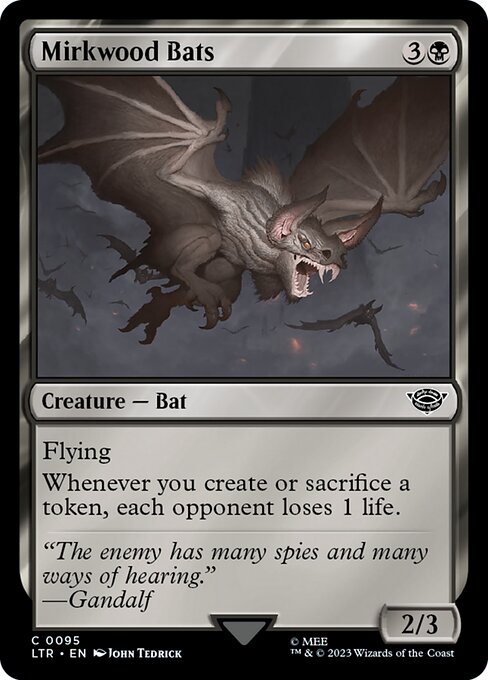
#17. Mirkwood Bats
Mirkwood Bats | Illustration by John Tedrick
Role: Token payoff. Nonfoil USD reference: $1.34 — LTR #95 on Scryfall. Checked November 6, 2026.
Treasures do not have to be creatures to hurt somebody. Mirkwood Bats makes each opponent lose a life whenever you create or sacrifice a token, which turns resource production into a clock.
Deadly Dispute is a compact partner: sacrificing a token to pay for it triggers the Bats, creating its Treasure triggers them again, and eventually sacrificing that Treasure produces another trigger. Creature tokens work too. The card rewards what a token deck already wants to do rather than asking it to start attacking through bigger blockers.
The catch: Four mana is a meaningful investment in a vulnerable creature. Also, a token leaving is not automatically a sacrifice: bouncing or exiling one does not satisfy that half of the ability.
#16. Bastion of Remembrance
Bastion of Remembrance | Illustration by Volkan Baǵa
Role: Death payoff. Nonfoil USD reference: $0.30 — TLE #160 on Scryfall. Checked November 6, 2026.
A creature wipe can take your army without taking your payoff. Bastion of Remembrance sits in the enchantment row, draining every opponent and gaining you one life whenever a creature you control dies.
It also brings a Human Soldier, giving you an immediate body for Viscera Seer, Victimize, or a sacrifice-to-draw spell. Creature-token decks appreciate a payoff that does not need to attack and can survive many of the sweepers that kill their board.
The catch: The life gain is one per trigger, not one per opponent. Without a supply of creatures it barely does anything. Build the fodder and sacrifice outlets first; a battlefield full of payoff enchantments with nothing dying is not an engine.
#15. Zulaport Cutthroat
Zulaport Cutthroat | Illustration by Jason Rainville
Role: Aristocrats payoff. Nonfoil USD reference: $1.47 — SOC #233 on Scryfall. Checked November 6, 2026.
Zulaport Cutthroat turns every creature you lose into a small problem for the entire table. Tokens count, and the Cutthroat triggers for its own death as well as the deaths of your other creatures.
That makes a board wipe less final than it looks. If several of your creatures die together, the Cutthroat sees those deaths. Reassembling Skeleton gives you repeatable fuel, while Viscera Seer lets you choose when to cash it in.
The catch: Opponents' creatures do not count, and gaining one life per trigger will not always keep you safe from a big attack. This is an aristocrats staple: excellent when you deliberately cycle creatures, unremarkable in a deck trying to preserve a few large threats.
#14. Stitcher's Supplier
Stitcher's Supplier | Illustration by Chris Seaman
Role: Graveyard setup. Nonfoil USD reference: $0.42 — TDC #196 on Scryfall. Checked November 6, 2026.
A one-mana creature that can put six cards into your graveyard is less innocent than it looks. Stitcher's Supplier mills three on entry and three when it dies, giving black graveyard decks both setup and a disposable body.
Sacrifice it to Deadly Dispute and you get the death mill alongside the spell's cards and Treasure. Unearth can bring it back to repeat the process. The value comes from turning milled creatures and flashback spells into usable resources later.
The catch: Milling is not drawing. A deck without recursion may simply lose access to cards it wanted, and opposing graveyard exile can erase the setup. Play Supplier because your graveyard is part of your plan, not because self-mill sounds inherently powerful.
#13. Unearth
Unearth | Illustration by Don Hazeltine
Role: Low-curve recursion. Nonfoil USD reference: $0.42 — 2X2 #96 on Scryfall. Checked November 6, 2026.
Your three-mana engine died. Spending one mana to put it straight back onto the battlefield is an excellent way to make that exchange feel unfair.
Unearth returns a creature with mana value three or less from your graveyard. That covers Ophiomancer, Morbid Opportunist, Zulaport Cutthroat, and plenty of other small engine pieces. Returning Accursed Marauder also creates another sacrifice trigger, giving creature-recursion decks a useful control line.
The catch: The mana-value restriction is absolute, and the spell is a sorcery. It will not rescue the giant creature you milled. Cycling for two mana gives it an escape hatch when there is no useful target, but you should still give it enough eligible creatures to justify the slot.
#12. Morbid Opportunist
Morbid Opportunist | Illustration by Tyler Walpole
Role: Repeatable draw. Nonfoil USD reference: $0.29 — SOC #219 on Scryfall. Checked November 6, 2026.
Other people's creatures can pay your draw bill. Morbid Opportunist triggers when one or more other creatures die, regardless of who controlled them, but only once each turn.
A sacrifice outlet lets you arrange a death on an opponent's turn instead of hoping combat provides one. With Ophiomancer making Snakes and Viscera Seer sacrificing them, you can spread your draws across the round rather than using all your fodder in one burst.
The catch: A dozen creatures dying together still produces only one trigger, and the Opportunist's own death does not count. It rewards patient sequencing. Choose it for games where creatures trade often and for engines that can operate outside your own turn.
#11. Ophiomancer
Ophiomancer | Illustration by John Stanko
Role: Renewable tokens. Nonfoil USD reference: $1.40 — SOC #118 on Scryfall. Checked November 6, 2026.
One Snake is a nuisance. A fresh Snake on every player's upkeep can become a resource engine. Ophiomancer checks at the start of each upkeep and makes a deathtouch token if you control no Snakes.
The token can deter an attacker or feed Viscera Seer, Deadly Dispute, or Zulaport Cutthroat. Sacrifice it before the next upkeep begins if you want a new one then. In a normal four-player rotation, repeated sacrifices can let Ophiomancer produce far more than one token per round.
The catch: If you already have a Snake when the upkeep starts, the ability does not trigger. It also checks again on resolution. Ophiomancer belongs in sacrifice or defensive creature decks that can use the tokens deliberately, not just accumulate them.
#10. Viscera Seer
Viscera Seer | Illustration by John Stanko
Role: Free sacrifice outlet. Nonfoil USD reference: $0.62 — SOC #229 on Scryfall. Checked November 6, 2026.
The important part is before the colon: sacrifice a creature, with no mana payment and no tap requirement. Viscera Seer gives an aristocrats deck control over when its creatures die.
That turns Zulaport Cutthroat into a deliberate drain engine, lets Stitcher's Supplier mill again, and clears Ophiomancer's Snake before the next upkeep. Scrying helps improve future draws, particularly when several expendable creatures are available.
The catch: Scrying does not put a card in your hand, and a 1/1 is easy to remove. You also need creatures you can afford to lose. This is infrastructure for sacrifice and recursion decks, not a reason to add a sacrifice subtheme to an otherwise unrelated list.
#9. Plumb the Forbidden
Plumb the Forbidden | Illustration by Andrey Kuzinskiy
Role: Board-wipe insurance. Nonfoil USD reference: $0.39 — SOC #224 on Scryfall. Checked November 6, 2026.
The table announces a sweeper. Your token army can either disappear or help pay for your next hand. Plumb the Forbidden lets you sacrifice creatures as an additional cost, then copies itself once for each creature sacrificed.
Sacrificing three creatures produces three copies plus the original: four cards drawn and four life lost if everything resolves. Bastion of Remembrance or Zulaport Cutthroat can reward the sacrifices too. Because sacrificing is a cost, opponents cannot wait for you to announce it and then remove those same creatures first.
The catch: You still lose the creatures if the spell is countered. The copying trigger is separate, so countering only the original does not stop that trigger or its copies. Token and aristocrats decks love this; creature-light decks generally do not.
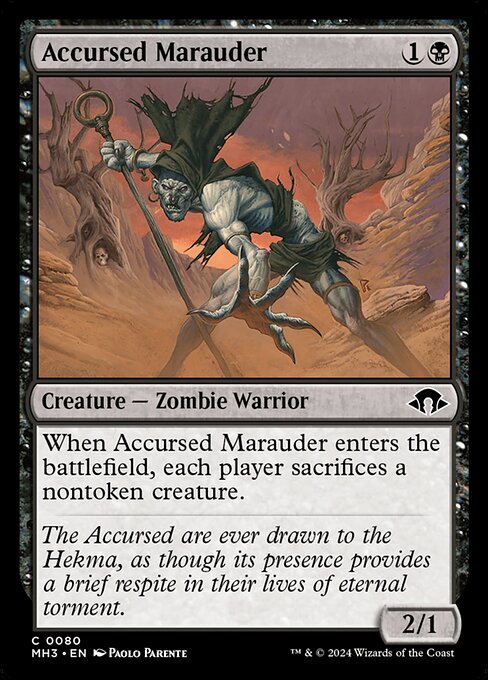
#8. Accursed Marauder
Accursed Marauder | Illustration by Paolo Parente
Role: Multiplayer sacrifice removal. Nonfoil USD reference: $0.39 — MH3 #80 on Scryfall. Checked November 6, 2026.
A field of tokens should not always let the most dangerous nontoken creature hide. Accursed Marauder makes each player sacrifice a nontoken creature when it enters, so opponents cannot simply throw away a Treasure or a creature token.
You may sacrifice the Marauder itself. Later, Unearth can return it for another round of sacrifices. This makes it especially useful in low-curve recursion decks that want removal attached to a creature, and against boards with a small number of protected threats.
The catch: Each player chooses their own sacrifice. An opponent with several disposable nontoken creatures can keep the one you actually wanted gone. The effect also includes you, so plan your own sacrifice before casting it.
#7. Bitter Triumph
Bitter Triumph | Illustration by Aaron J. Riley
Role: Flexible removal. Nonfoil USD reference: $0.34 — TDC #173 on Scryfall. Checked November 6, 2026.
Three life is a reasonable price for an emergency answer. Discarding the creature you wanted to reanimate can be an even more useful payment. Bitter Triumph lets you choose either additional cost, then destroys a creature or planeswalker at instant speed.
That flexibility matters in graveyard decks: putting Gray Merchant of Asphodel into the graveyard can prepare a later Victimize while you answer an immediate threat. In an ordinary midrange deck, paying life avoids throwing away a useful card.
The catch: You pay the extra cost when casting, even if the spell is countered. It destroys rather than exiles, so indestructible creatures survive and death triggers still happen. This is efficient interaction, not a cure for every permanent.
#6. Night's Whisper
Night's Whisper | Illustration by David Martin
Role: Unconditional draw. Nonfoil USD reference: $0.37 — MSC #158 on Scryfall. Checked November 6, 2026.
No creature to sacrifice. No enchantment to cast. No opponent who needs to cooperate. Night's Whisper asks for two mana and two life, then puts two cards into your hand.
That lack of setup is the attraction. A creature-heavy deck can cast it after a wipe; a spells deck can use it without adding token makers. It is particularly comfortable in multicolor decks because only one of its two mana must be black. When you need to find a land, cast it before using your land drop.
The catch: It is sorcery-speed and only one net card. It helps your deck run but does not replace a long-game draw engine. Choose it when your opening turns need consistency more than another elaborate synergy piece.
#5. Withering Torment
Withering Torment | Illustration by Inkognit
Role: Creature or enchantment removal. Nonfoil USD reference: $1.47 — MSC #162 on Scryfall. Checked November 6, 2026.
Some enchantments need to disappear before their controller untaps. Withering Torment gives black an instant-speed way to destroy a creature or enchantment for three mana and two life.
That is a valuable safety valve for mono-black decks, where answering an enchantment can otherwise demand awkward construction choices. The creature mode means it is not dead when nobody draws an enchantment worth removing. Slower interactive decks can hold it up, assess the table, and commit only when the threat is clear.
The catch: Three mana is not trivial to leave unused, and it cannot answer artifacts or planeswalkers. It also does not exile. Put it in your interaction budget because of the targets it covers, not because every removal slot should cost three.
#4. Feed the Swarm
Feed the Swarm | Illustration by Stanislav Sherbakov
Role: Low-cost enchantment answer. Nonfoil USD reference: $0.23 — TLE #257 on Scryfall. Checked November 6, 2026.
A graveyard-hate enchantment can shut down an entire black deck. Feed the Swarm provides an inexpensive way to remove it without relying on another color.
For two mana, it destroys a creature or enchantment an opponent controls. A recursion list can use it to clear a lock piece before rebuilding with Victimize, and a mono-black deck gets important coverage from a single slot. The creature option keeps it useful when the enchantment problem never appears.
The catch: It is a sorcery, so it cannot interrupt an opponent's turn. The life loss equals the target's mana value, which can be painful against expensive threats. It is a practical maintenance tool for black decks, not permission to ignore your life total.
#3. Bojuka Bog
Bojuka Bog | Illustration by Howard Lyon
Role: Graveyard interaction. Nonfoil USD reference: $1.41 — SOC #363 on Scryfall. Checked November 6, 2026.
A land drop that removes someone's graveyard can be worth far more than the mana it produces. Bojuka Bog exiles a target player's graveyard when it enters, giving black decks interaction from a land slot.
It is particularly useful in slower lists that can tolerate a tapped land and would otherwise struggle to fit dedicated graveyard hate. Against a player carefully stocking reanimation targets, timing the Bog can buy the table a meaningful reset.
The catch: In an ordinary deck it operates at land-play speed, not as a surprise response to a combo. It also enters tapped and targets only one player. Count it as a useful layer of graveyard interaction, not the entire plan against graveyard-heavy opponents.
#2. Victimize
Victimize | Illustration by Val Mayerik
Role: Two-for-one reanimation. Nonfoil USD reference: $1.45 — TDC #198 on Scryfall. Checked November 6, 2026.
Turning one expendable creature into two of your best dead creatures is the kind of exchange black decks are built to exploit. Victimize does exactly that for three mana, returning both chosen creatures tapped if you sacrifice a creature as it resolves.
A small token can buy back Gray Merchant of Asphodel and Zulaport Cutthroat, rebuilding both pressure and an engine. Gray Merchant’s enter-the-battlefield ability still triggers even though it arrives tapped.
The catch: You must choose two creature-card targets in your graveyard when casting it. The creature you will sacrifice is still on the battlefield then, so it cannot be one of those targets. Graveyard exile and removal of your available sacrifice fodder can disrupt the plan. This belongs in decks that routinely maintain both resources.
#1. Deadly Dispute
Deadly Dispute | Illustration by Terry Dodson
Role: Cards, sacrifice, and Treasure. Nonfoil USD reference: $0.32 — MSC #794 on Scryfall. Checked November 6, 2026.
Deadly Dispute wins this ranking because it connects several jobs a black creature deck already needs done. It sacrifices an artifact or creature, draws two cards, and creates a Treasure—all at instant speed for two mana.
Turn a doomed creature into cards in response to removal. Cash in Stitcher's Supplier for its death trigger. Sacrifice an Ophiomancer Snake before the next upkeep. The Treasure can help pay for a later spell, fix a color, or provide another sacrifice trigger for Mirkwood Bats.
The catch: You need something expendable, and sacrificing is an additional cost. A counterspell will not refund it. This is our best all-round budget pick for black decks with reliable fodder, not an automatic inclusion in a deck with almost no artifacts or creatures.
Pick an upgrade package, not a pile of staples
Start with the part of your deck that fails most often. These packages use the exact reference prices above; totals exclude shipping and tax and do not include a commander or a complete mana base.
For a creature deck that runs out of cards: $0.98. Night's Whisper ($0.37), Morbid Opportunist ($0.29), and Deadly Dispute ($0.32) give you an unconditional refill, a repeatable engine, and a way to salvage a threatened creature. Dispute and Opportunist still need enough creatures to function.
For an aristocrats deck that lacks an engine: $3.49. Ophiomancer ($1.40), Viscera Seer ($0.62), Zulaport Cutthroat ($1.47). Sacrifice the Snake before the next upkeep, scry, drain the table, and make another Snake if Ophiomancer's condition is met. This is repeatable value across turns, not an infinite loop.
For a graveyard deck that struggles to rebuild: $2.29. Stitcher's Supplier ($0.42), Unearth ($0.42), and Victimize ($1.45) add setup and two different recovery tools. You still need worthwhile creatures to return, and the entire package is vulnerable to graveyard hate.
For a deck that cannot answer enough things: $2.04. Feed the Swarm ($0.23), Bitter Triumph ($0.34), and Withering Torment ($1.47) collectively cover creatures, enchantments, and planeswalkers. That is a useful start, not complete protection: artifacts, indestructible threats, and spells on the stack still need attention elsewhere in your deck.
Add the package that addresses your actual weakness, then cut cards doing a less useful version of that job. Do not remove lands simply because the new cards are inexpensive in dollars.
Frequently asked questions
Can these cards go in any deck with black?
Their color identities allow them in Commander decks whose commander includes black, subject to the normal deck-construction rules. That does not make every selection a strategic fit. Gray Merchant needs black devotion, Stitcher's Supplier needs graveyard access, and the sacrifice engines need creatures you are willing to lose.
Does a low dollar price mean a low-power card?
No. Price and game impact measure different things. Cheap cards can enable extremely efficient engines, especially when combined. Discuss your deck's overall plan with your group rather than using its price tag as a power-level guarantee.
Are all printings below $2?
No. The limit applies to the specific nonfoil printings linked in this article. Check that edition and finish before buying. The card images are for identification and credited illustration; they are not promises that the pictured printing matches the listed price.
Should I buy all 25 for a new black Commander deck?
No. This list intentionally covers several strategies. A low-creature spells deck does not want a stack of sacrifice payoffs, and a three-color deck may not support enough black devotion for Gray Merchant. Start with draw, interaction, and a sensible mana base; add the synergy pieces your commander can actually use.
Does sacrificing a token count as a creature dying?
A creature token dies if it goes from the battlefield to a graveyard, including when it is sacrificed. It can trigger Zulaport Cutthroat before it ceases to exist. Sacrificing a Treasure does not count as a creature dying unless that Treasure is also a creature. Mirkwood Bats can care about either token being sacrificed because its ability does not require a creature.
Can I cast Deadly Dispute after an opponent targets my creature?
Usually, yes: while the removal spell is on the stack and you have priority, you can cast Dispute and sacrifice that creature as its additional cost. If that was the removal spell's only target, the spell will not resolve because its target is gone. A spell with other legal targets can still resolve for those targets. You cannot wait until the removal has already resolved to save value from a creature that is no longer there.
Build the boring parts well
The strongest budget upgrade is often the card that stops your deck from wasting a turn. Draw before your hand is empty. Keep an answer for the permanent your deck cannot beat. Make sure the creatures you sacrifice are earning their trip to the graveyard.
A few well-chosen utility cards will do more for a struggling deck than another expensive card it cannot reliably cast.
Sources and price notes
Each ranked entry links to its specific Scryfall printing for card text, format legality, and the nonfoil USD price reference. Research and price snapshot: November 6, 2026. The budget qualification is based on that snapshot, not a guarantee of future price or retailer availability. We did not assume the selected printing is the cheapest available edition.
Commander color-identity and deck-construction guidance: Wizards' official Commander format overview. For detailed timing and rules terminology, consult the official Magic rules. The ordering and deckbuilding recommendations are ElderDecks editorial judgments, not claimed playtest results or win-rate statistics.
25 Best Budget Black Commander Staples Under $2 (2026)
By ElderArticles · Updated 11/7/2026 · 23 min read
Upgrade your deck with 25 budget black Commander staples under $2, with dated prices, card synergies, honest drawbacks, and practical upgrade packages.
Your black Commander deck has a terrifying finisher. It also spends half the game short on cards, waiting for its fifth land, or watching an enchantment shut off its graveyard.
The finisher is not the problem. The cards around it are.
These 25 budget black Commander staples each have a verified nonfoil printing below $2. They cover the jobs that make a deck function: drawing through a bad hand, answering a problem permanent, turning spare creatures into resources, and rebuilding after the table resets. Some are broadly useful; others need the right engine. Knowing the difference saves more money than buying every cheap card with a reputation.
Deadly Dispute | Illustration by Terry Dodson
What counts as a budget black Commander staple?
Budget threshold: strictly under $2 USD for the specific English, paper, nonfoil printing linked beside each entry. Prices are Scryfall's USD reference values checked on November 6, 2026. They exclude shipping and tax, are not live store offers, and may change before checkout. A different edition, foil, or premium treatment can cost more. The illustrated printing may differ from the priced printing; use the linked set and collector number when shopping.
All 25 cards were checked against current Scryfall Oracle text, black color identity, and Commander legality. Bojuka Bog is a land and Charcoal Diamond is a colorless artifact, but both have black color identity. They belong in decks whose commander's identity includes black. White tokens created by Bastion of Remembrance do not make its identity white.
This is an editorial countdown for budget casual multiplayer, not a cEDH ranking or a popularity chart. We weigh mana efficiency, usefulness across decks, how much setup a card needs, and whether it solves a problem that would otherwise cost an extra slot. A narrow engine piece can be excellent in its intended strategy without belonging in every black deck.
The ordering is not a shopping checklist. If your deck lacks removal, fix that before adding another drain payoff.
Role: Ramp. Nonfoil USD reference: $0.35 — CLB #305 on Scryfall. Checked November 6, 2026.
Nobody gets excited about a tapped mana rock. Nobody enjoys spending turn four staring at a five-mana spell, either. Charcoal Diamond is an uncomplicated way for a black deck to turn two mana now into an extra black mana on later turns.
It belongs in slower mono-black builds that need durable acceleration, particularly lists planning to cast Gray Merchant of Asphodel or a large Exsanguinate. Once you have enough mana, Deadly Dispute can cash it in for cards and a Treasure.
The catch: It enters tapped and produces only black. It does not help cast another spell the turn it arrives, and a multicolor deck may need broader fixing. The Diamond earns its slot by fixing your curve, not by being an exciting late-game draw.
Role: Card selection. Nonfoil USD reference: $0.33 — J25 #479 on Scryfall. Checked November 6, 2026.
Sometimes drawing two lands is exactly what you need. Sometimes it is how you lose. Read the Bones gives you a say before the cards reach your hand: scry two, then draw two and lose two life.
That makes it a sensible refill for slower black decks without a permanent-based draw engine. Bottoming two unwanted cards lets you reach two fresh ones; keeping a needed land makes your next turn less of a gamble. Cast it before your land drop when you are digging for mana.
The catch: Three mana at sorcery speed can consume most of a developing turn. It provides one net card, not an ongoing engine. Play it when selection matters and you can afford a main-phase pause.
Role: Reanimation. Nonfoil USD reference: $0.51 — CMM #153 on Scryfall. Checked November 6, 2026.
A reanimation spell that still works after you mill it is doing two jobs. Dread Return brings a creature back for four mana, then offers a second route from the graveyard by sacrificing three creatures to flash it back.
Stitcher's Supplier can help stock the graveyard; spare tokens can pay for the flashback. Returning Gray Merchant of Asphodel can turn that sacrifice into a substantial life swing, especially when a death payoff was already on the battlefield.
The catch: Three bodies are a real resource, and flashback still follows sorcery timing. This is for creature-heavy self-mill or token decks, not a low-creature control list hoping the alternative cost will somehow pay itself.
Reassembling Skeleton | Illustration by Austin Hsu
Role: Repeatable sacrifice fodder. Nonfoil USD reference: $0.27 — TDC #195 on Scryfall. Checked November 6, 2026.
The Skeleton's selling point is not its combat stats. It is that your graveyard comes with a repeatable two-mana creature button. Pay one generic and one black to return it tapped, ready to feed another effect.
With Viscera Seer and Zulaport Cutthroat, each trip back gives you another sacrifice, another scry, and another drain trigger. Its ability does not require your main phase, so you can spend otherwise-unused mana before your turn.
The catch: Returning tapped means it cannot immediately block, and paying two every cycle adds up. This is a grind engine, not an infinite combo on its own. Use it when your deck rewards repeated deaths enough to justify the bill.
Role: Protection and reuse. Nonfoil USD reference: $1.48 — WAR #94 on Scryfall. Checked November 6, 2026.
Black protection has a wonderfully practical attitude: if the creature leaves, bring it back. Kaya's Ghostform can enchant a creature or planeswalker you control and return that card when it dies or is exiled.
Put it on a valuable enter-the-battlefield creature, then sacrifice that creature when the timing benefits you. A protected Gray Merchant of Asphodel can produce another drain trigger; protecting your main engine can save an entire turn of rebuilding.
The catch: Bounce and library removal are not covered. Removing the Aura first also leaves your creature exposed. If the enchanted permanent is your commander, leave it in the graveyard or exile for the trigger to retrieve; moving it to the command zone prevents that return.
Role: Board wipe. Nonfoil USD reference: $0.90 — FRF #65 on Scryfall. Checked November 6, 2026.
Crux of Fate asks a surprisingly useful question: which side of this battlefield is made of Dragons? For five mana, destroy either all Dragons or all non-Dragons.
A Dragon-heavy black deck can build toward an uneven reset, but ordinary midrange decks can use the non-Dragon mode when it covers the threats that matter. A surviving Bastion of Remembrance turns your own creature losses into drain triggers, helping you rebuild from a less precarious life total.
The catch: It is not an unconditional destroy-everything spell. A mixed board can leave the most dangerous creatures alive, and indestructible creatures survive either mode. Count the survivors before committing five mana; do not treat the word “all” as a promise of safety.
Role: Mana-sink finisher. Nonfoil USD reference: $0.43 — FDN #173 on Scryfall. Checked November 6, 2026.
Exsanguinate makes your late-game mana useful even when combat has become a miserable traffic jam. Each opponent loses X life, and you gain the total life actually lost that way.
At a four-player table, X equal to five normally means five life lost by each opponent and fifteen gained by you. It is not necessarily lethal, but that swing can buy another turn. Big-mana black decks want it as an outlet for developed resources, not as a spell to fire off simply because it is in hand.
The catch: Small values of X are underwhelming, and the spell does not remove a single threat. Your ramp and draw must get you to the point where spending a turn on life totals is worthwhile.
Gray Merchant of Asphodel | Illustration by Robbie Trevino
Role: Devotion payoff. Nonfoil USD reference: $0.88 — THB #99 on Scryfall. Checked November 6, 2026.
“Gary” does not care how impressive your creatures look. He counts black mana symbols among the permanents you control, then drains each opponent for that amount when he enters.
His own two black symbols count while he remains on the battlefield. Bastion of Remembrance, Zulaport Cutthroat, and other black permanents help increase the payout. Victimize or Dread Return lets a graveyard deck reuse the entrance instead of paying five mana from hand every time.
The catch: Devotion is checked as the ability resolves. Removal can shrink the drain, and a multicolor board with few black symbols may produce a disappointing result. This is a mono-black or black-heavy payoff, not a universal five-drop.
Role: Token payoff. Nonfoil USD reference: $1.34 — LTR #95 on Scryfall. Checked November 6, 2026.
Treasures do not have to be creatures to hurt somebody. Mirkwood Bats makes each opponent lose a life whenever you create or sacrifice a token, which turns resource production into a clock.
Deadly Dispute is a compact partner: sacrificing a token to pay for it triggers the Bats, creating its Treasure triggers them again, and eventually sacrificing that Treasure produces another trigger. Creature tokens work too. The card rewards what a token deck already wants to do rather than asking it to start attacking through bigger blockers.
The catch: Four mana is a meaningful investment in a vulnerable creature. Also, a token leaving is not automatically a sacrifice: bouncing or exiling one does not satisfy that half of the ability.
Bastion of Remembrance | Illustration by Volkan Baǵa
Role: Death payoff. Nonfoil USD reference: $0.30 — TLE #160 on Scryfall. Checked November 6, 2026.
A creature wipe can take your army without taking your payoff. Bastion of Remembrance sits in the enchantment row, draining every opponent and gaining you one life whenever a creature you control dies.
It also brings a Human Soldier, giving you an immediate body for Viscera Seer, Victimize, or a sacrifice-to-draw spell. Creature-token decks appreciate a payoff that does not need to attack and can survive many of the sweepers that kill their board.
The catch: The life gain is one per trigger, not one per opponent. Without a supply of creatures it barely does anything. Build the fodder and sacrifice outlets first; a battlefield full of payoff enchantments with nothing dying is not an engine.
Zulaport Cutthroat | Illustration by Jason Rainville
Role: Aristocrats payoff. Nonfoil USD reference: $1.47 — SOC #233 on Scryfall. Checked November 6, 2026.
Zulaport Cutthroat turns every creature you lose into a small problem for the entire table. Tokens count, and the Cutthroat triggers for its own death as well as the deaths of your other creatures.
That makes a board wipe less final than it looks. If several of your creatures die together, the Cutthroat sees those deaths. Reassembling Skeleton gives you repeatable fuel, while Viscera Seer lets you choose when to cash it in.
The catch: Opponents' creatures do not count, and gaining one life per trigger will not always keep you safe from a big attack. This is an aristocrats staple: excellent when you deliberately cycle creatures, unremarkable in a deck trying to preserve a few large threats.
Stitcher's Supplier | Illustration by Chris Seaman
Role: Graveyard setup. Nonfoil USD reference: $0.42 — TDC #196 on Scryfall. Checked November 6, 2026.
A one-mana creature that can put six cards into your graveyard is less innocent than it looks. Stitcher's Supplier mills three on entry and three when it dies, giving black graveyard decks both setup and a disposable body.
Sacrifice it to Deadly Dispute and you get the death mill alongside the spell's cards and Treasure. Unearth can bring it back to repeat the process. The value comes from turning milled creatures and flashback spells into usable resources later.
The catch: Milling is not drawing. A deck without recursion may simply lose access to cards it wanted, and opposing graveyard exile can erase the setup. Play Supplier because your graveyard is part of your plan, not because self-mill sounds inherently powerful.
Role: Low-curve recursion. Nonfoil USD reference: $0.42 — 2X2 #96 on Scryfall. Checked November 6, 2026.
Your three-mana engine died. Spending one mana to put it straight back onto the battlefield is an excellent way to make that exchange feel unfair.
Unearth returns a creature with mana value three or less from your graveyard. That covers Ophiomancer, Morbid Opportunist, Zulaport Cutthroat, and plenty of other small engine pieces. Returning Accursed Marauder also creates another sacrifice trigger, giving creature-recursion decks a useful control line.
The catch: The mana-value restriction is absolute, and the spell is a sorcery. It will not rescue the giant creature you milled. Cycling for two mana gives it an escape hatch when there is no useful target, but you should still give it enough eligible creatures to justify the slot.
Morbid Opportunist | Illustration by Tyler Walpole
Role: Repeatable draw. Nonfoil USD reference: $0.29 — SOC #219 on Scryfall. Checked November 6, 2026.
Other people's creatures can pay your draw bill. Morbid Opportunist triggers when one or more other creatures die, regardless of who controlled them, but only once each turn.
A sacrifice outlet lets you arrange a death on an opponent's turn instead of hoping combat provides one. With Ophiomancer making Snakes and Viscera Seer sacrificing them, you can spread your draws across the round rather than using all your fodder in one burst.
The catch: A dozen creatures dying together still produces only one trigger, and the Opportunist's own death does not count. It rewards patient sequencing. Choose it for games where creatures trade often and for engines that can operate outside your own turn.
Role: Renewable tokens. Nonfoil USD reference: $1.40 — SOC #118 on Scryfall. Checked November 6, 2026.
One Snake is a nuisance. A fresh Snake on every player's upkeep can become a resource engine. Ophiomancer checks at the start of each upkeep and makes a deathtouch token if you control no Snakes.
The token can deter an attacker or feed Viscera Seer, Deadly Dispute, or Zulaport Cutthroat. Sacrifice it before the next upkeep begins if you want a new one then. In a normal four-player rotation, repeated sacrifices can let Ophiomancer produce far more than one token per round.
The catch: If you already have a Snake when the upkeep starts, the ability does not trigger. It also checks again on resolution. Ophiomancer belongs in sacrifice or defensive creature decks that can use the tokens deliberately, not just accumulate them.
Role: Free sacrifice outlet. Nonfoil USD reference: $0.62 — SOC #229 on Scryfall. Checked November 6, 2026.
The important part is before the colon: sacrifice a creature, with no mana payment and no tap requirement. Viscera Seer gives an aristocrats deck control over when its creatures die.
That turns Zulaport Cutthroat into a deliberate drain engine, lets Stitcher's Supplier mill again, and clears Ophiomancer's Snake before the next upkeep. Scrying helps improve future draws, particularly when several expendable creatures are available.
The catch: Scrying does not put a card in your hand, and a 1/1 is easy to remove. You also need creatures you can afford to lose. This is infrastructure for sacrifice and recursion decks, not a reason to add a sacrifice subtheme to an otherwise unrelated list.
Plumb the Forbidden | Illustration by Andrey Kuzinskiy
Role: Board-wipe insurance. Nonfoil USD reference: $0.39 — SOC #224 on Scryfall. Checked November 6, 2026.
The table announces a sweeper. Your token army can either disappear or help pay for your next hand. Plumb the Forbidden lets you sacrifice creatures as an additional cost, then copies itself once for each creature sacrificed.
Sacrificing three creatures produces three copies plus the original: four cards drawn and four life lost if everything resolves. Bastion of Remembrance or Zulaport Cutthroat can reward the sacrifices too. Because sacrificing is a cost, opponents cannot wait for you to announce it and then remove those same creatures first.
The catch: You still lose the creatures if the spell is countered. The copying trigger is separate, so countering only the original does not stop that trigger or its copies. Token and aristocrats decks love this; creature-light decks generally do not.
Role: Multiplayer sacrifice removal. Nonfoil USD reference: $0.39 — MH3 #80 on Scryfall. Checked November 6, 2026.
A field of tokens should not always let the most dangerous nontoken creature hide. Accursed Marauder makes each player sacrifice a nontoken creature when it enters, so opponents cannot simply throw away a Treasure or a creature token.
You may sacrifice the Marauder itself. Later, Unearth can return it for another round of sacrifices. This makes it especially useful in low-curve recursion decks that want removal attached to a creature, and against boards with a small number of protected threats.
The catch: Each player chooses their own sacrifice. An opponent with several disposable nontoken creatures can keep the one you actually wanted gone. The effect also includes you, so plan your own sacrifice before casting it.
Role: Flexible removal. Nonfoil USD reference: $0.34 — TDC #173 on Scryfall. Checked November 6, 2026.
Three life is a reasonable price for an emergency answer. Discarding the creature you wanted to reanimate can be an even more useful payment. Bitter Triumph lets you choose either additional cost, then destroys a creature or planeswalker at instant speed.
That flexibility matters in graveyard decks: putting Gray Merchant of Asphodel into the graveyard can prepare a later Victimize while you answer an immediate threat. In an ordinary midrange deck, paying life avoids throwing away a useful card.
The catch: You pay the extra cost when casting, even if the spell is countered. It destroys rather than exiles, so indestructible creatures survive and death triggers still happen. This is efficient interaction, not a cure for every permanent.
Role: Unconditional draw. Nonfoil USD reference: $0.37 — MSC #158 on Scryfall. Checked November 6, 2026.
No creature to sacrifice. No enchantment to cast. No opponent who needs to cooperate. Night's Whisper asks for two mana and two life, then puts two cards into your hand.
That lack of setup is the attraction. A creature-heavy deck can cast it after a wipe; a spells deck can use it without adding token makers. It is particularly comfortable in multicolor decks because only one of its two mana must be black. When you need to find a land, cast it before using your land drop.
The catch: It is sorcery-speed and only one net card. It helps your deck run but does not replace a long-game draw engine. Choose it when your opening turns need consistency more than another elaborate synergy piece.
Role: Creature or enchantment removal. Nonfoil USD reference: $1.47 — MSC #162 on Scryfall. Checked November 6, 2026.
Some enchantments need to disappear before their controller untaps. Withering Torment gives black an instant-speed way to destroy a creature or enchantment for three mana and two life.
That is a valuable safety valve for mono-black decks, where answering an enchantment can otherwise demand awkward construction choices. The creature mode means it is not dead when nobody draws an enchantment worth removing. Slower interactive decks can hold it up, assess the table, and commit only when the threat is clear.
The catch: Three mana is not trivial to leave unused, and it cannot answer artifacts or planeswalkers. It also does not exile. Put it in your interaction budget because of the targets it covers, not because every removal slot should cost three.
Feed the Swarm | Illustration by Stanislav Sherbakov
Role: Low-cost enchantment answer. Nonfoil USD reference: $0.23 — TLE #257 on Scryfall. Checked November 6, 2026.
A graveyard-hate enchantment can shut down an entire black deck. Feed the Swarm provides an inexpensive way to remove it without relying on another color.
For two mana, it destroys a creature or enchantment an opponent controls. A recursion list can use it to clear a lock piece before rebuilding with Victimize, and a mono-black deck gets important coverage from a single slot. The creature option keeps it useful when the enchantment problem never appears.
The catch: It is a sorcery, so it cannot interrupt an opponent's turn. The life loss equals the target's mana value, which can be painful against expensive threats. It is a practical maintenance tool for black decks, not permission to ignore your life total.
Role: Graveyard interaction. Nonfoil USD reference: $1.41 — SOC #363 on Scryfall. Checked November 6, 2026.
A land drop that removes someone's graveyard can be worth far more than the mana it produces. Bojuka Bog exiles a target player's graveyard when it enters, giving black decks interaction from a land slot.
It is particularly useful in slower lists that can tolerate a tapped land and would otherwise struggle to fit dedicated graveyard hate. Against a player carefully stocking reanimation targets, timing the Bog can buy the table a meaningful reset.
The catch: In an ordinary deck it operates at land-play speed, not as a surprise response to a combo. It also enters tapped and targets only one player. Count it as a useful layer of graveyard interaction, not the entire plan against graveyard-heavy opponents.
Role: Two-for-one reanimation. Nonfoil USD reference: $1.45 — TDC #198 on Scryfall. Checked November 6, 2026.
Turning one expendable creature into two of your best dead creatures is the kind of exchange black decks are built to exploit. Victimize does exactly that for three mana, returning both chosen creatures tapped if you sacrifice a creature as it resolves.
A small token can buy back Gray Merchant of Asphodel and Zulaport Cutthroat, rebuilding both pressure and an engine. Gray Merchant’s enter-the-battlefield ability still triggers even though it arrives tapped.
The catch: You must choose two creature-card targets in your graveyard when casting it. The creature you will sacrifice is still on the battlefield then, so it cannot be one of those targets. Graveyard exile and removal of your available sacrifice fodder can disrupt the plan. This belongs in decks that routinely maintain both resources.
Role: Cards, sacrifice, and Treasure. Nonfoil USD reference: $0.32 — MSC #794 on Scryfall. Checked November 6, 2026.
Deadly Dispute wins this ranking because it connects several jobs a black creature deck already needs done. It sacrifices an artifact or creature, draws two cards, and creates a Treasure—all at instant speed for two mana.
Turn a doomed creature into cards in response to removal. Cash in Stitcher's Supplier for its death trigger. Sacrifice an Ophiomancer Snake before the next upkeep. The Treasure can help pay for a later spell, fix a color, or provide another sacrifice trigger for Mirkwood Bats.
The catch: You need something expendable, and sacrificing is an additional cost. A counterspell will not refund it. This is our best all-round budget pick for black decks with reliable fodder, not an automatic inclusion in a deck with almost no artifacts or creatures.
Pick an upgrade package, not a pile of staples
Start with the part of your deck that fails most often. These packages use the exact reference prices above; totals exclude shipping and tax and do not include a commander or a complete mana base.
For a creature deck that runs out of cards: $0.98.Night's Whisper ($0.37), Morbid Opportunist ($0.29), and Deadly Dispute ($0.32) give you an unconditional refill, a repeatable engine, and a way to salvage a threatened creature. Dispute and Opportunist still need enough creatures to function.
For an aristocrats deck that lacks an engine: $3.49.Ophiomancer ($1.40), Viscera Seer ($0.62), Zulaport Cutthroat ($1.47). Sacrifice the Snake before the next upkeep, scry, drain the table, and make another Snake if Ophiomancer's condition is met. This is repeatable value across turns, not an infinite loop.
For a graveyard deck that struggles to rebuild: $2.29.Stitcher's Supplier ($0.42), Unearth ($0.42), and Victimize ($1.45) add setup and two different recovery tools. You still need worthwhile creatures to return, and the entire package is vulnerable to graveyard hate.
For a deck that cannot answer enough things: $2.04.Feed the Swarm ($0.23), Bitter Triumph ($0.34), and Withering Torment ($1.47) collectively cover creatures, enchantments, and planeswalkers. That is a useful start, not complete protection: artifacts, indestructible threats, and spells on the stack still need attention elsewhere in your deck.
Add the package that addresses your actual weakness, then cut cards doing a less useful version of that job. Do not remove lands simply because the new cards are inexpensive in dollars.
Frequently asked questions
Can these cards go in any deck with black?
Their color identities allow them in Commander decks whose commander includes black, subject to the normal deck-construction rules. That does not make every selection a strategic fit. Gray Merchant needs black devotion, Stitcher's Supplier needs graveyard access, and the sacrifice engines need creatures you are willing to lose.
Does a low dollar price mean a low-power card?
No. Price and game impact measure different things. Cheap cards can enable extremely efficient engines, especially when combined. Discuss your deck's overall plan with your group rather than using its price tag as a power-level guarantee.
Are all printings below $2?
No. The limit applies to the specific nonfoil printings linked in this article. Check that edition and finish before buying. The card images are for identification and credited illustration; they are not promises that the pictured printing matches the listed price.
Should I buy all 25 for a new black Commander deck?
No. This list intentionally covers several strategies. A low-creature spells deck does not want a stack of sacrifice payoffs, and a three-color deck may not support enough black devotion for Gray Merchant. Start with draw, interaction, and a sensible mana base; add the synergy pieces your commander can actually use.
Does sacrificing a token count as a creature dying?
A creature token dies if it goes from the battlefield to a graveyard, including when it is sacrificed. It can trigger Zulaport Cutthroat before it ceases to exist. Sacrificing a Treasure does not count as a creature dying unless that Treasure is also a creature. Mirkwood Bats can care about either token being sacrificed because its ability does not require a creature.
Can I cast Deadly Dispute after an opponent targets my creature?
Usually, yes: while the removal spell is on the stack and you have priority, you can cast Dispute and sacrifice that creature as its additional cost. If that was the removal spell's only target, the spell will not resolve because its target is gone. A spell with other legal targets can still resolve for those targets. You cannot wait until the removal has already resolved to save value from a creature that is no longer there.
Build the boring parts well
The strongest budget upgrade is often the card that stops your deck from wasting a turn. Draw before your hand is empty. Keep an answer for the permanent your deck cannot beat. Make sure the creatures you sacrifice are earning their trip to the graveyard.
A few well-chosen utility cards will do more for a struggling deck than another expensive card it cannot reliably cast.
Sources and price notes
Each ranked entry links to its specific Scryfall printing for card text, format legality, and the nonfoil USD price reference. Research and price snapshot: November 6, 2026. The budget qualification is based on that snapshot, not a guarantee of future price or retailer availability. We did not assume the selected printing is the cheapest available edition.
Commander color-identity and deck-construction guidance: Wizards' official Commander format overview. For detailed timing and rules terminology, consult the official Magic rules. The ordering and deckbuilding recommendations are ElderDecks editorial judgments, not claimed playtest results or win-rate statistics.
AI-generated article, published by an ElderDecks editor.