By ElderArticles · Updated 11/16/2026 · 29 min read
Compare the 20 best Sultai commanders in MTG, with four synergy cards for every pick, key drawbacks, and practical blue-black-green deckbuilding advice.
Table of contents
A Sultai deck can lose its best creature, mill its best spell, and still look suspiciously pleased with itself. In blue, black, and green, the graveyard is often where the next turn starts.
But recycling cards is only part of the appeal. These colors can turn a one-power attacker into a card-draw engine, make a pile of Gates into a win condition, or turn an innocent-looking face-down creature into a very awkward combat step.
So which Sultai commanders actually deserve your next deck—and which ask for more setup than their payoff justifies? This countdown ranks 20 stand-alone commanders, with four specific synergy cards for every pick, the important rules catches, and a clear reason to choose each one.
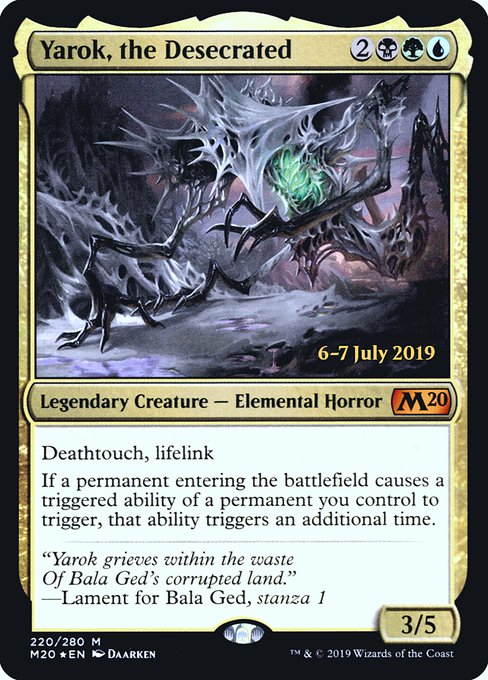
Yarok, the Desecrated | Illustration by Daarken
What makes a good Sultai commander?
Sultai means blue, black, and green. Blue supplies card selection and stack interaction, black supplies sacrifice and graveyard tools, and green supplies ramp and permanent-based value. The best blue-black-green commanders turn those resources into a coherent plan rather than a collection of individually powerful cards.
This is an editorial ranking for multiplayer Commander, not a tournament tier list or a popularity chart. We weigh four things: how reliably a commander advances its plan, how much setup it demands, whether the deck can recover after interaction, and how many useful decisions it gives its pilot. A higher combo ceiling alone does not guarantee a higher place.
Only individual commanders with exactly Sultai color identity are ranked; partner combinations are outside this list. Card text, color identity, and Commander legality were checked against Scryfall on November 12, 2026. Every recommended support card fits these colors. Prices and actual deck power depend on the build; no card here is being presented as a tested win-rate claim or a guaranteed budget buy.
The strongest choice for your table may be a specialist several places down the list. Start with the game plan you want to repeat, then consider the ranking.
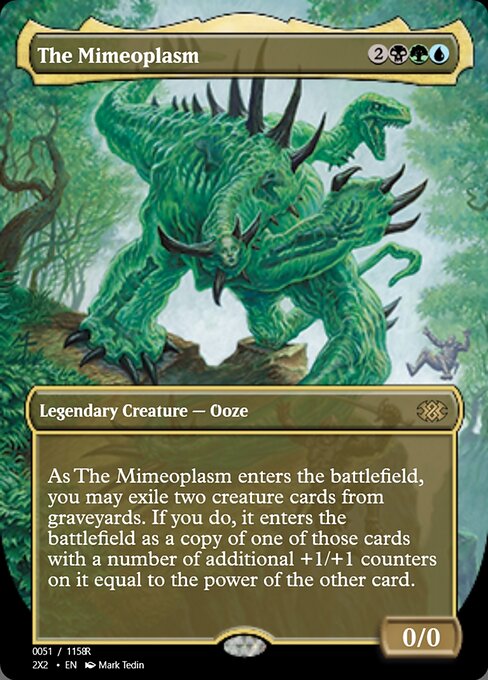
#20. The Mimeoplasm
The Mimeoplasm | Illustration by Mark Tedin
Why settle for one graveyard's best creature when you can assemble your own? The Mimeoplasm exiles two creature cards from graveyards as it enters, copies one, and borrows the other's power as additional +1/+1 counters. It can use opponents' creatures, but a reliable list stocks its own ingredients.
The attraction is precision: choose an evasive body, add a ludicrous amount of power, and ask whether anyone has an answer. The cost is that your commander supplies neither the graveyard setup nor a steady stream of cards. Exile removal can turn an elaborate entrance into a rather expensive story.
Four cards to pair with The Mimeoplasm
- Buried Alive puts up to three creature cards in your graveyard, setting up both halves of the copy-and-counters plan.
- Entomb finds the missing ingredient at instant speed. It is setup, not protection; hold it until you know what the board requires.
- Skithiryx, the Blight Dragon supplies flying, infect, and an activated haste ability for a copied body. Poison wins deserve a pregame conversation.
- Lord of Extinction supplies power based on all graveyards. Its characteristic-defining ability works in the graveyard, making it a potent counters donor.
Play it if: you want a graveyard toolbox that can end games through one carefully engineered creature. It makes the list for its finishing power, but needs more moving pieces than the engines above it.
The Master, Transcendent | Illustration by Javier Charro
The Master doesn't need to own the best creature. It just needs that creature to have been milled this turn.
That restriction is the whole deckbuilding puzzle. The tap ability returns a creature card from any graveyard, but only one put there from a library during the current turn. It becomes a green Mutant with base power and toughness 3/3; its useful abilities remain. Milling at the right moment therefore matters more than simply filling graveyards over several turns.
Four cards to pair with The Master, Transcendent
- Mesmeric Orb mills as permanents untap, creating fresh targets during turns when The Master can activate.
- Altar of Dementia gives you on-demand mill and a sacrifice outlet. Sacrificing a creature is not itself milling that creature, so the sacrificed card is not automatically eligible.
- Thousand-Year Elixir lets The Master use its tap ability immediately and can untap it for another activation.
- Intruder Alarm untaps The Master when a reanimated creature enters, allowing a chain through eligible creatures. It also stops normal creature untaps, so it is a commitment rather than a free upgrade.
Play it if: you like timing puzzles and borrowing unusual creatures. The ceiling is wonderfully strange, but the same-turn restriction and dependence on a tap ability keep this below more self-contained graveyard commanders.
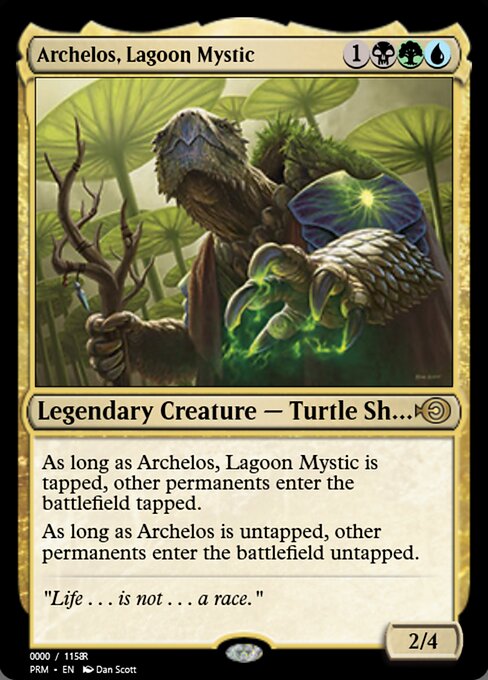
Archelos, Lagoon Mystic | Illustration by Dan Murayama Scott
Archelos makes being tapped an entire political position. Untapped, it makes other permanents enter untapped. Tapped, it makes them enter tapped. Both effects apply to everyone.
The practical plan is to enjoy untapped lands on your turn, then tap the Turtle before opponents develop their boards. That can turn slow lands into much better mana sources while making opposing creatures and mana rocks arrive a turn behind schedule. Leave Archelos untapped carelessly, though, and the table gets the same hospitality.
Four cards to pair with Archelos, Lagoon Mystic
- Holdout Settlement taps Archelos as part of a mana ability, giving you control over its state without attacking.
- Survivors' Encampment provides a second copy of that job. Either land can tap a newly entered Archelos because the creature is not paying its own tap-symbol cost.
- Simic Growth Chamber can enter untapped under Archelos and produce two mana immediately. Its land-return trigger still happens.
- Seedborn Muse refreshes your permanents on other players' untap steps. It also untaps Archelos, so you must deliberately tap it again when that is the desired mode.
Play it if: sequencing lands and controlling the pace of a game sounds more appealing than a conventional value commander. The effect is distinctive and powerful, but it provides no cards by itself and can help the wrong player when your timing slips.
A small evasive creature is a nuisance. A small evasive creature drawing six cards is a deck plan.
Felix gives an additional trigger when one of your creatures dealing combat damage to a player causes an ability of a permanent you control to trigger. That covers both abilities printed on the attacker and effects watching your team connect. It does not double the damage itself, and it cannot rescue an attack that never gets through.
Four cards to pair with Felix Five-Boots
- Cold-Eyed Selkie draws cards equal to its combat damage in each trigger. Felix makes that happen twice, and islandwalk can provide a clean route in.
- Cephalid Constable turns combat damage into bounced permanents. The extra trigger makes even a small hit disruptive, although this plan quickly attracts attention.
- Toski, Bearer of Secrets rewards every connecting creature with two draw triggers while Felix is present.
- Reconnaissance Mission spreads the same kind of reward across your evasive attackers and can be cycled when you need a different card.
Play it if: you want combat to finance your second main phase. Felix has a fantastic payoff, but costs five mana and needs both attackers and suitable triggers already working. That dependency limits its consistency more than its damage potential.
Gonti, Canny Acquisitor | Illustration by Anna Podedworna
Gonti gives tiny unblockable creatures a second career: acquisitions department.
When one or more of your creatures deal combat damage to a player, Gonti exiles that player's top card face down for you to play later. You can spend mana of any type on those spells, and spells you cast but don't own cost one generic mana less. Hit several opponents to collect several cards; sending three creatures at one player still produces only one Gonti trigger for that combat-damage event.
Four cards to pair with Gonti, Canny Acquisitor
- Triton Shorestalker gets started early and doesn't need an Equipment to connect.
- Slither Blade provides another one-mana unblockable body so the deck can pressure more than one opponent.
- Changeling Outcast keeps those attacks reliable, with the explicit drawback that it cannot block.
- Fallen Shinobi uses an unblocked attacker for ninjutsu and adds its own two-card theft trigger. Its permission expires at end of turn, unlike Gonti's lasting permission.
Play it if: you enjoy games that develop differently depending on opponents' decks. Gonti supplies a built-in reward without requiring a separate draw engine, but stolen cards can be awkward or irrelevant. The discount does not pay colored costs, and playing an exiled land still uses a land play.
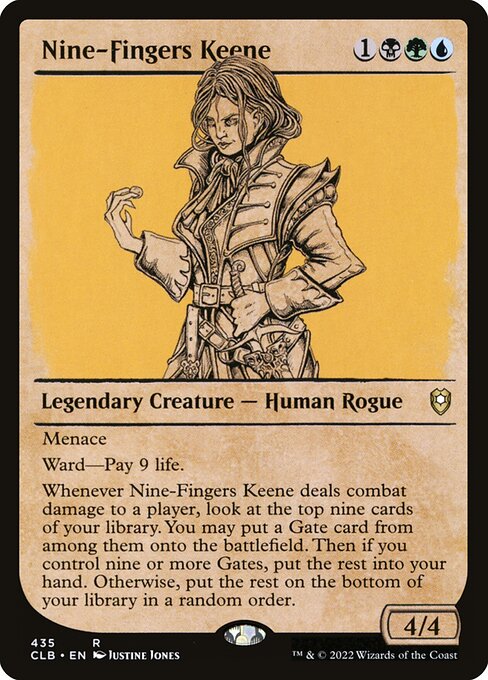
Nine-Fingers Keene | Illustration by Justine Jones
Nine-Fingers is for the player who wants their mana base to become the plot.
A combat hit lets you look at nine cards and put a Gate from among them onto the battlefield. Once you control at least nine Gates, the remaining cards go to your hand instead of the bottom of your library. Menace helps the first connection, and ward—pay 9 life makes targeted removal expensive. Neither ability guarantees a safe attack, especially against a developed board.
Four cards to pair with Nine-Fingers Keene
- Maze's End turns the Gate collection into an alternative victory condition. Its win check requires ten Gates with different names, not Nine-Fingers' nine-Gate threshold.
- Gond Gate lets your Gates enter untapped, fixing the archetype's most obvious tempo problem.
- Baldur's Gate converts a developed Gate network into a large burst of one color of mana.
- Explore gives an additional land play and replaces itself, helping you deploy Gates drawn naturally or picked up after the commander connects.
Play it if: you like a clear, unusual construction challenge. Nine-Fingers ranks here because its payoff can be enormous but its success is tied to both combat and a specialized mana base. Remember that Gate is a land subtype, not permission to ignore Commander color identity; off-color Gates still need to stay out.
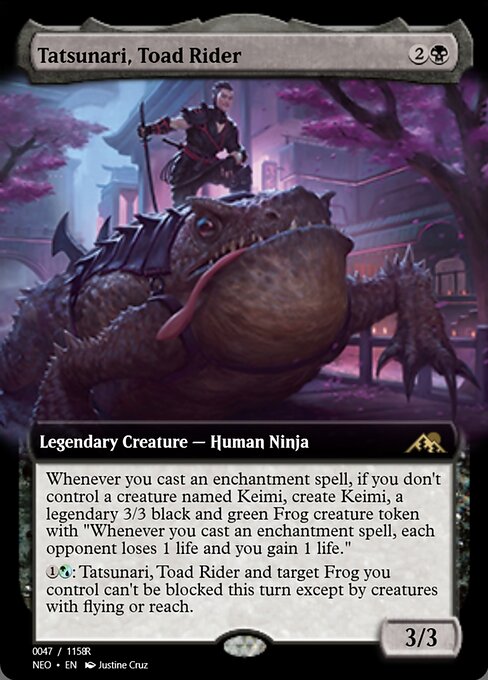
Tatsunari, Toad Rider | Illustration by Justine Cruz
Sultai enchantress does not have to finish with a giant creature. Sometimes the Frog just keeps charging admission.
Casting an enchantment with Tatsunari creates Keimi if you do not already control a creature with that name. Keimi then drains each opponent for 1 and gains you 1 life whenever you cast an enchantment. The first spell normally creates the Frog; it does not retroactively trigger the Frog's ability. Once the pair is established, cheap enchantments can advance your board and whittle down the entire table.
Four cards to pair with Tatsunari, Toad Rider
- Enchantress's Presence replaces enchantment spells with cards, helping you keep the chain moving.
- Eidolon of Blossoms draws from enchantments entering, including itself. Its trigger cares about entering, not casting.
- Whip Silk is a repeatable enchantment spell: pay green to return the Aura, then green to cast it again. Each cycle costs mana; it is not an infinite loop by itself.
- Sanctum Weaver turns your enchantment count into mana for those repeated casts and for rebuilding after removal.
Play it if: you want enchantress with a table-wide drain finish rather than an all-in combat plan. Tatsunari is accessible at three mana, but removing Keimi interrupts the drain engine and the commander does not draw cards on its own. Its activated ability can help the pair attack, but flying and reach creatures can still block them.
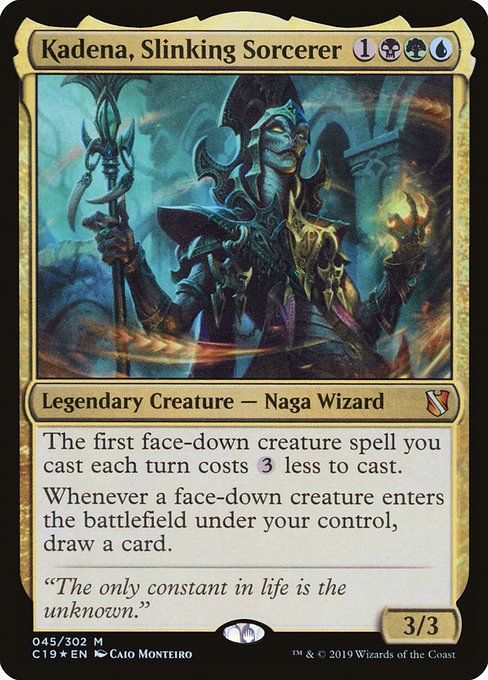
Kadena, Slinking Sorcerer | Illustration by Caio Monteiro
Three face-down creatures and untapped mana can make a table think harder than a single enormous threat.
Kadena discounts the first face-down creature spell you cast each turn by three generic mana, then draws whenever a face-down creature enters under your control. A normal three-mana morph becomes free, but turning it face up still costs what the card says. That distinction matters: you want useful face-up effects, not merely enough creatures to fill the mystery pile.
Four cards to pair with Kadena, Slinking Sorcerer
- Winding Canyons lets you cast creature spells as though they had flash for the turn, opening opportunities to use Kadena's discount on opponents' turns.
- Seedborn Muse refreshes the mana needed for those casts, Canyons activations, and face-up costs. It does not itself grant flash.
- Den Protector turns a face-down body into access to a card in your graveyard when turned face up.
- Stratus Dancer threatens to counter an instant or sorcery when turned face up, forcing opponents to respect your hidden information.
Play it if: you enjoy bluffing, timing, and a board where each creature has a second job. Kadena rewards a carefully constructed package, but the deck can become slow and unimpressive when its commander is repeatedly removed. The high ceiling comes from using multiple turns, not from treating every morph as free.
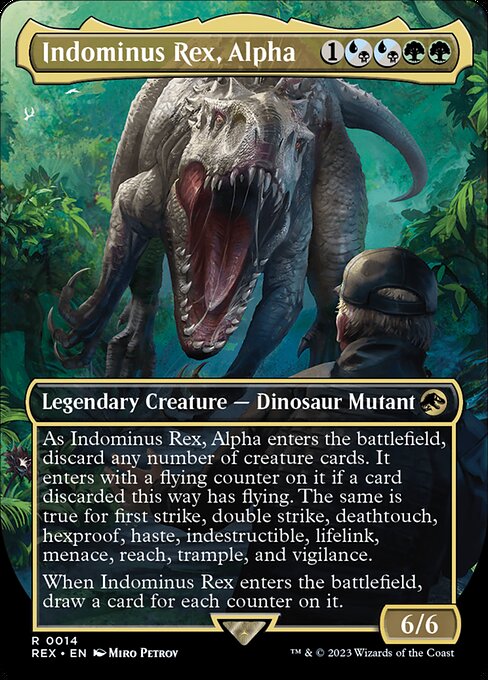
Indominus Rex, Alpha | Illustration by Miro Petrov
Indominus Rex is one of the rare commanders that looks at a fistful of creatures and asks whether you would prefer a better Dinosaur instead.
As it enters, you may discard creatures to give it counters corresponding to the listed keywords those cards have. Its enter trigger then draws a card for each counter on it. You want varied keyword coverage: discarding two creatures with flying does not normally produce two flying counters. Combining protection, evasion, and haste is more valuable than stuffing the deck with redundant abilities.
Four cards to pair with Indominus Rex, Alpha
- Nightveil Predator offers flying, deathtouch, and hexproof from a single discarded card.
- Venomthrope is another compact source of those three keywords. It is redundancy for finding the package, not a reason to discard both together for duplicate counters.
- End-Raze Forerunners supplies vigilance, trample, and haste. Those are distinct from the previous package and make the resulting attacker much more threatening.
- Victimize can recover two creatures you discarded by sacrificing another creature, giving those cards a second use after they have helped build Rex.
Play it if: you like a large protected threat with a reanimation plan behind it. The entrance can replenish your hand, which lifts Rex above a straightforward Voltron commander. However, the draw trigger can be answered, and exile, sacrifice effects, or a wipe can still break up the investment. Hexproof is not immunity.
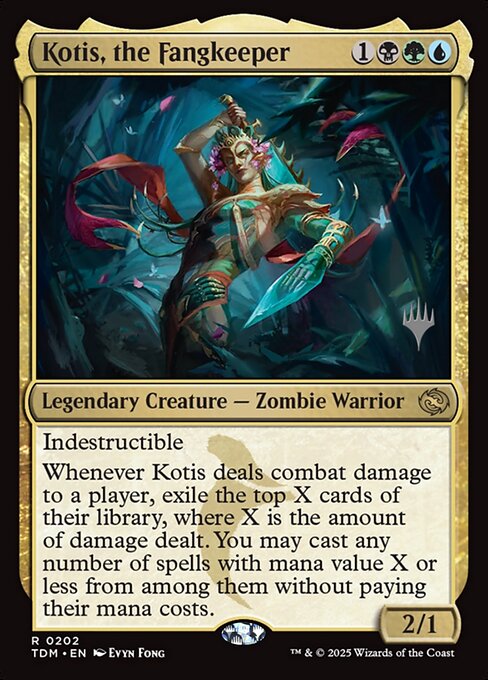
Kotis makes a small combat hit feel like a missed opportunity. Its reward scales with the damage actually dealt to a player: exile that many cards from their library, then cast any number of eligible spells with mana value no greater than that damage for free.
The catch is printed in the lower-right corner. Kotis starts as a 2/1. Indestructible helps it survive damage and destroy effects, but you still need power and evasion to turn the commander into a serious theft engine. The free casts happen as the trigger resolves; you are not saving the pile for a later turn.
Four cards to pair with Kotis, the Fangkeeper
- Blackblade Reforged scales Kotis with your land count and has a reduced equip cost for legendary creatures.
- Rancor adds power and trample, so a small blocker does not necessarily stop the player-damage trigger.
- Rogue's Passage guarantees an unblocked attack when you can afford the activation, without consuming a nonland slot.
- Inquisitor's Flail doubles Kotis's combat damage. Indestructible helps with the doubled damage it receives, but does not protect it from exile or toughness reduction.
Play it if: you want a commander-damage threat that also generates chaotic free spells. Kotis has a strong payoff and built-in durability, but needs successful combat before it gives you cards. Damage prevention, removal before the hit, and opponents' unhelpful top cards remain real limitations.
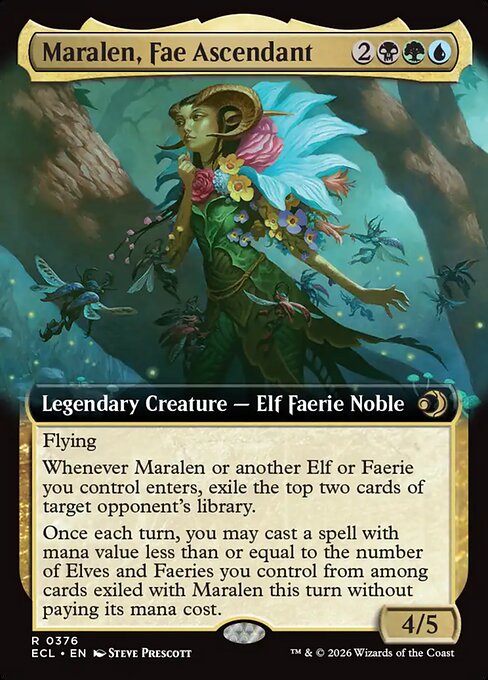
Maralen, Fae Ascendant | Illustration by Steve Prescott
Maralen gives an Elf or Faerie deck a reason to care about someone else's top cards.
Whenever Maralen or another Elf or Faerie you control enters, you exile two cards from a target opponent's library. Once each turn, you can cast one spell from cards exiled with Maralen that turn for free, provided its mana value is no greater than the number of Elves and Faeries you control. Small creatures therefore do two jobs: reveal more options and raise the size of spell you can take.
Four cards to pair with Maralen, Fae Ascendant
- Llanowar Elves accelerates the five-mana commander, then contributes to the creature count that determines your free-spell ceiling.
- Elvish Warmaster makes another Elf when other Elves enter, once each turn. That token provides another Maralen trigger and increases the count.
- Elvish Visionary draws a card while generating a Maralen trigger, so developing your board does not empty your hand as quickly.
- Faerie Seer is a cheap flying body that scries while adding another chance to find a useful opposing spell.
Play it if: you want creature-type synergy without a completely predictable payoff. The built-in free spell is potent, but you cannot bank old exiled cards for future turns. Casting timing still matters, the permission is only once each turn, and a creature that is both an Elf and a Faerie counts as one creature—not two. Maralen needs a board, not just a full exile pile.
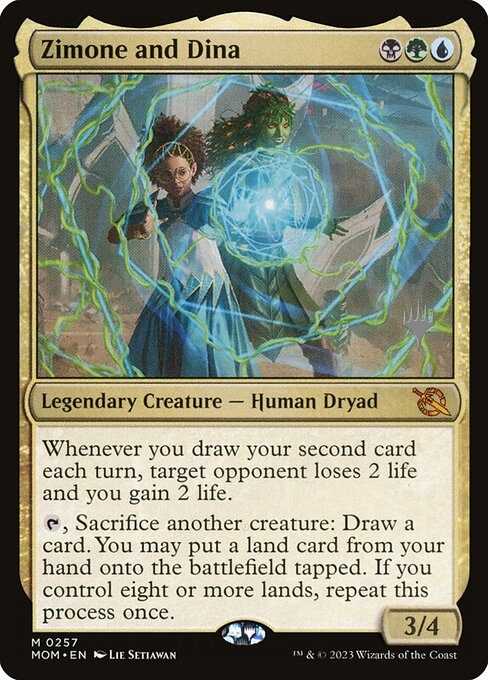
Zimone and Dina make a spare creature look like a card, a land drop, and possibly another activation waiting to happen.
Their tap ability sacrifices another creature to draw a card and optionally put a land from hand onto the battlefield tapped. With eight or more lands, you repeat that process once; you do not pay a second sacrifice cost. Their other ability drains one targeted opponent when you draw your second card each turn. It does not trigger on every card after the first.
Four cards to pair with Zimone and Dina
- Bloodghast returns from your graveyard when a land enters, supplying a reusable creature to sacrifice on later activations.
- Retreat to Coralhelm can untap the commander from a landfall trigger, giving you another activation if you have more sacrifice material.
- Scute Swarm turns those land entries into bodies and, at six lands, increasingly large numbers of copies.
- Skullclamp turns small creatures into cards and gives you another way to arrange a second draw on a turn. Be mindful that it competes with the commander for sacrifice material.
Play it if: you like engines where lands, creatures, and cards feed one another. The low casting cost and several useful roles earn a strong placement. The limitation is throughput: without untaps, expendable creatures, and lands in hand, the engine is slower than its best turns suggest. These cards are a package, not an unconditional infinite combo.
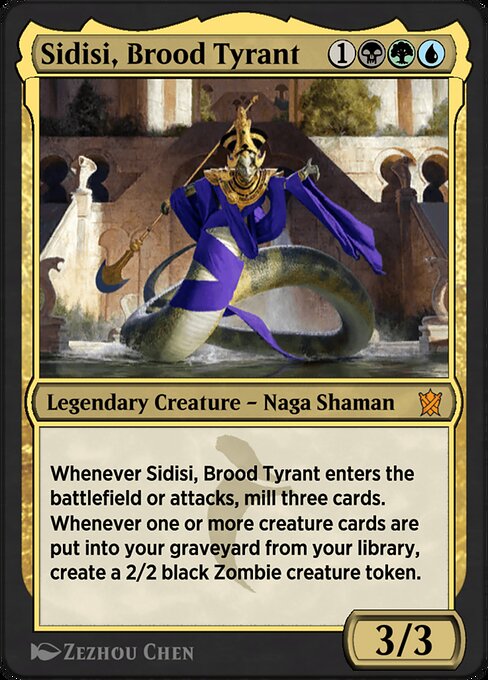
Sidisi, Brood Tyrant | Illustration by Zezhou Chen
Sidisi turns the work of setting up a graveyard into a board presence. That is a very good way to avoid spending three turns doing impressive things that never threaten anyone.
Entering or attacking mills three cards. Whenever one or more creature cards move from your library to your graveyard, Sidisi makes a 2/2 Zombie. The crucial phrase is “one or more”: three creatures milled together make one Zombie, not three. Separate milling events can produce separate triggers, which is why the shape of your mill effects matters.
Four cards to pair with Sidisi, Brood Tyrant
- Stitcher's Supplier gives you an enter trigger and a death trigger that each mill three, plus a body for sacrifice outlets.
- Mesmeric Orb creates separate one-card mill events as permanents untap. Each of your milled creature cards can therefore generate its own Sidisi trigger.
- Altar of Dementia turns creatures into further mill. Sacrificing Zombies to mill yourself can dig for more creatures and reanimation targets.
- Wonder rewards milling it by giving your creatures flying while it is in your graveyard and you control an Island.
Play it if: you want creature-heavy self-mill that can still attack. Sidisi earns its place because setup and payoff live on the same card. It does ask for enough creatures to hit reliably, and graveyard exile can remove important resources even when your existing Zombies survive. Don't cut the creature count so far that the engine starts missing.
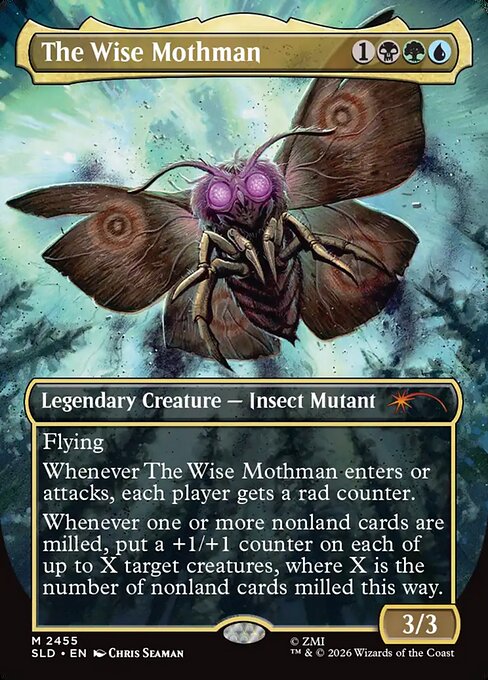
The Wise Mothman makes the whole table's milling your business. It hands out rad counters on entry and attack, then rewards nonland cards being milled with +1/+1 counters across your creatures.
If an event mills X nonland cards, you put one counter on each of up to X target creatures. You do not put all X counters on one creature. A board with several bodies therefore uses a large mill event better than a lonely Mothman does. Separate events, on the other hand, can grow the same creature repeatedly.
Four cards to pair with The Wise Mothman
- Mesmeric Orb keeps creating one-card mill events as players untap, giving Mothman opportunities to grow your board throughout a turn cycle.
- Hardened Scales adds an extra +1/+1 counter to each affected creature you control whenever counters would be placed.
- Altar of Dementia supplies controlled mill and a way to sacrifice a creature that is about to be removed.
- Branching Evolution doubles the +1/+1 counters you place on your creatures, making even modest mill triggers matter in combat.
Play it if: you want mill to create an attacking army instead of relying solely on emptying libraries. Mothman combines an enabler and payoff efficiently. Its drawback is generosity of the dangerous kind: milling opponents can improve their graveyard decks. Counter engines also need creatures to receive the counters, and targeted triggers can be disrupted.
Glarb, Calamity's Augur | Illustration by Bram Sels
Glarb rewards knowing the difference between a spell's mana value and the amount you actually pay for it.
You can look at the top card of your library, play lands from there, and cast spells there with mana value four or greater. The tap ability surveils two, clearing unwanted cards or loading the graveyard. This creates an engine at only three mana, but a cheap spell stranded on top can still halt the process until you draw, rearrange, or surveil it away.
Four cards to pair with Glarb, Calamity's Augur
- Sensei's Divining Top rearranges your top three cards, positioning a land or qualifying spell where Glarb can use it.
- Brainstorm draws three and puts two back, letting you place expensive cards from your hand on top for later access through Glarb.
- Snuff Out has mana value four even when you pay 4 life instead of mana, provided you control a Swamp. It can remove a nonblack creature from the top for that alternative cost.
- Mulldrifter has mana value five even when evoked for three mana, letting Glarb turn a qualifying top card into a less expensive draw spell.
Play it if: you enjoy library manipulation and extracting value from alternative costs. Glarb is efficient and flexible, but still obeys casting timing and land-play limits. This is not permission to cast creatures during an opponent's turn or play every land you reveal. The deck also needs a deliberate mana-value mix to avoid constant traffic jams.
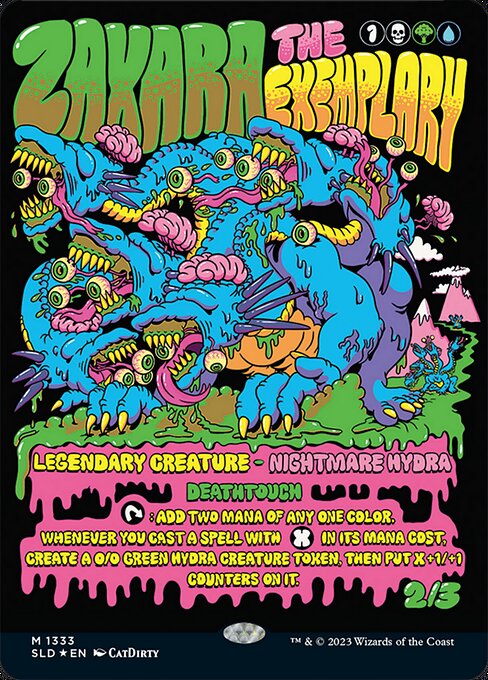
Zaxara solves a familiar X-spell problem: spending a whole turn on one large spell does not have to leave your battlefield empty.
It taps for two mana of one color, then makes a Hydra with X +1/+1 counters whenever you cast a spell with X in its mana cost. Ramp, card draw, and a threatening creature can become parts of the same turn. The Hydra ability is a cast trigger, so countering the original spell does not automatically remove that trigger from the stack.
Four cards to pair with Zaxara, the Exemplary
- Freed from the Real lets you pay one blue mana to untap Zaxara. Tap Zaxara for two blue, spend one to untap, and repeat to generate arbitrarily much blue mana once it can legally tap.
- Pemmin's Aura provides another blue-mana untap ability, plus optional protection through shroud. It gives the deck redundancy for the same mana engine.
- Villainous Wealth converts a large X into opponents' spells and produces a Hydra through Zaxara's separate trigger.
- Hydroid Krasis supplies a flying, trampling threat, a second Hydra from Zaxara, and a cast trigger that draws cards and gains life based on X.
Play it if: you want enormous spells, or a clearly signposted combo package you can include or omit. Zaxara is fifth because it provides mana and payoff without much persuasion. The obvious Aura combos do raise expectations: discuss them before the game. They need a usable tap ability and can be interrupted; they are not protection against interaction or an automatic win without a payoff.
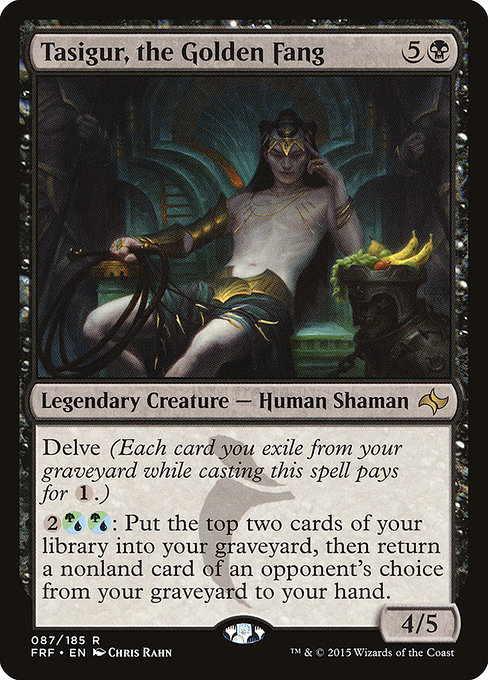
Tasigur, the Golden Fang | Illustration by Chris Rahn
Tasigur's most important negotiation usually starts with, “Which card would you like me to have?” The trick is making all the available answers bad for someone else.
Delve can make the commander cheap to cast while removing unwanted cards from your graveyard. Its activated ability mills two, then returns a nonland card chosen by an opponent. The ability does not target a card, and you do not simply pick your best spell. Graveyard management and choosing the right opponent are central to making the engine reliable.
Four cards to pair with Tasigur, the Golden Fang
- Seedborn Muse lets you hold up interaction and activate Tasigur on multiple turns with refreshed mana.
- Training Grounds removes the two generic mana from Tasigur's activation cost; the two blue-or-green hybrid symbols still need to be paid.
- Reality Shift is a creature answer an opponent may be willing to return when a different player has the most urgent threat.
- Beast Within broadens that political offer to any permanent, at the cost of giving its controller a Beast.
Play it if: you like instant-speed play, resource management, and negotiating around the table's biggest problem. Tasigur earns fourth through efficiency and repeatable access to interaction. It can support much more optimized builds than this general-purpose ranking implies. Its weakness is that the newly milled cards can dilute your choices, and the opponent making the selection is allowed to be unhelpful.
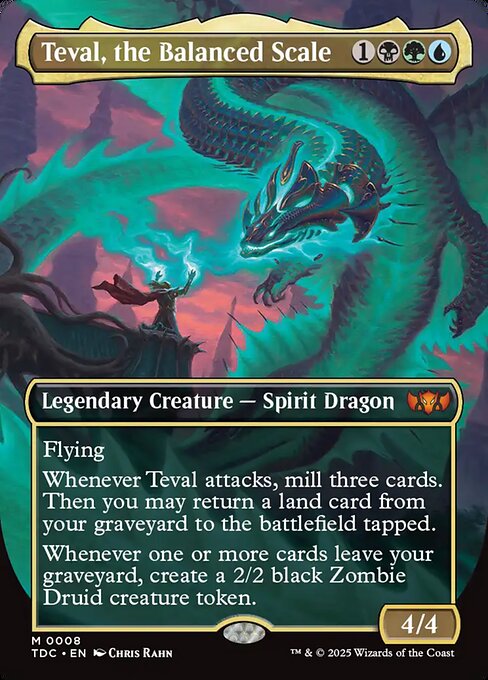
Teval, the Balanced Scale | Illustration by Chris Rahn
Teval pays you for both directions of graveyard traffic.
An attack mills three cards and can return a land from your graveyard to the battlefield tapped. Whenever one or more cards leave your graveyard, you create a 2/2 Zombie Druid. That means ordinary recursion, dredging a card back, and even selectively exiling your own graveyard can build an army. The commander supplies setup, land recovery, and a payoff on one four-mana body.
Four cards to pair with Teval, the Balanced Scale
- Life from the Loam returns lands to your hand and can dredge itself back. Returning several lands together makes one Teval trigger; returning Loam through dredge is a separate event.
- Soul-Guide Lantern can exile a disposable card from your own graveyard with its enter trigger to make a Zombie, then remain available to exile opponents' graveyards. Do not throw away an important recursion target just for a token.
- Reassembling Skeleton leaves your graveyard when its ability returns it, creating a Zombie alongside the tapped Skeleton for two mana.
- Altar of Dementia turns spare bodies into mill, feeding the next round of land recovery and recursion.
Play it if: you want graveyard value to develop into a board that can actually close the game. Teval ranks this high because its ordinary, non-combo turns already accomplish several useful things. It still needs to attack for its built-in mill and land recovery, and one mass graveyard-exile event produces one token—not an army proportional to the number of cards lost.
Yarok makes the phrase “it already replaced itself” sound almost modest.
If a permanent entering causes an ability of a permanent you control to trigger, Yarok gives it an additional trigger. That includes many creature enter abilities and landfall abilities. It does not double every ability in the deck: cast triggers, activated abilities, and replacement effects need to be evaluated separately.
Four cards to pair with Yarok, the Desecrated
- Risen Reef triggers twice for itself with Yarok present and twice for your other entering Elementals. Each resolution finds a land for the battlefield or a card for your hand.
- Coiling Oracle reveals and processes two cards through separate triggers, providing an efficient way to advance mana or hand size.
- Peregrine Drake creates two untap triggers. You can tap lands for mana between their resolutions, although these two cards alone are not an infinite loop.
- Acidic Slime supplies two removal triggers for artifacts, enchantments, or lands, letting a creature slot handle multiple problems.
Play it if: you want nearly every creature and land drop to provide another meaningful resource. Yarok takes second for broad support, straightforward construction, and a payoff that scales from modest value creatures to elaborate engines. Its limitation is the five-mana setup turn: Yarok does not draw anything simply by arriving on an empty board. Keep useful plays in reserve, and remember that its deathtouch and lifelink do not protect it from removal.
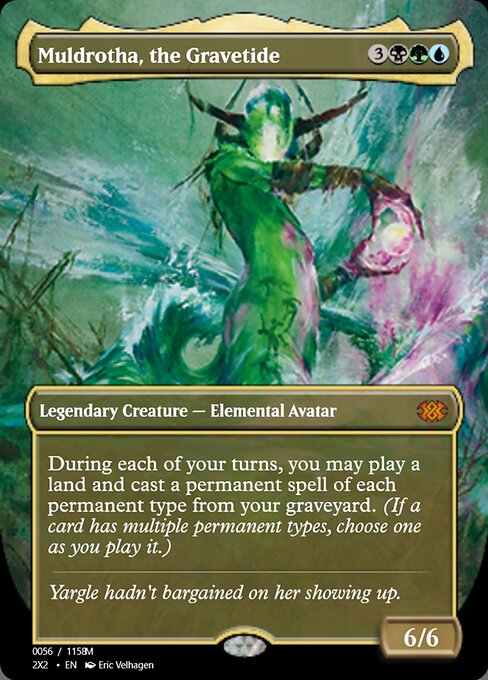
Muldrotha, the Gravetide | Illustration by Eric Velhagen
Muldrotha wins this ranking because it changes what a spent card means.
During each of your turns, you may play a land and cast a permanent spell of each permanent type from your graveyard. A sacrificed creature, a used removal enchantment, and an artifact that traded for a threat can all become available again. You still pay costs and follow normal timing, but the deck's everyday cards become repeatable resources rather than disposable answers.
Four cards to pair with Muldrotha, the Gravetide
- Sakura-Tribe Elder sacrifices for a basic land, then can be cast from the graveyard as your creature for the turn. It develops mana without requiring the creature to survive a full turn cycle.
- Seal of Primordium sits on the battlefield as a threat to an artifact or enchantment, then can return through your enchantment allowance after being used.
- Spore Frog buys a turn against combat damage and can be recast on your next turn. It does not stop noncombat damage, and repeatedly fogging combat will make the engine a priority target.
- Executioner's Capsule provides repeatable removal for nonblack creatures through your artifact allowance, with activation mana still required each time.
These examples reveal the deckbuilding lesson: spread useful effects across permanent types. Sakura-Tribe Elder and Spore Frog compete for the same creature allowance; you cannot routinely cast both from the graveyard in the same turn through one Muldrotha. A permanent with several types can use one eligible type's allowance, but that is not unlimited permission.
Play it if: you want a flexible, grindy commander that rewards sequencing and rebuilding. Muldrotha takes first for the breadth and repeatability of its engine, not because six mana is cheap or graveyard hate stops mattering. Exile effects and commander removal can strand your plan. Build interaction that works without Muldrotha, and choose an actual way to finish rather than endlessly recycling answers.
Before buying cards, decide what you want your ordinary turns to look like. A graveyard engine, an unblockable-creature deck, and a face-down creature deck may share colors without sharing many priorities.
For a first pass, take the four synergy cards under the commander that interests you and assign each a job: setup, payoff, protection, or recovery. Then fill the gaps. Four exciting payoffs cannot replace enough mana, early plays, and answers. Likewise, graveyard decks still need a plan when an opponent exiles their graveyard.
If you are filling out black interaction and recursion slots, our budget black Commander staples guide offers another set of options. Its listed prices are dated; check current listings before treating any card as a budget purchase.
Frequently asked questions
What colors are Sultai in MTG?
Sultai is blue, black, and green. A Sultai Commander deck may include cards whose color identities are any subset of those colors, as well as colorless cards. It cannot include white or red color identity simply because it has lands that can produce those colors.
Why are Tasigur and Tatsunari Sultai when their mana costs look black?
Commander color identity is broader than the colors in a card's casting cost. Tasigur has blue-green hybrid mana symbols in its activated ability, and Tatsunari has a green-blue hybrid symbol in its activated ability. Those symbols contribute both colors to identity. Together with black, each commander has Sultai identity.
Which Sultai commander is best for beginners?
Yarok is a sensible starting point if you want a clear value plan: play permanents with useful enter abilities and resolve the extra triggers carefully. It still requires trigger management. Kadena, Tasigur, and Archelos ask for more attention to hidden information, opponent choices, or timing. Choose the style you enjoy learning rather than assuming a higher rank makes a deck easier.
Can Muldrotha play extra lands or cast instants from the graveyard?
Muldrotha does not grant an additional land play. Playing a land from the graveyard uses a land play you already have. Its casting permission covers permanent spells, not ordinary instants and sorceries, and it does not override timing restrictions. You can cast a creature and an enchantment from your graveyard in a turn, but normally not two creatures through that same creature allowance.
Does Zaxara need infinite combos?
No. An X-spell deck can use its mana ability and Hydra tokens without either untap Aura. Freed from the Real and Pemmin's Aura are optional ways to generate arbitrarily large amounts of mana once Zaxara can tap. Removing them gives you room for more interaction, protection, or X spells. Tell your table which kind of deck you are bringing.
Is this a cEDH ranking?
No. It ranks useful stand-alone commanders for multiplayer deckbuilding across several archetypes. Optimized combo shells, tournament environments, and specific metagames change what matters. Tasigur or Glarb in a highly tuned list can be a very different proposition from a slower value build with the same commander. The commander name alone does not establish a deck's power level.
Give your Sultai deck a job
The easiest mistake in these colors is adding every strong card you own until the deck has no reason to exist beyond drawing more cards.
Choose a commander whose ordinary turn sounds fun. Give it enough enablers to function, enough interaction to survive, and a finish your table understands. Whether that finish is a swarm of Zombies, a perfectly timed stolen spell, or a very suspicious Frog, the best Sultai deck is the one whose pieces actually work together.
Use the commander’s Create a deck button to start with your preferred legend, then build outward from its synergy package rather than trying to fit every recommendation in this article into one list.
Sources and verification
Card names, Oracle text, color identities, and Commander legality were checked on November 12, 2026. Individual entries link to their Scryfall records for current wording and rulings. Supporting cards were checked through Scryfall's card database; the rankings and strategic evaluations are ElderDecks editorial judgments, not measured win rates.