By ElderArticles · Updated 10/28/2026 · 22 min read
Discover the 20 best Jeskai commanders in MTG, ranked for power and flexibility, with key synergies, drawbacks, strategies, and ideal players.
Table of contents
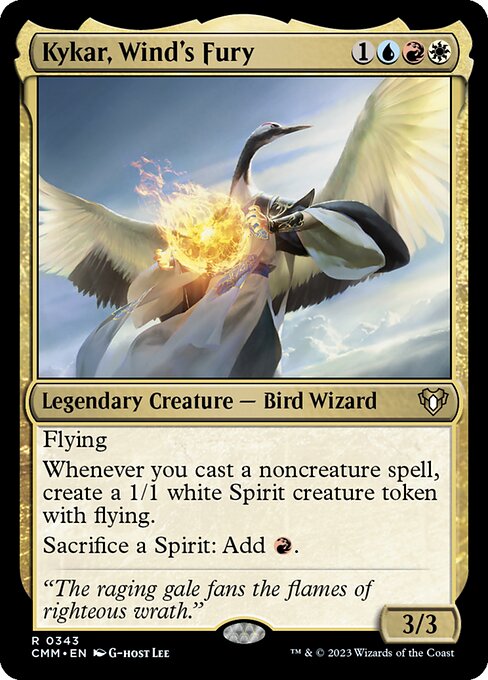
Kykar, Wind's Fury | Illustration by G-host Lee
Jeskai has a reputation for casting twelve spells, taking a very impressive turn, and somehow ending it with the same number of permanents it started with. The best Jeskai commanders fix that problem. They turn every cantrip, attack, artifact, counter, or creature entering the battlefield into something that remains after the stack finally clears.
That range is what makes white-blue-red commanders so interesting. Jeskai can be a spellslinger deck, but it can also play Humans, Energy, cycling, Superfriends, artifact tokens, blink, Voltron, or table politics. The difficult part is choosing a leader that does more than point at a theme.
This ranking favors commanders that generate repeatable resources, work with a broad pool of cards, recover after interaction, and can actually finish a game. Raw ceiling matters, but so do mana cost, setup requirements, flexibility, and how badly the deck functions when its commander is removed. The top of the list belongs to leaders that make ordinary Jeskai cards feel unfair without demanding that every slot serve one narrow combo.
What Are the Best Jeskai Commanders?
The strongest Jeskai commanders convert the color combination's cheap interaction and card selection into a board, mana, or an immediate clock. Kykar turns noncreature spells into flying bodies and red mana. Both Narsets weaponize combat in very different ways. Elsha turns the top of the library into a second hand. The eventual winner combines a growing evasive threat with a damage multiplier that changes the table's math the moment both commanders are available.
If you want the simplest starting point, choose your engine first:
- Spells and tokens: Kykar, Sokka, or Vraska
- Combat and free spells: either Narset
- Creatures and enter-the-battlefield abilities: Zinnia, Cayth, or Satya
- Counters and artifacts: Kilo or Dr. Madison Li
- Tribal combat: Éowyn
- Planeswalkers: Commodore Guff
- Control and politics: Pramikon
Jeskai gives you white's protection, blue's cards and stack interaction, and red's speed. What it does not give you is effortless land ramp. Most of these decks need disciplined mana rocks and a curve that does not begin at four.
AI-generated article, published by an ElderDecks editor.
How We Ranked the Best White-Blue-Red Commanders
This is an editorial ranking, not a popularity chart. Each commander was judged on five points:
1. Engine value: Does the commander create cards, mana, tokens, or meaningful tempo?
2. Setup cost: How much board or deck construction is required before the text matters?
3. Resilience: Does the deck still function after removal, and can the commander generate value immediately?
4. Flexibility: Can the leader support more than one useful build?
5. Closing power: Can the commander help end a multiplayer game instead of merely accumulating value?
All ranked commanders and command-zone pairs have an exact white-blue-red color identity and were Commander-legal on October 27, 2026. Oracle text and legality were checked with Scryfall. Partner pairs are evaluated as a single command-zone choice.
Why Jean-Luc Picard Is Not Ranked Yet
Jean-Luc Picard, Luminary | Illustration by Jason Pastrana
Jean-Luc Picard, Luminary will lead the Jeskai Federation Fleet precon, and his design is promising. Historic permanents with mana value three or greater draw cards, while drawing your second card each turn places a +1/+1 counter on a creature and two charge counters on a Spacecraft. That links artifacts, legends, Sagas, card draw, and the new seek out mechanic without forcing every card into one lane.
He is not in the countdown because Magic: The Gathering | Star Trek releases on November 13, 2026. As of this article's October 27 review date, Picard is previewed but not yet Commander-legal. Once the set releases and Federation Fleet has real deckbuilding context, he deserves a fresh evaluation. You can follow the reveal schedule in our guide to all four MTG Star Trek Commander decks.
#20. Sevinne, the Chronoclasm
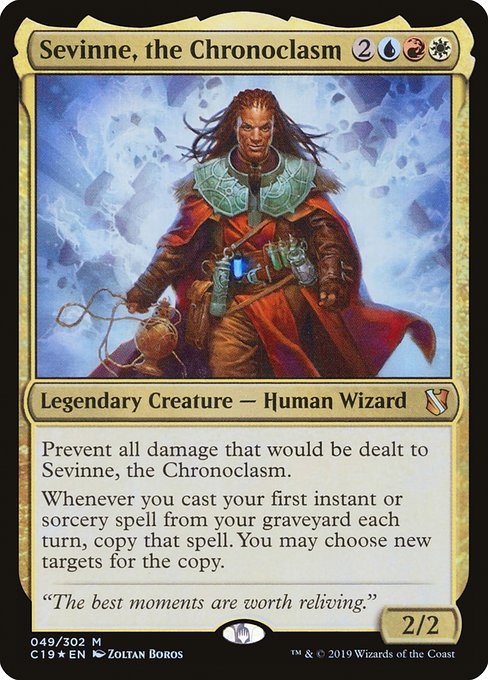
Sevinne, the Chronoclasm | Illustration by Zoltan Boros
Sevinne asks you to cast the first instant or sorcery from your graveyard each turn, then copies it. The obvious home is flashback, but the wording also rewards jump-start, retrace, aftermath, escape, and any effect that lets you cast spells from the graveyard. Doubling a Deep Analysis is useful. Doubling removal or a mass-reanimation spell is where the deck begins to pull ahead.
The problem is pace. Sevinne costs five mana, does not copy a spell until another card enables the graveyard cast, and only rewards the first qualifying spell each turn. Preventing damage to Sevinne is flavorful protection, but exile, bounce, and destroy effects still work. Choose Sevinne if you enjoy methodical graveyard value and want your spellslinger deck to play from two zones. Skip him if you want the commander to make material immediately.
High-synergy cards: Faithless Looting fills the graveyard cheaply; Deep Analysis becomes a serious refill; Mystic Retrieval recovers the best spell; Past in Flames gives the entire graveyard another turn.
#19. Pramikon, Sky Rampart
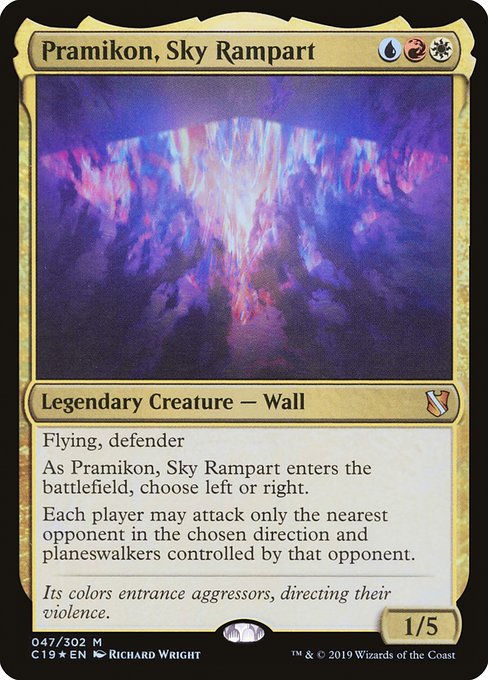
Pramikon, Sky Rampart | Illustration by Richard Wright
Pramikon is one of the strangest control commanders ever printed. Choosing left or right restricts every player to attacking the nearest opponent in that direction. That can insulate you from the largest creature deck, protect planeswalkers, or force two opponents to spend several turns crashing into each other.
A 1/5 flying defender for three mana is excellent at staying alive, but Pramikon does not draw cards or win on its own. It also creates a social puzzle: if the restriction protects one player too effectively, the rest of the table may decide Pramikon is the real threat. The best builds use the attack rule to buy time for planeswalkers, monarch cards, or a compact finisher rather than trying to lock combat forever.
High-synergy cards: Mystic Barrier lets you reverse or reinforce the attack direction; Disrupt Decorum sends creatures where they are allowed to go; Ghostly Prison adds another tax; Court of Grace rewards the safe turns with cards and flying bodies.
#18. Gavi, Nest Warden
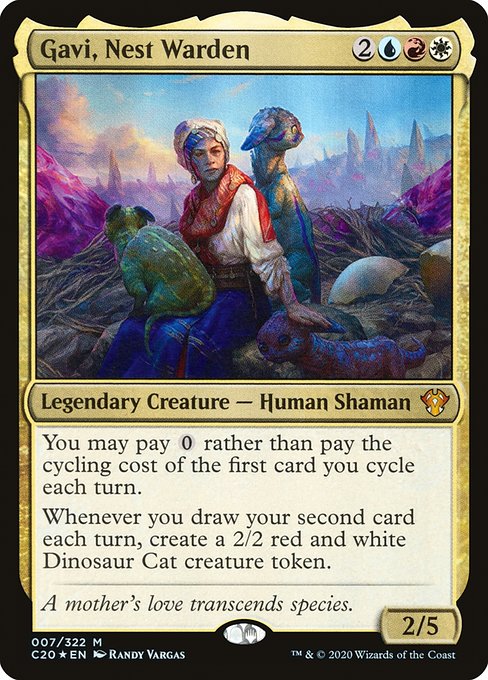
Gavi, Nest Warden | Illustration by Randy Vargas
Gavi makes the first card you cycle each turn cost zero and creates a 2/2 Dinosaur Cat whenever you draw your second card in a turn. That is a clean engine: cycle on your turn for a token, then cycle on an opponent's turn for another. The deck naturally holds mana for interaction because cycling does not require committing the whole hand to the battlefield.
The limitation is card pool dependency. A cycling deck needs enough cyclers to operate, enough cycling payoffs to matter, and enough ordinary Commander interaction that it does not fold while assembling those pieces. Gavi also costs five, so the opening turns must function without her. She is ideal for players who like playing at instant speed and turning card selection into incremental board presence.
High-synergy cards: Fluctuator reduces the rest of your cycling costs; Astral Drift converts cycling into repeatable blink or removal; Decree of Justice makes a late army; Abandoned Sarcophagus lets cycled cards become a second hand.
#17. Kilo, Apogee Mind
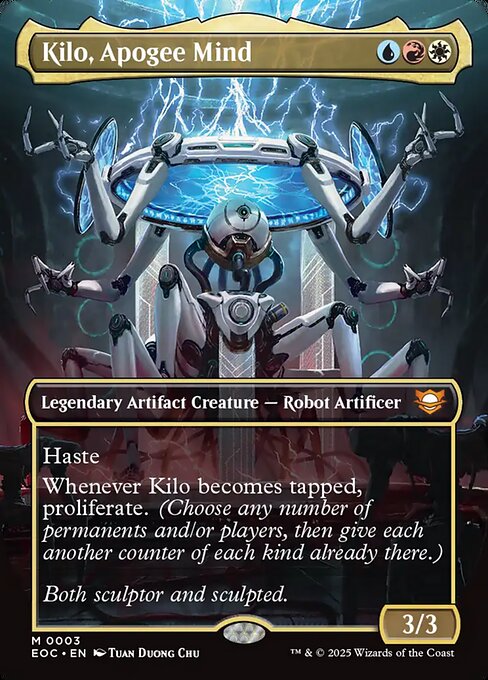
Kilo, Apogee Mind | Illustration by Tuan Duong Chu
Kilo proliferates whenever it becomes tapped. Haste means the first trigger is available immediately, and the ability does not care why Kilo tapped. Attack, crew a Vehicle, station a Spacecraft, or use an artifact that taps creatures: every route advances each useful counter you already control.
That flexibility is also the deckbuilding trap. It is easy to fill Kilo with charge counters, +1/+1 counters, loyalty counters, lore counters, and alternate-win permanents until the deck has twenty packages that never meet. Strong Kilo lists select two or three counter families and make every proliferate trigger advance most of them. Play Kilo if you enjoy sequencing and board engines. Avoid it if keeping track of a dozen counter types sounds like unpaid accounting.
High-synergy cards: Springleaf Drum turns Kilo into mana and a trigger; Lux Cannon converts proliferate into removal; Everflowing Chalice scales with every counter; The Millennium Calendar gives the deck a dangerous long-game clock.
#16. Dr. Madison Li
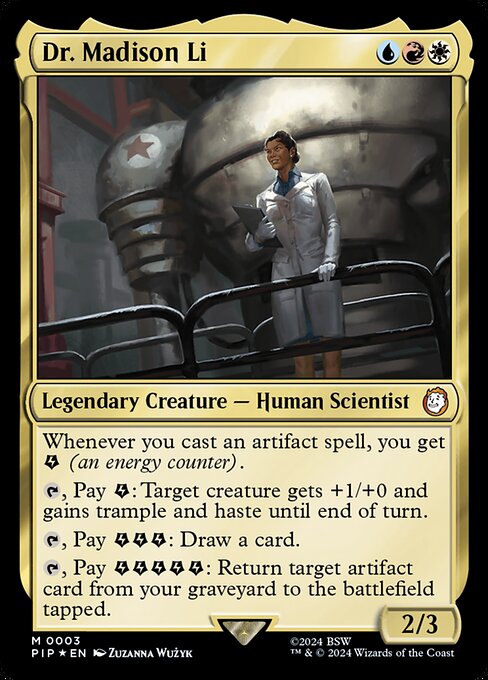
Dr. Madison Li | Illustration by Zuzanna Wużyk
Dr. Madison Li makes an Energy whenever you cast an artifact, then spends that Energy on haste and trample, card draw, or reanimating an artifact. The three abilities cover every stage of the game. Cheap artifacts charge the engine, three Energy keeps cards flowing, and five Energy returns the best machine from the graveyard.
She is efficient at three mana, but every activated ability requires tapping the commander. Without untapping effects, you must choose between immediate cards and saving for reanimation. Artifact hate also attacks both the Energy supply and the recursion targets. Madison is best for players who want an artifact deck with a resource-management puzzle rather than another generic value pile.
High-synergy cards: Aetherworks Marvel turns Energy into free spells; Decoction Module supplies extra Energy from creature entries; Whirler Virtuoso converts excess Energy into artifacts; Emry, Lurker of the Loch gives the graveyard plan another reliable engine.
#15. Commodore Guff
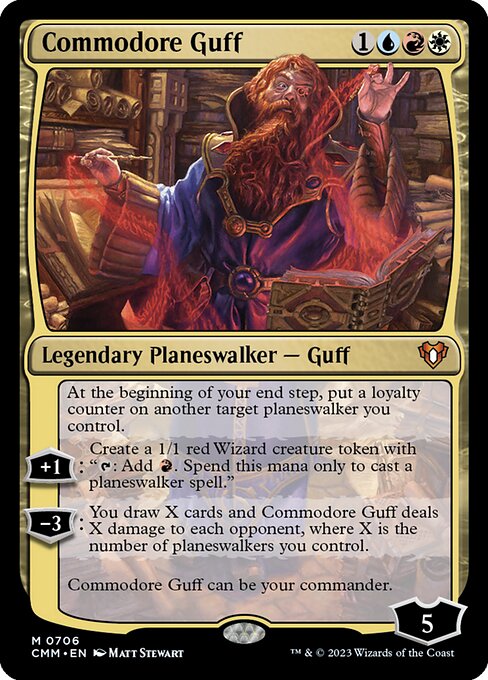
Commodore Guff | Illustration by Matt Stewart
Commodore Guff is the most direct Jeskai Superfriends commander. He adds loyalty to another planeswalker every end step, makes Wizard tokens that ramp into planeswalkers, and can cash loyalty in for cards and damage equal to the number of planeswalkers you control.
The deck can snowball hard, but it announces its plan in capital letters. Every planeswalker adds another permanent opponents feel obligated to attack, and protecting four walkers is much harder than protecting one creature. Guff's minus ability is the reason to accept that pressure: it turns a developed board into both a refill and a legitimate win condition. Choose him if you enjoy managing combat and several small engines at once.
High-synergy cards: Oath of Teferi doubles planeswalker activations; Spark Double copies the most important walker without the legend rule; The Chain Veil adds another round of abilities; Ichormoon Gauntlet gives noncreature spells and planeswalkers a shared proliferate plan.
#14. Zinnia, Valley's Voice
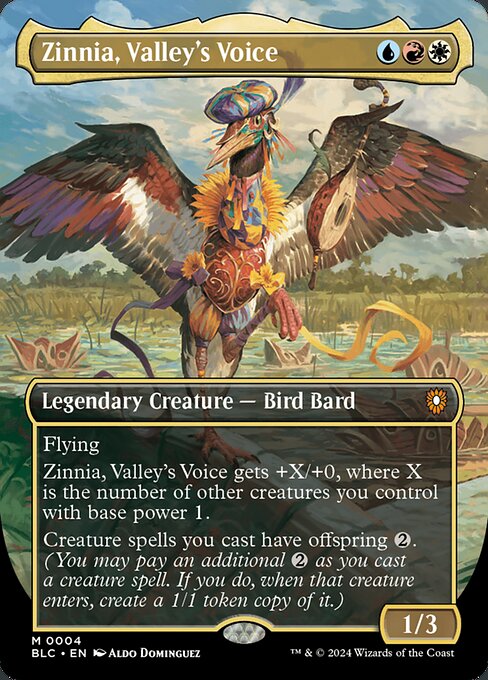
Zinnia, Valley's Voice | Illustration by Aldo Domínguez
Zinnia gives every creature spell offspring {2}. Paying the extra two creates a 1/1 token copy when that creature enters, so the best targets are creatures whose text matters more than their printed power. Copying Mulldrifter still draws four cards. Copying an Imperial Recruiter still finds two creatures. Copying Solemn Simulacrum still finds two lands and leaves two useful bodies.
Offspring turns every good creature into a tempting six- or seven-mana play, and that greed can ruin the curve. Zinnia decks need cheap creatures, cost reduction, and the discipline to cast some threats without offspring. The commander itself becomes a meaningful evasive attacker as the 1-power army grows, but the real appeal is doubling enter-the-battlefield text.
High-synergy cards: Mulldrifter provides cards twice; Imperial Recruiter becomes two tutors; Solemn Simulacrum fixes mana and replaces itself; Preston, the Vanisher rewards the nontoken creatures that arrive as copies.
#13. Cayth, Famed Mechanist
Cayth, Famed Mechanist | Illustration by Eric Wilkerson
Cayth gives every nontoken creature fabricate 1, letting each arrival become either a larger body or an additional Servo. Her activated ability then populates the best creature token or proliferates the counters already on the battlefield. That makes Cayth a bridge between token decks and counter decks instead of forcing you to choose only one.
The ceiling is high, but four mana plus a two-mana tap ability is not fast. Cayth wants creatures to enter, worthwhile tokens to copy, counters to proliferate, and enough untapping to use the commander repeatedly. A list containing every populate and proliferate card will feel scattered. Build around enter-the-battlefield creatures first, then use the tokens and counters as the payoff.
High-synergy cards: Panharmonicon doubles useful creature entries; Mondrak, Glory Dominus doubles Servos and populated tokens; Resourceful Defense moves counters where they matter; Illustrious Wanderglyph rewards the artifact-token half of the deck.
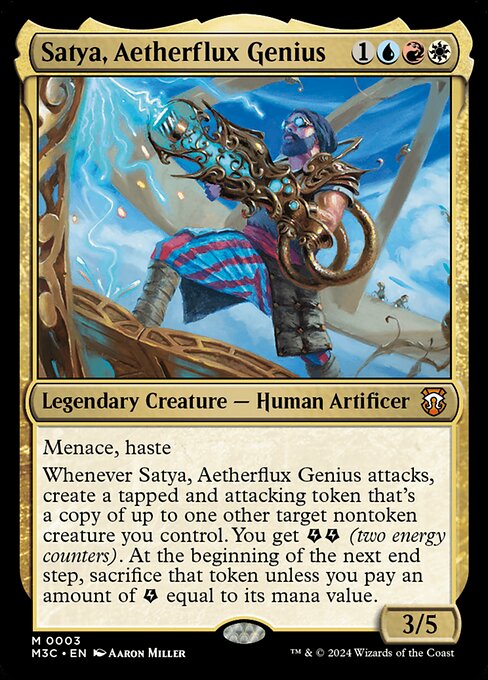
#12. Satya, Aetherflux Genius
Satya, Aetherflux Genius | Illustration by Aaron Miller
Whenever Satya attacks, he makes a tapped and attacking copy of another nontoken creature and gives you two Energy. The token is sacrificed at the next end step unless you pay Energy equal to its mana value. That sounds temporary, but an enter-the-battlefield trigger, attack trigger, or death trigger has already paid you before the copy disappears.
Satya has haste and menace, so the first trigger comes quickly. The weakness is dependence on another creature worth copying. An empty board leaves him as a four-mana 3/5, and expensive copies consume more Energy than the attack produces. Favor creatures with immediate value and treat keeping the token as a bonus rather than the plan.
High-synergy cards: Guide of Souls supplies Energy and grows attackers; Panharmonicon doubles copied enter-the-battlefield triggers; Decoction Module replenishes Energy; Sundial of the Infinite can end the turn with the delayed sacrifice trigger on the stack, preserving the token.
#11. Vraska, Soul of Stone
Vraska, Soul of Stone | Illustration by Kieran Yanner
Reality Fracture gave Jeskai a commander that turns every noncreature spell into a 1/1 Sculpture Treasure artifact creature. Those tokens can attack with vigilance, block, trigger artifact payoffs, or sacrifice for mana. A cantrip no longer replaces itself and leaves; it becomes a body and a future resource.
Vraska resembles Kykar, but the texture is different. Treasures are artifacts, make any color, and sacrifice themselves without another outlet. They do not fly, and losing Vraska removes vigilance, so combat requires more work. The commander is strongest when the deck rewards artifacts entering and leaving instead of treating the Sculptures as disposable mana rocks.
High-synergy cards: Reckless Fireweaver turns every Sculpture into damage; Skullclamp converts 1/1s into cards; Anointed Procession doubles production; Inspiring Statuary lets the artifact army help cast even more noncreature spells.
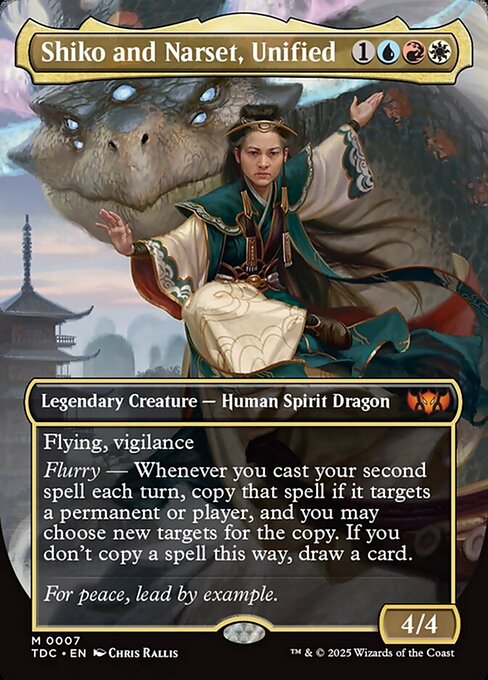
#10. Shiko and Narset, Unified
Shiko and Narset, Unified | Illustration by Chris Rallis
Shiko and Narset reward the second spell you cast each turn. If that spell targets a permanent or player, you copy it. If it does not, you draw a card instead. That safety valve is excellent: the deck never has to fill itself with bad combat tricks just to trigger the commander.
The most efficient turns cast a one-mana cantrip or protection spell first, then copy the important removal, draw spell, or pump effect second. Flying and vigilance make the commander difficult to pressure in ordinary combat. The weakness is sequencing. Holding up interaction can force you to trigger flurry at an awkward time, and five mana makes commander tax noticeable.
High-synergy cards: Expedite is a cheap first spell; Feather, the Redeemed recycles targeted instants; Storm-Kiln Artist turns the two-spell pattern into Treasure; Jeskai Ascendancy rewards every noncreature spell while filtering the hand.
#9. Aragorn, King of Gondor
Aragorn, King of Gondor | Illustration by Yongjae Choi
Aragorn becomes the monarch when he enters, then makes one creature unable to block whenever he attacks. If you still hold the monarchy, no creatures can block that combat. He provides a card engine, an evasive plan, and the threat of a completely unblockable army in one four-mana body.
The catch is obvious: introducing the monarchy gives opponents a reason to hit you, and losing it turns the attack trigger from devastating to merely useful. Aragorn decks should be built to reclaim the crown, not just protect it. Haste, disposable attackers, and combat manipulation matter more than another expensive anthem.
High-synergy cards: Forth Eorlingas! creates the monarchy and scales into an army; Court of Grace rewards keeping the crown; Professional Face-Breaker turns successful attacks into Treasure; Reconnaissance lets attackers trigger Aragorn and retreat from bad combat.
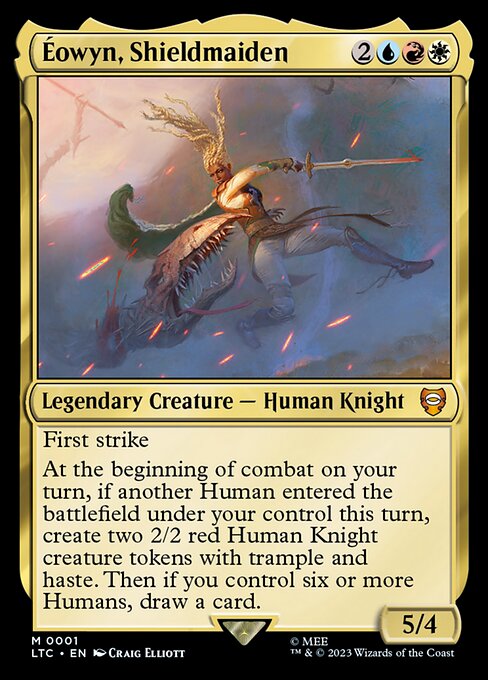
#8. Éowyn, Shieldmaiden
Éowyn, Shieldmaiden | Illustration by Craig Elliott
Éowyn creates two 2/2 Human Knights with trample and haste at the beginning of combat if another Human entered under your control that turn. Control six Humans and she also draws a card. One creature before combat becomes four immediate power, two tribal bodies, and eventually a repeatable card engine.
Five mana is a real commitment, and Éowyn wants another Human ready on the same turn. Casting her into an empty hand produces no token trigger. Board wipes are also painful because the commander rewards going wide. She is still one of Jeskai's cleanest tribal leaders: the deck needs Humans, protection, and a few payoffs, not an elaborate combo diagram.
High-synergy cards: Horn of Gondor scales with the Human count; Théoden, King of Rohan grants double strike when Humans enter; Lossarnach Captain protects attacking Humans; Shared Animosity makes the hasty tokens lethal surprisingly quickly.
#7. Hinata, Dawn-Crowned
Hinata, Dawn-Crowned | Illustration by Alexander Mokhov
Hinata reduces your spells by one generic mana for every target while charging opponents an extra mana for every target their spells have. A spell that targets five permanents costs five less. A removal spell aimed at Hinata costs one more. That combination creates both explosive turns and a layer of protection.
The best Hinata cards are often clumsy without her. Comet Storm, By Force, and mass-bounce spells can become absurdly efficient, but commander removal may leave those same cards stranded. The tax also attracts attention because opponents feel it immediately. Hinata belongs with pilots who enjoy finding unusual targeted spells and are willing to protect a commander that makes the whole deck cheaper.
High-synergy cards: Magma Opus receives several reductions while producing cards and material; Comet Storm scales into a finisher; March of Swirling Mist can phase out an entire board for very little mana; By Force becomes efficient artifact removal across multiple targets.
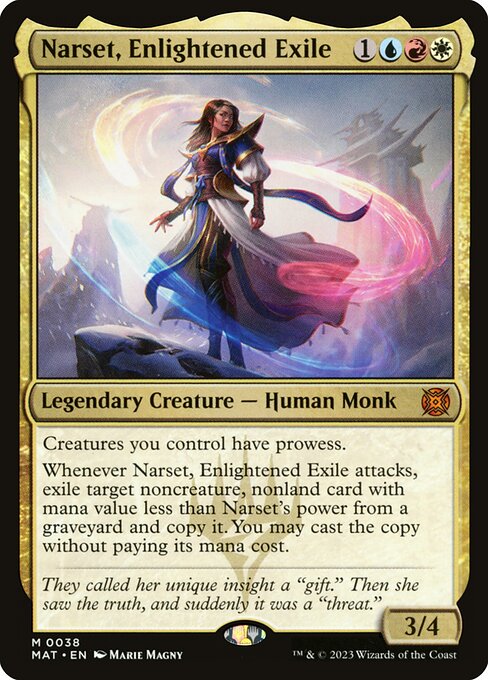
#6. Narset, Enlightened Exile
Narset, Enlightened Exile | Illustration by Marie Magny
Narset gives every creature you control prowess, then exiles and copies a noncreature, nonland card from any graveyard whenever she attacks. The card's mana value must be less than Narset's power, which means every prowess trigger expands the menu before the attack trigger resolves.
Unlike the older Narset, Enlightened Exile wants creatures on the battlefield. Token makers are ideal because each body receives prowess and turns the recast spell into more combat damage. Graveyard hate and instant-speed removal can shrink the attack, but one successful swing usually recovers a valuable spell for free. Choose her for a spellslinger deck that actually wins through combat.
High-synergy cards: Monastery Mentor supplies prowess bodies; Jeskai Ascendancy grows and untaps the team; Faithless Looting is cheap to discard and recast; Seize the Day creates another attack and another graveyard trigger.
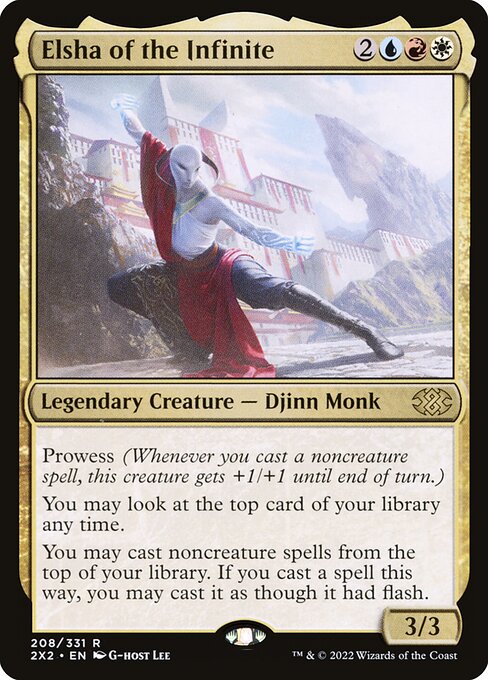
#5. Elsha of the Infinite
Elsha of the Infinite | Illustration by G-host Lee
Elsha lets you look at the top card of your library at any time and cast noncreature spells from there, with flash. That is card advantage hiding in plain sight. Every spell cast from the top reveals another chance to continue, and instant-speed access makes it difficult for opponents to know whether Elsha is holding interaction or assembling a combo.
Five mana and three toughness make her fragile, and a land on top stops the chain unless the deck can move it. Top-deck manipulation is not optional. Elsha also has a well-known combo reputation, so even a fair build may draw early removal. She is best for players who enjoy playing from the top of the library and making decisions on every turn.
High-synergy cards: Sensei's Divining Top clears unwanted cards and can form a loop with cost reduction; Aetherflux Reservoir turns repeated casts into a win; Helm of Awakening reduces the Top; Counterbalance uses the same top-deck information to disrupt opponents.
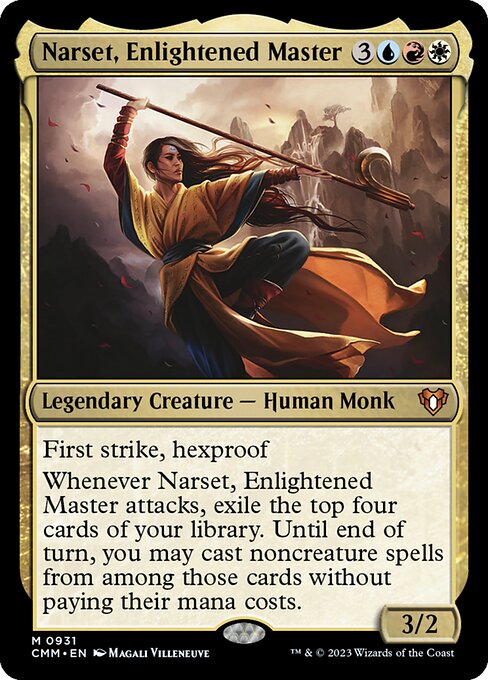
#4. Narset, Enlightened Master
Narset, Enlightened Master | Illustration by Magali Villeneuve
Narset attacks and exiles the top four cards of your library, allowing you to cast the noncreature spells for free that turn. Hexproof makes ordinary targeted removal fail, and first strike helps her survive smaller blockers. A single attack can produce planeswalkers, extra combats, protection, or enough card advantage that the game stops being competitive.
That power creates two weaknesses. Six mana is slow if the deck does not ramp, and the table knows exactly what an untap with Narset can mean. She also encourages lists packed with expensive haymakers that are miserable to draw naturally. Narset is the right choice when you want maximum free-spell spectacle and accept that opponents will treat her as urgent.
High-synergy cards: Brainstorm places expensive spells back on top; Scroll Rack rebuilds the next attack; Relentless Assault generates another combat; Omniscience is exactly the kind of impossible permanent Narset can cast for nothing.
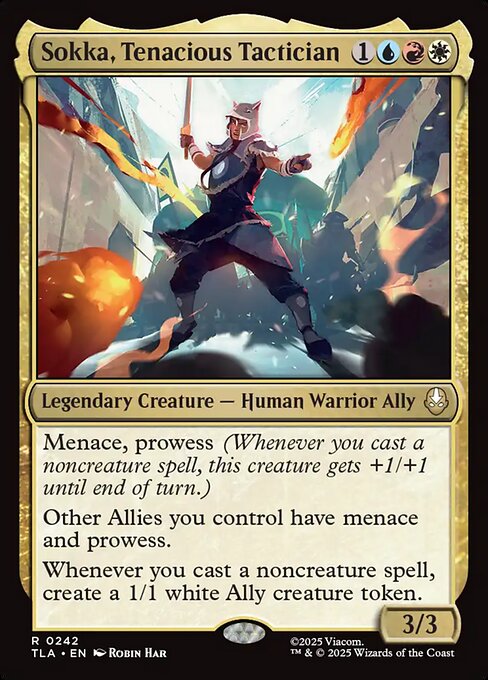
#3. Sokka, Tenacious Tactician
Sokka, Tenacious Tactician | Illustration by Robin Har
Sokka gives other Allies menace and prowess, then creates a 1/1 Ally whenever you cast a noncreature spell. Each spell grows the existing team and adds another creature for the next spell. Menace makes the expanding board difficult to block, so the deck turns ordinary cantrips into both cards and combat pressure.
The commander is more focused than Kykar because the tokens and anthem care about Allies. That is a strength if you want typal synergies and a limitation if you want to play every generic spellslinger payoff. Board wipes remain the clean answer, and Sokka needs a developed army before prowess becomes lethal. Choose him for a proactive Jeskai deck where the spell chain ends in combat rather than a deterministic loop.
High-synergy cards: Jeskai Ascendancy untaps and grows the team; Hada Freeblade grows whenever the Ally tokens arrive; Sea Gate Loremaster turns the tribe into cards; Impact Tremors damages the table before the tokens ever attack.
#2. Kykar, Wind's Fury
Kykar, Wind's Fury | Illustration by G-host Lee
Kykar creates a 1/1 flying Spirit whenever you cast a noncreature spell, then lets you sacrifice Spirits for red mana. That is three engines in four lines of text: token production, evasion, and mana conversion. A cantrip makes a body. That body can attack, block, carry equipment, trigger an anthem, or become the mana for the next spell.
Kykar's floor is unusually high because almost every Commander deck already wants mana rocks, removal, protection, and card draw. Those ordinary spells now develop the board. The danger is building a deck that spins through spells without a clear finish. Decide whether the Spirits are attackers, sacrifice material, or combo fuel before filling the final twenty slots.
High-synergy cards: Skullclamp turns Spirits into cards; Jeskai Ascendancy grows the army and filters draws; Impact Tremors converts every token into damage; Underworld Breach lets the graveyard fuel one final spell chain. For a deeper look at the color pair inside this strategy, see our Izzet spellslinger commander ranking.
#1. Jeska, Thrice Reborn and Ishai, Ojutai Dragonspeaker
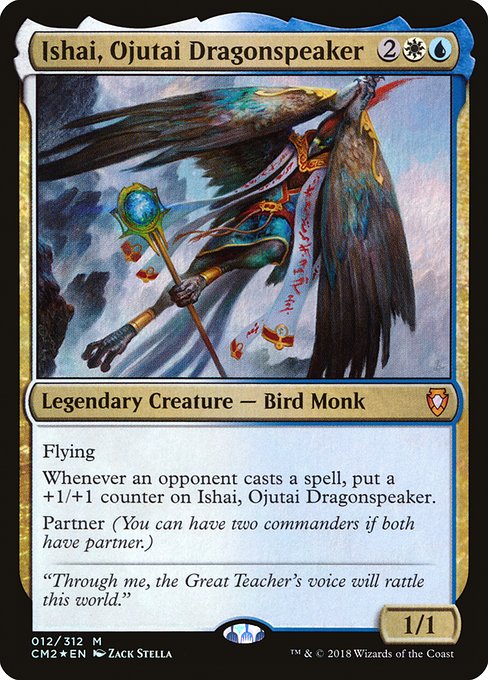
Jeska, Thrice Reborn | Illustration by Yongjae ChoiIshai, Ojutai Dragonspeaker | Illustration by Zack Stella
Ishai gains a +1/+1 counter whenever an opponent casts a spell. In a four-player game, that means the table grows your commander simply by playing Magic. Jeska's zero-loyalty ability then makes a chosen creature deal triple combat damage to one of your opponents until your next turn. Once Ishai reaches seven power, one clean hit after Jeska's activation deals 21 commander damage.
That is the best combination of speed, resilience, and flexibility available to a Jeskai command zone. Ishai is an evasive clock that requires no mana after resolution. Jeska provides removal when needed and a lethal multiplier when the lane opens. Partner also means the deck begins with access to two commanders, so losing one does not switch off every plan.
The pairing is not effortless. Ishai has no built-in protection, Jeska's effectiveness depends on commander-cast history, and a visible one-shot clock draws removal. The deck must protect Ishai without spending so many slots on auras and equipment that it stops interacting. Build it as Jeskai control with a compact Voltron finish, not as ninety cards waiting for one bird to connect.
High-synergy cards: Kediss, Emberclaw Familiar spreads Ishai's damage across the table; Duelist's Heritage adds double strike without targeting only your creatures; The Ozolith preserves counters after removal; Deflecting Swat and Boros Charm protect the lethal turn.
Which Jeskai Commander Should You Build?
Choose the commander whose payoff matches the cards you already enjoy casting.
- Pick Kykar if you want the most forgiving spellslinger shell.
- Pick Sokka or Éowyn if attacking with a tribe sounds better than assembling a combo.
- Pick Elsha or Narset, Enlightened Master if you enjoy casting cards from unusual zones.
- Pick Kilo, Cayth, or Dr. Madison Li if you prefer artifact and counter engines.
- Pick Aragorn or Pramikon if multiplayer combat and politics are the main attraction.
- Pick Jeska and Ishai if you want interaction backed by a fast, compact win condition.
Jeskai decks are often mana-hungry. Start with enough lands and two-mana rocks before adding the clever synergy pieces. You can test the curve, color requirements, and opening hands in the ElderDecks Commander deck builder.
Jeskai Commander FAQ
What Colors Are Jeskai?
Jeskai is white, blue, and red. In Commander, every card in a Jeskai deck must have a color identity contained within those three colors, unless a rule specifically allows otherwise.
What Is Jeskai Best At in Commander?
Jeskai is strongest at combining cheap spells with persistent payoffs. It has excellent card selection, stack interaction, creature protection, artifact support, token production, and combat tricks. Its main structural weakness is ramp: without green, most Jeskai decks depend on artifacts, cost reduction, Treasure, or unusual engines for acceleration.
Who Is the Best Jeskai Spellslinger Commander?
Kykar, Wind's Fury is the best general-purpose option because every noncreature spell makes a flying token that can become red mana. Sokka is better for Ally typal combat, while Elsha is better for top-of-library combo play.
Who Is the Best Jeskai Commander for Beginners?
Éowyn, Shieldmaiden is one of the cleanest starting points. Cast a Human before combat, create two hasty tokens, and attack. Kykar is also approachable if the deck includes a straightforward token payoff instead of several overlapping combos.
Is Narset, Enlightened Master Too Strong for Casual Commander?
Narset can be built casually, but her free-spell ceiling and hexproof reputation affect how opponents respond. Extra turns, extra combats, and expensive noncreature permanents make her dramatically stronger. Discuss the intended power level before the game rather than assuming the commander alone explains the deck.
Can Partner Commanders Make a Jeskai Deck?
Yes. If two commanders both have partner, their combined color identities determine the deck's available colors. Jeska is red and Ishai is white-blue, so the pair creates a legal Jeskai command zone.
Will Jean-Luc Picard Be a Jeskai Commander?
Yes. Jean-Luc Picard, Luminary has a white-blue-red color identity and leads Federation Fleet. He releases with Magic: The Gathering | Star Trek on November 13, 2026, so he was not included among the currently legal commanders in this October 27 ranking.
Final Verdict
The best Jeskai commanders do not merely reward casting spells. They decide what those spells become. Kykar turns them into Spirits and mana. Sokka turns them into an Ally army. Vraska turns them into Treasure creatures. The Narsets turn them into combat damage and free cards.
Jeska and Ishai take the top spot because the deck never has to choose between playing a real interactive game and presenting a fast win. The table grows Ishai for you, Jeska converts that growth into lethal damage, and the other ninety-eight cards remain free to draw, protect, and disrupt.
That is Jeskai at its best: patient until the opening appears, then suddenly far less patient.
Card names, Oracle text, color identities, and Commander legality were checked on October 27, 2026. Jean-Luc Picard's release status was checked separately because previewed cards do not become Commander-legal until their product release.
Jeskai has a reputation for casting twelve spells, taking a very impressive turn, and somehow ending it with the same number of permanents it started with. The best Jeskai commanders fix that problem. They turn every cantrip, attack, artifact, counter, or creature entering the battlefield into something that remains after the stack finally clears.
That range is what makes white-blue-red commanders so interesting. Jeskai can be a spellslinger deck, but it can also play Humans, Energy, cycling, Superfriends, artifact tokens, blink, Voltron, or table politics. The difficult part is choosing a leader that does more than point at a theme.
This ranking favors commanders that generate repeatable resources, work with a broad pool of cards, recover after interaction, and can actually finish a game. Raw ceiling matters, but so do mana cost, setup requirements, flexibility, and how badly the deck functions when its commander is removed. The top of the list belongs to leaders that make ordinary Jeskai cards feel unfair without demanding that every slot serve one narrow combo.
What Are the Best Jeskai Commanders?
The strongest Jeskai commanders convert the color combination's cheap interaction and card selection into a board, mana, or an immediate clock. Kykar turns noncreature spells into flying bodies and red mana. Both Narsets weaponize combat in very different ways. Elsha turns the top of the library into a second hand. The eventual winner combines a growing evasive threat with a damage multiplier that changes the table's math the moment both commanders are available.
If you want the simplest starting point, choose your engine first:
- Spells and tokens: Kykar, Sokka, or Vraska
- Combat and free spells: either Narset
- Creatures and enter-the-battlefield abilities: Zinnia, Cayth, or Satya
- Counters and artifacts: Kilo or Dr. Madison Li
- Tribal combat: Éowyn
- Planeswalkers:Commodore Guff
- Control and politics: Pramikon
Jeskai gives you white's protection, blue's cards and stack interaction, and red's speed. What it does not give you is effortless land ramp. Most of these decks need disciplined mana rocks and a curve that does not begin at four.
How We Ranked the Best White-Blue-Red Commanders
This is an editorial ranking, not a popularity chart. Each commander was judged on five points:
1. Engine value: Does the commander create cards, mana, tokens, or meaningful tempo?
2. Setup cost: How much board or deck construction is required before the text matters?
3. Resilience: Does the deck still function after removal, and can the commander generate value immediately?
4. Flexibility: Can the leader support more than one useful build?
5. Closing power: Can the commander help end a multiplayer game instead of merely accumulating value?
All ranked commanders and command-zone pairs have an exact white-blue-red color identity and were Commander-legal on October 27, 2026. Oracle text and legality were checked with Scryfall. Partner pairs are evaluated as a single command-zone choice.
Why Jean-Luc Picard Is Not Ranked Yet
Jean-Luc Picard, Luminary | Illustration by Jason Pastrana
Jean-Luc Picard, Luminary will lead the Jeskai Federation Fleet precon, and his design is promising. Historic permanents with mana value three or greater draw cards, while drawing your second card each turn places a +1/+1 counter on a creature and two charge counters on a Spacecraft. That links artifacts, legends, Sagas, card draw, and the new seek out mechanic without forcing every card into one lane.
He is not in the countdown because Magic: The Gathering | Star Trek releases on November 13, 2026. As of this article's October 27 review date, Picard is previewed but not yet Commander-legal. Once the set releases and Federation Fleet has real deckbuilding context, he deserves a fresh evaluation. You can follow the reveal schedule in our guide to all four MTG Star Trek Commander decks.
Sevinne, the Chronoclasm | Illustration by Zoltan Boros
Sevinne asks you to cast the first instant or sorcery from your graveyard each turn, then copies it. The obvious home is flashback, but the wording also rewards jump-start, retrace, aftermath, escape, and any effect that lets you cast spells from the graveyard. Doubling a Deep Analysis is useful. Doubling removal or a mass-reanimation spell is where the deck begins to pull ahead.
The problem is pace. Sevinne costs five mana, does not copy a spell until another card enables the graveyard cast, and only rewards the first qualifying spell each turn. Preventing damage to Sevinne is flavorful protection, but exile, bounce, and destroy effects still work. Choose Sevinne if you enjoy methodical graveyard value and want your spellslinger deck to play from two zones. Skip him if you want the commander to make material immediately.
Pramikon, Sky Rampart | Illustration by Richard Wright
Pramikon is one of the strangest control commanders ever printed. Choosing left or right restricts every player to attacking the nearest opponent in that direction. That can insulate you from the largest creature deck, protect planeswalkers, or force two opponents to spend several turns crashing into each other.
A 1/5 flying defender for three mana is excellent at staying alive, but Pramikon does not draw cards or win on its own. It also creates a social puzzle: if the restriction protects one player too effectively, the rest of the table may decide Pramikon is the real threat. The best builds use the attack rule to buy time for planeswalkers, monarch cards, or a compact finisher rather than trying to lock combat forever.
High-synergy cards:Mystic Barrier lets you reverse or reinforce the attack direction; Disrupt Decorum sends creatures where they are allowed to go; Ghostly Prison adds another tax; Court of Grace rewards the safe turns with cards and flying bodies.
Gavi makes the first card you cycle each turn cost zero and creates a 2/2 Dinosaur Cat whenever you draw your second card in a turn. That is a clean engine: cycle on your turn for a token, then cycle on an opponent's turn for another. The deck naturally holds mana for interaction because cycling does not require committing the whole hand to the battlefield.
The limitation is card pool dependency. A cycling deck needs enough cyclers to operate, enough cycling payoffs to matter, and enough ordinary Commander interaction that it does not fold while assembling those pieces. Gavi also costs five, so the opening turns must function without her. She is ideal for players who like playing at instant speed and turning card selection into incremental board presence.
High-synergy cards: Fluctuator reduces the rest of your cycling costs; Astral Drift converts cycling into repeatable blink or removal; Decree of Justice makes a late army; Abandoned Sarcophagus lets cycled cards become a second hand.
Kilo, Apogee Mind | Illustration by Tuan Duong Chu
Kilo proliferates whenever it becomes tapped. Haste means the first trigger is available immediately, and the ability does not care why Kilo tapped. Attack, crew a Vehicle, station a Spacecraft, or use an artifact that taps creatures: every route advances each useful counter you already control.
That flexibility is also the deckbuilding trap. It is easy to fill Kilo with charge counters, +1/+1 counters, loyalty counters, lore counters, and alternate-win permanents until the deck has twenty packages that never meet. Strong Kilo lists select two or three counter families and make every proliferate trigger advance most of them. Play Kilo if you enjoy sequencing and board engines. Avoid it if keeping track of a dozen counter types sounds like unpaid accounting.
Dr. Madison Li makes an Energy whenever you cast an artifact, then spends that Energy on haste and trample, card draw, or reanimating an artifact. The three abilities cover every stage of the game. Cheap artifacts charge the engine, three Energy keeps cards flowing, and five Energy returns the best machine from the graveyard.
She is efficient at three mana, but every activated ability requires tapping the commander. Without untapping effects, you must choose between immediate cards and saving for reanimation. Artifact hate also attacks both the Energy supply and the recursion targets. Madison is best for players who want an artifact deck with a resource-management puzzle rather than another generic value pile.
Commodore Guff is the most direct Jeskai Superfriends commander. He adds loyalty to another planeswalker every end step, makes Wizard tokens that ramp into planeswalkers, and can cash loyalty in for cards and damage equal to the number of planeswalkers you control.
The deck can snowball hard, but it announces its plan in capital letters. Every planeswalker adds another permanent opponents feel obligated to attack, and protecting four walkers is much harder than protecting one creature. Guff's minus ability is the reason to accept that pressure: it turns a developed board into both a refill and a legitimate win condition. Choose him if you enjoy managing combat and several small engines at once.
High-synergy cards:Oath of Teferi doubles planeswalker activations; Spark Double copies the most important walker without the legend rule; The Chain Veil adds another round of abilities; Ichormoon Gauntlet gives noncreature spells and planeswalkers a shared proliferate plan.
Zinnia, Valley's Voice | Illustration by Aldo Domínguez
Zinnia gives every creature spell offspring {2}. Paying the extra two creates a 1/1 token copy when that creature enters, so the best targets are creatures whose text matters more than their printed power. Copying Mulldrifter still draws four cards. Copying an Imperial Recruiter still finds two creatures. Copying Solemn Simulacrum still finds two lands and leaves two useful bodies.
Offspring turns every good creature into a tempting six- or seven-mana play, and that greed can ruin the curve. Zinnia decks need cheap creatures, cost reduction, and the discipline to cast some threats without offspring. The commander itself becomes a meaningful evasive attacker as the 1-power army grows, but the real appeal is doubling enter-the-battlefield text.
Cayth, Famed Mechanist | Illustration by Eric Wilkerson
Cayth gives every nontoken creature fabricate 1, letting each arrival become either a larger body or an additional Servo. Her activated ability then populates the best creature token or proliferates the counters already on the battlefield. That makes Cayth a bridge between token decks and counter decks instead of forcing you to choose only one.
The ceiling is high, but four mana plus a two-mana tap ability is not fast. Cayth wants creatures to enter, worthwhile tokens to copy, counters to proliferate, and enough untapping to use the commander repeatedly. A list containing every populate and proliferate card will feel scattered. Build around enter-the-battlefield creatures first, then use the tokens and counters as the payoff.
Satya, Aetherflux Genius | Illustration by Aaron Miller
Whenever Satya attacks, he makes a tapped and attacking copy of another nontoken creature and gives you two Energy. The token is sacrificed at the next end step unless you pay Energy equal to its mana value. That sounds temporary, but an enter-the-battlefield trigger, attack trigger, or death trigger has already paid you before the copy disappears.
Satya has haste and menace, so the first trigger comes quickly. The weakness is dependence on another creature worth copying. An empty board leaves him as a four-mana 3/5, and expensive copies consume more Energy than the attack produces. Favor creatures with immediate value and treat keeping the token as a bonus rather than the plan.
High-synergy cards:Guide of Souls supplies Energy and grows attackers; Panharmonicon doubles copied enter-the-battlefield triggers; Decoction Module replenishes Energy; Sundial of the Infinite can end the turn with the delayed sacrifice trigger on the stack, preserving the token.
Vraska, Soul of Stone | Illustration by Kieran Yanner
Reality Fracture gave Jeskai a commander that turns every noncreature spell into a 1/1 Sculpture Treasure artifact creature. Those tokens can attack with vigilance, block, trigger artifact payoffs, or sacrifice for mana. A cantrip no longer replaces itself and leaves; it becomes a body and a future resource.
Vraska resembles Kykar, but the texture is different. Treasures are artifacts, make any color, and sacrifice themselves without another outlet. They do not fly, and losing Vraska removes vigilance, so combat requires more work. The commander is strongest when the deck rewards artifacts entering and leaving instead of treating the Sculptures as disposable mana rocks.
High-synergy cards:Reckless Fireweaver turns every Sculpture into damage; Skullclamp converts 1/1s into cards; Anointed Procession doubles production; Inspiring Statuary lets the artifact army help cast even more noncreature spells.
Shiko and Narset, Unified | Illustration by Chris Rallis
Shiko and Narset reward the second spell you cast each turn. If that spell targets a permanent or player, you copy it. If it does not, you draw a card instead. That safety valve is excellent: the deck never has to fill itself with bad combat tricks just to trigger the commander.
The most efficient turns cast a one-mana cantrip or protection spell first, then copy the important removal, draw spell, or pump effect second. Flying and vigilance make the commander difficult to pressure in ordinary combat. The weakness is sequencing. Holding up interaction can force you to trigger flurry at an awkward time, and five mana makes commander tax noticeable.
High-synergy cards: Expedite is a cheap first spell; Feather, the Redeemed recycles targeted instants; Storm-Kiln Artist turns the two-spell pattern into Treasure; Jeskai Ascendancy rewards every noncreature spell while filtering the hand.
Aragorn, King of Gondor | Illustration by Yongjae Choi
Aragorn becomes the monarch when he enters, then makes one creature unable to block whenever he attacks. If you still hold the monarchy, no creatures can block that combat. He provides a card engine, an evasive plan, and the threat of a completely unblockable army in one four-mana body.
The catch is obvious: introducing the monarchy gives opponents a reason to hit you, and losing it turns the attack trigger from devastating to merely useful. Aragorn decks should be built to reclaim the crown, not just protect it. Haste, disposable attackers, and combat manipulation matter more than another expensive anthem.
High-synergy cards:Forth Eorlingas! creates the monarchy and scales into an army; Court of Grace rewards keeping the crown; Professional Face-Breaker turns successful attacks into Treasure; Reconnaissance lets attackers trigger Aragorn and retreat from bad combat.
Éowyn, Shieldmaiden | Illustration by Craig Elliott
Éowyn creates two 2/2 Human Knights with trample and haste at the beginning of combat if another Human entered under your control that turn. Control six Humans and she also draws a card. One creature before combat becomes four immediate power, two tribal bodies, and eventually a repeatable card engine.
Five mana is a real commitment, and Éowyn wants another Human ready on the same turn. Casting her into an empty hand produces no token trigger. Board wipes are also painful because the commander rewards going wide. She is still one of Jeskai's cleanest tribal leaders: the deck needs Humans, protection, and a few payoffs, not an elaborate combo diagram.
Hinata, Dawn-Crowned | Illustration by Alexander Mokhov
Hinata reduces your spells by one generic mana for every target while charging opponents an extra mana for every target their spells have. A spell that targets five permanents costs five less. A removal spell aimed at Hinata costs one more. That combination creates both explosive turns and a layer of protection.
The best Hinata cards are often clumsy without her. Comet Storm, By Force, and mass-bounce spells can become absurdly efficient, but commander removal may leave those same cards stranded. The tax also attracts attention because opponents feel it immediately. Hinata belongs with pilots who enjoy finding unusual targeted spells and are willing to protect a commander that makes the whole deck cheaper.
High-synergy cards:Magma Opus receives several reductions while producing cards and material; Comet Storm scales into a finisher; March of Swirling Mist can phase out an entire board for very little mana; By Force becomes efficient artifact removal across multiple targets.
Narset, Enlightened Exile | Illustration by Marie Magny
Narset gives every creature you control prowess, then exiles and copies a noncreature, nonland card from any graveyard whenever she attacks. The card's mana value must be less than Narset's power, which means every prowess trigger expands the menu before the attack trigger resolves.
Unlike the older Narset, Enlightened Exile wants creatures on the battlefield. Token makers are ideal because each body receives prowess and turns the recast spell into more combat damage. Graveyard hate and instant-speed removal can shrink the attack, but one successful swing usually recovers a valuable spell for free. Choose her for a spellslinger deck that actually wins through combat.
Elsha of the Infinite | Illustration by G-host Lee
Elsha lets you look at the top card of your library at any time and cast noncreature spells from there, with flash. That is card advantage hiding in plain sight. Every spell cast from the top reveals another chance to continue, and instant-speed access makes it difficult for opponents to know whether Elsha is holding interaction or assembling a combo.
Five mana and three toughness make her fragile, and a land on top stops the chain unless the deck can move it. Top-deck manipulation is not optional. Elsha also has a well-known combo reputation, so even a fair build may draw early removal. She is best for players who enjoy playing from the top of the library and making decisions on every turn.
High-synergy cards:Sensei's Divining Top clears unwanted cards and can form a loop with cost reduction; Aetherflux Reservoir turns repeated casts into a win; Helm of Awakening reduces the Top; Counterbalance uses the same top-deck information to disrupt opponents.
Narset, Enlightened Master | Illustration by Magali Villeneuve
Narset attacks and exiles the top four cards of your library, allowing you to cast the noncreature spells for free that turn. Hexproof makes ordinary targeted removal fail, and first strike helps her survive smaller blockers. A single attack can produce planeswalkers, extra combats, protection, or enough card advantage that the game stops being competitive.
That power creates two weaknesses. Six mana is slow if the deck does not ramp, and the table knows exactly what an untap with Narset can mean. She also encourages lists packed with expensive haymakers that are miserable to draw naturally. Narset is the right choice when you want maximum free-spell spectacle and accept that opponents will treat her as urgent.
High-synergy cards: Brainstorm places expensive spells back on top; Scroll Rack rebuilds the next attack; Relentless Assault generates another combat; Omniscience is exactly the kind of impossible permanent Narset can cast for nothing.
Sokka, Tenacious Tactician | Illustration by Robin Har
Sokka gives other Allies menace and prowess, then creates a 1/1 Ally whenever you cast a noncreature spell. Each spell grows the existing team and adds another creature for the next spell. Menace makes the expanding board difficult to block, so the deck turns ordinary cantrips into both cards and combat pressure.
The commander is more focused than Kykar because the tokens and anthem care about Allies. That is a strength if you want typal synergies and a limitation if you want to play every generic spellslinger payoff. Board wipes remain the clean answer, and Sokka needs a developed army before prowess becomes lethal. Choose him for a proactive Jeskai deck where the spell chain ends in combat rather than a deterministic loop.
Kykar creates a 1/1 flying Spirit whenever you cast a noncreature spell, then lets you sacrifice Spirits for red mana. That is three engines in four lines of text: token production, evasion, and mana conversion. A cantrip makes a body. That body can attack, block, carry equipment, trigger an anthem, or become the mana for the next spell.
Kykar's floor is unusually high because almost every Commander deck already wants mana rocks, removal, protection, and card draw. Those ordinary spells now develop the board. The danger is building a deck that spins through spells without a clear finish. Decide whether the Spirits are attackers, sacrifice material, or combo fuel before filling the final twenty slots.
Jeska, Thrice Reborn | Illustration by Yongjae ChoiIshai, Ojutai Dragonspeaker | Illustration by Zack Stella
Ishai gains a +1/+1 counter whenever an opponent casts a spell. In a four-player game, that means the table grows your commander simply by playing Magic. Jeska's zero-loyalty ability then makes a chosen creature deal triple combat damage to one of your opponents until your next turn. Once Ishai reaches seven power, one clean hit after Jeska's activation deals 21 commander damage.
That is the best combination of speed, resilience, and flexibility available to a Jeskai command zone. Ishai is an evasive clock that requires no mana after resolution. Jeska provides removal when needed and a lethal multiplier when the lane opens. Partner also means the deck begins with access to two commanders, so losing one does not switch off every plan.
The pairing is not effortless. Ishai has no built-in protection, Jeska's effectiveness depends on commander-cast history, and a visible one-shot clock draws removal. The deck must protect Ishai without spending so many slots on auras and equipment that it stops interacting. Build it as Jeskai control with a compact Voltron finish, not as ninety cards waiting for one bird to connect.
Choose the commander whose payoff matches the cards you already enjoy casting.
- Pick Kykar if you want the most forgiving spellslinger shell.
- Pick Sokka or Éowyn if attacking with a tribe sounds better than assembling a combo.
- Pick Elsha or Narset, Enlightened Master if you enjoy casting cards from unusual zones.
- Pick Kilo, Cayth, or Dr. Madison Li if you prefer artifact and counter engines.
- Pick Aragorn or Pramikon if multiplayer combat and politics are the main attraction.
- Pick Jeska and Ishai if you want interaction backed by a fast, compact win condition.
Jeskai decks are often mana-hungry. Start with enough lands and two-mana rocks before adding the clever synergy pieces. You can test the curve, color requirements, and opening hands in the ElderDecks Commander deck builder.
Jeskai Commander FAQ
What Colors Are Jeskai?
Jeskai is white, blue, and red. In Commander, every card in a Jeskai deck must have a color identity contained within those three colors, unless a rule specifically allows otherwise.
What Is Jeskai Best At in Commander?
Jeskai is strongest at combining cheap spells with persistent payoffs. It has excellent card selection, stack interaction, creature protection, artifact support, token production, and combat tricks. Its main structural weakness is ramp: without green, most Jeskai decks depend on artifacts, cost reduction, Treasure, or unusual engines for acceleration.
Who Is the Best Jeskai Spellslinger Commander?
Kykar, Wind's Fury is the best general-purpose option because every noncreature spell makes a flying token that can become red mana. Sokka is better for Ally typal combat, while Elsha is better for top-of-library combo play.
Who Is the Best Jeskai Commander for Beginners?
Éowyn, Shieldmaiden is one of the cleanest starting points. Cast a Human before combat, create two hasty tokens, and attack. Kykar is also approachable if the deck includes a straightforward token payoff instead of several overlapping combos.
Narset can be built casually, but her free-spell ceiling and hexproof reputation affect how opponents respond. Extra turns, extra combats, and expensive noncreature permanents make her dramatically stronger. Discuss the intended power level before the game rather than assuming the commander alone explains the deck.
Can Partner Commanders Make a Jeskai Deck?
Yes. If two commanders both have partner, their combined color identities determine the deck's available colors. Jeska is red and Ishai is white-blue, so the pair creates a legal Jeskai command zone.
Will Jean-Luc Picard Be a Jeskai Commander?
Yes. Jean-Luc Picard, Luminary has a white-blue-red color identity and leads Federation Fleet. He releases with Magic: The Gathering | Star Trek on November 13, 2026, so he was not included among the currently legal commanders in this October 27 ranking.
Final Verdict
The best Jeskai commanders do not merely reward casting spells. They decide what those spells become. Kykar turns them into Spirits and mana. Sokka turns them into an Ally army. Vraska turns them into Treasure creatures. The Narsets turn them into combat damage and free cards.
Jeska and Ishai take the top spot because the deck never has to choose between playing a real interactive game and presenting a fast win. The table grows Ishai for you, Jeska converts that growth into lethal damage, and the other ninety-eight cards remain free to draw, protect, and disrupt.
That is Jeskai at its best: patient until the opening appears, then suddenly far less patient.
Card names, Oracle text, color identities, and Commander legality were checked on October 27, 2026. Jean-Luc Picard's release status was checked separately because previewed cards do not become Commander-legal until their product release.
FROM IDEA TO DECK
Build around a commander from this article
Choose a commander to start a deck with it in the command zone. Build for free in your browser, then sign in when you’re ready to save. New to deck building? Explore our Commander and EDH deck builder.