By ElderArticles · Updated 10/22/2026 · 15 min read
Discover the 15 best Izzet spellslinger commanders, with ranked strengths, weaknesses, key synergies, win conditions, and the right pilot for each.
Table of contents
Izzet decks have a reputation for taking ten-minute turns and accomplishing nothing. The good ones do the opposite: every cantrip either pays you back, builds a board, stores mana, or quietly assembles the turn that ends the game.
The best Izzet spellslinger commander overall is Vivi Ornitier. Vivi turns noncreature spells into permanent power, table-wide damage, and a larger burst of mana on the next turn. Stella Lee is the cleaner combo commander, while Veyran and Mizzix remain the picks for players who want triggered-ability fireworks or old-fashioned cost-reduction storm.
Vivi Ornitier | Illustration by Toni Infante
This ranking covers blue-red commanders that reward instants, sorceries, or dense noncreature packages. It is aimed at multiplayer Commander—not a strict cEDH tier list—and weighs what the commander supplies from the command zone, how quickly the engine starts, how well it rebuilds, and whether the deck can win in more than one way.
How We Ranked the Best Izzet Spellslinger Commanders
A commander earns points for doing work by itself. Card advantage, mana production, spell copying, and a built-in payoff are more valuable than merely being the right colors. We also considered setup cost, resilience, color requirements, and how badly the deck stumbles when its first payoff or combo is stopped.
That favors self-contained engines, but it does not make the lower entries bad. Balmor can kill a table with tokens more cleanly than several commanders ranked above it; Ghyrson is unmatched if your box of one-damage cards is already calling your name. The ranking asks which commander gives the broadest, most reliable spellslinger shell—not which legend is allowed to have the most fun.
#15. Jori En, Ruin Diver
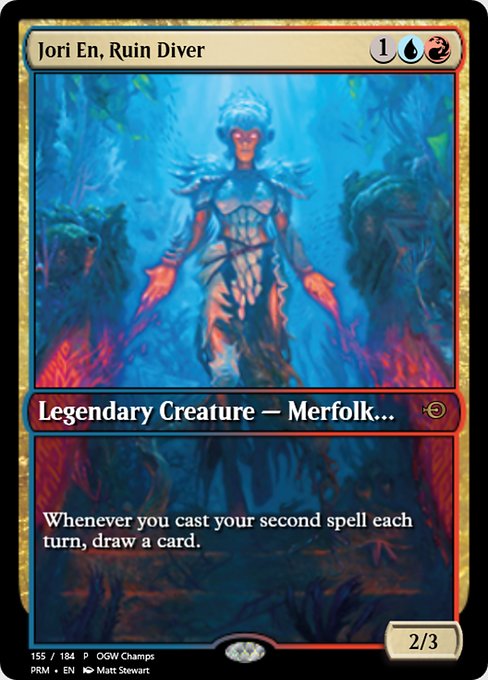
Jori En, Ruin Diver | Illustration by Matt Stewart
Jori En is the honest version of Izzet spellslinger. Cast your second spell in a turn and draw a card. The trigger works on every turn, so an instant-heavy list can turn a cheap cantrip plus interaction into several extra cards per rotation.
AI-generated article, published by an ElderDecks editor.
Opt
,
Consider
, and
Frantic Search
keep the second-spell threshold painless, while
Isochron Scepter
can provide a repeatable first or second spell.
The ceiling is deliberately modest: Jori En draws only once each turn and does nothing for spell number one. That makes her slower than modern engines, but also less likely to eat removal on sight. She is a good choice for pilots who want interactive, stack-based Magic without building around an obvious infinite line.
Best for: Patient value players and first-time spellslinger pilots.
#14. Balmor, Battlemage Captain
Balmor, Battlemage Captain | Illustration by Bram Sels
Balmor asks a wonderfully rude question: what if the cantrip deck simply attacked for 40? Every instant or sorcery gives your creatures +1/+0 and trample for the turn, turning Young Pyromancer, Third Path Iconoclast, Talrand, Sky Summoner, and Murmuring Mystic into both token engines and finishers. At two mana, Balmor can arrive early or wait in the command zone until the lethal turn.
The tradeoff is that Balmor needs a board. A sweeper leaves you with a 1/3 flyer and a hand full of spells that may not rebuild fast enough. He also contributes no cards or mana himself. Build him when you want spellslinger to end in combat, and protect the token makers that give all those pump triggers somewhere useful to land.
High-synergy cards: Young Pyromancer, Third Path Iconoclast, Talrand, Sky Summoner, Murmuring Mystic, Expedite.
Best for: Aggressive pilots who want a clear, non-combo finish.
#13. Bria, Riptide Rogue
Bria, Riptide Rogue | Illustration by Borja Pindado
Bria is Balmor’s more elaborate cousin. She gives your other creatures prowess, has prowess herself, and makes a creature unblockable whenever you cast a noncreature spell. A cluttered battlefield stops mattering when a double-digit token or a pumped Storm-Kiln Artist simply walks around it.
Four mana is a meaningful step up from Balmor, and Bria still needs creatures in play before the text becomes scary. The upside is precision: rather than hoping trample damage breaks through, you choose the attacker that connects. Pair token makers with cheap protection such as Shore Up and Slip Out the Back, then force opponents to answer both the board and the commander.
High-synergy cards: Storm-Kiln Artist, Third Path Iconoclast, Young Pyromancer, Monastery Mentor, Shore Up.
Best for: Players who like prowess combat but want control over exactly where the damage goes.
#12. Ghyrson Starn, Kelermorph
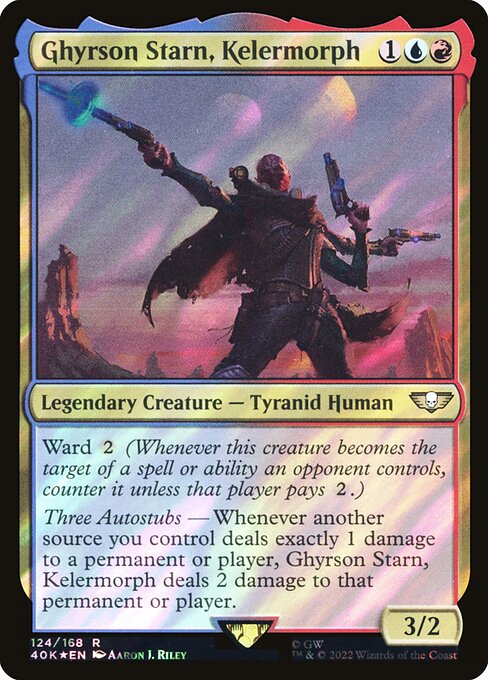
Ghyrson Starn, Kelermorph | Illustration by Aaron J. Riley
Ghyrson turns every exact point of damage from another source you control into three. Thermo-Alchemist and Firebrand Archer become real clocks, End the Festivities can scorch small boards, and a Curiosity effect attached to the right pinger keeps the ammunition coming. Ward {2} helps, because the deck is far less impressive when its multiplier is absent.
The words “exactly 1 damage” are the catch. Effects that replace or increase that initial damage can switch Ghyrson off, and many generic Izzet staples do not interact with him at all. He is less a universal spellslinger commander than the charismatic mayor of Pinger Town. If that is the town you want to live in, nobody else runs it better.
High-synergy cards: Thermo-Alchemist, Firebrand Archer, Kessig Flamebreather, End the Festivities, Curiosity.
Best for: Brewers who enjoy turning forgotten one-damage cards into precision removal and a win condition.
#11. Eris, Roar of the Storm
Eris, Roar of the Storm | Illustration by Aurore Folny
Eris looks like a ten-mana commander until the graveyard does the accounting. Each different mana value among your instant and sorcery cards cuts two generic mana from the price. Once Eris lands, your second spell each turn creates a 4/4 flying Dragon Elemental with prowess. Faithless Looting, Thought Scour, and Frantic Search stock the yard while keeping your curve varied.
Those Dragons end games quickly and do not require an infinite combo, but the engine has two fragile joints. Graveyard hate can make Eris expensive again, and commander tax is much harder to absorb after the first removal spell. Treat your graveyard as a carefully built cost-reduction ladder, not a bin full of interchangeable cantrips.
High-synergy cards: Faithless Looting, Thought Scour, Frantic Search, Big Score, Dig Through Time.
Best for: Graveyard-minded players who want their spell chains to leave a dragon army behind.
#10. Alania, Divergent Storm
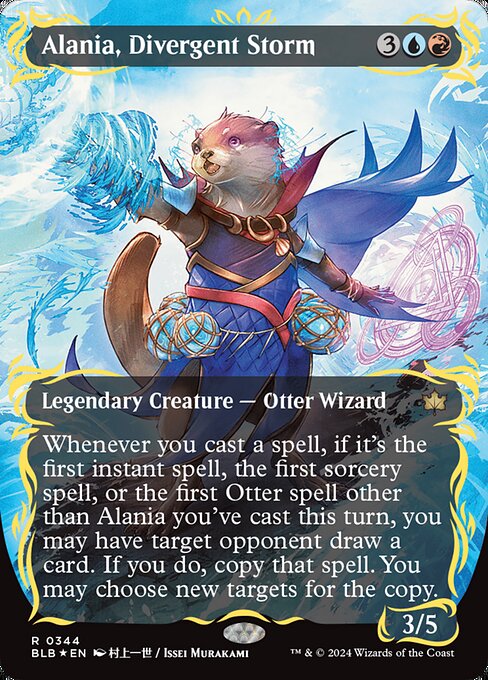
Alania, Divergent Storm | Illustration by Issei Murakami
Alania can copy your first instant, first sorcery, and first other Otter each turn. The bill is unusual: an opponent may draw a card for each copy you take. That turns sequencing into the deck’s main skill test. Copy a Brass’s Bounty or Dig Through Time, and one enemy card looks like pocket change. Spend the trigger on something trivial, and you have subsidized the wrong player for very little gain.
Five mana and the political drawback keep Alania out of the top tier, but few commanders make big, splashy spells feel this satisfying. Instant-speed play also lets you choose a different opponent when the turn cycle changes. She rewards judgment more than raw spell count, which is refreshing in a color pair often accused of playing solitaire.
High-synergy cards: Dig Through Time, Brass’s Bounty, Sublime Epiphany, Big Score, Stormcatch Mentor.
Best for: Political pilots who prefer copying premium spells to chaining twenty tiny ones.
#9. Galazeth Prismari
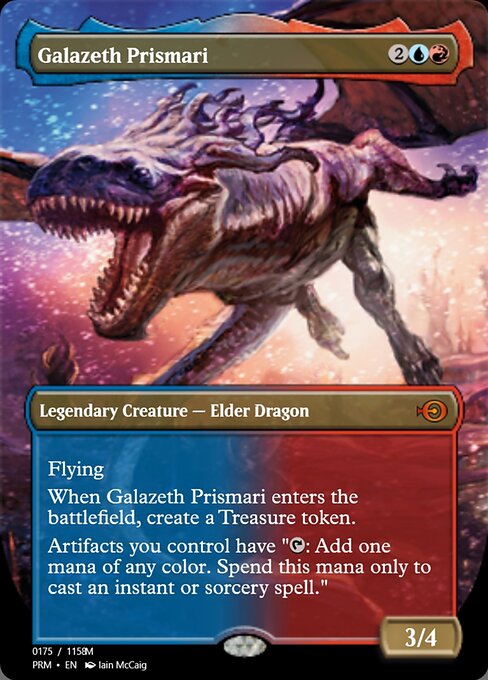
Galazeth Prismari | Illustration by Iain McCaig
Galazeth arrives with a Treasure and lets every artifact you control tap for mana to cast instants and sorceries. Suddenly Treasure, Clue, Blood, and spare mana rocks all help power the next Crackle with Power or overloaded interaction spell. Storm-Kiln Artist, Big Score, and Brass’s Bounty are especially dangerous because the spells manufacture the resources that cast the next spell.
There is an important fence around the ability: that artifact mana cannot cast your permanents or pay activated abilities. Artifact sweepers can also erase what looked like a comfortable mana advantage. Galazeth is strongest when the artifact package is already useful and the big turns are dominated by instants and sorceries—not when a deck is trying to disguise a generic artifact pile as spellslinger.
High-synergy cards: Storm-Kiln Artist, Big Score, Brass’s Bounty, Unexpected Windfall, Crackle with Power.
Best for: Players who enjoy banking resources before one enormous spell turn.
#8. Ovika, Enigma Goliath
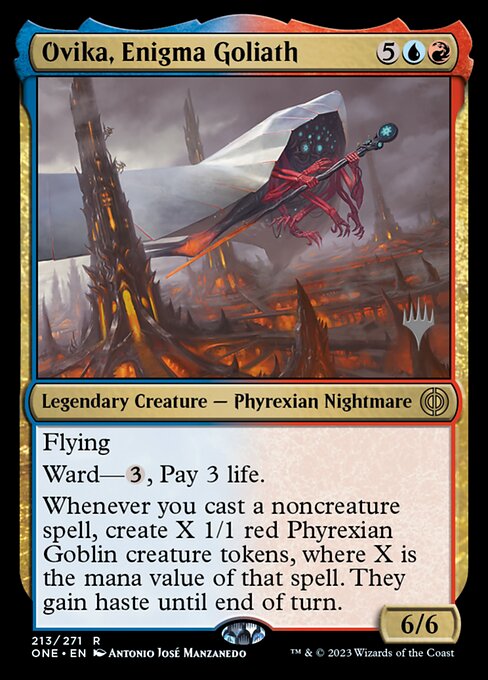
Ovika, Enigma Goliath | Illustration by Antonio José Manzanedo
Ovika charges seven mana, then makes the receipt worth keeping. Each noncreature spell creates a number of 1/1 Phyrexian Goblins equal to that spell’s mana value, and those tokens gain haste until end of turn. Impact Tremors and Purphoros, God of the Forge turn creation into direct damage; Skullclamp turns the survivors into cards; Shared Animosity makes even a modest wave lethal in combat.
Flying plus a punishing ward cost gives Ovika more staying power than most expensive engines, but seven mana is still seven mana. If opponents answer her twice, the deck can spend the rest of the game trying to recast its commander. Ramp hard, keep a protection spell ready, and favor noncreature interaction so that even defensive plays build your army.
High-synergy cards: Impact Tremors, Purphoros, God of the Forge, Skullclamp, Shared Animosity, Jeska’s Will.
Best for: Battlecruiser tables and pilots who want every spell to make bodies.
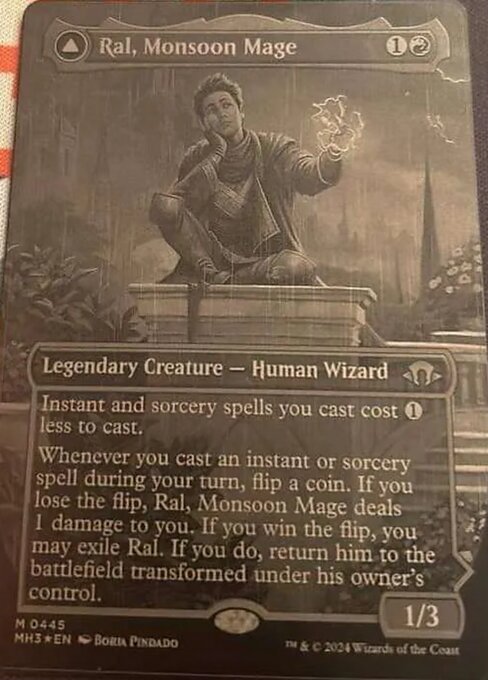
Ral starts as a two-mana cost reducer for instants and sorceries. During your turn, casting those spells also flips coins; wins help transform him into Ral, Leyline Prodigy, where the planeswalker side supplies more value, cost reduction, and eventually a frightening spell-copying emblem. Cheap cantrips make the transformation attempt almost incidental, and Krark’s Thumb gives the coin flips a nudge.
The front face reduces generic costs only, so one-mana spells with colored requirements stay one mana. Transformation is random, and the planeswalker side can be attacked in ways a creature commander cannot. Still, Ral asks very little up front and makes a classic Past in Flames turn substantially easier to assemble.
High-synergy cards: Krark’s Thumb, Consider, Bonus Round, Past in Flames, Frantic Search.
Best for: Storm players who want an efficient commander and do not mind a little variance.
#6. Vadrik, Astral Archmage
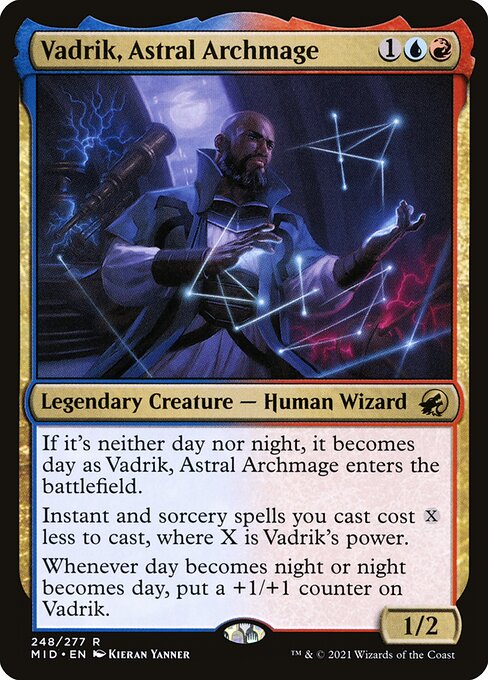
Vadrik, Astral Archmage | Illustration by Kieran Yanner
Vadrik reduces instant and sorcery costs by his power, so a single counter or pump spell can create absurd amounts of virtual mana. Day turning to night gives him a counter, but cards such as Seething Anger and Lunar Frenzy let you skip the celestial timetable. From there, Comet Storm, draw-X spells, and buyback effects become dramatically cheaper.
The engine is explosive and fragile. Vadrik has only two toughness at baseline, colored mana symbols are not reduced, and losing him after spending resources on a pump spell can end the turn on the spot. The best builds avoid all-in tricks that are useless without him and include protection that can double as part of the spell chain.
Best for: Combo mathematicians who enjoy turning commander power into mana.
#5. Niv-Mizzet, Parun
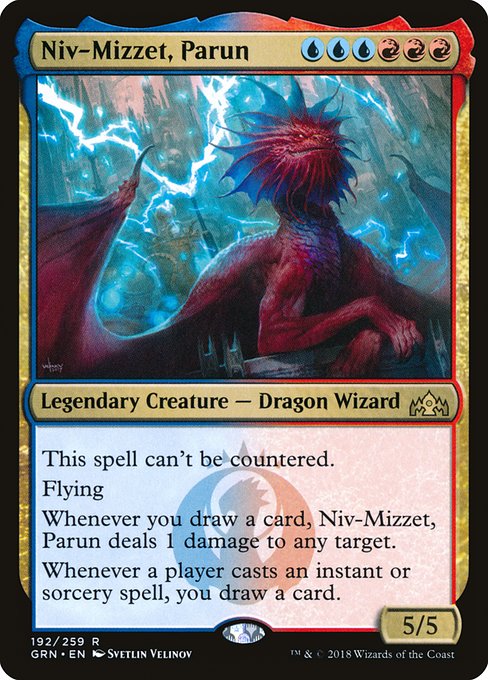
Niv-Mizzet, Parun | Illustration by Svetlin Velinov
Niv-Mizzet is a six-mana engine with no patience for half measures. He cannot be countered, draws whenever any player casts an instant or sorcery, and converts every card you draw into one damage anywhere. At an interactive table, opponents help refill your hand simply by playing the game.
Curiosity, Ophidian Eye, or Tandem Lookout can create a draw-and-damage loop once Niv hits an opponent, which gives the deck a compact finish. The cost is UUU RRR, a mana base that must be built with discipline, and a reputation that announces the combo before the commander resolves. Pick Niv when you want a control deck whose card-advantage engine is also the kill condition.
Best for: Draw-go control players comfortable becoming the table’s immediate problem.
#4. Mizzix of the Izmagnus
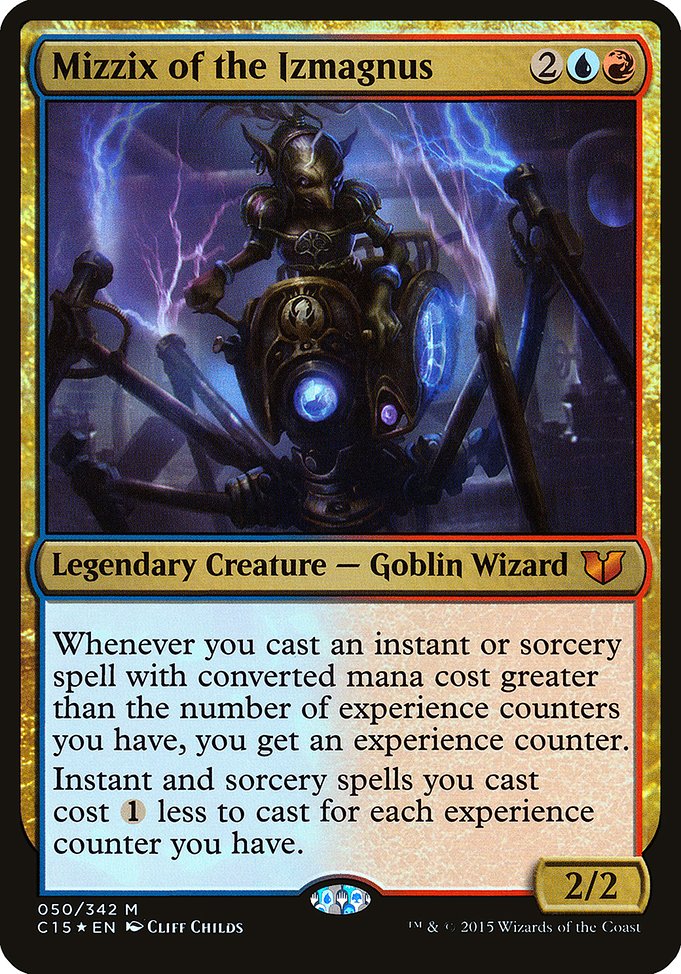
Mizzix of the Izmagnus | Illustration by Cliff Childs
Mizzix still defines cost-reduction storm. Casting an instant or sorcery with mana value greater than your experience-counter total earns another experience counter, and each counter discounts future instants and sorceries by one generic mana. Crucially, those experience counters belong to you. Removing Mizzix interrupts the discount, but it does not erase the work already done.
The early turns require careful stair-stepping, and the commander’s 2/2 body invites removal. Once the counters accumulate, Reiterate plus a mana-positive ritual or untap spell can produce a loop, while Past in Flames and Comet Storm offer straightforward ways to cash in. Colored pips remain the governor, so do not trim the land count just because the late game looks nearly free.
High-synergy cards: Reiterate, Reality Spasm, Turnabout, Past in Flames, Comet Storm.
Best for: Traditional storm fans who want their discounts to survive a commander trip to the command zone.
#3. Veyran, Voice of Duality
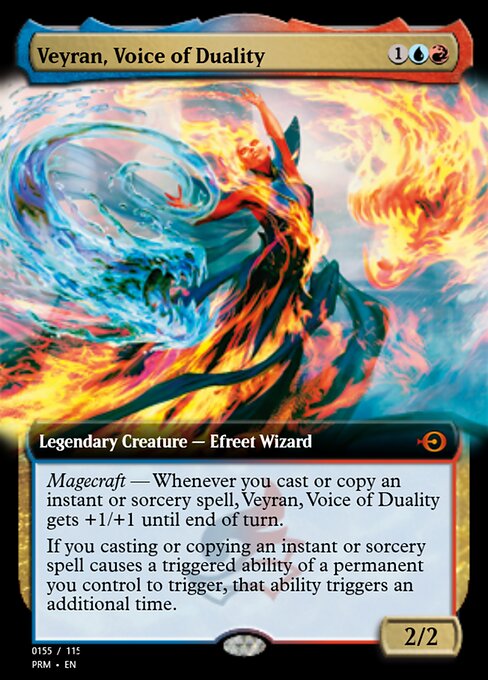
Veyran, Voice of Duality | Illustration by Mathias Kollros
Veyran does not merely trigger from a cast or copied spell; she makes triggered abilities on your permanents trigger an additional time when that spell causes them. Archmage Emeritus draws twice. Storm-Kiln Artist makes two Treasures. Young Pyromancer makes two tokens. Meanwhile, Veyran’s own magecraft trigger grows her into a credible commander-damage threat.
That flexibility is why Veyran ranks this high. The same shell can win through storm, tokens, burn triggers, or combat. The weakness is hidden in the word “permanents”: she does not draw cards or make mana alone, and a well-timed removal spell can halve the output of the entire turn. Deploy the payoff package before the fireworks, then protect the commander like the multiplier she is.
High-synergy cards: Archmage Emeritus, Storm-Kiln Artist, Young Pyromancer, Birgi, God of Storytelling, Harmonic Prodigy.
Best for: Tinkerers who want one commander to support several spellslinger finishes.
#2. Stella Lee, Wild Card
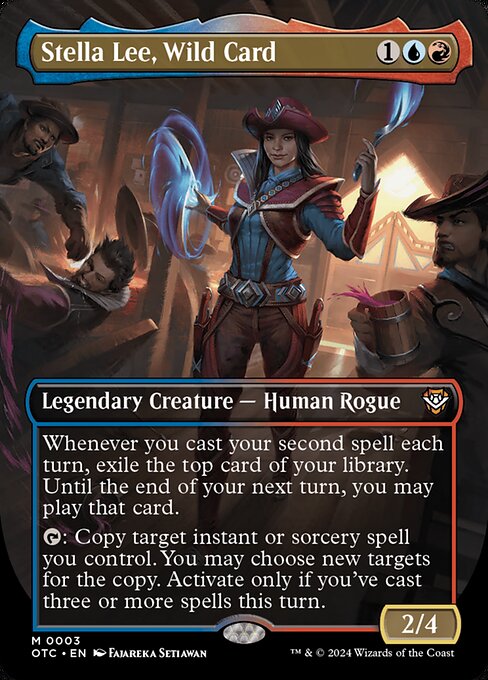
Stella Lee, Wild Card | Illustration by Fajareka Setiawan
Stella rewards the exact behavior Izzet decks already enjoy. Your second spell each turn exiles the top card of your library and lets you play it until the end of your next turn. After you cast three spells in a turn, Stella can tap to copy an instant or sorcery you control. That is card access, a copy engine, and a combo outlet on a three-mana commander.
Untap cantrips such as Cerulean Wisps and Refocus keep the chain moving, while Twisted Fealty can form a deterministic loop once Stella is active. The table usually knows what is coming: she has summoning sickness, must survive to tap, and needs the third-spell condition. Stella is brutally efficient, but the deck needs protection and a fair backup plan for games where everyone saves removal for her.
Best for: Combo pilots who want the command zone to supply both velocity and the repeatable copy effect.
#1. Vivi Ornitier
Vivi Ornitier | Illustration by Toni Infante
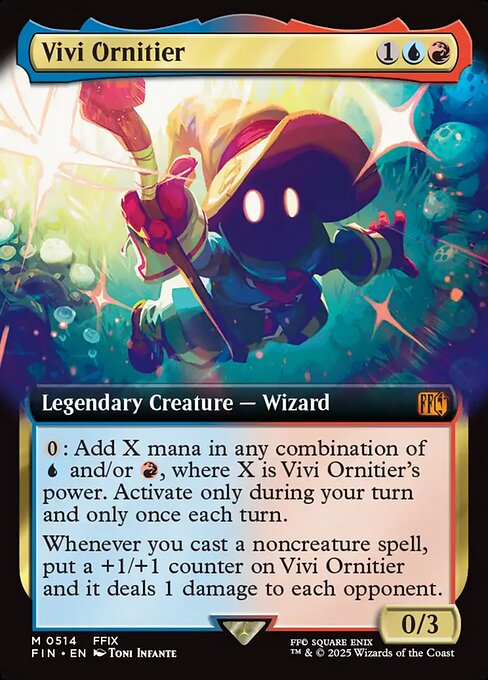
Vivi is our best Izzet spellslinger commander because every noncreature spell advances three plans at once. It puts a +1/+1 counter on Vivi, deals one damage to each opponent, and makes his once-per-turn mana ability larger for your next turn. Vigilance even lets him attack without giving up that tap ability. A harmless cantrip now grows a threat, drains the table, and improves the following turn’s resources.
The cleanest builds keep the curve low, pair Vivi with Birgi, God of Storytelling and Storm-Kiln Artist for additional mana, then use Frantic Search, Jeska’s Will, and Past in Flames to turn the graveyard into a second hand. Vivi does not draw cards by himself, and removal resets the stored counters, so the deck still needs real card advantage and protection. What puts him at number one is momentum: no other commander here converts routine noncreature spells into pressure and future mana so efficiently without demanding a separate payoff permanent.
High-synergy cards: Birgi, God of Storytelling, Storm-Kiln Artist, Frantic Search, Jeska’s Will, Past in Flames.
Best for: Players who want a fast, self-contained engine that can win through damage, storm, or a giant mana turn.
Which Izzet Commander Should You Build?
Choose Vivi Ornitier for the strongest all-purpose engine, Stella Lee for compact combos, Veyran for doubled triggers, Mizzix for escalating discounts, and Niv-Mizzet, Parun for spell-heavy control. If combat is more your speed, Balmor and Bria make every cantrip point toward the red zone; if you want a stranger build-around, Ghyrson and Eris reward much narrower card pools.
Whichever commander you choose, start with the deck’s actual bottleneck. Cost reducers need enough colored sources. Token payoffs need ways to rebuild after a wipe. Combo commanders need protection and a plan that still functions when the commander costs five. ElderCodex’s Commander deck builder is a useful place to test those ratios before you sleeve the list.
Frequently Asked Questions
What Is an Izzet Spellslinger Deck?
“Izzet” means blue-red, while “spellslinger” describes a deck built to profit from casting many instants, sorceries, or noncreature spells. Some lists copy one huge spell; others chain cantrips, make tokens, trigger burn effects, or reduce costs until an X-spell ends the game.
What Is the Best Izzet Spellslinger Commander for Beginners?
Jori En, Ruin Diver is the cleanest teacher: cast a second spell, draw a card, and learn when to hold up interaction. Balmor is equally approachable if you prefer combat, because the game plan is visible—make creatures, cast spells, and attack with trample.
What Is the Best Izzet Commander for High-Power Combo?
Stella Lee offers one of the most compact command-zone combo engines, while Vivi, Veyran, and Mizzix can all produce explosive high-power turns. The best choice depends on whether your group welcomes deterministic loops, and on how much interaction you expect to fight through.
What Is the Difference Between Spellslinger and Storm?
Spellslinger is the broader archetype. A deck may cast only a few spells per turn but profit from each one through cards, tokens, or damage. Storm decks specifically try to cast a long chain in one turn and convert the spell count into a decisive payoff.
Can Izzet Spellslinger Win Without an Infinite Combo?
Absolutely. Balmor and Bria win in combat, Eris builds an air force, Ovika floods the table with hasty tokens, and Niv-Mizzet can grind down life totals through ordinary draws and interaction. Infinite combos are an option, not an entry fee.
Final Thoughts
The best Izzet commanders do more than give you permission to cast spells—they make those spells solve the deck’s next problem. Vivi creates mana and pressure, Stella turns spell count into cards and copies, Veyran doubles the machinery, and Mizzix makes expensive effects attainable. Pick the engine whose failure mode you can live with, then build enough protection, card flow, and alternate wins that one removal spell does not turn your clever machine into a pile of blue-red parts.
Rules and Card References
Card names, Oracle text, color identity, and Commander legality were checked on October 22, 2026 using Scryfall’s Commander-legal Izzet search and individual card records. Deck construction follows the official Commander rules. Synergy suggestions are editorial recommendations, not claims of guaranteed performance.
By ElderArticles · Updated 10/22/2026 · 15 min read
Discover the 15 best Izzet spellslinger commanders, with ranked strengths, weaknesses, key synergies, win conditions, and the right pilot for each.
Table of contents
Izzet decks have a reputation for taking ten-minute turns and accomplishing nothing. The good ones do the opposite: every cantrip either pays you back, builds a board, stores mana, or quietly assembles the turn that ends the game.
The best Izzet spellslinger commander overall is Vivi Ornitier. Vivi turns noncreature spells into permanent power, table-wide damage, and a larger burst of mana on the next turn. Stella Lee is the cleaner combo commander, while Veyran and Mizzix remain the picks for players who want triggered-ability fireworks or old-fashioned cost-reduction storm.
Vivi Ornitier | Illustration by Toni Infante
This ranking covers blue-red commanders that reward instants, sorceries, or dense noncreature packages. It is aimed at multiplayer Commander—not a strict cEDH tier list—and weighs what the commander supplies from the command zone, how quickly the engine starts, how well it rebuilds, and whether the deck can win in more than one way.
How We Ranked the Best Izzet Spellslinger Commanders
A commander earns points for doing work by itself. Card advantage, mana production, spell copying, and a built-in payoff are more valuable than merely being the right colors. We also considered setup cost, resilience, color requirements, and how badly the deck stumbles when its first payoff or combo is stopped.
That favors self-contained engines, but it does not make the lower entries bad. Balmor can kill a table with tokens more cleanly than several commanders ranked above it; Ghyrson is unmatched if your box of one-damage cards is already calling your name. The ranking asks which commander gives the broadest, most reliable spellslinger shell—not which legend is allowed to have the most fun.
Jori En, Ruin Diver | Illustration by Matt Stewart
Jori En is the honest version of Izzet spellslinger. Cast your second spell in a turn and draw a card. The trigger works on every turn, so an instant-heavy list can turn a cheap cantrip plus interaction into several extra cards per rotation. Opt, Consider, and Frantic Search keep the second-spell threshold painless, while Isochron Scepter can provide a repeatable first or second spell.
The ceiling is deliberately modest: Jori En draws only once each turn and does nothing for spell number one. That makes her slower than modern engines, but also less likely to eat removal on sight. She is a good choice for pilots who want interactive, stack-based Magic without building around an obvious infinite line.
Balmor, Battlemage Captain | Illustration by Bram Sels
Balmor asks a wonderfully rude question: what if the cantrip deck simply attacked for 40? Every instant or sorcery gives your creatures +1/+0 and trample for the turn, turning Young Pyromancer, Third Path Iconoclast, Talrand, Sky Summoner, and Murmuring Mystic into both token engines and finishers. At two mana, Balmor can arrive early or wait in the command zone until the lethal turn.
The tradeoff is that Balmor needs a board. A sweeper leaves you with a 1/3 flyer and a hand full of spells that may not rebuild fast enough. He also contributes no cards or mana himself. Build him when you want spellslinger to end in combat, and protect the token makers that give all those pump triggers somewhere useful to land.
Bria, Riptide Rogue | Illustration by Borja Pindado
Bria is Balmor’s more elaborate cousin. She gives your other creatures prowess, has prowess herself, and makes a creature unblockable whenever you cast a noncreature spell. A cluttered battlefield stops mattering when a double-digit token or a pumped Storm-Kiln Artist simply walks around it.
Four mana is a meaningful step up from Balmor, and Bria still needs creatures in play before the text becomes scary. The upside is precision: rather than hoping trample damage breaks through, you choose the attacker that connects. Pair token makers with cheap protection such as Shore Up and Slip Out the Back, then force opponents to answer both the board and the commander.
Ghyrson Starn, Kelermorph | Illustration by Aaron J. Riley
Ghyrson turns every exact point of damage from another source you control into three. Thermo-Alchemist and Firebrand Archer become real clocks, End the Festivities can scorch small boards, and a Curiosity effect attached to the right pinger keeps the ammunition coming. Ward {2} helps, because the deck is far less impressive when its multiplier is absent.
The words “exactly 1 damage” are the catch. Effects that replace or increase that initial damage can switch Ghyrson off, and many generic Izzet staples do not interact with him at all. He is less a universal spellslinger commander than the charismatic mayor of Pinger Town. If that is the town you want to live in, nobody else runs it better.
Eris, Roar of the Storm | Illustration by Aurore Folny
Eris looks like a ten-mana commander until the graveyard does the accounting. Each different mana value among your instant and sorcery cards cuts two generic mana from the price. Once Eris lands, your second spell each turn creates a 4/4 flying Dragon Elemental with prowess. Faithless Looting, Thought Scour, and Frantic Search stock the yard while keeping your curve varied.
Those Dragons end games quickly and do not require an infinite combo, but the engine has two fragile joints. Graveyard hate can make Eris expensive again, and commander tax is much harder to absorb after the first removal spell. Treat your graveyard as a carefully built cost-reduction ladder, not a bin full of interchangeable cantrips.
Alania, Divergent Storm | Illustration by Issei Murakami
Alania can copy your first instant, first sorcery, and first other Otter each turn. The bill is unusual: an opponent may draw a card for each copy you take. That turns sequencing into the deck’s main skill test. Copy a Brass’s Bounty or Dig Through Time, and one enemy card looks like pocket change. Spend the trigger on something trivial, and you have subsidized the wrong player for very little gain.
Five mana and the political drawback keep Alania out of the top tier, but few commanders make big, splashy spells feel this satisfying. Instant-speed play also lets you choose a different opponent when the turn cycle changes. She rewards judgment more than raw spell count, which is refreshing in a color pair often accused of playing solitaire.
Galazeth arrives with a Treasure and lets every artifact you control tap for mana to cast instants and sorceries. Suddenly Treasure, Clue, Blood, and spare mana rocks all help power the next Crackle with Power or overloaded interaction spell. Storm-Kiln Artist, Big Score, and Brass’s Bounty are especially dangerous because the spells manufacture the resources that cast the next spell.
There is an important fence around the ability: that artifact mana cannot cast your permanents or pay activated abilities. Artifact sweepers can also erase what looked like a comfortable mana advantage. Galazeth is strongest when the artifact package is already useful and the big turns are dominated by instants and sorceries—not when a deck is trying to disguise a generic artifact pile as spellslinger.
Ovika, Enigma Goliath | Illustration by Antonio José Manzanedo
Ovika charges seven mana, then makes the receipt worth keeping. Each noncreature spell creates a number of 1/1 Phyrexian Goblins equal to that spell’s mana value, and those tokens gain haste until end of turn. Impact Tremors and Purphoros, God of the Forge turn creation into direct damage; Skullclamp turns the survivors into cards; Shared Animosity makes even a modest wave lethal in combat.
Flying plus a punishing ward cost gives Ovika more staying power than most expensive engines, but seven mana is still seven mana. If opponents answer her twice, the deck can spend the rest of the game trying to recast its commander. Ramp hard, keep a protection spell ready, and favor noncreature interaction so that even defensive plays build your army.
Ral starts as a two-mana cost reducer for instants and sorceries. During your turn, casting those spells also flips coins; wins help transform him into Ral, Leyline Prodigy, where the planeswalker side supplies more value, cost reduction, and eventually a frightening spell-copying emblem. Cheap cantrips make the transformation attempt almost incidental, and Krark’s Thumb gives the coin flips a nudge.
The front face reduces generic costs only, so one-mana spells with colored requirements stay one mana. Transformation is random, and the planeswalker side can be attacked in ways a creature commander cannot. Still, Ral asks very little up front and makes a classic Past in Flames turn substantially easier to assemble.
Vadrik, Astral Archmage | Illustration by Kieran Yanner
Vadrik reduces instant and sorcery costs by his power, so a single counter or pump spell can create absurd amounts of virtual mana. Day turning to night gives him a counter, but cards such as Seething Anger and Lunar Frenzy let you skip the celestial timetable. From there, Comet Storm, draw-X spells, and buyback effects become dramatically cheaper.
The engine is explosive and fragile. Vadrik has only two toughness at baseline, colored mana symbols are not reduced, and losing him after spending resources on a pump spell can end the turn on the spot. The best builds avoid all-in tricks that are useless without him and include protection that can double as part of the spell chain.
Niv-Mizzet, Parun | Illustration by Svetlin Velinov
Niv-Mizzet is a six-mana engine with no patience for half measures. He cannot be countered, draws whenever any player casts an instant or sorcery, and converts every card you draw into one damage anywhere. At an interactive table, opponents help refill your hand simply by playing the game.
Curiosity, Ophidian Eye, or Tandem Lookout can create a draw-and-damage loop once Niv hits an opponent, which gives the deck a compact finish. The cost is UUU RRR, a mana base that must be built with discipline, and a reputation that announces the combo before the commander resolves. Pick Niv when you want a control deck whose card-advantage engine is also the kill condition.
Mizzix of the Izmagnus | Illustration by Cliff Childs
Mizzix still defines cost-reduction storm. Casting an instant or sorcery with mana value greater than your experience-counter total earns another experience counter, and each counter discounts future instants and sorceries by one generic mana. Crucially, those experience counters belong to you. Removing Mizzix interrupts the discount, but it does not erase the work already done.
The early turns require careful stair-stepping, and the commander’s 2/2 body invites removal. Once the counters accumulate, Reiterate plus a mana-positive ritual or untap spell can produce a loop, while Past in Flames and Comet Storm offer straightforward ways to cash in. Colored pips remain the governor, so do not trim the land count just because the late game looks nearly free.
Veyran, Voice of Duality | Illustration by Mathias Kollros
Veyran does not merely trigger from a cast or copied spell; she makes triggered abilities on your permanents trigger an additional time when that spell causes them. Archmage Emeritus draws twice. Storm-Kiln Artist makes two Treasures. Young Pyromancer makes two tokens. Meanwhile, Veyran’s own magecraft trigger grows her into a credible commander-damage threat.
That flexibility is why Veyran ranks this high. The same shell can win through storm, tokens, burn triggers, or combat. The weakness is hidden in the word “permanents”: she does not draw cards or make mana alone, and a well-timed removal spell can halve the output of the entire turn. Deploy the payoff package before the fireworks, then protect the commander like the multiplier she is.
Stella Lee, Wild Card | Illustration by Fajareka Setiawan
Stella rewards the exact behavior Izzet decks already enjoy. Your second spell each turn exiles the top card of your library and lets you play it until the end of your next turn. After you cast three spells in a turn, Stella can tap to copy an instant or sorcery you control. That is card access, a copy engine, and a combo outlet on a three-mana commander.
Untap cantrips such as Cerulean Wisps and Refocus keep the chain moving, while Twisted Fealty can form a deterministic loop once Stella is active. The table usually knows what is coming: she has summoning sickness, must survive to tap, and needs the third-spell condition. Stella is brutally efficient, but the deck needs protection and a fair backup plan for games where everyone saves removal for her.
Vivi is our best Izzet spellslinger commander because every noncreature spell advances three plans at once. It puts a +1/+1 counter on Vivi, deals one damage to each opponent, and makes his once-per-turn mana ability larger for your next turn. Vigilance even lets him attack without giving up that tap ability. A harmless cantrip now grows a threat, drains the table, and improves the following turn’s resources.
The cleanest builds keep the curve low, pair Vivi with Birgi, God of Storytelling and Storm-Kiln Artist for additional mana, then use Frantic Search, Jeska’s Will, and Past in Flames to turn the graveyard into a second hand. Vivi does not draw cards by himself, and removal resets the stored counters, so the deck still needs real card advantage and protection. What puts him at number one is momentum: no other commander here converts routine noncreature spells into pressure and future mana so efficiently without demanding a separate payoff permanent.
Best for: Players who want a fast, self-contained engine that can win through damage, storm, or a giant mana turn.
Which Izzet Commander Should You Build?
Choose Vivi Ornitier for the strongest all-purpose engine, Stella Lee for compact combos, Veyran for doubled triggers, Mizzix for escalating discounts, and Niv-Mizzet, Parun for spell-heavy control. If combat is more your speed, Balmor and Bria make every cantrip point toward the red zone; if you want a stranger build-around, Ghyrson and Eris reward much narrower card pools.
Whichever commander you choose, start with the deck’s actual bottleneck. Cost reducers need enough colored sources. Token payoffs need ways to rebuild after a wipe. Combo commanders need protection and a plan that still functions when the commander costs five. ElderCodex’s Commander deck builder is a useful place to test those ratios before you sleeve the list.
Frequently Asked Questions
What Is an Izzet Spellslinger Deck?
“Izzet” means blue-red, while “spellslinger” describes a deck built to profit from casting many instants, sorceries, or noncreature spells. Some lists copy one huge spell; others chain cantrips, make tokens, trigger burn effects, or reduce costs until an X-spell ends the game.
What Is the Best Izzet Spellslinger Commander for Beginners?
Jori En, Ruin Diver is the cleanest teacher: cast a second spell, draw a card, and learn when to hold up interaction. Balmor is equally approachable if you prefer combat, because the game plan is visible—make creatures, cast spells, and attack with trample.
What Is the Best Izzet Commander for High-Power Combo?
Stella Lee offers one of the most compact command-zone combo engines, while Vivi, Veyran, and Mizzix can all produce explosive high-power turns. The best choice depends on whether your group welcomes deterministic loops, and on how much interaction you expect to fight through.
What Is the Difference Between Spellslinger and Storm?
Spellslinger is the broader archetype. A deck may cast only a few spells per turn but profit from each one through cards, tokens, or damage. Storm decks specifically try to cast a long chain in one turn and convert the spell count into a decisive payoff.
Can Izzet Spellslinger Win Without an Infinite Combo?
Absolutely. Balmor and Bria win in combat, Eris builds an air force, Ovika floods the table with hasty tokens, and Niv-Mizzet can grind down life totals through ordinary draws and interaction. Infinite combos are an option, not an entry fee.
Final Thoughts
The best Izzet commanders do more than give you permission to cast spells—they make those spells solve the deck’s next problem. Vivi creates mana and pressure, Stella turns spell count into cards and copies, Veyran doubles the machinery, and Mizzix makes expensive effects attainable. Pick the engine whose failure mode you can live with, then build enough protection, card flow, and alternate wins that one removal spell does not turn your clever machine into a pile of blue-red parts.
Rules and Card References
Card names, Oracle text, color identity, and Commander legality were checked on October 22, 2026 using Scryfall’s Commander-legal Izzet search and individual card records. Deck construction follows the official Commander rules. Synergy suggestions are editorial recommendations, not claims of guaranteed performance.
AI-generated article, published by an ElderDecks editor.