By ElderArticles · Updated 11/9/2026 · 29 min read
Find the best Gruul commanders for MTG, ranked with red-green strategies, four synergy cards per commander, key rules tips, and honest deckbuilding advice.
Table of contents
You spent six turns building the biggest creature at the table. Someone spent two mana making it disappear. Now you have eleven lands, one card in hand, and a very personal problem with the player holding up blue mana.
Gruul can do better than that. The best red-green commanders turn ramp into cards, turn support permanents into attackers, or make a routine land drop hurt every opponent. Big creatures are still welcome. They just need to do more than look impressive.
This countdown ranks twenty Gruul commanders by the engines they provide, the help they need, and what happens when an opponent interrupts the plan. Each entry includes four specific synergy picks and the catch you should know before building. We are saving the top spot for the end.
Xenagos, God of Revels | Illustration by Jason Chan
How We Ranked the Best Gruul Commanders
This is an original editorial ranking for multiplayer Commander, not a popularity chart, tournament tier list, or claim of personal playtesting. Immediate value, repeatable card or mana production, resilience, and the ability to threaten several opponents carry the most weight. Setup costs and narrow deckbuilding requirements count against a commander, even when its best turn looks spectacular.
The rankings assume purposeful decks rather than either the cheapest possible build or unrestricted competitive optimization. A higher rank is not a recommendation to bring a stronger deck to a casual table. The individual entries identify particularly explosive or resource-denial plans.
We checked the selected commanders and recommended support cards against Scryfall's current card data on November 9, 2026, alongside Wizards' Commander rules and banned list. All twenty leaders have exactly red-green color identity and are Commander-legal. This list covers individual commanders, not partner combinations. No price threshold or metagame percentage is claimed.
The four-card packages illustrate useful relationships; they are not mandatory purchases or complete decklists.
#20. Hugs, Grisly Guardian
AI-generated article, published by an ElderDecks editor.
Hugs, Grisly Guardian | Illustration by Steve Prescott
Hugs looks like a stompy commander, but the real attraction is how much work one card can do for your hand and mana base.
Its entrance exiles X cards with permission to play them through the end of your next turn. The extra land play helps you use the lands you find and makes a large Hugs easier to afford later. That generous window matters: you do not have to spend your entire remaining hand immediately after paying for your commander.
Four cards worth pairing:
Azusa, Lost but Seeking: Adds two more land plays to Hugs's allowance. Excellent when your hand and exile pile contain lands; less impressive when neither does.
Escape to the Wilds: Provides another batch of playable cards and an extra land play for the turn. Plan the sequence before committing your mana.
Valakut Exploration: Turns those additional land entries into more options, then converts its unused exiled cards into damage at your end step.
Return of the Wildspeaker: Hugs is a non-Human, so its printed power can support a substantial refill without asking you to connect in combat.
The catch: Commander tax does not increase X. You still need to invest extra mana in X to see extra cards, and an expensive recast can leave little mana to use them. Choose Hugs for a flexible lands-and-big-spells deck, not a low-cost engine that starts immediately.
Wildsear, Scouring Maw | Illustration by Campbell White
Gruul enchantments deserve more attention than “put an Aura on the biggest creature.” Wildsear gives the archetype a reason to exist all by itself.
Enchantment spells cast from your hand gain cascade, letting a single cast uncover another spell. Your expensive enchantments become both payoffs and opportunities to advance the board. Cascade is a cast trigger, so countering the original enchantment does not automatically counter the cascade trigger.
Four cards worth pairing:
Wild Growth: Helps cast Wildsear early and remains a useful low-end cascade hit when you have an appropriate land.
Utopia Sprawl: Another efficient ramp enchantment, but it needs a Forest. Build the mana base accordingly.
Greater Good: A four-mana enchantment that can cascade when cast from hand, then turns expendable large creatures into fresh cards at the cost of discarding three.
Possibility Storm: A high-disruption option. Your original enchantment cast can still trigger cascade even if Storm replaces the spell. This complicates everyone's sequencing, so reserve it for tables that enjoy that experience.
The catch: The free enchantment you cast from exile does not gain another cascade from Wildsear. A five-mana commander also needs enough ramp and protection to justify the setup. Choose this if you enjoy building a carefully tuned enchantment package rather than a generic creature curve.
Halana and Alena, Partners | Illustration by Jason Rainville
A creature that grows permanently and attacks immediately is a much better topdeck than one that asks everyone to ignore it for a turn.
Halana and Alena put counters on another creature at the beginning of your combat and grant it haste. Increasing the commander's power therefore improves every future combat trigger. You can build one enormous attacker, but spreading the counters across several threats usually makes targeted removal less devastating.
Four cards worth pairing:
Kami of Whispered Hopes: Adds an extra counter to your counter placements and turns its own growing power into mana. Haste from the commander can let a newly cast Kami tap that turn.
Managorger Hydra: Grows from every player's spells and already has trample, making it an excellent destination for additional counters.
Forgotten Ancient: Collects counters around the table, then can move them onto Halana and Alena during your upkeep to improve the combat trigger.
Rhythm of the Wild: Offers a counter or haste for nontoken creatures while protecting your creature spells from being countered. The commander can take the counter and begin distributing a larger batch immediately.
The catch: The ability cannot target Halana and Alena themselves. Removing them before the trigger resolves can also deny future turns of growth, even though the current trigger uses last known information if needed. Play this for counters and creature development with very little bookkeeping beyond combat.
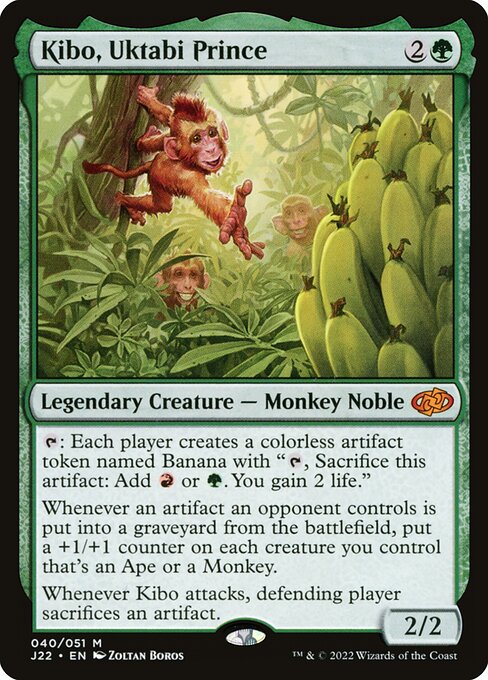
Kibo, Uktabi Prince | Illustration by Zoltan Boros
Kibo hands out snacks, then makes everyone nervous about eating them.
Each opponent's artifact that goes to the graveyard from the battlefield grows every Ape and Monkey you control. Bananas create a built-in supply, but opposing Treasures, Clues, Food, and ordinary artifacts can contribute too. The attack trigger pressures one defending player's artifacts, although that player chooses what to sacrifice.
Four cards worth pairing:
Hardened Scales: Adds another counter to each qualifying counter placement, making a sequence of sacrificed artifacts especially productive.
Viridian Revel: Turns artifacts entering opponents' graveyards into optional cards for you. Artifact tokens do reach the graveyard before ceasing to exist.
Gorilla Shaman: Destroys a noncreature artifact with mana value zero for one mana. Opposing Bananas and Treasures are convenient targets, although their controllers may sacrifice them in response.
Vandalblast: The overloaded version can clear opposing artifacts while giving Kibo a separate trigger for each one that reaches the graveyard.
The catch: Your gifts really do help opponents ramp, and Kibo's counters only help Apes and Monkeys. The deck needs enough beneficiaries and enough pressure to turn generosity into a win. Choose Kibo for artifact punishment with a creature-type theme and a little table politics.
Neyith of the Dire Hunt | Illustration by Magali Villeneuve
Neyith makes blocking feel like doing you a favor. Refusing to block may be worse.
Your creatures fighting or becoming blocked produces card advantage, while the combat ability can double a creature's power and require it to be blocked if able. That supports a satisfying midrange plan: develop a threatening creature, remove an important blocker, and make combat difficult to navigate.
Four cards worth pairing:
Ulvenwald Tracker: Supplies repeatable fights so you can generate a draw trigger without relying entirely on opponents' blocking choices.
Foe-Razer Regent: Fights when it enters and rewards your surviving fighters with counters at the next end step. Its seven-mana cost makes it a payoff, not early interaction.
Tail Swipe: A cheap fight spell with a small boost during your main phase. Check toughness and marked damage before sending your creature into the fight.
Garruk's Uprising: Adds trample so a forced block does not simply absorb your enormous attacker, while large creatures can also replace themselves on entry.
The catch: Neyith says “one or more.” Several creatures becoming blocked in the same event do not each draw a card, and fighting is not combat damage. Choose this for interactive creature battles, not a deck that wants to ignore the opposing board.
Ruric Thar, the Unbowed | Illustration by Tyler Jacobson
Some commanders ask opponents a question. Ruric Thar sends an invoice.
Six damage for casting a noncreature spell changes how the table spends its life total. The best way to exploit that is to put ramp, removal, and card advantage on creatures, so your deck can keep functioning while opponents pay for ordinary game actions. This is a punishment strategy, not a guarantee that anyone will stop casting spells.
Four cards worth pairing:
Beast Whisperer: Keeps the creature-heavy plan supplied with cards as you cast creatures.
Reclamation Sage: Answers an artifact or enchantment without triggering Ruric Thar's noncreature-spell punishment.
Bane of Progress: Provides a much bigger artifact-and-enchantment cleanup. It destroys yours too, so design around that before treating it as a one-sided sweeper.
Somberwald Sage: Accelerates creature spells by three mana, including your six-mana commander. Its mana cannot pay for noncreature spells or activated abilities.
The catch: The damage hits you too, including when you cast protection or a board wipe. Ruric Thar also has to attack each combat if able. Choose it when you want creature-heavy pressure and your group is comfortable with punishing spell-heavy decks.
Roxanne, Starfall Savant | Illustration by Ina Wong
Roxanne brings her own removal and mana rock, then threatens to bring another every combat. That is a respectable job application for a five-drop.
Each Meteorite enters tapped and deals two damage through its own triggered ability. Once it can tap, Roxanne's mana ability adds an extra mana of a type it produced. The same bonus applies to other artifact tokens tapped for mana, including Treasures. You get useful material even if Roxanne is removed after the entrance trigger.
Four cards worth pairing:
Tireless Provisioner: Turns landfall into Treasures, which produce two mana apiece with Roxanne present.
Bootleggers' Stash: Lets lands create Treasures, setting up a larger store of resources. It is expensive and needs a later payoff to justify the investment.
Academy Manufactor: Expands Provisioner's Treasure production into Treasure, Food, and Clue tokens. It does not modify Meteorite creation by itself.
Strionic Resonator: Copies Roxanne's entrance or attack trigger for another Meteorite, or copies a Meteorite's damage trigger when that is more urgent.
The catch: Roxanne does not double the mana from every artifact. Ordinary nontoken mana rocks do not qualify, and the Meteorites enter tapped. Choose this for artifact-token ramp that can pick off utility creatures while building toward larger turns.
Tovolar, Dire Overlord // Tovolar, the Midnight Scourge | Illustration by Zoltan Boros
Werewolves have always had atmosphere. Tovolar gives them something more important: a reason to keep attacking after your opening hand is gone.
A Wolf or Werewolf connecting with a player draws a card. Multiple creatures can therefore produce multiple draws, and the upkeep ability helps establish night once you have three Wolves and/or Werewolves. On the reverse face, the activated pump-and-trample ability gives spare mana a useful destination.
Four cards worth pairing:
Nightpack Ambusher: Buffs the pack and can create another Wolf when you finish your turn without casting a spell. Flash lets it contribute without forcing you to use your own turn for setup.
Immerwolf: Buffs Wolves and Werewolves and stops non-Human Werewolves from transforming. That can preserve transformed threats, but it can also stop you returning a utility Werewolf to its front face.
Howlpack Piper: Its front face can put creatures from hand onto the battlefield, untapping if you put in a Wolf or Werewolf. At night it becomes Wildsong Howler, so do not assume the Piper ability will always be available.
Kessig Wolf Run: Gives a key attacker trample without spending a nonland deck slot, helping turn a stalled board into a draw trigger.
The catch: The card advantage depends on combat damage to players. A packed battlefield or repeated sweepers can stop the engine. Choose Tovolar when the creature-type theme is part of the appeal, not merely an inconvenience on the way to drawing cards.
Anzrag, the Quake-Mole | Illustration by Helge C. Balzer
Anzrag has eight power for four mana, but the interesting number is how many combat phases you can get out of a block.
Whenever it becomes blocked, your creatures untap and you get another combat after the current phase. The trigger happens before combat damage, so it can resolve even if Anzrag subsequently dies. Keeping the Mole alive is what lets the threat continue through the extra combat.
Four cards worth pairing:
Dolmen Gate: Prevents combat damage to your attacking creatures, helping Anzrag survive blocks. It does not stop exile or other non-damage removal.
Roar of Challenge: Makes creatures block the targeted attacker if able, and Anzrag's power normally satisfies ferocious for indestructible. Blockers still need to be able to block in each combat.
Bear Umbra: Adds a destruction shield and untaps your lands whenever the enchanted creature attacks, freeing resources for protection and follow-up plays.
Heroic Intervention: Protects the board from targeted interaction and destruction for a turn, making a committed combat sequence safer.
The catch: Multiple blockers do not give one trigger each; Anzrag triggers once when it becomes blocked. Opponents can also decline to block unless an effect requires it. The commander supplies neither cards nor mana on its own. Choose it for combat puzzles and extra-combat pressure, with protection treated as essential infrastructure.
Wulfgar of Icewind Dale | Illustration by Aleksi Briclot
Wulfgar rewards creatures that do their best work before damage is assigned. If the word “attacks” appears in the right place, the deck starts getting interesting.
It adds a trigger when a creature you control attacking causes a triggered ability of a permanent you control to trigger. That can mean extra ramp, extra removal, or a second enormous team boost. It does not double every ability that happens during combat.
Four cards worth pairing:
Inferno Titan: Its attack produces two three-damage triggers with Wulfgar. The Titan's entrance trigger is not doubled by Wulfgar.
Pathbreaker Ibex: Two attack triggers give the team two boosts and trample. The second trigger calculates the greatest power after the first has resolved, so sequencing matters.
Sword of the Animist: Turns an equipped creature's attack into two opportunities to find basic lands.
Port Razer: A successful hit earns another combat and therefore more chances to trigger your attack abilities. Wulfgar does not double Port Razer's combat-damage trigger, and Port Razer cannot keep attacking the same player that turn.
The catch: Five mana is a lot for an amplifier when your battlefield is empty. You need useful attackers already in place or a way to grant haste to new ones. Choose Wulfgar if you enjoy stacking several pieces of combat value rather than leaning on a single giant attacker.
Omnath, Locus of Rage | Illustration by Brad Rigney
Seven mana is a serious commitment. Omnath pays you back by making every subsequent land a threat and making those threats unpleasant to kill.
Landfall creates 5/5 Elementals. When Omnath or another Elemental you control dies, it deals three damage to any target. If a destroy-based sweeper kills Omnath and several of your Elementals together, Omnath sees those deaths. Exile-based sweepers tell a much less entertaining story.
Four cards worth pairing:
Harrow: Finds two basic lands at instant speed, producing two landfall triggers. Sacrificing a land is an additional cost, so a counterspell can leave you down a land.
Springbloom Druid: Also trades a land for two basics, but the sacrifice happens during resolution of its entrance ability. It leaves a useful creature behind.
Perilous Forays: Converts a creature and one mana into a land with a basic land type. Sacrificing an Elemental can give you a death trigger and then a replacement Elemental from the new land; the loop still requires mana and lands left to find.
Warstorm Surge: Each new 5/5 can deal five damage on entry, giving the deck a route around stalled combat.
The catch: Omnath is expensive and needs land entries after it arrives. Spend every ramp spell too early and your seven-drop may sit there admiring your lands. Choose it for a landfall deck with substantial noncombat reach and meaningful protection against ordinary creature destruction.
Klauth, Unrivaled Ancient | Illustration by Diego Andrade
Klauth turns an attack into a second main phase that can feel like a different game.
Flying and haste help it contribute immediately. When it attacks, it counts the power of all attacking creatures and produces that much mana in any combination of colors. The mana lasts through the turn, so you can use it after combat to deploy the next wave instead of cramming everything into an instant-speed window.
Four cards worth pairing:
Savage Ventmaw: Generates six additional mana when it attacks. Unlike Klauth's mana, this mana is not restricted to casting spells.
Return of the Wildspeaker: Refills your hand from a large non-Human's power, giving the mana burst something useful to cast.
Terror of the Peaks: Turns the creatures you deploy after combat into damage. It rewards spending the burst on a real follow-up, not merely making a large mana total.
Rhythm of the Wild: Helps new nontoken attackers join the next assault immediately, while its counter choice can increase a creature's contribution to Klauth's count.
The catch: Klauth's mana can only cast spells. It cannot pay Hellkite Charger's extra-combat ability, equip costs, or other activated abilities. Seven mana also makes removal before the attack expensive. Choose it for big-spell combat decks that can reliably convert one attack into additional resources.
Xenagos, God of Revels | Illustration by Jason Chan
Xenagos is the commander for players who would rather cast one frightening creature than manage a battlefield full of counters.
At the beginning of combat on your turn, another creature gets haste and a power-sized boost. You can cast a threat and immediately send it into combat, while Xenagos often stays safely outside creature removal when devotion is below seven. Indestructible helps against destruction, not exile or bounce.
Four cards worth pairing:
Malignus: Starts at half the highest opposing life total, rounded up, so Xenagos can make it enormous. Malignus still needs a route past blockers; it does not naturally have trample.
Ghalta, Primal Hunger: Brings a huge trampling body and can cost much less when you already control substantial power.
Unnatural Growth: Its beginning-of-combat trigger can resolve before Xenagos's, letting Xenagos calculate the boost from an already doubled creature. Both effects last until end of turn.
Chandra's Ignition: After combat, a surviving boosted creature can spread its power as damage to every opponent and every other creature. This is noncombat damage, not commander damage.
The catch: Xenagos does not draw cards, cannot target itself, and normally threatens one opponent at a time. Removal aimed at the chosen attacker can spoil the turn. Choose this for accessible, high-impact combat, with card draw and protection deliberately built into the supporting deck.
Tannuk, Memorial Ensign | Illustration by David Auden Nash
Tannuk does not need a cinematic attack step. It needs you to make your land drops—and then find a way to make another.
Every land entry deals one damage to each opponent. The second resolution of that ability each turn also draws a card. A three-mana commander that provides damage and card flow is efficient enough to start working before more expensive landfall engines arrive.
Four cards worth pairing:
Harrow: Two land entries on an opponent's turn can produce the second resolution and a card there, not just during your own turn. The sacrificed land remains an additional-cost risk.
Roiling Regrowth: Another instant-speed two-land effect. Its lands enter tapped, but the sacrifice is part of resolving the spell rather than an additional casting cost.
Ghost Town: Returns itself to hand for no mana when it is not your turn, providing a land you can replay later. It does not grant permission to play lands during opponents' turns.
Druid Class: At level two it grants an additional land play on each of your turns, making the draw threshold easier to reach without consuming a ramp spell every time.
The catch: The third, fourth, and fifth landfall resolutions in a turn do not each draw another card. They still deal damage. Tannuk also needs enough ways to access lands rather than simply emptying your hand faster. Choose it for a low-curve lands engine that can pressure all opponents without attacking.
Faldorn, Dread Wolf Herald | Illustration by Jason A. Engle
Faldorn makes “use it before it expires” card advantage feel much less risky when every successful cast also leaves a Wolf behind.
Casting a spell from exile or having a land enter from exile creates a 2/2 Wolf. Your red impulse-draw spells become board development as well as card access. The activated ability gives you a fallback outlet, but the deck is much stronger when multiple cards feed the exile plan instead of relying on that one tap ability.
Four cards worth pairing:
Reckless Impulse: Supplies two cards you can play through the end of your next turn. Both spells cast and lands played from that exile pile can make Wolves.
Wrenn's Resolve: Functional redundancy for the same efficient effect. Consistency is more useful here than finding a different-looking card for every slot.
Passionate Archaeologist: Gives your commander creature a damage trigger for casting from exile, converting spell mana values into pressure on a chosen opponent. Faldorn does not need to be able to choose a Background to include this in the ninety-nine.
Keeper of Secrets: Provides another damage payoff for spells cast outside your hand, including your exile casts. It is expensive, so treat it as a finisher rather than an enabler.
The catch: Exiling a card is not enough; you must actually cast the spell or have the land enter from exile. Mana, timing restrictions, and land-play limits still apply. Choose Faldorn if you like busy turns that build a token army while accessing more cards.
Raggadragga, Goreguts Boss | Illustration by Xavier Ribeiro
Your mana creatures have spent enough games hiding behind the real attackers. Raggadragga gives them a raise and sends them into combat.
Creatures with mana abilities get +2/+2 and untap when they attack. That means a creature that can attack may still be available to produce mana afterward. Spending at least seven mana to cast a spell also untaps a target creature and gives it +7/+7 and trample, opening explosive turns that combine ramp and pressure.
Four cards worth pairing:
Kami of Whispered Hopes: Its power-based mana ability benefits from Raggadragga's static boost and can benefit dramatically from the seven-mana trigger.
Marwyn, the Nurturer: Also taps for mana equal to power. The commander's boosts matter even when you are not committing to a full Elf deck.
Selvala, Heart of the Wilds: Converts the largest power on your board into flexible mana. Her draw trigger can also help an opponent with the largest new creature, so it is not exclusively your card-advantage engine.
Finale of Devastation: Spending seven or more mana on it can trigger Raggadragga; Finale's own enormous team boost still requires X to be at least ten. Those are different thresholds.
The catch: Untapping does not remove a creature from combat or cure summoning sickness. A spell's printed mana value is not the test for the seven-mana trigger—mana actually spent is. The deck can also lose its ramp and attackers to the same sweeper. Choose it for mana-creature engines with a genuine combat plan.
Meria, Scholar of Antiquity | Illustration by Carly Mazur
Meria is a useful reminder that red-green artifacts do not have to mean Treasures. Here, the important word is “nontoken.”
One untapped nontoken artifact becomes green mana; two become temporary access to the top card of your library. Cheap utility artifacts can therefore perform their normal jobs and help power the engine. The ability costs do not use a tap symbol on Meria, so summoning sickness does not stop her from activating them or stop a newly entered artifact being tapped to pay those costs.
Four cards worth pairing:
Howling Mine: Draw your extra card, then tap the Mine with Meria before an opponent's draw step so it does not give them the same bonus.
Winter Orb: A high-power, table-sensitive option. Meria can tap it before your untap step to turn off its restriction for that step. Leave it untapped for opposing untaps if that is your plan, and discuss the resource-denial strategy before the game.
Ichor Wellspring: Replaces itself when it enters and becomes material for Meria to tap. Tapping it is not sacrificing it, so that alone does not trigger its graveyard draw.
Sol Ring: Usually best tapped for its own two mana, but Meria lets it contribute to an exile activation when access to another card matters more.
The catch: Artifact tokens cannot pay either ability, and an artifact tapped for its own ability cannot simultaneously pay Meria's cost. The deck is potent but less forgiving to build than generic stompy. Choose it for careful resource sequencing; skip the denial package if your table wants a relaxed game.
Bello, Bard of the Brambles | Illustration by Slawomir Maniak
Bello asks a wonderful deckbuilding question: what if your card-advantage enchantment could also punch somebody and draw another card?
During your turn, qualifying non-Aura enchantments and non-Equipment artifacts with mana value four or greater become 4/4 Elementals with haste, indestructible, and a combat-damage draw trigger. They keep their existing abilities. You are not choosing between an engine permanent and an attacker; the same card can be both.
Four cards worth pairing:
Unnatural Growth: Becomes a creature on your turn and doubles your creatures' power and toughness at the beginning of combat, making the animated board much harder to contain.
Outpost Siege: On Khans, provides an extra playable card each upkeep, then can attack and draw through Bello. On Dragons, it offers a different payoff for creatures leaving the battlefield.
Esika's Chariot: Bello animates it without requiring crew during your turn. It brings two Cats and can copy a token when it attacks.
Asceticism: Protects your creatures from opposing targeted spells and abilities. During your turn it is also a Bello attacker, while its protection still helps Bello on opponents' turns.
The catch: Bello must remain on the battlefield. Remove it and ordinary noncreature artifacts and enchantments stop being creatures, losing the granted protections and attack plan. Mana-value requirements also make the deck expensive to develop. Choose it for resilient engine permanents that become a combat-and-card-draw machine.
Minsc & Boo, Timeless Heroes | Illustration by Justin Gerard
A commander that supplies its own threat, grows it, and can cash it in for cards has already solved several deckbuilding problems before you add a single synergy piece.
Minsc & Boo creates a hasty, trampling Hamster on entry and at your upkeep if you choose. The +1 grows a creature with haste or trample. The −2 sacrifices a creature for damage, and if it was a Hamster, you also draw cards equal to its power. The sacrifice happens when the loyalty ability resolves, not when you activate it.
Four cards worth pairing:
Branching Evolution: Doubles the +1/+1 counters placed on your creatures, making Boo threatening quickly. It does not double loyalty counters on the planeswalker.
The Ozolith: Preserves counters when Boo leaves and can move them to a replacement creature at the beginning of combat. It does not increase the power of a creature that has already been sacrificed.
Maskwood Nexus: Makes your creatures Hamsters as well as every other creature type, broadening which sacrifices can draw cards from the −2.
Tamiyo's Safekeeping: Can protect either the planeswalker or a creature from targeted removal and destruction. Indestructible will not save a planeswalker whose loyalty reaches zero.
The catch: You normally activate only one loyalty ability per turn, so growing Boo and sacrificing it with the commander are usually separate turns. Opponents can attack the planeswalker, and Boo remains subject to the legend rule. Choose this for a self-contained engine with damage, cards, and recurring threats. Its rules explicitly allow it to be your commander.
Etali, Primal Conqueror // Etali, Primal Sickness | Illustration by Yeong-Hao Han
Etali wins our top spot because its first useful action does not require surviving a trip around the table, connecting in combat, or assembling a collection of support permanents. It just needs to enter.
In a four-player game, the entrance trigger can uncover a nonland card from each of four libraries and let you cast any number of those spells without paying their mana costs. The results vary, and not every revealed spell will be useful or legally castable. Even so, getting immediate access to several spells is an enormous return from one commander. Removing Etali after the trigger is on the stack does not erase that trigger.
Four cards worth pairing:
Panharmonicon: Makes Etali's entrance ability trigger an additional time. Each trigger resolves separately, giving you another trip through the libraries.
Roaming Throne: Choose Dinosaur to give Etali another entrance trigger. This supports the same plan while providing a creature body, but it is not protection for Etali.
Temur Sabertooth: Returns Etali to your hand so you can cast it again without commander tax. Bouncing and recasting still costs substantial mana; this pair is not an automatic infinite loop.
Conjurer's Closet: Blinks Etali at your end step for another entrance trigger without recasting it. It is a five-mana setup piece and must survive until that end step to start paying you back.
The catch: Seven mana is expensive, and opponents can stop the creature spell before it enters or counter the triggered ability. Free spells still obey targeting and other restrictions, and X is normally zero when you cast a spell with X this way. This is a high-impact commander whose power level deserves a pregame conversation.
The reverse face provides a separate way to end games through combat damage and poison counters, but the ranking does not depend on paying for that transformation. Etali takes #1 for immediate value, repeatable entrance abuse, and the ability to turn ramp into a decisive board swing. Play it when that level of explosiveness matches your table.
Building a Gruul Deck That Survives the First Answer
Give the commander a job—and cover what it does not do
Xenagos supplies haste and damage but not a refill. Tannuk supplies cards and incremental damage but needs a consistent stream of lands. Meria supplies an artifact engine but cannot use the Treasure tokens another red-green deck might prioritize. Start with the commander’s actual needs, then choose ramp and draw that support those needs.
Avoid assuming every green deck wants the same collection of powerful creatures. A strong card can still be a poor fit if it competes with your engine for mana or dilutes the permanent types your commander requires.
Keep something in reserve
You do not have to put every creature in your hand onto the battlefield because your mana allows it. If the current board already forces an answer, consider holding a second threat or a draw spell for the rebuild. Protection helps, but neither hexproof nor indestructible is a universal answer to sweepers.
Practice the turn where your commander is removed before combat, and the turn where it costs two more mana than expected. If both leave the deck doing nothing, improve the supporting engine before adding another expensive finisher.
Plan for the whole table
Removing one opponent is not the same as winning a four-player game. Your plan might involve repeated combats, a growing board, landfall damage, or enough card advantage to rebuild after the first knockout. Whatever it is, identify it before filling the final slots with more power boosts.
Gruul refers to red and green. A Gruul commander's deck can include cards whose color identity is red, green, both, or colorless, subject to the format's other rules. Color identity is not always the same as the colors in a card's mana cost.
Why is Etali, Primal Conqueror a Gruul commander?
Although the front face costs only red and generic mana, its transform ability contains a green Phyrexian mana symbol. That contributes green to its color identity, so its Commander deck can use red and green cards.
What is a good Gruul commander for beginners?
Xenagos offers a clear plan: develop mana, cast a substantial creature, and attack with haste. Halana and Alena are another approachable option if you enjoy +1/+1 counters. Neither choice removes the need for interaction, card draw, and a conversation about the deck's power level.
Can a Gruul deck win without attacking?
Yes. Tannuk damages opponents through landfall, Omnath can deal damage through Elemental deaths, and Faldorn can support spell-from-exile damage payoffs. Those routes still require enough resources and a coherent plan; simply including a damage trigger does not make the deck reliable.
Can Minsc & Boo, Timeless Heroes be your commander?
Yes. Its rules explicitly say it can be your commander. Being a legendary planeswalker does not generally grant that permission; this card has a specific exception. Use the paper card here, not the separately rebalanced Arena version.
Are these budget or cEDH rankings?
Neither. This is a multiplayer deckbuilding ranking that weighs engine strength and practical play patterns. We do not claim current prices, complete deck costs, tournament results, or cEDH tier positions. Powerful individual cards and a high-ranked commander do not establish how a finished list will play.
Does commander damage include ability damage?
No. The commander-damage loss condition tracks combat damage dealt by a particular commander. Tannuk's landfall damage is not commander damage, and Boo is a token rather than your commander. Ordinary damage and poison still have their own consequences.
Pick the Engine You Want to Keep Playing
The right Gruul commander is not necessarily the one that produces the largest attack in a vacuum. It is the one whose ordinary turns you enjoy—and whose supporting deck still works after somebody interacts.
Pick a play pattern first: lands entering, artifacts tapping, spells leaving exile, enchantments attacking, or a creature arriving with immediate impact. Then use the four-card package as a starting point, add the resources that plan needs, and leave room for the cards that keep you in the game.
A giant creature is a good beginning. A deck that can make the next useful play is better.
Sources and Verification
Card names, current Oracle text, color identities, and Commander legality were checked using Scryfall on November 9, 2026. Each ranked entry includes its specific Scryfall card page for current text and rulings. Support-card recommendations were also checked against current card data.
EDHREC's Gruul commander index helped identify candidates. Its deck counts are not win rates and did not determine this editorial ranking. Art credits appear with the card and artwork images.
By ElderArticles · Updated 11/9/2026 · 29 min read
Find the best Gruul commanders for MTG, ranked with red-green strategies, four synergy cards per commander, key rules tips, and honest deckbuilding advice.
You spent six turns building the biggest creature at the table. Someone spent two mana making it disappear. Now you have eleven lands, one card in hand, and a very personal problem with the player holding up blue mana.
Gruul can do better than that. The best red-green commanders turn ramp into cards, turn support permanents into attackers, or make a routine land drop hurt every opponent. Big creatures are still welcome. They just need to do more than look impressive.
This countdown ranks twenty Gruul commanders by the engines they provide, the help they need, and what happens when an opponent interrupts the plan. Each entry includes four specific synergy picks and the catch you should know before building. We are saving the top spot for the end.
Xenagos, God of Revels | Illustration by Jason Chan
How We Ranked the Best Gruul Commanders
This is an original editorial ranking for multiplayer Commander, not a popularity chart, tournament tier list, or claim of personal playtesting. Immediate value, repeatable card or mana production, resilience, and the ability to threaten several opponents carry the most weight. Setup costs and narrow deckbuilding requirements count against a commander, even when its best turn looks spectacular.
The rankings assume purposeful decks rather than either the cheapest possible build or unrestricted competitive optimization. A higher rank is not a recommendation to bring a stronger deck to a casual table. The individual entries identify particularly explosive or resource-denial plans.
We checked the selected commanders and recommended support cards against Scryfall's current card data on November 9, 2026, alongside Wizards' Commander rules and banned list. All twenty leaders have exactly red-green color identity and are Commander-legal. This list covers individual commanders, not partner combinations. No price threshold or metagame percentage is claimed.
The four-card packages illustrate useful relationships; they are not mandatory purchases or complete decklists.
Hugs looks like a stompy commander, but the real attraction is how much work one card can do for your hand and mana base.
Its entrance exiles X cards with permission to play them through the end of your next turn. The extra land play helps you use the lands you find and makes a large Hugs easier to afford later. That generous window matters: you do not have to spend your entire remaining hand immediately after paying for your commander.
Four cards worth pairing:
Azusa, Lost but Seeking: Adds two more land plays to Hugs's allowance. Excellent when your hand and exile pile contain lands; less impressive when neither does.
Escape to the Wilds: Provides another batch of playable cards and an extra land play for the turn. Plan the sequence before committing your mana.
Valakut Exploration: Turns those additional land entries into more options, then converts its unused exiled cards into damage at your end step.
Return of the Wildspeaker: Hugs is a non-Human, so its printed power can support a substantial refill without asking you to connect in combat.
The catch: Commander tax does not increase X. You still need to invest extra mana in X to see extra cards, and an expensive recast can leave little mana to use them. Choose Hugs for a flexible lands-and-big-spells deck, not a low-cost engine that starts immediately.
Gruul enchantments deserve more attention than “put an Aura on the biggest creature.” Wildsear gives the archetype a reason to exist all by itself.
Enchantment spells cast from your hand gain cascade, letting a single cast uncover another spell. Your expensive enchantments become both payoffs and opportunities to advance the board. Cascade is a cast trigger, so countering the original enchantment does not automatically counter the cascade trigger.
Four cards worth pairing:
Wild Growth: Helps cast Wildsear early and remains a useful low-end cascade hit when you have an appropriate land.
Utopia Sprawl: Another efficient ramp enchantment, but it needs a Forest. Build the mana base accordingly.
Greater Good: A four-mana enchantment that can cascade when cast from hand, then turns expendable large creatures into fresh cards at the cost of discarding three.
Possibility Storm: A high-disruption option. Your original enchantment cast can still trigger cascade even if Storm replaces the spell. This complicates everyone's sequencing, so reserve it for tables that enjoy that experience.
The catch: The free enchantment you cast from exile does not gain another cascade from Wildsear. A five-mana commander also needs enough ramp and protection to justify the setup. Choose this if you enjoy building a carefully tuned enchantment package rather than a generic creature curve.
A creature that grows permanently and attacks immediately is a much better topdeck than one that asks everyone to ignore it for a turn.
Halana and Alena put counters on another creature at the beginning of your combat and grant it haste. Increasing the commander's power therefore improves every future combat trigger. You can build one enormous attacker, but spreading the counters across several threats usually makes targeted removal less devastating.
Four cards worth pairing:
Kami of Whispered Hopes: Adds an extra counter to your counter placements and turns its own growing power into mana. Haste from the commander can let a newly cast Kami tap that turn.
Managorger Hydra: Grows from every player's spells and already has trample, making it an excellent destination for additional counters.
Forgotten Ancient: Collects counters around the table, then can move them onto Halana and Alena during your upkeep to improve the combat trigger.
Rhythm of the Wild: Offers a counter or haste for nontoken creatures while protecting your creature spells from being countered. The commander can take the counter and begin distributing a larger batch immediately.
The catch: The ability cannot target Halana and Alena themselves. Removing them before the trigger resolves can also deny future turns of growth, even though the current trigger uses last known information if needed. Play this for counters and creature development with very little bookkeeping beyond combat.
Kibo hands out snacks, then makes everyone nervous about eating them.
Each opponent's artifact that goes to the graveyard from the battlefield grows every Ape and Monkey you control. Bananas create a built-in supply, but opposing Treasures, Clues, Food, and ordinary artifacts can contribute too. The attack trigger pressures one defending player's artifacts, although that player chooses what to sacrifice.
Four cards worth pairing:
Hardened Scales: Adds another counter to each qualifying counter placement, making a sequence of sacrificed artifacts especially productive.
Viridian Revel: Turns artifacts entering opponents' graveyards into optional cards for you. Artifact tokens do reach the graveyard before ceasing to exist.
Gorilla Shaman: Destroys a noncreature artifact with mana value zero for one mana. Opposing Bananas and Treasures are convenient targets, although their controllers may sacrifice them in response.
Vandalblast: The overloaded version can clear opposing artifacts while giving Kibo a separate trigger for each one that reaches the graveyard.
The catch: Your gifts really do help opponents ramp, and Kibo's counters only help Apes and Monkeys. The deck needs enough beneficiaries and enough pressure to turn generosity into a win. Choose Kibo for artifact punishment with a creature-type theme and a little table politics.
Neyith makes blocking feel like doing you a favor. Refusing to block may be worse.
Your creatures fighting or becoming blocked produces card advantage, while the combat ability can double a creature's power and require it to be blocked if able. That supports a satisfying midrange plan: develop a threatening creature, remove an important blocker, and make combat difficult to navigate.
Four cards worth pairing:
Ulvenwald Tracker: Supplies repeatable fights so you can generate a draw trigger without relying entirely on opponents' blocking choices.
Foe-Razer Regent: Fights when it enters and rewards your surviving fighters with counters at the next end step. Its seven-mana cost makes it a payoff, not early interaction.
Tail Swipe: A cheap fight spell with a small boost during your main phase. Check toughness and marked damage before sending your creature into the fight.
Garruk's Uprising: Adds trample so a forced block does not simply absorb your enormous attacker, while large creatures can also replace themselves on entry.
The catch: Neyith says “one or more.” Several creatures becoming blocked in the same event do not each draw a card, and fighting is not combat damage. Choose this for interactive creature battles, not a deck that wants to ignore the opposing board.
Some commanders ask opponents a question. Ruric Thar sends an invoice.
Six damage for casting a noncreature spell changes how the table spends its life total. The best way to exploit that is to put ramp, removal, and card advantage on creatures, so your deck can keep functioning while opponents pay for ordinary game actions. This is a punishment strategy, not a guarantee that anyone will stop casting spells.
Four cards worth pairing:
Beast Whisperer: Keeps the creature-heavy plan supplied with cards as you cast creatures.
Reclamation Sage: Answers an artifact or enchantment without triggering Ruric Thar's noncreature-spell punishment.
Bane of Progress: Provides a much bigger artifact-and-enchantment cleanup. It destroys yours too, so design around that before treating it as a one-sided sweeper.
Somberwald Sage: Accelerates creature spells by three mana, including your six-mana commander. Its mana cannot pay for noncreature spells or activated abilities.
The catch: The damage hits you too, including when you cast protection or a board wipe. Ruric Thar also has to attack each combat if able. Choose it when you want creature-heavy pressure and your group is comfortable with punishing spell-heavy decks.
Roxanne brings her own removal and mana rock, then threatens to bring another every combat. That is a respectable job application for a five-drop.
Each Meteorite enters tapped and deals two damage through its own triggered ability. Once it can tap, Roxanne's mana ability adds an extra mana of a type it produced. The same bonus applies to other artifact tokens tapped for mana, including Treasures. You get useful material even if Roxanne is removed after the entrance trigger.
Four cards worth pairing:
Tireless Provisioner: Turns landfall into Treasures, which produce two mana apiece with Roxanne present.
Bootleggers' Stash: Lets lands create Treasures, setting up a larger store of resources. It is expensive and needs a later payoff to justify the investment.
Academy Manufactor: Expands Provisioner's Treasure production into Treasure, Food, and Clue tokens. It does not modify Meteorite creation by itself.
Strionic Resonator: Copies Roxanne's entrance or attack trigger for another Meteorite, or copies a Meteorite's damage trigger when that is more urgent.
The catch: Roxanne does not double the mana from every artifact. Ordinary nontoken mana rocks do not qualify, and the Meteorites enter tapped. Choose this for artifact-token ramp that can pick off utility creatures while building toward larger turns.
Werewolves have always had atmosphere. Tovolar gives them something more important: a reason to keep attacking after your opening hand is gone.
A Wolf or Werewolf connecting with a player draws a card. Multiple creatures can therefore produce multiple draws, and the upkeep ability helps establish night once you have three Wolves and/or Werewolves. On the reverse face, the activated pump-and-trample ability gives spare mana a useful destination.
Four cards worth pairing:
Nightpack Ambusher: Buffs the pack and can create another Wolf when you finish your turn without casting a spell. Flash lets it contribute without forcing you to use your own turn for setup.
Immerwolf: Buffs Wolves and Werewolves and stops non-Human Werewolves from transforming. That can preserve transformed threats, but it can also stop you returning a utility Werewolf to its front face.
Howlpack Piper: Its front face can put creatures from hand onto the battlefield, untapping if you put in a Wolf or Werewolf. At night it becomes Wildsong Howler, so do not assume the Piper ability will always be available.
Kessig Wolf Run: Gives a key attacker trample without spending a nonland deck slot, helping turn a stalled board into a draw trigger.
The catch: The card advantage depends on combat damage to players. A packed battlefield or repeated sweepers can stop the engine. Choose Tovolar when the creature-type theme is part of the appeal, not merely an inconvenience on the way to drawing cards.
Anzrag has eight power for four mana, but the interesting number is how many combat phases you can get out of a block.
Whenever it becomes blocked, your creatures untap and you get another combat after the current phase. The trigger happens before combat damage, so it can resolve even if Anzrag subsequently dies. Keeping the Mole alive is what lets the threat continue through the extra combat.
Four cards worth pairing:
Dolmen Gate: Prevents combat damage to your attacking creatures, helping Anzrag survive blocks. It does not stop exile or other non-damage removal.
Roar of Challenge: Makes creatures block the targeted attacker if able, and Anzrag's power normally satisfies ferocious for indestructible. Blockers still need to be able to block in each combat.
Bear Umbra: Adds a destruction shield and untaps your lands whenever the enchanted creature attacks, freeing resources for protection and follow-up plays.
Heroic Intervention: Protects the board from targeted interaction and destruction for a turn, making a committed combat sequence safer.
The catch: Multiple blockers do not give one trigger each; Anzrag triggers once when it becomes blocked. Opponents can also decline to block unless an effect requires it. The commander supplies neither cards nor mana on its own. Choose it for combat puzzles and extra-combat pressure, with protection treated as essential infrastructure.
Wulfgar rewards creatures that do their best work before damage is assigned. If the word “attacks” appears in the right place, the deck starts getting interesting.
It adds a trigger when a creature you control attacking causes a triggered ability of a permanent you control to trigger. That can mean extra ramp, extra removal, or a second enormous team boost. It does not double every ability that happens during combat.
Four cards worth pairing:
Inferno Titan: Its attack produces two three-damage triggers with Wulfgar. The Titan's entrance trigger is not doubled by Wulfgar.
Pathbreaker Ibex: Two attack triggers give the team two boosts and trample. The second trigger calculates the greatest power after the first has resolved, so sequencing matters.
Sword of the Animist: Turns an equipped creature's attack into two opportunities to find basic lands.
Port Razer: A successful hit earns another combat and therefore more chances to trigger your attack abilities. Wulfgar does not double Port Razer's combat-damage trigger, and Port Razer cannot keep attacking the same player that turn.
The catch: Five mana is a lot for an amplifier when your battlefield is empty. You need useful attackers already in place or a way to grant haste to new ones. Choose Wulfgar if you enjoy stacking several pieces of combat value rather than leaning on a single giant attacker.
Seven mana is a serious commitment. Omnath pays you back by making every subsequent land a threat and making those threats unpleasant to kill.
Landfall creates 5/5 Elementals. When Omnath or another Elemental you control dies, it deals three damage to any target. If a destroy-based sweeper kills Omnath and several of your Elementals together, Omnath sees those deaths. Exile-based sweepers tell a much less entertaining story.
Four cards worth pairing:
Harrow: Finds two basic lands at instant speed, producing two landfall triggers. Sacrificing a land is an additional cost, so a counterspell can leave you down a land.
Springbloom Druid: Also trades a land for two basics, but the sacrifice happens during resolution of its entrance ability. It leaves a useful creature behind.
Perilous Forays: Converts a creature and one mana into a land with a basic land type. Sacrificing an Elemental can give you a death trigger and then a replacement Elemental from the new land; the loop still requires mana and lands left to find.
Warstorm Surge: Each new 5/5 can deal five damage on entry, giving the deck a route around stalled combat.
The catch: Omnath is expensive and needs land entries after it arrives. Spend every ramp spell too early and your seven-drop may sit there admiring your lands. Choose it for a landfall deck with substantial noncombat reach and meaningful protection against ordinary creature destruction.
Klauth turns an attack into a second main phase that can feel like a different game.
Flying and haste help it contribute immediately. When it attacks, it counts the power of all attacking creatures and produces that much mana in any combination of colors. The mana lasts through the turn, so you can use it after combat to deploy the next wave instead of cramming everything into an instant-speed window.
Four cards worth pairing:
Savage Ventmaw: Generates six additional mana when it attacks. Unlike Klauth's mana, this mana is not restricted to casting spells.
Return of the Wildspeaker: Refills your hand from a large non-Human's power, giving the mana burst something useful to cast.
Terror of the Peaks: Turns the creatures you deploy after combat into damage. It rewards spending the burst on a real follow-up, not merely making a large mana total.
Rhythm of the Wild: Helps new nontoken attackers join the next assault immediately, while its counter choice can increase a creature's contribution to Klauth's count.
The catch: Klauth's mana can only cast spells. It cannot pay Hellkite Charger's extra-combat ability, equip costs, or other activated abilities. Seven mana also makes removal before the attack expensive. Choose it for big-spell combat decks that can reliably convert one attack into additional resources.
Xenagos is the commander for players who would rather cast one frightening creature than manage a battlefield full of counters.
At the beginning of combat on your turn, another creature gets haste and a power-sized boost. You can cast a threat and immediately send it into combat, while Xenagos often stays safely outside creature removal when devotion is below seven. Indestructible helps against destruction, not exile or bounce.
Four cards worth pairing:
Malignus: Starts at half the highest opposing life total, rounded up, so Xenagos can make it enormous. Malignus still needs a route past blockers; it does not naturally have trample.
Ghalta, Primal Hunger: Brings a huge trampling body and can cost much less when you already control substantial power.
Unnatural Growth: Its beginning-of-combat trigger can resolve before Xenagos's, letting Xenagos calculate the boost from an already doubled creature. Both effects last until end of turn.
Chandra's Ignition: After combat, a surviving boosted creature can spread its power as damage to every opponent and every other creature. This is noncombat damage, not commander damage.
The catch: Xenagos does not draw cards, cannot target itself, and normally threatens one opponent at a time. Removal aimed at the chosen attacker can spoil the turn. Choose this for accessible, high-impact combat, with card draw and protection deliberately built into the supporting deck.
Tannuk does not need a cinematic attack step. It needs you to make your land drops—and then find a way to make another.
Every land entry deals one damage to each opponent. The second resolution of that ability each turn also draws a card. A three-mana commander that provides damage and card flow is efficient enough to start working before more expensive landfall engines arrive.
Four cards worth pairing:
Harrow: Two land entries on an opponent's turn can produce the second resolution and a card there, not just during your own turn. The sacrificed land remains an additional-cost risk.
Roiling Regrowth: Another instant-speed two-land effect. Its lands enter tapped, but the sacrifice is part of resolving the spell rather than an additional casting cost.
Ghost Town: Returns itself to hand for no mana when it is not your turn, providing a land you can replay later. It does not grant permission to play lands during opponents' turns.
Druid Class: At level two it grants an additional land play on each of your turns, making the draw threshold easier to reach without consuming a ramp spell every time.
The catch: The third, fourth, and fifth landfall resolutions in a turn do not each draw another card. They still deal damage. Tannuk also needs enough ways to access lands rather than simply emptying your hand faster. Choose it for a low-curve lands engine that can pressure all opponents without attacking.
Faldorn makes “use it before it expires” card advantage feel much less risky when every successful cast also leaves a Wolf behind.
Casting a spell from exile or having a land enter from exile creates a 2/2 Wolf. Your red impulse-draw spells become board development as well as card access. The activated ability gives you a fallback outlet, but the deck is much stronger when multiple cards feed the exile plan instead of relying on that one tap ability.
Four cards worth pairing:
Reckless Impulse: Supplies two cards you can play through the end of your next turn. Both spells cast and lands played from that exile pile can make Wolves.
Wrenn's Resolve: Functional redundancy for the same efficient effect. Consistency is more useful here than finding a different-looking card for every slot.
Passionate Archaeologist: Gives your commander creature a damage trigger for casting from exile, converting spell mana values into pressure on a chosen opponent. Faldorn does not need to be able to choose a Background to include this in the ninety-nine.
Keeper of Secrets: Provides another damage payoff for spells cast outside your hand, including your exile casts. It is expensive, so treat it as a finisher rather than an enabler.
The catch: Exiling a card is not enough; you must actually cast the spell or have the land enter from exile. Mana, timing restrictions, and land-play limits still apply. Choose Faldorn if you like busy turns that build a token army while accessing more cards.
Your mana creatures have spent enough games hiding behind the real attackers. Raggadragga gives them a raise and sends them into combat.
Creatures with mana abilities get +2/+2 and untap when they attack. That means a creature that can attack may still be available to produce mana afterward. Spending at least seven mana to cast a spell also untaps a target creature and gives it +7/+7 and trample, opening explosive turns that combine ramp and pressure.
Four cards worth pairing:
Kami of Whispered Hopes: Its power-based mana ability benefits from Raggadragga's static boost and can benefit dramatically from the seven-mana trigger.
Marwyn, the Nurturer: Also taps for mana equal to power. The commander's boosts matter even when you are not committing to a full Elf deck.
Selvala, Heart of the Wilds: Converts the largest power on your board into flexible mana. Her draw trigger can also help an opponent with the largest new creature, so it is not exclusively your card-advantage engine.
Finale of Devastation: Spending seven or more mana on it can trigger Raggadragga; Finale's own enormous team boost still requires X to be at least ten. Those are different thresholds.
The catch: Untapping does not remove a creature from combat or cure summoning sickness. A spell's printed mana value is not the test for the seven-mana trigger—mana actually spent is. The deck can also lose its ramp and attackers to the same sweeper. Choose it for mana-creature engines with a genuine combat plan.
Meria is a useful reminder that red-green artifacts do not have to mean Treasures. Here, the important word is “nontoken.”
One untapped nontoken artifact becomes green mana; two become temporary access to the top card of your library. Cheap utility artifacts can therefore perform their normal jobs and help power the engine. The ability costs do not use a tap symbol on Meria, so summoning sickness does not stop her from activating them or stop a newly entered artifact being tapped to pay those costs.
Four cards worth pairing:
Howling Mine: Draw your extra card, then tap the Mine with Meria before an opponent's draw step so it does not give them the same bonus.
Winter Orb: A high-power, table-sensitive option. Meria can tap it before your untap step to turn off its restriction for that step. Leave it untapped for opposing untaps if that is your plan, and discuss the resource-denial strategy before the game.
Ichor Wellspring: Replaces itself when it enters and becomes material for Meria to tap. Tapping it is not sacrificing it, so that alone does not trigger its graveyard draw.
Sol Ring: Usually best tapped for its own two mana, but Meria lets it contribute to an exile activation when access to another card matters more.
The catch: Artifact tokens cannot pay either ability, and an artifact tapped for its own ability cannot simultaneously pay Meria's cost. The deck is potent but less forgiving to build than generic stompy. Choose it for careful resource sequencing; skip the denial package if your table wants a relaxed game.
Bello asks a wonderful deckbuilding question: what if your card-advantage enchantment could also punch somebody and draw another card?
During your turn, qualifying non-Aura enchantments and non-Equipment artifacts with mana value four or greater become 4/4 Elementals with haste, indestructible, and a combat-damage draw trigger. They keep their existing abilities. You are not choosing between an engine permanent and an attacker; the same card can be both.
Four cards worth pairing:
Unnatural Growth: Becomes a creature on your turn and doubles your creatures' power and toughness at the beginning of combat, making the animated board much harder to contain.
Outpost Siege: On Khans, provides an extra playable card each upkeep, then can attack and draw through Bello. On Dragons, it offers a different payoff for creatures leaving the battlefield.
Esika's Chariot: Bello animates it without requiring crew during your turn. It brings two Cats and can copy a token when it attacks.
Asceticism: Protects your creatures from opposing targeted spells and abilities. During your turn it is also a Bello attacker, while its protection still helps Bello on opponents' turns.
The catch: Bello must remain on the battlefield. Remove it and ordinary noncreature artifacts and enchantments stop being creatures, losing the granted protections and attack plan. Mana-value requirements also make the deck expensive to develop. Choose it for resilient engine permanents that become a combat-and-card-draw machine.
A commander that supplies its own threat, grows it, and can cash it in for cards has already solved several deckbuilding problems before you add a single synergy piece.
Minsc & Boo creates a hasty, trampling Hamster on entry and at your upkeep if you choose. The +1 grows a creature with haste or trample. The −2 sacrifices a creature for damage, and if it was a Hamster, you also draw cards equal to its power. The sacrifice happens when the loyalty ability resolves, not when you activate it.
Four cards worth pairing:
Branching Evolution: Doubles the +1/+1 counters placed on your creatures, making Boo threatening quickly. It does not double loyalty counters on the planeswalker.
The Ozolith: Preserves counters when Boo leaves and can move them to a replacement creature at the beginning of combat. It does not increase the power of a creature that has already been sacrificed.
Maskwood Nexus: Makes your creatures Hamsters as well as every other creature type, broadening which sacrifices can draw cards from the −2.
Tamiyo's Safekeeping: Can protect either the planeswalker or a creature from targeted removal and destruction. Indestructible will not save a planeswalker whose loyalty reaches zero.
The catch: You normally activate only one loyalty ability per turn, so growing Boo and sacrificing it with the commander are usually separate turns. Opponents can attack the planeswalker, and Boo remains subject to the legend rule. Choose this for a self-contained engine with damage, cards, and recurring threats. Its rules explicitly allow it to be your commander.
Etali wins our top spot because its first useful action does not require surviving a trip around the table, connecting in combat, or assembling a collection of support permanents. It just needs to enter.
In a four-player game, the entrance trigger can uncover a nonland card from each of four libraries and let you cast any number of those spells without paying their mana costs. The results vary, and not every revealed spell will be useful or legally castable. Even so, getting immediate access to several spells is an enormous return from one commander. Removing Etali after the trigger is on the stack does not erase that trigger.
Four cards worth pairing:
Panharmonicon: Makes Etali's entrance ability trigger an additional time. Each trigger resolves separately, giving you another trip through the libraries.
Roaming Throne: Choose Dinosaur to give Etali another entrance trigger. This supports the same plan while providing a creature body, but it is not protection for Etali.
Temur Sabertooth: Returns Etali to your hand so you can cast it again without commander tax. Bouncing and recasting still costs substantial mana; this pair is not an automatic infinite loop.
Conjurer's Closet: Blinks Etali at your end step for another entrance trigger without recasting it. It is a five-mana setup piece and must survive until that end step to start paying you back.
The catch: Seven mana is expensive, and opponents can stop the creature spell before it enters or counter the triggered ability. Free spells still obey targeting and other restrictions, and X is normally zero when you cast a spell with X this way. This is a high-impact commander whose power level deserves a pregame conversation.
The reverse face provides a separate way to end games through combat damage and poison counters, but the ranking does not depend on paying for that transformation. Etali takes #1 for immediate value, repeatable entrance abuse, and the ability to turn ramp into a decisive board swing. Play it when that level of explosiveness matches your table.
Building a Gruul Deck That Survives the First Answer
Give the commander a job—and cover what it does not do
Xenagos supplies haste and damage but not a refill. Tannuk supplies cards and incremental damage but needs a consistent stream of lands. Meria supplies an artifact engine but cannot use the Treasure tokens another red-green deck might prioritize. Start with the commander’s actual needs, then choose ramp and draw that support those needs.
Avoid assuming every green deck wants the same collection of powerful creatures. A strong card can still be a poor fit if it competes with your engine for mana or dilutes the permanent types your commander requires.
Keep something in reserve
You do not have to put every creature in your hand onto the battlefield because your mana allows it. If the current board already forces an answer, consider holding a second threat or a draw spell for the rebuild. Protection helps, but neither hexproof nor indestructible is a universal answer to sweepers.
Practice the turn where your commander is removed before combat, and the turn where it costs two more mana than expected. If both leave the deck doing nothing, improve the supporting engine before adding another expensive finisher.
Plan for the whole table
Removing one opponent is not the same as winning a four-player game. Your plan might involve repeated combats, a growing board, landfall damage, or enough card advantage to rebuild after the first knockout. Whatever it is, identify it before filling the final slots with more power boosts.
Gruul refers to red and green. A Gruul commander's deck can include cards whose color identity is red, green, both, or colorless, subject to the format's other rules. Color identity is not always the same as the colors in a card's mana cost.
Why is Etali, Primal Conqueror a Gruul commander?
Although the front face costs only red and generic mana, its transform ability contains a green Phyrexian mana symbol. That contributes green to its color identity, so its Commander deck can use red and green cards.
What is a good Gruul commander for beginners?
Xenagos offers a clear plan: develop mana, cast a substantial creature, and attack with haste. Halana and Alena are another approachable option if you enjoy +1/+1 counters. Neither choice removes the need for interaction, card draw, and a conversation about the deck's power level.
Can a Gruul deck win without attacking?
Yes. Tannuk damages opponents through landfall, Omnath can deal damage through Elemental deaths, and Faldorn can support spell-from-exile damage payoffs. Those routes still require enough resources and a coherent plan; simply including a damage trigger does not make the deck reliable.
Yes. Its rules explicitly say it can be your commander. Being a legendary planeswalker does not generally grant that permission; this card has a specific exception. Use the paper card here, not the separately rebalanced Arena version.
Are these budget or cEDH rankings?
Neither. This is a multiplayer deckbuilding ranking that weighs engine strength and practical play patterns. We do not claim current prices, complete deck costs, tournament results, or cEDH tier positions. Powerful individual cards and a high-ranked commander do not establish how a finished list will play.
Does commander damage include ability damage?
No. The commander-damage loss condition tracks combat damage dealt by a particular commander. Tannuk's landfall damage is not commander damage, and Boo is a token rather than your commander. Ordinary damage and poison still have their own consequences.
Pick the Engine You Want to Keep Playing
The right Gruul commander is not necessarily the one that produces the largest attack in a vacuum. It is the one whose ordinary turns you enjoy—and whose supporting deck still works after somebody interacts.
Pick a play pattern first: lands entering, artifacts tapping, spells leaving exile, enchantments attacking, or a creature arriving with immediate impact. Then use the four-card package as a starting point, add the resources that plan needs, and leave room for the cards that keep you in the game.
A giant creature is a good beginning. A deck that can make the next useful play is better.
Sources and Verification
Card names, current Oracle text, color identities, and Commander legality were checked using Scryfall on November 9, 2026. Each ranked entry includes its specific Scryfall card page for current text and rulings. Support-card recommendations were also checked against current card data.
EDHREC's Gruul commander index helped identify candidates. Its deck counts are not win rates and did not determine this editorial ranking. Art credits appear with the card and artwork images.
AI-generated article, published by an ElderDecks editor.