20 Best Token Commanders: Go Wide, Sacrifice & Win
By ElderArticles · Updated 11/22/2026 · 22 min read
Explore the 20 best token commanders in MTG, with combat, sacrifice, and resource-token strategies, four synergies per commander, and practical deckbuilding tips.
Table of contents
The best token commanders do more than put extra creatures on the table. They turn one card into an army, convert spare tokens into mana and cards, or make every sacrifice push opponents closer to losing.
Chatterfang, Squirrel General is our overall pick for a flexible token engine. Baylen, the Haymaker leads our resource-focused choices, while Krenko, Mob Boss is an excellent starting point for a straightforward creature-token deck.
This guide ranks 20 commanders across combat, sacrifice, and resource-token strategies. Each entry explains its colors, its actual job in the deck, four synergy cards, and the weakness you need to build around.
Reviewed November 21, 2026. These are editorial recommendations for multiplayer Commander, weighing consistency, efficiency, useful resources, and finishing plans. This is not a tournament tier list or a popularity leaderboard. All featured commanders and recommended support cards were checked for Commander legality and color identity.
Token generators, multipliers, and payoffs are different jobs
Generators make the first tokens. Krenko and Anim Pakal can establish a board themselves. You can spend more of their supporting slots on protection, card draw, and ways to win.
Multipliers and converters improve another card's output. Adrix and Nev double tokens; Jinnie Fay changes what you make. Neither solves a hand that contains no token production.
Payoffs spend or reward tokens. Baylen turns them into resources, Jetmir makes a wide board lethal, and Teysa improves death triggers. These commanders need a dependable supply of material.
Some commanders fill several roles. Chatterfang adds Squirrels and supplies a sacrifice ability, while Marneus draws cards and has a token-making activation. Identify what your commander supplies before filling the other roles in the 99.
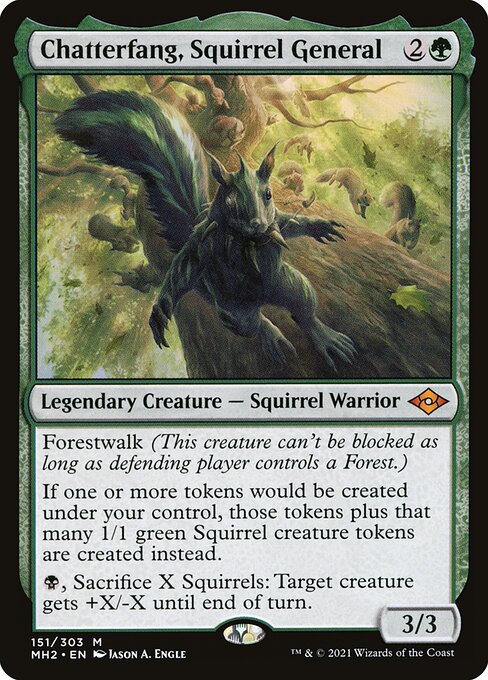
1. Chatterfang, Squirrel General
Chatterfang, Squirrel General | Illustration by Jason A. Engle
Colors: black-green. Role: multiplier and sacrifice engine.
Chatterfang adds a Squirrel for each token created under your control, including Treasures, Food, and Clues. He does not make another copy of the original token: one Treasure becomes one Treasure plus one Squirrel. That lets ordinary resource cards also build your army.
His black activation sacrifices Squirrels to give a creature +X/-X. Token production, sacrifice payoffs, and creature control therefore support the same game plan, earning him our first-place ranking.
Death-to-Treasure engine:Pitiless Plunderer makes a Treasure when another creature you control dies; Chatterfang adds a Squirrel alongside it.
Repeatable production:Chitterspitter makes Squirrels and can grow the whole group through acorn counters.
Landfall support:Tireless Provisioner makes Food or Treasure from land drops, with Squirrels added by Chatterfang.
Finishing payoff:Zulaport Cutthroat turns your creatures' deaths into life loss for every opponent.
Main drawback: Chatterfang needs other token makers to start. Plunderer can enable repeatable sacrifice lines, so decide whether you want a combo-focused build or a combat-and-attrition version.
2. Baylen, the Haymaker
Baylen, the Haymaker | Illustration by Ryan Pancoast
Colors: red-green-white. Role: mana, card-draw, and combat payoff.
Baylen taps two tokens for a mana, three for a card, or four to add three counters to itself and gain trample for the turn. Any untapped tokens can pay these costs, including Food, Clues, and newly created creature tokens.
That flexibility makes Baylen an excellent commander for players who want choices beyond attacking. A collection of resource tokens can fund spells, refill your hand, or build a commander-damage threat without being sacrificed.
Resource multiplier:Academy Manufactor turns each would-be Food, Clue, or Treasure into one of each.
Creature production:Scute Swarm can produce increasingly large token boards once you reach six lands.
Untap support:Seedborn Muse refreshes your permanents on opponents' untap steps, reopening Baylen's resource options.
Main drawback: Baylen makes no tokens. Also, a token tapped to pay one ability cannot pay another until it untaps; tapping creatures may leave you short of blockers.
3. Adrix and Nev, Twincasters
Adrix and Nev, Twincasters | Illustration by Andrew Mar
Colors: green-blue. Role: token multiplier.
Adrix and Nev double every kind of token created under your control. Creature copies, Plants, and resource tokens all benefit, giving you broad deckbuilding room in colors with strong ramp and card draw.
Their ward ability adds friction to targeted removal, but the real attraction is having your multiplier available from the command zone. Build a solid token-production deck first, then let the commander increase its output.
Large token batch:Avenger of Zendikar creates Plants according to your land count and grows them with later land drops.
Copy upgrade:Esix, Fractal Bloom can replace your first token creation on your turn with copies of a useful creature.
Board expansion:Second Harvest copies each token you control, with Adrix and Nev increasing the number created.
Combat finish:Beastmaster Ascension turns a sufficiently wide attack into a large team-wide boost.
Main drawback: A multiplier is weak on an empty board without a follow-up. Avoid filling your hand with several doubling effects and too few cards that actually create tokens.
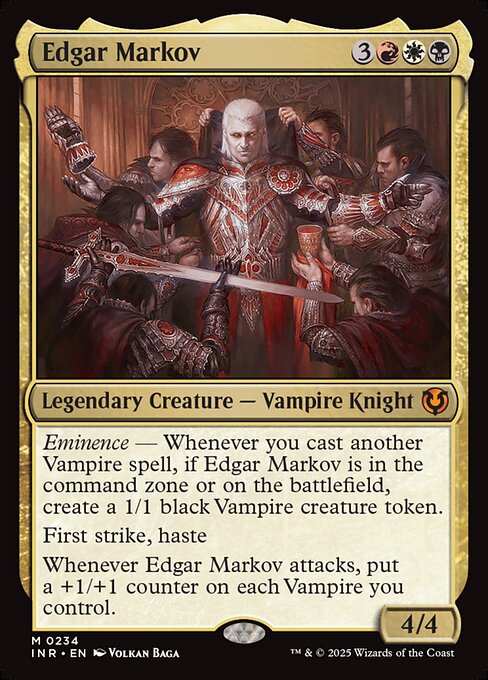
Edgar's eminence ability gives you a Vampire token when you cast another Vampire spell while he is in the command zone or on the battlefield. The engine therefore starts before you spend six mana on your commander.
A low curve lets you produce bodies rapidly, then choose between attacking and sacrificing. Casting Edgar adds a hasty threat and an attack trigger that grows your Vampires, but the deck should already be working without him.
Death payoff:Cordial Vampire grows your Vampires whenever a creature dies.
Board utility:Captivating Vampire boosts the tribe and lets five untapped Vampires steal an opposing creature.
Hand refill:Champion of Dusk draws according to your Vampire count, with matching life loss.
Combat finish:Shared Animosity rewards attacking with a large group sharing the Vampire type.
Main drawback: Edgar strongly rewards one creature type. A powerful generic token maker may contribute less than a cheap Vampire that supports the eminence plan.
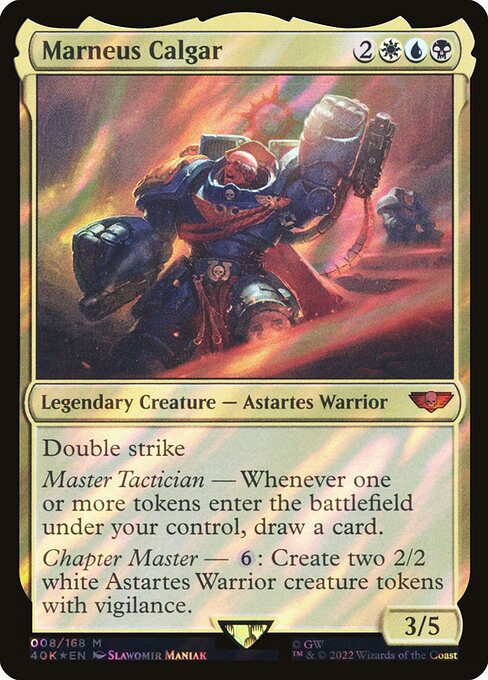
5. Marneus Calgar
Marneus Calgar | Illustration by Slawomir Maniak
Colors: white-blue-black. Role: card-draw engine and token generator.
Marneus draws a card whenever one or more tokens enter under your control. That includes noncreature tokens, so Treasures and Clues can help keep your hand full while funding future plays.
He also has a six-mana activation that creates two vigilant Astartes Warriors. The important distinction is that he draws once per simultaneous entry event, not once per token in that event. Several small, separate token events can generate more cards than one large batch.
Repeated token events:Smothering Tithe can make Treasures as opponents draw and decline to pay.
Steady production:Bitterblossom supplies a flying token each of your upkeeps at the cost of a life.
Resource multiplication:Academy Manufactor broadens each Food, Clue, or Treasure event, although a simultaneous batch still gives Marneus one draw trigger.
Exit payoff:Nadier's Nightblade drains opponents when your tokens leave, including when you spend resource tokens.
Main drawback: Five mana is a meaningful setup cost. Include card draw that works before Marneus arrives, and do not mistake a doubled token batch for doubled draw triggers.
6. Krenko, Mob Boss
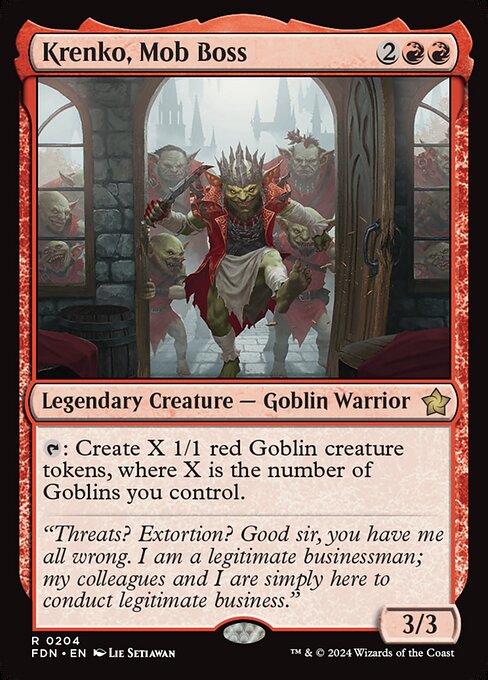
Krenko, Mob Boss | Illustration by Lie Setiawan
Colors: red. Role: Goblin token generator.
Krenko taps to make a Goblin for each Goblin you control, including himself. Each successful activation increases the size of the next one, giving a simple creature deck an explosive ceiling.
He is our recommendation for a first token deck because the priorities are clear: establish Goblins, give Krenko a safe activation, and turn the resulting bodies into cards, mana, or damage. You can build that plan without adding other colors.
Haste and protection:Lightning Greaves helps Krenko activate immediately while protecting him from targeted effects.
Mana conversion:Skirk Prospector sacrifices Goblins for red mana.
Card draw:Skullclamp turns unbuffed 1/1 Goblins into two cards when its toughness reduction kills them.
Direct damage:Goblin Bombardment lets your army deal damage without getting through blockers.
Main drawback: Krenko needs haste or a turn cycle before his tap ability is available. Repeated removal or a sweeper can reset both the commander and the Goblin count.
7. Jinnie Fay, Jetmir's Second
Jinnie Fay, Jetmir's Second | Illustration by David Gaillet
Jinnie Fay can replace a token-making event with that many hasty 2/2 Cats or vigilant 3/1 Dogs. Resource-token producers become potential creature engines, and the replacement is optional: you can keep a Treasure when you need mana.
She works especially well when you want a combat deck built from cards that also serve practical resource roles. Choose the token type according to whether immediate attacks or vigilant blockers matter more.
Bigger batches:Academy Manufactor can expand a resource-token event before Jinnie replaces it with Cats or Dogs. The order of these replacement effects matters.
Landfall bodies:Tireless Provisioner can turn land drops into creatures instead of Food or Treasure.
Combat resources:Professional Face-Breaker produces Treasures from connecting with players; keep them or convert them as needed.
Independent draw:Idol of Oblivion draws after you have created a token that turn.
Main drawback: Converted Cats and Dogs do not retain Treasure, Food, or Clue abilities. Turning every resource into a creature can leave you unable to pay for your next spell.
8. Mondrak, Glory Dominus
Mondrak, Glory Dominus | Illustration by Jason A. Engle
Colors: white. Role: token multiplier.
Mondrak doubles all tokens created under your control and can gain an indestructible counter by paying its activation cost and sacrificing two other artifacts and/or creatures.
That combination makes it a strong mono-white choice: your production spells go further, and spare tokens can help protect the multiplier. The deck still needs enough producers and ways to refill its hand after deploying them.
Attack production:Adeline makes a Human for each opponent when you attack.
Scalable production:Secure the Wastes turns available mana into Warriors at instant speed.
Card conversion:Skullclamp draws from dying equipped creatures; anthem effects can prevent it from immediately killing 1/1s.
Ongoing draw:Bennie Bracks draws at an end step if you created a token during that turn.
Main drawback: Indestructible does not protect against exile, bounce, or toughness reduction to zero. Mondrak also cannot create a token army without help.
9. Jetmir, Nexus of Revels
Jetmir, Nexus of Revels | Illustration by Ryan Pancoast
Colors: red-green-white. Role: combat finisher.
Jetmir rewards having three, six, and nine creatures. At nine, the combined bonuses give your creatures +3/+0, vigilance, trample, and double strike. Tokens are an efficient way to reach those thresholds.
Unlike a production engine, Jetmir often works best as the payoff you deploy after building a board. A handful of small creatures can suddenly threaten a player who looked safe a moment earlier.
Wide-board spell:March of the Multitudes uses convoke to turn existing creatures and mana into more Soldiers.
Repeatable production:Adeline increases your creature count across successive attacks.
Protection:Heroic Intervention gives your permanents hexproof and indestructible for a crucial turn.
Production plus protection:Grand Crescendo creates Citizens and grants your creatures indestructible.
Main drawback: The bonuses depend on your current creature count. Removal before damage can drop you below a threshold and take away a combat ability you were relying on.
10. Ghave, Guru of Spores
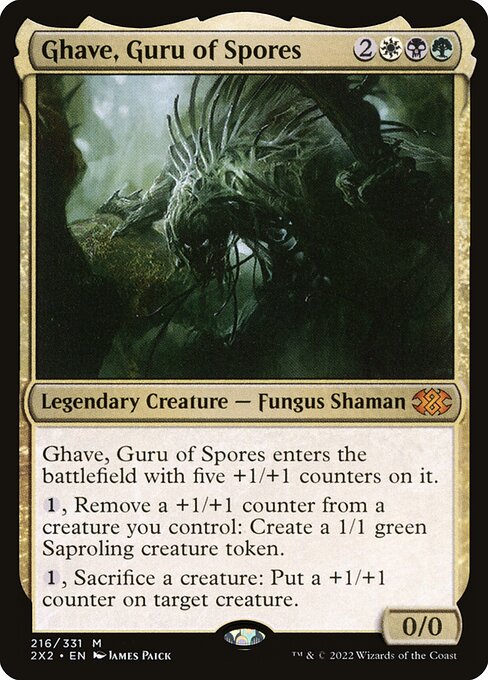
Ghave, Guru of Spores | Illustration by James Paick
Colors: white-black-green. Role: token generator and sacrifice engine.
Ghave enters with five counters. Spend one mana and remove a counter from one of your creatures to make a Saproling; spend one mana and sacrifice a creature to put a counter on a creature.
That makes counters and bodies interchangeable resources, provided you have mana. Ghave suits players who enjoy managing an engine and choosing when to expand the board, sacrifice creatures, or concentrate power on one threat.
Mana support:Cryptolith Rite gives your creatures a mana-producing tap ability. Newly created creatures still need haste or time before using it.
Counter supply:Good-Fortune Unicorn puts a counter on each other creature entering under your control, giving Ghave more counters to spend.
Death payoff:Poison-Tip Archer makes opponents lose life whenever another creature dies.
Card draw:Skullclamp draws when an equipped creature dies, including one sacrificed to Ghave.
Main drawback: Every exchange uses mana. Ghave can look busy without improving your position if you have no payoff for the creatures entering or dying.
11. Anim Pakal, Thousandth Moon
Anim Pakal, Thousandth Moon | Illustration by Chris Rahn
Attack with at least one non-Gnome and Anim Pakal gains a counter, then creates attacking Gnomes equal to her counter total. She does not need to attack herself, so an inexpensive creature can start the engine while she stays safe.
Counters make each later attack more productive. This is a strong choice when you want tokens to build momentum through combat rather than through a collection of enchantments.
Counter growth:Lae'zel increases the counters Anim Pakal receives.
Card selection:Rumor Gatherer scries as creatures enter and replaces its second resolution each turn with a card draw.
Noncombat damage:Impact Tremors makes each Gnome entering hurt every opponent.
Protection and growth:Unbreakable Formation protects your creatures; cast during your main phase, it also adds counters and vigilance.
Main drawback: A board containing only Gnomes cannot trigger Anim Pakal by attacking. Keep non-Gnome attackers available, and remember that entering tapped and attacking does not trigger another attack ability.
12. Rhys the Redeemed
Rhys the Redeemed | Illustration by Steve Prescott
Colors: green-white. Role: token generator and copier.
Rhys costs one mana to cast, but his activations are the real investment. The smaller one creates an Elf Warrior; the six-mana ability creates a copy of each creature token you control.
He rewards a classic green-white plan: ramp, establish tokens, then expand the army at a moment that leaves opponents little time to respond before your next attack. His larger ability copies creature tokens, not every Treasure or Food you own.
More activations:Seedborn Muse untaps Rhys and your mana sources during opponents' untap steps.
Combat finish:Beastmaster Ascension gives your board a substantial boost after enough attackers have added quest counters.
Hand refill:Skullclamp turns expendable creatures into cards when they die.
Main drawback: Rhys can be cheap to cast and still slow to develop. You need both mana and an existing token board for the larger activation to justify its cost.
13. Tivit, Seller of Secrets
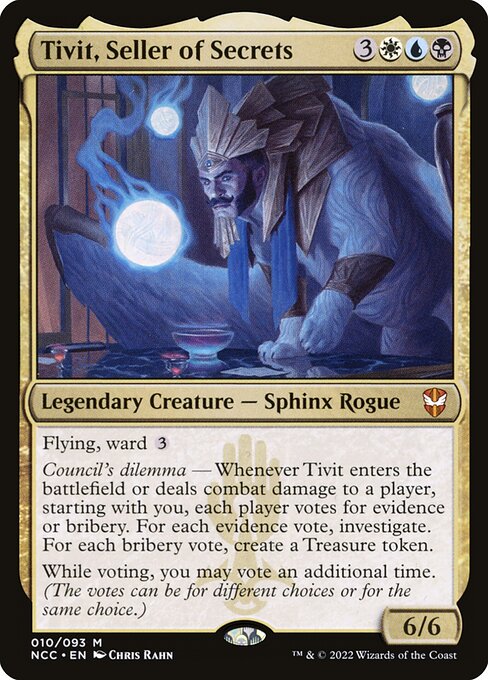
Tivit, Seller of Secrets | Illustration by Chris Rahn
Colors: white-blue-black. Role: Clue and Treasure generator.
Tivit creates resources through voting when it enters or deals combat damage to a player. In an ordinary four-player game, taking the additional vote produces five votes and therefore five artifact tokens per trigger, divided between Clues and Treasures.
Flying helps repeat the process through combat, while ward makes targeted interaction more expensive. Tivit works well when you want token production to fund a larger control or artifact plan.
Resource multiplication:Academy Manufactor makes the Clue-versus-Treasure split much less important by creating one of each resource type instead.
Repeat the entry trigger:Ephemerate blinks Tivit, with rebound offering another opportunity next upkeep.
Optional combo route:Time Sieve spends five artifacts for an extra turn. Tivit can replenish them by connecting in combat, enabling a repeatable extra-turn line if you keep producing enough artifacts and opponents cannot interrupt it.
Mana support:Inspiring Statuary lets artifacts help pay generic costs for nonartifact spells through improvise.
Main drawback: Tivit costs six mana. The Time Sieve plan also depends on sufficient artifacts and continued access to new ones; fewer players, blockers, or removal can break the sequence.
14. Xyris, the Writhing Storm
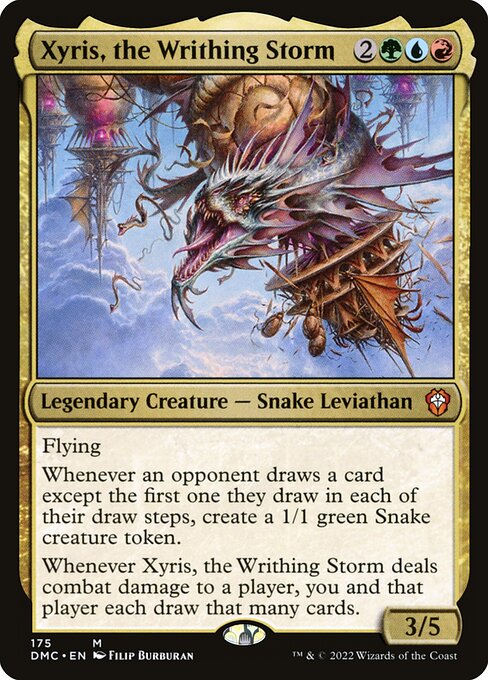
Xyris, the Writhing Storm | Illustration by Filip Burburan
Xyris makes a Snake when an opponent draws a card, except the first card they draw in each of their draw steps. Its combat-damage ability also makes you and the damaged player draw that many cards.
That creates a powerful but political bargain: your opponents receive resources while you receive bodies. A good Xyris deck has a way to exploit those bodies immediately, rather than handing out fresh answers and hoping the Snakes survive.
Burst production:Windfall can make many Snakes as opponents refill their hands.
Steady production:Howling Mine provides extra draws while untapped; the additional opponent draw can trigger Xyris.
Immediate damage:Impact Tremors turns Snake creation into damage without waiting for an attack.
Your own refill:Skullclamp converts small Snakes into cards when they die.
Main drawback: Opponents may use the cards you give them to stop you. Xyris's payoff should be on the battlefield before you make the table draw a large number of cards.
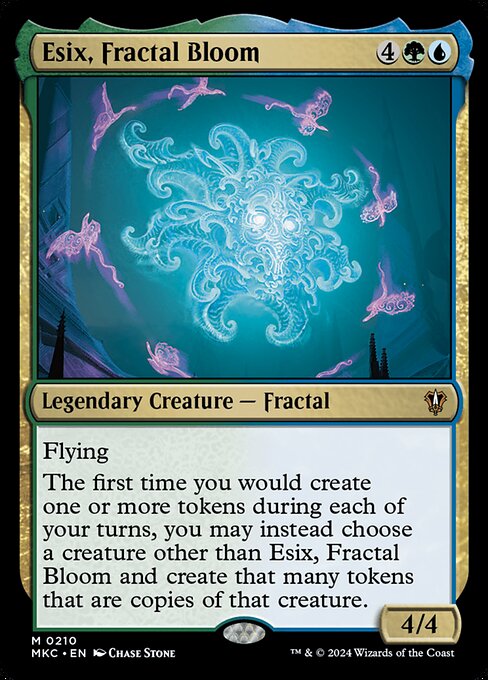
15. Esix, Fractal Bloom
Esix, Fractal Bloom | Illustration by Chase Stone
Colors: green-blue. Role: token-copy replacement.
Esix can replace your first token creation during each of your turns with the same number of copies of a creature other than Esix. That creature can belong to an opponent.
The goal is one well-timed, large token event. Instead of adding a few small bodies, you can create multiple copies of a powerful creature with an entry ability. Esix changes quality rather than simply increasing quantity.
Large batch:Avenger of Zendikar offers a token count tied to your lands and a strong creature to copy in later events.
Valuable template:Hornet Queen makes defensive Insects when it enters and can be a productive nonlegendary copy choice.
Landfall setup:Rampaging Baloths lets a land drop trigger token creation after you have deployed Esix.
Existing-board payoff:Second Harvest creates copies of your tokens; Esix can replace that first creation event on your turn with copies of a different creature.
Main drawback: Esix costs six mana and only affects the first eligible event on your turn. If you already created tokens before casting it, you must wait until your next turn to use its replacement effect.
16. Brudiclad, Telchor Engineer
Brudiclad, Telchor Engineer | Illustration by Daarken
Colors: blue-red. Role: token generator and transformer.
At the beginning of combat on your turn, Brudiclad makes a Myr and can turn every other token you control into a copy of one chosen token. It also gives creature tokens haste.
Small artifact tokens can become a coordinated attacking force if you establish an impressive token to copy. Even Treasures can change into creature copies, so decide whether you need an army more than the resources you are replacing.
Cheap token production:Third Path Iconoclast makes artifact Soldiers when you cast noncreature spells.
Production and setup:Saheeli, Sublime Artificer makes Servos and can temporarily turn an artifact into a copy of another artifact or creature.
Copy template:Feldon creates a token copy of a creature in your graveyard for Brudiclad to use.
Artifact payoff:Myr Battlesphere supplies Myr and offers a threatening creature-copy template through Feldon or Saheeli.
Main drawback: Changing an existing token into a copy does not make it enter again. You do not receive a new set of entry triggers merely because Brudiclad changed the board's appearance.
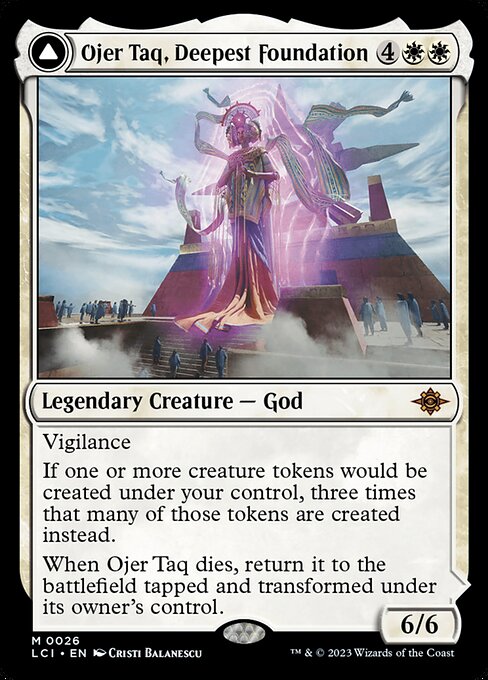
17. Ojer Taq, Deepest Foundation // Temple of Civilization
Ojer Taq, Deepest Foundation // Temple of Civilization | Illustration by Cristi Balanescu
Colors: white. Role: creature-token multiplier.
Ojer Taq triples creature-token production. A spell that would make four Soldiers makes twelve instead, giving mono-white decks a particularly large reward for resolving one production spell after their commander.
Its death trigger can return it transformed as a land, with a later route back to the creature face. Leave it in the graveyard if you want that trigger to return it, rather than moving it to the command zone.
Repeatable production:Elspeth, Sun's Champion makes three Soldiers with her plus-one ability, becoming nine with Ojer Taq.
Scalable production:Secure the Wastes turns a modest mana investment into a larger Warrior army.
Attack production:Adeline repeatedly supplies Humans for the multiplier.
Card draw:Bennie Bracks rewards turns in which you created tokens, helping find the next producer.
Main drawback: Six mana is expensive for a commander that does not make tokens itself. Unlike Mondrak, Ojer Taq triples creature tokens only; ordinary Treasures, Clues, and Food are unaffected.
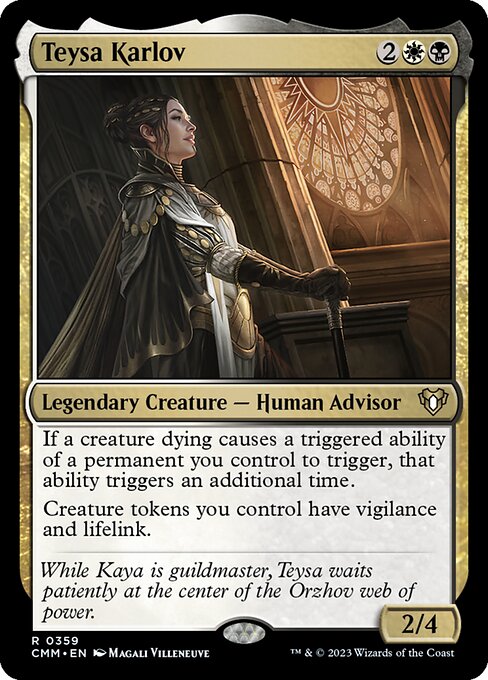
18. Teysa Karlov
Teysa Karlov | Illustration by Magali Villeneuve
Colors: white-black. Role: death-trigger payoff.
Teysa makes your permanents' relevant death-triggered abilities trigger an additional time when a creature dies. She also gives your creature tokens vigilance and lifelink.
This is the aristocrats approach: make expendable creatures, sacrifice them on your terms, and win through repeated life loss. Teysa improves the rewards, but does not supply either the token makers or the sacrifice outlet.
Renewable material:Ophiomancer makes a Snake at each upkeep if you control no Snakes, allowing repeated production if you sacrifice the previous one.
Sacrifice outlet:Viscera Seer converts creatures into scrying without a mana payment.
Drain payoff:Zulaport Cutthroat makes your creatures' deaths cost every opponent life, with an additional trigger from Teysa.
Card draw:Skullclamp triggers an additional time when its equipped creature dies while Teysa applies, drawing four cards in total.
Main drawback: Do not confuse death triggers with every sacrifice-related ability. Teysa does not double Viscera Seer's activated ability, and an ability triggered specifically by sacrificing is not automatically a death trigger.
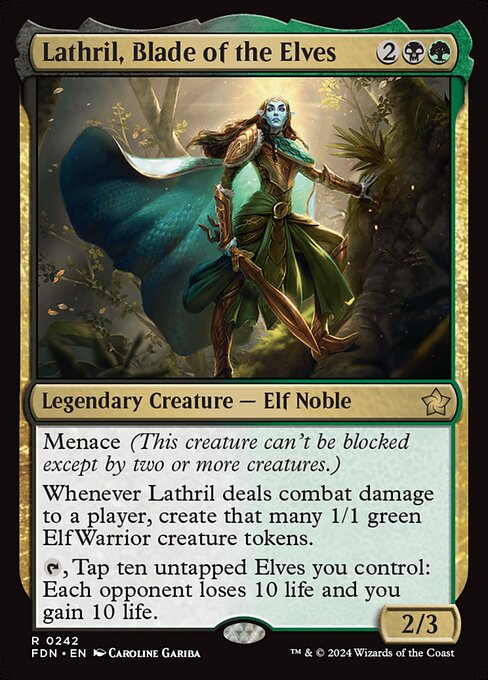
19. Lathril, Blade of the Elves
Lathril, Blade of the Elves | Illustration by Caroline Gariba
Colors: black-green. Role: Elf token generator and drain finisher.
Lathril makes Elf Warriors equal to the combat damage she deals to a player. Her other ability taps her and ten other untapped Elves to make each opponent lose ten life while you gain ten.
That gives an Elf deck two connected plans: grow Lathril and connect to build the board, then use a large Elf count to finish without attacking through blockers. Existing Elf mana engines support both halves.
Extra production:Elvish Warmaster adds an Elf when other Elves enter, limited to once each turn.
Mana and size:Elvish Archdruid strengthens your other Elves and produces mana according to your Elf count.
Combat pressure:Beastmaster Ascension can boost Lathril's damage and the size of your whole army.
Another activation:Vitalize untaps your creatures, allowing another Lathril activation if she and ten other Elves are available.
Main drawback: Lathril needs to connect to make her own tokens, or receive substantial help from other Elf producers. Her tap symbol also means haste or controlling her since your turn began matters.
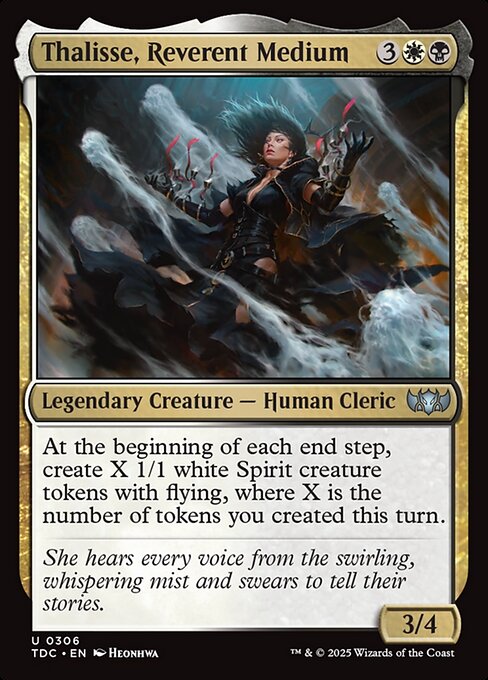
20. Thalisse, Reverent Medium
Thalisse, Reverent Medium | Illustration by Heonhwa
At each end step, Thalisse makes flying Spirits equal to the number of tokens you created earlier that turn. The count includes resource tokens and tokens you have already spent or sacrificed.
This is an appealing bridge between artifact resources and a creature army. Make Treasures or a batch of Warriors, then receive Spirits later. Creating tokens on opponents' turns can also generate extra end-step production.
Off-turn production:Smothering Tithe can make Treasures during opponents' turns when they draw and decline to pay.
Removal payoff:Revel in Riches creates Treasures from opposing creatures dying, with a separate win condition if you retain enough Treasures for your upkeep.
Instant-speed batch:Secure the Wastes produces Warriors before an end step so Thalisse can count them.
Combat support:Intangible Virtue gives your creature tokens a power-and-toughness boost and vigilance.
Main drawback: You must wait for the end-step trigger, and Thalisse costs five mana. The Spirits created by one resolution do not cause her to trigger again during that same end step.
Which token commander fits your play style?
For a first creature-token deck, choose Krenko or Anim Pakal. Both supply production from the command zone and make the deck's next steps easy to understand: generate bodies, protect the engine, and add a payoff.
For classic green-white tokens, choose Rhys. If you want red as well, Jinnie Fay offers flexible token conversion, Baylen adds resource decisions, and Jetmir provides a powerful combat finish.
For sacrifice and life loss, choose Chatterfang, Ghave, or Teysa. Chatterfang offers black-green production and death payoffs. Ghave adds white and a counter engine, while Teysa focuses on white-black death-trigger rewards.
For noncreature resource tokens, choose Baylen, Marneus, or Tivit. Food, Clues, and Treasures can contribute even when attacking is impossible. Pay attention to whether your commander wants tokens to enter, remain untapped, or be sacrificed.
For unusual copy turns, choose Esix or Brudiclad. Esix changes a token-creation event; Brudiclad changes tokens already on the battlefield. Those are different plans and need different setup.
How to build a token deck that can finish a game
Begin with the job your commander does not perform. A Jetmir deck needs enough production to reach its creature thresholds. A Krenko deck already has repeatable production, so haste, card draw, and protection deserve more attention. A Teysa deck needs producers, sacrifice outlets, and death payoffs working together.
As a starting guideline, try roughly 36–38 lands, 8–10 ramp pieces, and 12–16 cards that create tokens, then adjust for your commander's role and mana costs. These are starting points, not requirements. Count cards that serve more than one role, and leave meaningful room for interaction and card draw.
Pick a finish before adding more multipliers. Combat decks need size, evasion, haste, or trample. Sacrifice decks need a payoff such as Zulaport Cutthroat. Resource decks need a way to turn accumulated mana and cards into a decisive board or another win condition. More tokens alone do not guarantee progress.
Keep a producer in reserve when possible. An enchantment that generates tokens over several turns or a spell held for after a sweeper can matter more than adding another ten creatures to a board already large enough to threaten the table.
Token rules worth knowing
Do creature tokens die?
Yes. A creature token moving from the battlefield to the graveyard dies and can trigger death abilities. It then ceases to exist. Exiling or bouncing a token does not count as dying, and a departed token cannot be reanimated.
Do Treasures, Food, and Clues count?
They are tokens, so effects covering all tokens can apply. Effects restricted to creature tokens do not affect ordinary noncreature resource tokens. Read that qualifier before pairing a multiplier with a resource engine.
Do token doublers stack?
Two applicable doubling replacement effects normally make four times the original number, not three times. Each applies once to the event. Neither repeatedly doubles its own result forever.
Do token copies inherit counters?
Ordinary copy effects do not copy +1/+1 counters or temporary boosts. Copying a token with five counters does not give the new token those five counters.
Can new tokens be tapped immediately?
It depends on the cost. Baylen can tap newly created creature tokens to pay his abilities. A creature's own tap-symbol ability, such as one granted by Cryptolith Rite, normally requires haste or that you controlled it continuously since your most recent turn began.
Start building your token Commander deck
Pick a commander whose role matches the games you enjoy, then use its Create a deck button to begin. The free ElderDecks Commander deck builder lets you put the plan together and check the balance between production, resources, interaction, and finishing cards.
For related deckbuilding ideas, explore the ElderDecks Commander articles. A token deck can start with Selesnya combat, Golgari sacrifice, or a resource engine and still play very differently from another deck using the same colors.
Would you rather attack with your tokens, sacrifice them, or turn them into more cards and mana?
Sources and card references
Card text, rulings, and legality were checked on November 21, 2026. Rankings and deckbuilding recommendations are ElderDecks editorial judgments. Each featured image includes an illustrator credit; card images are provided via Scryfall, with artwork and card designs belonging to Wizards of the Coast and their respective rights holders.
20 Best Token Commanders: Go Wide, Sacrifice & Win
By ElderArticles · Updated 11/22/2026 · 22 min read
Explore the 20 best token commanders in MTG, with combat, sacrifice, and resource-token strategies, four synergies per commander, and practical deckbuilding tips.
The best token commanders do more than put extra creatures on the table. They turn one card into an army, convert spare tokens into mana and cards, or make every sacrifice push opponents closer to losing.
This guide ranks 20 commanders across combat, sacrifice, and resource-token strategies. Each entry explains its colors, its actual job in the deck, four synergy cards, and the weakness you need to build around.
Reviewed November 21, 2026. These are editorial recommendations for multiplayer Commander, weighing consistency, efficiency, useful resources, and finishing plans. This is not a tournament tier list or a popularity leaderboard. All featured commanders and recommended support cards were checked for Commander legality and color identity.
Token generators, multipliers, and payoffs are different jobs
Generators make the first tokens. Krenko and Anim Pakal can establish a board themselves. You can spend more of their supporting slots on protection, card draw, and ways to win.
Multipliers and converters improve another card's output. Adrix and Nev double tokens; Jinnie Fay changes what you make. Neither solves a hand that contains no token production.
Payoffs spend or reward tokens. Baylen turns them into resources, Jetmir makes a wide board lethal, and Teysa improves death triggers. These commanders need a dependable supply of material.
Some commanders fill several roles. Chatterfang adds Squirrels and supplies a sacrifice ability, while Marneus draws cards and has a token-making activation. Identify what your commander supplies before filling the other roles in the 99.
Colors: black-green. Role: multiplier and sacrifice engine.
Chatterfang adds a Squirrel for each token created under your control, including Treasures, Food, and Clues. He does not make another copy of the original token: one Treasure becomes one Treasure plus one Squirrel. That lets ordinary resource cards also build your army.
His black activation sacrifices Squirrels to give a creature +X/-X. Token production, sacrifice payoffs, and creature control therefore support the same game plan, earning him our first-place ranking.
Death-to-Treasure engine:Pitiless Plunderer makes a Treasure when another creature you control dies; Chatterfang adds a Squirrel alongside it.
Repeatable production:Chitterspitter makes Squirrels and can grow the whole group through acorn counters.
Landfall support:Tireless Provisioner makes Food or Treasure from land drops, with Squirrels added by Chatterfang.
Finishing payoff:Zulaport Cutthroat turns your creatures' deaths into life loss for every opponent.
Main drawback: Chatterfang needs other token makers to start. Plunderer can enable repeatable sacrifice lines, so decide whether you want a combo-focused build or a combat-and-attrition version.
Colors: red-green-white. Role: mana, card-draw, and combat payoff.
Baylen taps two tokens for a mana, three for a card, or four to add three counters to itself and gain trample for the turn. Any untapped tokens can pay these costs, including Food, Clues, and newly created creature tokens.
That flexibility makes Baylen an excellent commander for players who want choices beyond attacking. A collection of resource tokens can fund spells, refill your hand, or build a commander-damage threat without being sacrificed.
Resource multiplier:Academy Manufactor turns each would-be Food, Clue, or Treasure into one of each.
Creature production:Scute Swarm can produce increasingly large token boards once you reach six lands.
Untap support:Seedborn Muse refreshes your permanents on opponents' untap steps, reopening Baylen's resource options.
Main drawback: Baylen makes no tokens. Also, a token tapped to pay one ability cannot pay another until it untaps; tapping creatures may leave you short of blockers.
Adrix and Nev double every kind of token created under your control. Creature copies, Plants, and resource tokens all benefit, giving you broad deckbuilding room in colors with strong ramp and card draw.
Their ward ability adds friction to targeted removal, but the real attraction is having your multiplier available from the command zone. Build a solid token-production deck first, then let the commander increase its output.
Large token batch:Avenger of Zendikar creates Plants according to your land count and grows them with later land drops.
Copy upgrade:Esix, Fractal Bloom can replace your first token creation on your turn with copies of a useful creature.
Board expansion:Second Harvest copies each token you control, with Adrix and Nev increasing the number created.
Combat finish:Beastmaster Ascension turns a sufficiently wide attack into a large team-wide boost.
Main drawback: A multiplier is weak on an empty board without a follow-up. Avoid filling your hand with several doubling effects and too few cards that actually create tokens.
Edgar's eminence ability gives you a Vampire token when you cast another Vampire spell while he is in the command zone or on the battlefield. The engine therefore starts before you spend six mana on your commander.
A low curve lets you produce bodies rapidly, then choose between attacking and sacrificing. Casting Edgar adds a hasty threat and an attack trigger that grows your Vampires, but the deck should already be working without him.
Death payoff:Cordial Vampire grows your Vampires whenever a creature dies.
Board utility:Captivating Vampire boosts the tribe and lets five untapped Vampires steal an opposing creature.
Hand refill:Champion of Dusk draws according to your Vampire count, with matching life loss.
Combat finish:Shared Animosity rewards attacking with a large group sharing the Vampire type.
Main drawback: Edgar strongly rewards one creature type. A powerful generic token maker may contribute less than a cheap Vampire that supports the eminence plan.
Colors: white-blue-black. Role: card-draw engine and token generator.
Marneus draws a card whenever one or more tokens enter under your control. That includes noncreature tokens, so Treasures and Clues can help keep your hand full while funding future plays.
He also has a six-mana activation that creates two vigilant Astartes Warriors. The important distinction is that he draws once per simultaneous entry event, not once per token in that event. Several small, separate token events can generate more cards than one large batch.
Repeated token events:Smothering Tithe can make Treasures as opponents draw and decline to pay.
Steady production:Bitterblossom supplies a flying token each of your upkeeps at the cost of a life.
Resource multiplication:Academy Manufactor broadens each Food, Clue, or Treasure event, although a simultaneous batch still gives Marneus one draw trigger.
Exit payoff:Nadier's Nightblade drains opponents when your tokens leave, including when you spend resource tokens.
Main drawback: Five mana is a meaningful setup cost. Include card draw that works before Marneus arrives, and do not mistake a doubled token batch for doubled draw triggers.
Krenko taps to make a Goblin for each Goblin you control, including himself. Each successful activation increases the size of the next one, giving a simple creature deck an explosive ceiling.
He is our recommendation for a first token deck because the priorities are clear: establish Goblins, give Krenko a safe activation, and turn the resulting bodies into cards, mana, or damage. You can build that plan without adding other colors.
Haste and protection:Lightning Greaves helps Krenko activate immediately while protecting him from targeted effects.
Mana conversion:Skirk Prospector sacrifices Goblins for red mana.
Card draw:Skullclamp turns unbuffed 1/1 Goblins into two cards when its toughness reduction kills them.
Direct damage:Goblin Bombardment lets your army deal damage without getting through blockers.
Main drawback: Krenko needs haste or a turn cycle before his tap ability is available. Repeated removal or a sweeper can reset both the commander and the Goblin count.
Jinnie Fay can replace a token-making event with that many hasty 2/2 Cats or vigilant 3/1 Dogs. Resource-token producers become potential creature engines, and the replacement is optional: you can keep a Treasure when you need mana.
She works especially well when you want a combat deck built from cards that also serve practical resource roles. Choose the token type according to whether immediate attacks or vigilant blockers matter more.
Bigger batches:Academy Manufactor can expand a resource-token event before Jinnie replaces it with Cats or Dogs. The order of these replacement effects matters.
Landfall bodies:Tireless Provisioner can turn land drops into creatures instead of Food or Treasure.
Combat resources:Professional Face-Breaker produces Treasures from connecting with players; keep them or convert them as needed.
Independent draw:Idol of Oblivion draws after you have created a token that turn.
Main drawback: Converted Cats and Dogs do not retain Treasure, Food, or Clue abilities. Turning every resource into a creature can leave you unable to pay for your next spell.
Mondrak doubles all tokens created under your control and can gain an indestructible counter by paying its activation cost and sacrificing two other artifacts and/or creatures.
That combination makes it a strong mono-white choice: your production spells go further, and spare tokens can help protect the multiplier. The deck still needs enough producers and ways to refill its hand after deploying them.
Attack production:Adeline makes a Human for each opponent when you attack.
Scalable production:Secure the Wastes turns available mana into Warriors at instant speed.
Card conversion:Skullclamp draws from dying equipped creatures; anthem effects can prevent it from immediately killing 1/1s.
Ongoing draw:Bennie Bracks draws at an end step if you created a token during that turn.
Main drawback: Indestructible does not protect against exile, bounce, or toughness reduction to zero. Mondrak also cannot create a token army without help.
Jetmir rewards having three, six, and nine creatures. At nine, the combined bonuses give your creatures +3/+0, vigilance, trample, and double strike. Tokens are an efficient way to reach those thresholds.
Unlike a production engine, Jetmir often works best as the payoff you deploy after building a board. A handful of small creatures can suddenly threaten a player who looked safe a moment earlier.
Wide-board spell:March of the Multitudes uses convoke to turn existing creatures and mana into more Soldiers.
Repeatable production:Adeline increases your creature count across successive attacks.
Protection:Heroic Intervention gives your permanents hexproof and indestructible for a crucial turn.
Production plus protection:Grand Crescendo creates Citizens and grants your creatures indestructible.
Main drawback: The bonuses depend on your current creature count. Removal before damage can drop you below a threshold and take away a combat ability you were relying on.
Colors: white-black-green. Role: token generator and sacrifice engine.
Ghave enters with five counters. Spend one mana and remove a counter from one of your creatures to make a Saproling; spend one mana and sacrifice a creature to put a counter on a creature.
That makes counters and bodies interchangeable resources, provided you have mana. Ghave suits players who enjoy managing an engine and choosing when to expand the board, sacrifice creatures, or concentrate power on one threat.
Mana support:Cryptolith Rite gives your creatures a mana-producing tap ability. Newly created creatures still need haste or time before using it.
Counter supply:Good-Fortune Unicorn puts a counter on each other creature entering under your control, giving Ghave more counters to spend.
Death payoff:Poison-Tip Archer makes opponents lose life whenever another creature dies.
Card draw:Skullclamp draws when an equipped creature dies, including one sacrificed to Ghave.
Main drawback: Every exchange uses mana. Ghave can look busy without improving your position if you have no payoff for the creatures entering or dying.
Attack with at least one non-Gnome and Anim Pakal gains a counter, then creates attacking Gnomes equal to her counter total. She does not need to attack herself, so an inexpensive creature can start the engine while she stays safe.
Counters make each later attack more productive. This is a strong choice when you want tokens to build momentum through combat rather than through a collection of enchantments.
Counter growth:Lae'zel increases the counters Anim Pakal receives.
Card selection:Rumor Gatherer scries as creatures enter and replaces its second resolution each turn with a card draw.
Noncombat damage:Impact Tremors makes each Gnome entering hurt every opponent.
Protection and growth:Unbreakable Formation protects your creatures; cast during your main phase, it also adds counters and vigilance.
Main drawback: A board containing only Gnomes cannot trigger Anim Pakal by attacking. Keep non-Gnome attackers available, and remember that entering tapped and attacking does not trigger another attack ability.
Colors: green-white. Role: token generator and copier.
Rhys costs one mana to cast, but his activations are the real investment. The smaller one creates an Elf Warrior; the six-mana ability creates a copy of each creature token you control.
He rewards a classic green-white plan: ramp, establish tokens, then expand the army at a moment that leaves opponents little time to respond before your next attack. His larger ability copies creature tokens, not every Treasure or Food you own.
More activations:Seedborn Muse untaps Rhys and your mana sources during opponents' untap steps.
Combat finish:Beastmaster Ascension gives your board a substantial boost after enough attackers have added quest counters.
Hand refill:Skullclamp turns expendable creatures into cards when they die.
Main drawback: Rhys can be cheap to cast and still slow to develop. You need both mana and an existing token board for the larger activation to justify its cost.
Colors: white-blue-black. Role: Clue and Treasure generator.
Tivit creates resources through voting when it enters or deals combat damage to a player. In an ordinary four-player game, taking the additional vote produces five votes and therefore five artifact tokens per trigger, divided between Clues and Treasures.
Flying helps repeat the process through combat, while ward makes targeted interaction more expensive. Tivit works well when you want token production to fund a larger control or artifact plan.
Resource multiplication:Academy Manufactor makes the Clue-versus-Treasure split much less important by creating one of each resource type instead.
Repeat the entry trigger:Ephemerate blinks Tivit, with rebound offering another opportunity next upkeep.
Optional combo route:Time Sieve spends five artifacts for an extra turn. Tivit can replenish them by connecting in combat, enabling a repeatable extra-turn line if you keep producing enough artifacts and opponents cannot interrupt it.
Mana support:Inspiring Statuary lets artifacts help pay generic costs for nonartifact spells through improvise.
Main drawback: Tivit costs six mana. The Time Sieve plan also depends on sufficient artifacts and continued access to new ones; fewer players, blockers, or removal can break the sequence.
Xyris makes a Snake when an opponent draws a card, except the first card they draw in each of their draw steps. Its combat-damage ability also makes you and the damaged player draw that many cards.
That creates a powerful but political bargain: your opponents receive resources while you receive bodies. A good Xyris deck has a way to exploit those bodies immediately, rather than handing out fresh answers and hoping the Snakes survive.
Burst production:Windfall can make many Snakes as opponents refill their hands.
Steady production:Howling Mine provides extra draws while untapped; the additional opponent draw can trigger Xyris.
Immediate damage:Impact Tremors turns Snake creation into damage without waiting for an attack.
Your own refill:Skullclamp converts small Snakes into cards when they die.
Main drawback: Opponents may use the cards you give them to stop you. Xyris's payoff should be on the battlefield before you make the table draw a large number of cards.
Esix can replace your first token creation during each of your turns with the same number of copies of a creature other than Esix. That creature can belong to an opponent.
The goal is one well-timed, large token event. Instead of adding a few small bodies, you can create multiple copies of a powerful creature with an entry ability. Esix changes quality rather than simply increasing quantity.
Large batch:Avenger of Zendikar offers a token count tied to your lands and a strong creature to copy in later events.
Valuable template:Hornet Queen makes defensive Insects when it enters and can be a productive nonlegendary copy choice.
Landfall setup:Rampaging Baloths lets a land drop trigger token creation after you have deployed Esix.
Existing-board payoff:Second Harvest creates copies of your tokens; Esix can replace that first creation event on your turn with copies of a different creature.
Main drawback: Esix costs six mana and only affects the first eligible event on your turn. If you already created tokens before casting it, you must wait until your next turn to use its replacement effect.
Colors: blue-red. Role: token generator and transformer.
At the beginning of combat on your turn, Brudiclad makes a Myr and can turn every other token you control into a copy of one chosen token. It also gives creature tokens haste.
Small artifact tokens can become a coordinated attacking force if you establish an impressive token to copy. Even Treasures can change into creature copies, so decide whether you need an army more than the resources you are replacing.
Cheap token production:Third Path Iconoclast makes artifact Soldiers when you cast noncreature spells.
Production and setup:Saheeli, Sublime Artificer makes Servos and can temporarily turn an artifact into a copy of another artifact or creature.
Copy template:Feldon creates a token copy of a creature in your graveyard for Brudiclad to use.
Artifact payoff:Myr Battlesphere supplies Myr and offers a threatening creature-copy template through Feldon or Saheeli.
Main drawback: Changing an existing token into a copy does not make it enter again. You do not receive a new set of entry triggers merely because Brudiclad changed the board's appearance.
Ojer Taq triples creature-token production. A spell that would make four Soldiers makes twelve instead, giving mono-white decks a particularly large reward for resolving one production spell after their commander.
Its death trigger can return it transformed as a land, with a later route back to the creature face. Leave it in the graveyard if you want that trigger to return it, rather than moving it to the command zone.
Repeatable production:Elspeth, Sun's Champion makes three Soldiers with her plus-one ability, becoming nine with Ojer Taq.
Scalable production:Secure the Wastes turns a modest mana investment into a larger Warrior army.
Attack production:Adeline repeatedly supplies Humans for the multiplier.
Card draw:Bennie Bracks rewards turns in which you created tokens, helping find the next producer.
Main drawback: Six mana is expensive for a commander that does not make tokens itself. Unlike Mondrak, Ojer Taq triples creature tokens only; ordinary Treasures, Clues, and Food are unaffected.
Teysa makes your permanents' relevant death-triggered abilities trigger an additional time when a creature dies. She also gives your creature tokens vigilance and lifelink.
This is the aristocrats approach: make expendable creatures, sacrifice them on your terms, and win through repeated life loss. Teysa improves the rewards, but does not supply either the token makers or the sacrifice outlet.
Renewable material:Ophiomancer makes a Snake at each upkeep if you control no Snakes, allowing repeated production if you sacrifice the previous one.
Sacrifice outlet:Viscera Seer converts creatures into scrying without a mana payment.
Drain payoff:Zulaport Cutthroat makes your creatures' deaths cost every opponent life, with an additional trigger from Teysa.
Card draw:Skullclamp triggers an additional time when its equipped creature dies while Teysa applies, drawing four cards in total.
Main drawback: Do not confuse death triggers with every sacrifice-related ability. Teysa does not double Viscera Seer's activated ability, and an ability triggered specifically by sacrificing is not automatically a death trigger.
Colors: black-green. Role: Elf token generator and drain finisher.
Lathril makes Elf Warriors equal to the combat damage she deals to a player. Her other ability taps her and ten other untapped Elves to make each opponent lose ten life while you gain ten.
That gives an Elf deck two connected plans: grow Lathril and connect to build the board, then use a large Elf count to finish without attacking through blockers. Existing Elf mana engines support both halves.
Extra production:Elvish Warmaster adds an Elf when other Elves enter, limited to once each turn.
Mana and size:Elvish Archdruid strengthens your other Elves and produces mana according to your Elf count.
Combat pressure:Beastmaster Ascension can boost Lathril's damage and the size of your whole army.
Another activation:Vitalize untaps your creatures, allowing another Lathril activation if she and ten other Elves are available.
Main drawback: Lathril needs to connect to make her own tokens, or receive substantial help from other Elf producers. Her tap symbol also means haste or controlling her since your turn began matters.
At each end step, Thalisse makes flying Spirits equal to the number of tokens you created earlier that turn. The count includes resource tokens and tokens you have already spent or sacrificed.
This is an appealing bridge between artifact resources and a creature army. Make Treasures or a batch of Warriors, then receive Spirits later. Creating tokens on opponents' turns can also generate extra end-step production.
Off-turn production:Smothering Tithe can make Treasures during opponents' turns when they draw and decline to pay.
Removal payoff:Revel in Riches creates Treasures from opposing creatures dying, with a separate win condition if you retain enough Treasures for your upkeep.
Instant-speed batch:Secure the Wastes produces Warriors before an end step so Thalisse can count them.
Combat support:Intangible Virtue gives your creature tokens a power-and-toughness boost and vigilance.
Main drawback: You must wait for the end-step trigger, and Thalisse costs five mana. The Spirits created by one resolution do not cause her to trigger again during that same end step.
Which token commander fits your play style?
For a first creature-token deck, choose Krenko or Anim Pakal. Both supply production from the command zone and make the deck's next steps easy to understand: generate bodies, protect the engine, and add a payoff.
For classic green-white tokens, choose Rhys. If you want red as well, Jinnie Fay offers flexible token conversion, Baylen adds resource decisions, and Jetmir provides a powerful combat finish.
For sacrifice and life loss, choose Chatterfang, Ghave, or Teysa. Chatterfang offers black-green production and death payoffs. Ghave adds white and a counter engine, while Teysa focuses on white-black death-trigger rewards.
For noncreature resource tokens, choose Baylen, Marneus, or Tivit. Food, Clues, and Treasures can contribute even when attacking is impossible. Pay attention to whether your commander wants tokens to enter, remain untapped, or be sacrificed.
For unusual copy turns, choose Esix or Brudiclad. Esix changes a token-creation event; Brudiclad changes tokens already on the battlefield. Those are different plans and need different setup.
How to build a token deck that can finish a game
Begin with the job your commander does not perform. A Jetmir deck needs enough production to reach its creature thresholds. A Krenko deck already has repeatable production, so haste, card draw, and protection deserve more attention. A Teysa deck needs producers, sacrifice outlets, and death payoffs working together.
As a starting guideline, try roughly 36–38 lands, 8–10 ramp pieces, and 12–16 cards that create tokens, then adjust for your commander's role and mana costs. These are starting points, not requirements. Count cards that serve more than one role, and leave meaningful room for interaction and card draw.
Pick a finish before adding more multipliers. Combat decks need size, evasion, haste, or trample. Sacrifice decks need a payoff such as Zulaport Cutthroat. Resource decks need a way to turn accumulated mana and cards into a decisive board or another win condition. More tokens alone do not guarantee progress.
Keep a producer in reserve when possible. An enchantment that generates tokens over several turns or a spell held for after a sweeper can matter more than adding another ten creatures to a board already large enough to threaten the table.
Token rules worth knowing
Do creature tokens die?
Yes. A creature token moving from the battlefield to the graveyard dies and can trigger death abilities. It then ceases to exist. Exiling or bouncing a token does not count as dying, and a departed token cannot be reanimated.
Do Treasures, Food, and Clues count?
They are tokens, so effects covering all tokens can apply. Effects restricted to creature tokens do not affect ordinary noncreature resource tokens. Read that qualifier before pairing a multiplier with a resource engine.
Do token doublers stack?
Two applicable doubling replacement effects normally make four times the original number, not three times. Each applies once to the event. Neither repeatedly doubles its own result forever.
Do token copies inherit counters?
Ordinary copy effects do not copy +1/+1 counters or temporary boosts. Copying a token with five counters does not give the new token those five counters.
Can new tokens be tapped immediately?
It depends on the cost. Baylen can tap newly created creature tokens to pay his abilities. A creature's own tap-symbol ability, such as one granted by Cryptolith Rite, normally requires haste or that you controlled it continuously since your most recent turn began.
Start building your token Commander deck
Pick a commander whose role matches the games you enjoy, then use its Create a deck button to begin. The free ElderDecks Commander deck builder lets you put the plan together and check the balance between production, resources, interaction, and finishing cards.
For related deckbuilding ideas, explore the ElderDecks Commander articles. A token deck can start with Selesnya combat, Golgari sacrifice, or a resource engine and still play very differently from another deck using the same colors.
Would you rather attack with your tokens, sacrifice them, or turn them into more cards and mana?
Sources and card references
Card text, rulings, and legality were checked on November 21, 2026. Rankings and deckbuilding recommendations are ElderDecks editorial judgments. Each featured image includes an illustrator credit; card images are provided via Scryfall, with artwork and card designs belonging to Wizards of the Coast and their respective rights holders.