By ElderArticles · Updated 10/26/2026 · 17 min read
The best Simic landfall commanders, ranked with strengths, drawbacks, ideal strategies, and high-synergy cards for every green-blue lands deck.
Table of contents
Aesi, Tyrant of Gyre Strait is the best Simic landfall commander for most players. It gives you the two things every lands deck wants—an extra land drop and a card for every land that enters—without demanding a narrow build. Tatyova, Benthic Druid is the leaner alternative, while Zimone, Mystery Unraveler is the pick if you want your landfall deck to do something stranger than draw half its library.
Green-blue commanders have no shortage of ways to turn lands into cards, creatures, counters, or absurd amounts of mana. The trick is choosing an engine that produces the kind of game you actually want to play. Some of these commanders reward clean, traditional landfall. Others animate lands, exploit the graveyard, or use explore to smuggle extra lands onto the battlefield.
This ranking covers commanders with an exactly green-blue color identity. It favors leaders that actively enable land drops or convert them into a meaningful payoff—not merely Simic commanders that can survive inside a lands deck.
Aesi, Tyrant of Gyre Strait | Illustration by Stephen Andrade Scott Okumura
How We Ranked the Best Simic Landfall Commanders
The ranking weighs five things: engine strength, speed, resilience, deckbuilding flexibility, and the quality of the payoff. A commander that draws cards and enables extra land drops ranks above one that needs three other cards before the land engine starts working. Mana value matters, too. Six-mana commanders can be spectacular, but they need to justify the risk of paying eight after one removal spell.
We also considered how distinctly each commander plays. Aesi and Tatyova are brutally efficient, but not everyone wants another value pile. Zimone, Mystery Unraveler, Slogurk, the Overslime, and Jyoti, Moag Ancient earn their places by pushing lands into very different jobs.
Every card name and Commander color identity was checked against Scryfall on October 26, 2026. Synergy recommendations were cross-checked against current EDHREC commander data and then evaluated for how directly they support each commander's actual rules text.
#15. Gretchen Titchwillow
AI-generated article, published by an ElderDecks editor.
Gretchen Titchwillow | Illustration by Justine Mara Andersen
Gretchen is the plain bowl of oatmeal on this list, and I mean that affectionately. Four mana draws a card and lets you put a land from your hand onto the battlefield. There is no timing restriction, no once-per-turn clause, and no need to attack. If you hold up interaction and nobody gives you a reason to cast it, Gretchen converts that unused mana into a card and another land.
The problem is efficiency. Paying four repeatedly is slow, and Gretchen does not reward the land after it arrives. Seedborn Muse and Wilderness Reclamation fix the first issue, while Lotus Cobra and Tireless Provisioner help turn each activation into more resources. Simic Growth Chamber is especially useful because it keeps a land in hand for the next activation.
Best for: Draw-go players who want a low-profile commander and a dependable mana sink. Skip Gretchen if you want explosive landfall turns without first assembling an untap engine.
#14. Zimone, Quandrix Prodigy
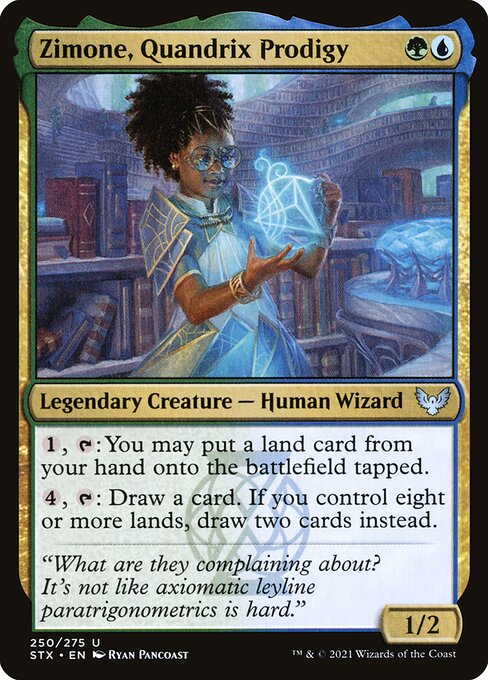
Zimone, Quandrix Prodigy | Illustration by Ryan Pancoast
Zimone offers the same basic bargain at half the activation cost: tap her to put a land from your hand onto the battlefield tapped. Once you control eight lands, the ability draws a card as well. She arrives early, turns bounce lands into real acceleration, and quietly puts you ahead while louder commanders absorb removal.
Her ceiling is lower than Aesi's because she only activates once per untap and does nothing when other effects put lands into play. Untapping her is therefore the entire game. Retreat to Coralhelm, Kelpie Guide, Kiora's Follower, and Thousand-Year Elixir turn one activation into several. The cheap mana value also makes commander tax less painful than it is for the top end of this list.
Best for: Players who enjoy tap-untap engines and incremental advantage. She is less satisfying if you want the commander itself to be the landfall payoff.
#13. Nicanzil, Current Conductor
Nicanzil, Current Conductor | Illustration by Fariba Khamseh
Nicanzil makes explore decks function like landfall decks. Whenever one of your creatures explores a land card, you may put a land from your hand onto the battlefield tapped. Explore a nonland instead and Nicanzil gets a +1/+1 counter. Either result advances the board, which is why this two-mana commander plays better than its modest stats suggest.
The catch is structural: Nicanzil does nothing without a steady supply of explore triggers. Hakbal of the Surging Soul is absurd here, Path of Discovery makes every creature participate, and Topography Tracker lets your explorers dig twice. Cenote Scout and Jadelight Spelunker provide cheaper setup. This is not generic Simic landfall; it is an explore deck with lands as the reward.
High-synergy cards: Hakbal of the Surging Soul, Path of Discovery, Topography Tracker, Jadelight Spelunker, Twists and Turns.
Best for: Players who want creature-heavy land ramp and a commander that costs only two mana. Avoid it if your preferred landfall list is mostly ramp sorceries and payoff enchantments.
#12. Thrasios, Triton Hero
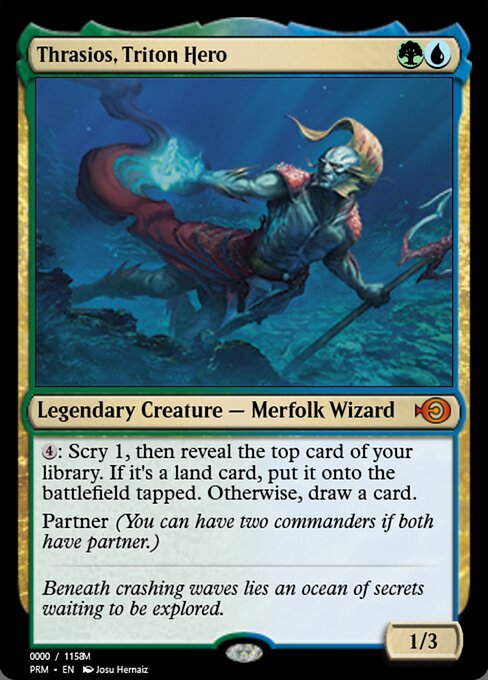
Thrasios, Triton Hero | Illustration by Josu Hernaiz
Thrasios turns excess mana into selection, cards, and occasional ramp. For four mana you scry 1, reveal the top card, and put it onto the battlefield tapped if it is a land; otherwise, you draw it. The ability works at instant speed and has no tap symbol, so infinite or merely excessive mana converts directly into your deck.
That flexibility comes with baggage. Thrasios has partner, and pairing him with another commander can change the deck's color identity entirely. If you keep the deck genuinely Simic, Kydele, Chosen of Kruphix is the natural partner. Training Grounds, Biomancer's Familiar, and Seedborn Muse make the activation far more threatening. Thrasios is powerful, but he is more of a mana outlet that finds lands than a commander that rewards landfall.
High-synergy cards: Training Grounds, Biomancer's Familiar, Seedborn Muse, Wilderness Reclamation, Kydele, Chosen of Kruphix.
Best for: Combo-minded players and anyone who wants to keep mana open. He is a poor choice if you want visible landfall payoffs in the command zone.
#11. Uro, Titan of Nature's Wrath
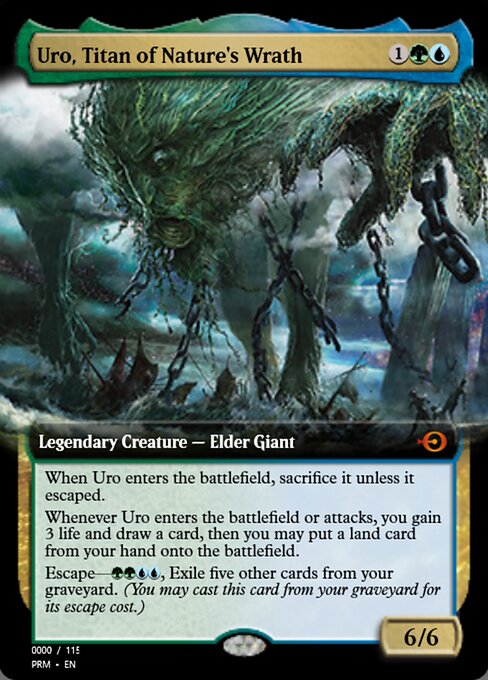
Uro, Titan of Nature's Wrath | Illustration by Vincent Proce
Uro draws a card, gains 3 life, and lets you put a land from your hand onto the battlefield whenever it enters or attacks. Unless it escaped, it also sacrifices itself. That last line looks like a drawback, but it gives graveyard decks a repeatable value spell and eventually a 6/6 attacker.
Building around Uro means accepting that your commander does not stay on the battlefield after a normal cast. Self-mill, land recursion, and effects that care about creatures leaving the battlefield help turn that awkwardness into an engine. Life from the Loam supplies lands and escape fuel, while Altar of Dementia and Greater Good can stock the graveyard after Uro returns. Ramunap Excavator keeps milled utility lands from becoming collateral damage.
High-synergy cards: Life from the Loam, Ramunap Excavator, Greater Good, Altar of Dementia, Ancient Greenwarden.
Best for: Graveyard players who prefer repeated bursts of value to a permanent landfall engine. Graveyard hate and commander tax make Uro substantially clumsier than the commanders above it.
#10. Tatyova, Steward of Tides
Tatyova, Steward of Tides | Illustration by Howard Lyon
This Tatyova trades card draw for an air force. Your land creatures have flying, and once you control seven lands, each new land can turn a land you control into a 3/3 Elemental with haste. The land remains a land, so every ramp spell can add both mana and an evasive attacker.
Turning lands into creatures is also dangerous. A routine Wrath of God can become mass land destruction if you animate too many at once. Heroic Intervention and Tamiyo's Safekeeping are not optional niceties here; they are insurance. Awaken the Woods supplies disposable Forest Dryad land tokens, while Jyoti, Moag Ancient and Jolrael, Voice of Zhalfir add more ways to weaponize the mana base.
High-synergy cards: Awaken the Woods, Jyoti, Moag Ancient, Jolrael, Voice of Zhalfir, Heroic Intervention, Embodiment of Insight.
Best for: Combat players who want landfall to end games instead of generating another stack of cards. Do not overanimate real lands into open mana.
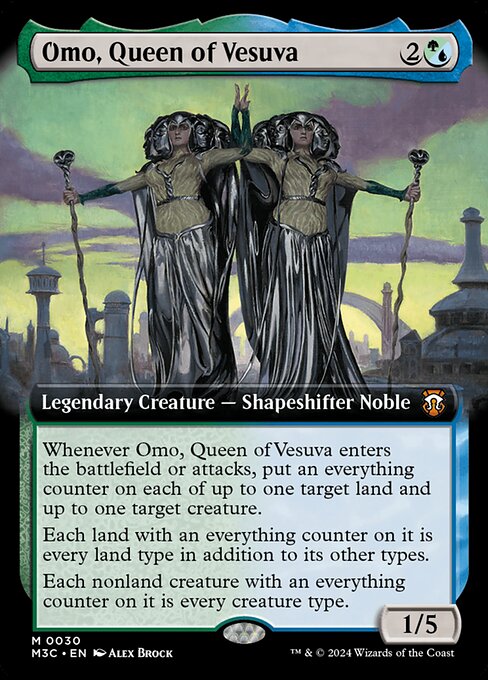
#9. Omo, Queen of Vesuva
Omo, Queen of Vesuva | Illustration by Alex Brock
Omo is the weird-land specialist. When she enters or attacks, she places an everything counter on a land and another on a creature. Lands with those counters gain every land type, which means one carefully marked land can count as an Urza's Mine, Urza's Tower, Urza's Power-Plant, Locus, Gate, Desert, Cave, and far more.
This deck is less about triggering landfall ten times and more about making specific lands misbehave. Cloudpost and Glimmerpost scale with the number of Loci, Maze's End can count everything-counter lands as Gates, and the Urza lands suddenly become much easier to assemble. Copy Land, Vesuva, and Thespian's Stage give the deck redundancy. Omo herself must keep attacking to spread counters, so protection matters.
Best for: Players who love utility lands, type-changing rules, and puzzle-box mana bases. Omo is not the pick for a straightforward Rampaging Baloths deck.
#8. Jolrael, Voice of Zhalfir
Jolrael, Voice of Zhalfir | Illustration by Scott M. Fischer
At the beginning of combat on your turn, Jolrael turns one land into a flying, hasty Bird with power and toughness equal to the number of cards in your hand. Whenever one of your land creatures hits a player, you draw a card. The result is a tidy loop: keep a large hand, make a large Bird, connect, and keep the hand full.
Jolrael needs both cards and combat access. Reliquary Tower and Thought Vessel preserve the hand, while Tatyova, Steward of Tides gives every land creature flying. Jyoti, Moag Ancient turns the rest of the mana base into attackers, and Rogue's Passage helps the animated land get through when the sky is crowded. Removal aimed at the creature can still destroy the land, so protection is essential.
High-synergy cards: Tatyova, Steward of Tides, Jyoti, Moag Ancient, Awaken the Woods, Heroic Intervention, Reliquary Tower.
Best for: Players who want one enormous flying land rather than dozens of landfall tokens. The strategy is vulnerable to instant-speed removal and board wipes.
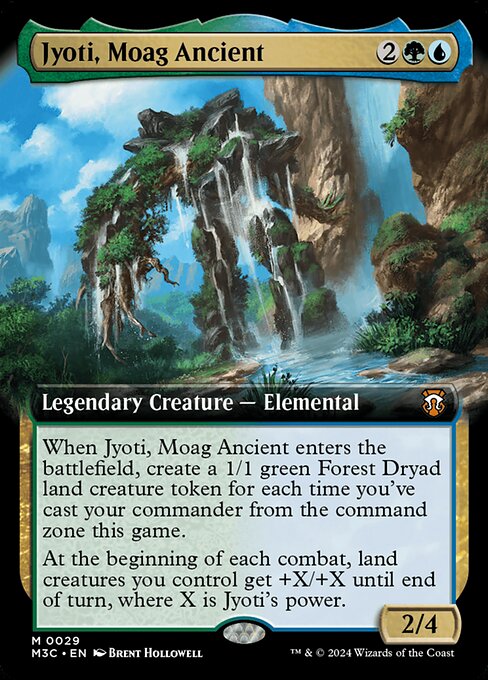
#7. Jyoti, Moag Ancient
Jyoti, Moag Ancient | Illustration by Brent Hollowell
Jyoti arrives with a 1/1 Forest Dryad land creature token for each time you have cast your commander from the command zone that game. Then, at the beginning of every combat—not only yours—your land creatures get +X/+X until end of turn, where X is Jyoti's power. Commander tax becomes part of the scaling plan instead of pure punishment.
The unusual “each combat” wording makes instant-speed land animation especially nasty. Turn a land into a creature before an opponent's combat and it receives the same boost. Blackblade Reforged makes Jyoti huge, while Awaken the Woods, Tatyova, Steward of Tides, and Embodiment of Insight expand the land-creature army. The drawback is obvious: sweepers can erase both your creatures and your mana.
High-synergy cards: Awaken the Woods, Blackblade Reforged, Tatyova, Steward of Tides, Embodiment of Insight, Heroic Intervention.
Best for: Go-wide combat players who do not mind putting their mana base in danger. Jyoti is explosive, but it demands disciplined protection.
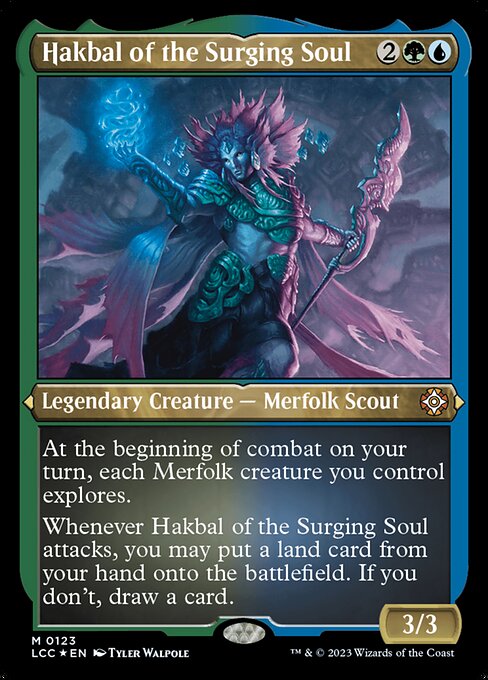
#6. Hakbal of the Surging Soul
Hakbal of the Surging Soul | Illustration by Tyler Walpole
Hakbal gives every Merfolk you control an explore trigger at the beginning of combat. Lands revealed this way go to your hand; nonlands return to the library or graveyard while the explorer receives a +1/+1 counter. When Hakbal attacks, you may put a land from your hand onto the battlefield or draw a card.
That makes Hakbal both a tribal commander and a land engine. Nicanzil, Current Conductor converts explored lands into extra land drops. Deeproot Pilgrimage turns tapping Merfolk into more bodies, and Herald of Secret Streams makes the accumulated counters difficult to block. The limitation is equally clear: a creature-light landfall pile wastes Hakbal's best ability.
High-synergy cards: Nicanzil, Current Conductor, Deeproot Pilgrimage, Path of Discovery, Topography Tracker, Herald of Secret Streams.
Best for: Merfolk players who want land advantage without abandoning tribal combat. Choose a more traditional commander if your deck begins with 40 lands and twenty ramp spells.
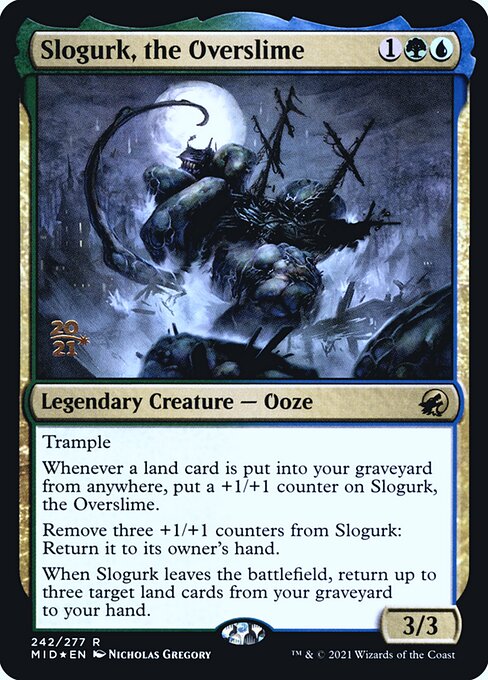
#5. Slogurk, the Overslime
Slogurk, the Overslime | Illustration by Nicholas Gregory
Slogurk gets a +1/+1 counter whenever a land card goes to your graveyard from anywhere. Remove three counters and it returns to your hand. When it leaves the battlefield, you may return up to three target land cards from your graveyard to your hand. Fetch lands, cycling lands, discard outlets, and sacrifice effects all become fuel.
This is the most technical commander in the top five. Zuran Orb can sacrifice lands at will, Life from the Loam keeps the graveyard loop moving, and Trade Routes both discards lands and returns lands you control. Lonely Sandbar and Tranquil Thicket cycle when you need action and come back later. Slogurk can grind forever, but it needs a payoff beyond merely replaying the same lands.
High-synergy cards: Zuran Orb, Life from the Loam, Trade Routes, Walk the Aeons, Ramunap Excavator.
Best for: Players who enjoy graveyard loops, land sacrifice, and intricate resource engines. It is less beginner-friendly than Aesi or Tatyova.
#4. Bonny Pall, Clearcutter
Bonny Pall, Clearcutter | Illustration by Bryan Sola
Bonny Pall brings Beau, a legendary Ox whose power and toughness equal the number of lands you control. Whenever Bonny attacks, you draw a card and may put a land from your hand or graveyard onto the battlefield. One card gives you a giant blocker, repeatable card advantage, and land recursion.
Six mana is the real tax. If Bonny dies before attacking, you paid a full turn for Beau and little else. Haste from Lightning Greaves helps, while Roaming Throne naming Giant can double the attack trigger. Life from the Loam keeps lands available, and Field of the Dead rewards every recursive land drop with another body. Bonny is slower than the top three but much better at ending games through combat.
High-synergy cards: Roaming Throne, Life from the Loam, Field of the Dead, Lightning Greaves, Ancient Greenwarden.
Best for: Players who want land recursion attached to big, honest creatures. Protect Bonny or be prepared to pay eight mana for the second attempt.
#3. Zimone, Mystery Unraveler
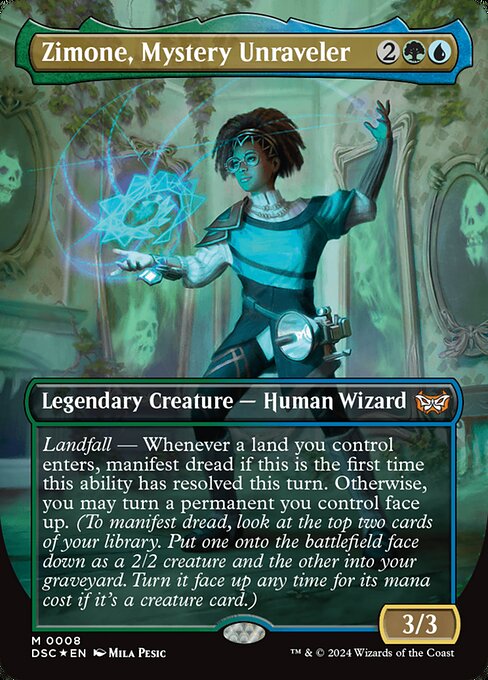
Zimone, Mystery Unraveler | Illustration by Mila Pesic
Zimone's first landfall resolution each turn manifests dread. Later resolutions that turn can turn a permanent you control face up. Fetch lands and instant-speed ramp let you repeat that pattern on opposing turns, building a board of face-down permanents and then flipping expensive creatures without paying their mana costs.
This is the Simic landfall commander for players bored with drawing cards. Hedge Shredder turns lands milled by manifest dread into additional ramp. Hauntwoods Shrieker can reveal or turn creatures face up, while Yedora, Grave Gardener gives nontoken creatures another life as face-down Forests. The deck can whiff by manifesting instants and sorceries, so the permanent count needs to be unusually high.
Best for: Players who enjoy hidden information, face-down creatures, and cheating enormous permanents into play. It requires more deliberate deck construction than Aesi or Tatyova.
#2. Tatyova, Benthic Druid
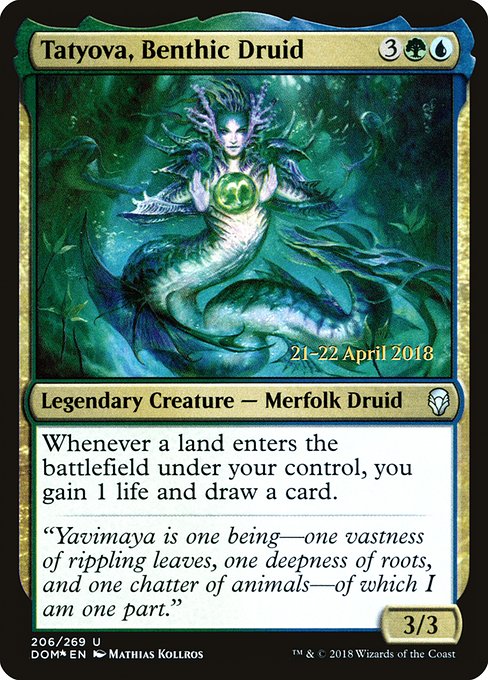
Tatyova, Benthic Druid | Illustration by Mathias Kollros
Tatyova draws a card and gains 1 life whenever a land enters under your control. That is the entire pitch, and it remains excellent. Rampant Growth replaces itself. A fetch land draws twice. A bounce land guarantees another trigger next turn. The life gain looks incidental until repeated land loops put you comfortably out of reach of chip damage.
Unlike Aesi, Tatyova does not grant an additional land play. You must supply Exploration, Azusa, Lost but Seeking, Sakura-Tribe Scout, or similar effects yourself. Retreat to Coralhelm plus a creature that puts lands into play can create long loops with Simic Growth Chamber. The commander costs five, which makes recovering from removal easier than it is for Aesi.
Best for: Players who want the cleanest card-draw engine at a manageable mana value. Tatyova can become repetitive, so include concrete finishers rather than drawing cards for the sake of drawing cards.
#1. Aesi, Tyrant of Gyre Strait
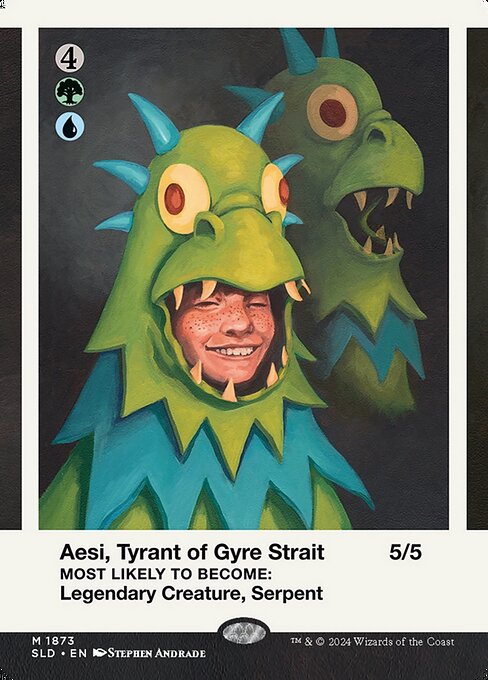
Aesi, Tyrant of Gyre Strait | Illustration by Stephen Andrade Scott Okumura
Aesi is Tatyova with an Exploration stapled on. You may play an additional land on each of your turns, and every land entering under your control draws a card. The two abilities feed one another: the first extra land replaces itself, the new card may be another land, and suddenly a “fair” ramp turn has put half a dozen permanents onto the battlefield.
That efficiency is why Aesi ranks first—and why the table will treat it like the threat it is. Six mana means removal hurts, while cards such as Narset, Parter of Veils and Orcish Bowmasters can punish the draw engine. Run protection, but also run ways to win. Scute Swarm, Avenger of Zendikar, Rampaging Baloths, and Retreat to Coralhelm ensure the deck eventually converts velocity into a result.
High-synergy cards: Azusa, Lost but Seeking, Ancient Greenwarden, Scute Swarm, Lotus Cobra, Rampaging Baloths.
Best for: Anyone who wants the strongest all-purpose Simic landfall commander. Pick something lower on the list if your group is tired of value engines or if you want your commander to create a more unusual game.
Which Simic Landfall Commander Should You Choose?
Choose Aesi for maximum raw power, Tatyova, Benthic Druid for a cheaper version of the same engine, or Zimone, Mystery Unraveler when you want landfall to cheat permanents into play. Bonny Pall is the best combat-oriented traditional lands commander, while Slogurk is the graveyard specialist.
For creature decks, Hakbal and Nicanzil make explore matter. For animated-land combat, use Jyoti, Jolrael, or Tatyova, Steward of Tides. Pick Omo if the sentence “all land types at once” sounds like an invitation rather than a rules headache.
No matter which commander you choose, avoid the classic Simic trap: generating an impressive amount of mana and cardboard without including a way to close the game. A landfall deck still needs finishers, interaction, and protection—not just 37 lands and optimism.
Frequently Asked Questions
What Is the Best Simic Landfall Commander?
Aesi, Tyrant of Gyre Strait is the best overall Simic landfall commander. It enables an extra land play and draws a card whenever a land enters under your control, combining setup and payoff in one card.
Is Aesi Better Than Tatyova?
Aesi has the stronger rules text because it provides an additional land play, but Tatyova costs one less mana and gains life. Tatyova is easier to recast; Aesi is more explosive when it survives.
How Many Lands Should a Simic Landfall Deck Play?
Most Simic landfall decks should begin around 38 to 42 lands. Commanders that repeatedly put lands into play or need lands in hand often prefer the high end. Adjust downward only when your curve, cheap ramp, and playtesting support it.
Do Fetch Lands Trigger Landfall Twice?
Yes. Playing a fetch land causes one land to enter. Sacrificing it to find another land causes a second land to enter. The sacrifice also supports graveyard commanders such as Slogurk, the Overslime.
Are Land Creatures Still Lands?
Usually, yes. Effects from Tatyova, Steward of Tides and Jolrael, Voice of Zhalfir explicitly say the animated permanent is still a land. That means creature removal and creature board wipes can destroy it, which is the central risk of land-animation strategies.
Can Uro Be Your Commander?
Yes. Uro, Titan of Nature's Wrath is a legendary creature with a green-blue color identity and is Commander-legal as of October 26, 2026. Its sacrifice and escape text make it play differently from a normal permanent commander.
Final Verdict
Simic landfall is not one deck. Aesi and Tatyova turn lands into cards, Zimone turns them into face-up surprises, Slogurk turns the graveyard into a second hand, and Jyoti turns the mana base sideways. That range is the color pair's real strength.
If you want the safest recommendation, build Aesi. If you want the most memorable games, start with Zimone, Slogurk, Omo, or Jyoti and let the lands do something your table did not expect.
Aesi, Tyrant of Gyre Strait is the best Simic landfall commander for most players. It gives you the two things every lands deck wants—an extra land drop and a card for every land that enters—without demanding a narrow build. Tatyova, Benthic Druid is the leaner alternative, while Zimone, Mystery Unraveler is the pick if you want your landfall deck to do something stranger than draw half its library.
Green-blue commanders have no shortage of ways to turn lands into cards, creatures, counters, or absurd amounts of mana. The trick is choosing an engine that produces the kind of game you actually want to play. Some of these commanders reward clean, traditional landfall. Others animate lands, exploit the graveyard, or use explore to smuggle extra lands onto the battlefield.
This ranking covers commanders with an exactly green-blue color identity. It favors leaders that actively enable land drops or convert them into a meaningful payoff—not merely Simic commanders that can survive inside a lands deck.
Aesi, Tyrant of Gyre Strait | Illustration by Stephen Andrade Scott Okumura
How We Ranked the Best Simic Landfall Commanders
The ranking weighs five things: engine strength, speed, resilience, deckbuilding flexibility, and the quality of the payoff. A commander that draws cards and enables extra land drops ranks above one that needs three other cards before the land engine starts working. Mana value matters, too. Six-mana commanders can be spectacular, but they need to justify the risk of paying eight after one removal spell.
We also considered how distinctly each commander plays. Aesi and Tatyova are brutally efficient, but not everyone wants another value pile. Zimone, Mystery Unraveler, Slogurk, the Overslime, and Jyoti, Moag Ancient earn their places by pushing lands into very different jobs.
Every card name and Commander color identity was checked against Scryfall on October 26, 2026. Synergy recommendations were cross-checked against current EDHREC commander data and then evaluated for how directly they support each commander's actual rules text.
Gretchen Titchwillow | Illustration by Justine Mara Andersen
Gretchen is the plain bowl of oatmeal on this list, and I mean that affectionately. Four mana draws a card and lets you put a land from your hand onto the battlefield. There is no timing restriction, no once-per-turn clause, and no need to attack. If you hold up interaction and nobody gives you a reason to cast it, Gretchen converts that unused mana into a card and another land.
The problem is efficiency. Paying four repeatedly is slow, and Gretchen does not reward the land after it arrives. Seedborn Muse and Wilderness Reclamation fix the first issue, while Lotus Cobra and Tireless Provisioner help turn each activation into more resources. Simic Growth Chamber is especially useful because it keeps a land in hand for the next activation.
Best for: Draw-go players who want a low-profile commander and a dependable mana sink. Skip Gretchen if you want explosive landfall turns without first assembling an untap engine.
Zimone, Quandrix Prodigy | Illustration by Ryan Pancoast
Zimone offers the same basic bargain at half the activation cost: tap her to put a land from your hand onto the battlefield tapped. Once you control eight lands, the ability draws a card as well. She arrives early, turns bounce lands into real acceleration, and quietly puts you ahead while louder commanders absorb removal.
Her ceiling is lower than Aesi's because she only activates once per untap and does nothing when other effects put lands into play. Untapping her is therefore the entire game. Retreat to Coralhelm, Kelpie Guide, Kiora's Follower, and Thousand-Year Elixir turn one activation into several. The cheap mana value also makes commander tax less painful than it is for the top end of this list.
Best for: Players who enjoy tap-untap engines and incremental advantage. She is less satisfying if you want the commander itself to be the landfall payoff.
Nicanzil, Current Conductor | Illustration by Fariba Khamseh
Nicanzil makes explore decks function like landfall decks. Whenever one of your creatures explores a land card, you may put a land from your hand onto the battlefield tapped. Explore a nonland instead and Nicanzil gets a +1/+1 counter. Either result advances the board, which is why this two-mana commander plays better than its modest stats suggest.
The catch is structural: Nicanzil does nothing without a steady supply of explore triggers. Hakbal of the Surging Soul is absurd here, Path of Discovery makes every creature participate, and Topography Tracker lets your explorers dig twice. Cenote Scout and Jadelight Spelunker provide cheaper setup. This is not generic Simic landfall; it is an explore deck with lands as the reward.
Best for: Players who want creature-heavy land ramp and a commander that costs only two mana. Avoid it if your preferred landfall list is mostly ramp sorceries and payoff enchantments.
Thrasios, Triton Hero | Illustration by Josu Hernaiz
Thrasios turns excess mana into selection, cards, and occasional ramp. For four mana you scry 1, reveal the top card, and put it onto the battlefield tapped if it is a land; otherwise, you draw it. The ability works at instant speed and has no tap symbol, so infinite or merely excessive mana converts directly into your deck.
That flexibility comes with baggage. Thrasios has partner, and pairing him with another commander can change the deck's color identity entirely. If you keep the deck genuinely Simic, Kydele, Chosen of Kruphix is the natural partner. Training Grounds, Biomancer's Familiar, and Seedborn Muse make the activation far more threatening. Thrasios is powerful, but he is more of a mana outlet that finds lands than a commander that rewards landfall.
Uro, Titan of Nature's Wrath | Illustration by Vincent Proce
Uro draws a card, gains 3 life, and lets you put a land from your hand onto the battlefield whenever it enters or attacks. Unless it escaped, it also sacrifices itself. That last line looks like a drawback, but it gives graveyard decks a repeatable value spell and eventually a 6/6 attacker.
Building around Uro means accepting that your commander does not stay on the battlefield after a normal cast. Self-mill, land recursion, and effects that care about creatures leaving the battlefield help turn that awkwardness into an engine. Life from the Loam supplies lands and escape fuel, while Altar of Dementia and Greater Good can stock the graveyard after Uro returns. Ramunap Excavator keeps milled utility lands from becoming collateral damage.
Best for: Graveyard players who prefer repeated bursts of value to a permanent landfall engine. Graveyard hate and commander tax make Uro substantially clumsier than the commanders above it.
Tatyova, Steward of Tides | Illustration by Howard Lyon
This Tatyova trades card draw for an air force. Your land creatures have flying, and once you control seven lands, each new land can turn a land you control into a 3/3 Elemental with haste. The land remains a land, so every ramp spell can add both mana and an evasive attacker.
Omo is the weird-land specialist. When she enters or attacks, she places an everything counter on a land and another on a creature. Lands with those counters gain every land type, which means one carefully marked land can count as an Urza's Mine, Urza's Tower, Urza's Power-Plant, Locus, Gate, Desert, Cave, and far more.
This deck is less about triggering landfall ten times and more about making specific lands misbehave. Cloudpost and Glimmerpost scale with the number of Loci, Maze's End can count everything-counter lands as Gates, and the Urza lands suddenly become much easier to assemble. Copy Land, Vesuva, and Thespian's Stage give the deck redundancy. Omo herself must keep attacking to spread counters, so protection matters.
Best for: Players who love utility lands, type-changing rules, and puzzle-box mana bases. Omo is not the pick for a straightforward Rampaging Baloths deck.
Jolrael, Voice of Zhalfir | Illustration by Scott M. Fischer
At the beginning of combat on your turn, Jolrael turns one land into a flying, hasty Bird with power and toughness equal to the number of cards in your hand. Whenever one of your land creatures hits a player, you draw a card. The result is a tidy loop: keep a large hand, make a large Bird, connect, and keep the hand full.
Jolrael needs both cards and combat access. Reliquary Tower and Thought Vessel preserve the hand, while Tatyova, Steward of Tides gives every land creature flying. Jyoti, Moag Ancient turns the rest of the mana base into attackers, and Rogue's Passage helps the animated land get through when the sky is crowded. Removal aimed at the creature can still destroy the land, so protection is essential.
Best for: Players who want one enormous flying land rather than dozens of landfall tokens. The strategy is vulnerable to instant-speed removal and board wipes.
Jyoti, Moag Ancient | Illustration by Brent Hollowell
Jyoti arrives with a 1/1 Forest Dryad land creature token for each time you have cast your commander from the command zone that game. Then, at the beginning of every combat—not only yours—your land creatures get +X/+X until end of turn, where X is Jyoti's power. Commander tax becomes part of the scaling plan instead of pure punishment.
The unusual “each combat” wording makes instant-speed land animation especially nasty. Turn a land into a creature before an opponent's combat and it receives the same boost. Blackblade Reforged makes Jyoti huge, while Awaken the Woods, Tatyova, Steward of Tides, and Embodiment of Insight expand the land-creature army. The drawback is obvious: sweepers can erase both your creatures and your mana.
Hakbal of the Surging Soul | Illustration by Tyler Walpole
Hakbal gives every Merfolk you control an explore trigger at the beginning of combat. Lands revealed this way go to your hand; nonlands return to the library or graveyard while the explorer receives a +1/+1 counter. When Hakbal attacks, you may put a land from your hand onto the battlefield or draw a card.
That makes Hakbal both a tribal commander and a land engine. Nicanzil, Current Conductor converts explored lands into extra land drops. Deeproot Pilgrimage turns tapping Merfolk into more bodies, and Herald of Secret Streams makes the accumulated counters difficult to block. The limitation is equally clear: a creature-light landfall pile wastes Hakbal's best ability.
Best for: Merfolk players who want land advantage without abandoning tribal combat. Choose a more traditional commander if your deck begins with 40 lands and twenty ramp spells.
Slogurk, the Overslime | Illustration by Nicholas Gregory
Slogurk gets a +1/+1 counter whenever a land card goes to your graveyard from anywhere. Remove three counters and it returns to your hand. When it leaves the battlefield, you may return up to three target land cards from your graveyard to your hand. Fetch lands, cycling lands, discard outlets, and sacrifice effects all become fuel.
This is the most technical commander in the top five. Zuran Orb can sacrifice lands at will, Life from the Loam keeps the graveyard loop moving, and Trade Routes both discards lands and returns lands you control. Lonely Sandbar and Tranquil Thicket cycle when you need action and come back later. Slogurk can grind forever, but it needs a payoff beyond merely replaying the same lands.
Bonny Pall, Clearcutter | Illustration by Bryan Sola
Bonny Pall brings Beau, a legendary Ox whose power and toughness equal the number of lands you control. Whenever Bonny attacks, you draw a card and may put a land from your hand or graveyard onto the battlefield. One card gives you a giant blocker, repeatable card advantage, and land recursion.
Six mana is the real tax. If Bonny dies before attacking, you paid a full turn for Beau and little else. Haste from Lightning Greaves helps, while Roaming Throne naming Giant can double the attack trigger. Life from the Loam keeps lands available, and Field of the Dead rewards every recursive land drop with another body. Bonny is slower than the top three but much better at ending games through combat.
Zimone, Mystery Unraveler | Illustration by Mila Pesic
Zimone's first landfall resolution each turn manifests dread. Later resolutions that turn can turn a permanent you control face up. Fetch lands and instant-speed ramp let you repeat that pattern on opposing turns, building a board of face-down permanents and then flipping expensive creatures without paying their mana costs.
This is the Simic landfall commander for players bored with drawing cards. Hedge Shredder turns lands milled by manifest dread into additional ramp. Hauntwoods Shrieker can reveal or turn creatures face up, while Yedora, Grave Gardener gives nontoken creatures another life as face-down Forests. The deck can whiff by manifesting instants and sorceries, so the permanent count needs to be unusually high.
Best for: Players who enjoy hidden information, face-down creatures, and cheating enormous permanents into play. It requires more deliberate deck construction than Aesi or Tatyova.
Tatyova, Benthic Druid | Illustration by Mathias Kollros
Tatyova draws a card and gains 1 life whenever a land enters under your control. That is the entire pitch, and it remains excellent. Rampant Growth replaces itself. A fetch land draws twice. A bounce land guarantees another trigger next turn. The life gain looks incidental until repeated land loops put you comfortably out of reach of chip damage.
Unlike Aesi, Tatyova does not grant an additional land play. You must supply Exploration, Azusa, Lost but Seeking, Sakura-Tribe Scout, or similar effects yourself. Retreat to Coralhelm plus a creature that puts lands into play can create long loops with Simic Growth Chamber. The commander costs five, which makes recovering from removal easier than it is for Aesi.
Best for: Players who want the cleanest card-draw engine at a manageable mana value. Tatyova can become repetitive, so include concrete finishers rather than drawing cards for the sake of drawing cards.
Aesi, Tyrant of Gyre Strait | Illustration by Stephen Andrade Scott Okumura
Aesi is Tatyova with an Exploration stapled on. You may play an additional land on each of your turns, and every land entering under your control draws a card. The two abilities feed one another: the first extra land replaces itself, the new card may be another land, and suddenly a “fair” ramp turn has put half a dozen permanents onto the battlefield.
Best for: Anyone who wants the strongest all-purpose Simic landfall commander. Pick something lower on the list if your group is tired of value engines or if you want your commander to create a more unusual game.
Which Simic Landfall Commander Should You Choose?
Choose Aesi for maximum raw power, Tatyova, Benthic Druid for a cheaper version of the same engine, or Zimone, Mystery Unraveler when you want landfall to cheat permanents into play. Bonny Pall is the best combat-oriented traditional lands commander, while Slogurk is the graveyard specialist.
For creature decks, Hakbal and Nicanzil make explore matter. For animated-land combat, use Jyoti, Jolrael, or Tatyova, Steward of Tides. Pick Omo if the sentence “all land types at once” sounds like an invitation rather than a rules headache.
No matter which commander you choose, avoid the classic Simic trap: generating an impressive amount of mana and cardboard without including a way to close the game. A landfall deck still needs finishers, interaction, and protection—not just 37 lands and optimism.
Frequently Asked Questions
What Is the Best Simic Landfall Commander?
Aesi, Tyrant of Gyre Strait is the best overall Simic landfall commander. It enables an extra land play and draws a card whenever a land enters under your control, combining setup and payoff in one card.
Is Aesi Better Than Tatyova?
Aesi has the stronger rules text because it provides an additional land play, but Tatyova costs one less mana and gains life. Tatyova is easier to recast; Aesi is more explosive when it survives.
How Many Lands Should a Simic Landfall Deck Play?
Most Simic landfall decks should begin around 38 to 42 lands. Commanders that repeatedly put lands into play or need lands in hand often prefer the high end. Adjust downward only when your curve, cheap ramp, and playtesting support it.
Do Fetch Lands Trigger Landfall Twice?
Yes. Playing a fetch land causes one land to enter. Sacrificing it to find another land causes a second land to enter. The sacrifice also supports graveyard commanders such as Slogurk, the Overslime.
Are Land Creatures Still Lands?
Usually, yes. Effects from Tatyova, Steward of Tides and Jolrael, Voice of Zhalfir explicitly say the animated permanent is still a land. That means creature removal and creature board wipes can destroy it, which is the central risk of land-animation strategies.
Can Uro Be Your Commander?
Yes. Uro, Titan of Nature's Wrath is a legendary creature with a green-blue color identity and is Commander-legal as of October 26, 2026. Its sacrifice and escape text make it play differently from a normal permanent commander.
Final Verdict
Simic landfall is not one deck. Aesi and Tatyova turn lands into cards, Zimone turns them into face-up surprises, Slogurk turns the graveyard into a second hand, and Jyoti turns the mana base sideways. That range is the color pair's real strength.
If you want the safest recommendation, build Aesi. If you want the most memorable games, start with Zimone, Slogurk, Omo, or Jyoti and let the lands do something your table did not expect.