15 Best +1/+1 Counter Commanders: Build an Engine, Not Just a Big Creature
By ElderArticles · Updated 11/23/2026 · 19 min read
Find the 15 best +1/+1 counter commanders in MTG, with key synergies, damage and mana engines, ways through blockers, and advice for rebuilding after removal.
Table of contents
The best +1/+1 counter commanders turn a growing board into something useful: cheaper spells, extra cards, more mana, or a way to finish the game. A creature with twenty counters still needs help if a single blocker can stop it.
Shalai and Hallar is our overall pick for turning counters into a win condition. Hakbal of the Surging Soul offers a strong Merfolk engine, while Hamza, Guardian of Arashin is our first recommendation for a straightforward green-white counters deck.
Below are 15 commanders ranked for multiplayer Commander, with four synergy cards for each, a clear game plan, and a weakness to build around. The order reflects our editorial assessment of consistency, resources, and finishing power. It is not a tournament tier list, and the strongest choice for your table will depend on the deck around it.
Reviewed November 22, 2026. The featured commanders and support cards were checked for Commander legality and compatibility with their commander's color identity.
What makes a good +1/+1 counter commander?
Counter decks have three jobs to cover. They need cards that place the first counters, effects that reward or increase those counters, and a way to turn the resulting advantage into a win.
Hakbal helps supply the first counters. Vorinclex increases what other cards produce. Hamza converts a board of creatures with counters into cheaper creature spells. These abilities need different support, even when their decks share many cards.
Before adding another multiplier, ask what happens if you draw it onto an empty battlefield. Reliable creatures, card draw, interaction, and recovery spells are what let the spectacular turns happen more than once.
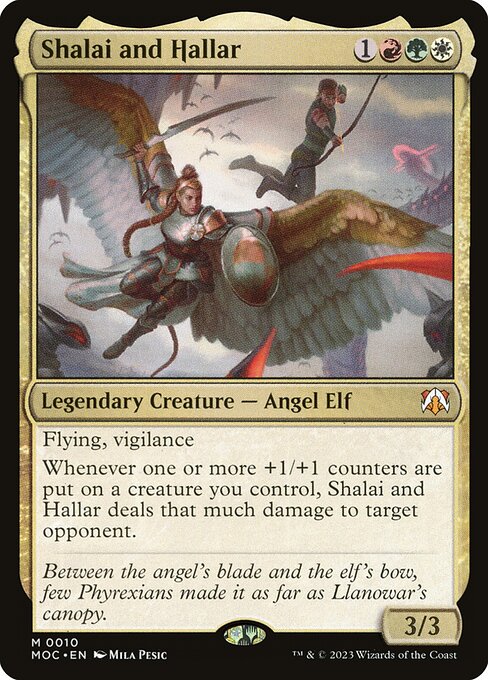
1. Shalai and Hallar
Shalai and Hallar | Illustration by Mila Pesic
Colors: red-green-white. Best for: counters that deal direct damage.
Shalai and Hallar deals damage to a target opponent whenever you put one or more +1/+1 counters on a creature you control. The damage equals the number placed in that event. Adding three counters to one creature produces a three-damage trigger; adding one to each of three creatures produces three separate one-damage triggers.
That gives ordinary counter development a finishing role. You can attack with larger creatures while dealing damage that ignores blockers, which is why this commander leads our list.
Efficient support:Hardened Scales adds an extra counter to each applicable placement event.
Creature-based support:Conclave Mentor provides a similar increase on a body that can receive counters itself.
Repeatable production:Forgotten Ancient grows as players cast spells and can distribute its counters during your upkeep.
Interaction plus growth:Scavenging Ooze attacks graveyards, gaining a counter and life whenever its ability exiles a creature card.
Build around this weakness: Shalai and Hallar supplies the damage payoff, not the initial counters. Keep enough independent counter producers, and remember that this triggered damage is not combat damage and does not count toward the 21-damage commander rule.
2. Hakbal of the Surging Soul
Hakbal of the Surging Soul | Illustration by Tyler Walpole
Colors: green-blue. Best for: a Merfolk army with built-in resources.
At the beginning of combat on your turn, every Merfolk you control explores. Revealed lands go to your hand; nonlands give the exploring creature a +1/+1 counter and can remain on top or go to the graveyard. Hakbal does not need to attack for this ability to work.
Its separate attack trigger can put a land from your hand onto the battlefield, or draw a card if you do not. Together, these abilities help a creature-heavy deck develop its board and keep finding resources.
Additional counters:Deeproot Elite rewards each other Merfolk entering under your control.
Team boost:Merfolk Mistbinder strengthens your other Merfolk. Its +1/+1 bonus is an anthem effect, not a counter.
Finishing tool:Herald of Secret Streams makes creatures with +1/+1 counters unable to be blocked.
Protection:Ripples of Potential proliferates, then can phase out your permanents that received counters that way.
Build around this weakness: Hakbal rewards Merfolk density. A deck packed with generic counter enhancers can leave too few creatures to explore. Also, exploring does not guarantee a counter when you reveal a land.
3. Animar, Soul of Elements
Animar, Soul of Elements | Illustration by Filip Burburan
Colors: green-blue-red. Best for: creature chains and optional combo finishes.
Animar receives a +1/+1 counter whenever you cast a creature spell, then reduces the generic portion of future creature spells by its counter total. Your board development makes the next creature easier to cast.
This is an engine centered on counters on one creature, rather than distributing them across an army. Protection from white and black helps against some interaction, but does not make Animar safe from every sweeper or removal spell.
Cast-trigger draw:Beast Whisperer helps keep creature chains supplied with cards.
Optional combo piece:Ancestral Statue can return itself. With at least four counters on Animar and no additional costs, you can repeatedly cast it for zero mana to add more counters to Animar.
Damage payoff:Walking Ballista turns counters into damage. Animar's reduction can help pay its double-X cost, but you still choose and pay for the total cost normally.
Entry-trigger draw:Guardian Project rewards nontoken creatures entering when its name conditions are met.
Build around this weakness: Removing Animar removes the accumulated discount. Colored mana costs still need paying. A repeatable Statue line also needs a finish, and mandatory draw triggers limit how often you can repeat it safely.
4. Hamza, Guardian of Arashin
Hamza, Guardian of Arashin | Illustration by Wisnu Tan
Colors: green-white. Best for: learning counters through a creature-heavy deck.
Hamza costs one generic mana less for each creature you control with a +1/+1 counter. Once on the battlefield, it gives your creature spells the same reduction.
The key is the number of creatures with counters, not the total number of counters. Five creatures with one counter each give a larger discount than one creature with five counters. That encourages a broad board and makes your early creatures useful well into the game.
Counter distribution:Good-Fortune Unicorn puts a counter on each other creature entering under your control.
Hand refill:Armorcraft Judge draws for each creature you control with a +1/+1 counter.
Protection and cards:Inspiring Call draws from those creatures and gives them indestructible for the turn.
Evasion:Abzan Falconer gives creatures with +1/+1 counters flying.
Build around this weakness: A sweeper can remove both your threats and your discounts. Include ramp and draw that can help rebuild without an established creature board. Neither Hamza discount removes colored mana requirements.
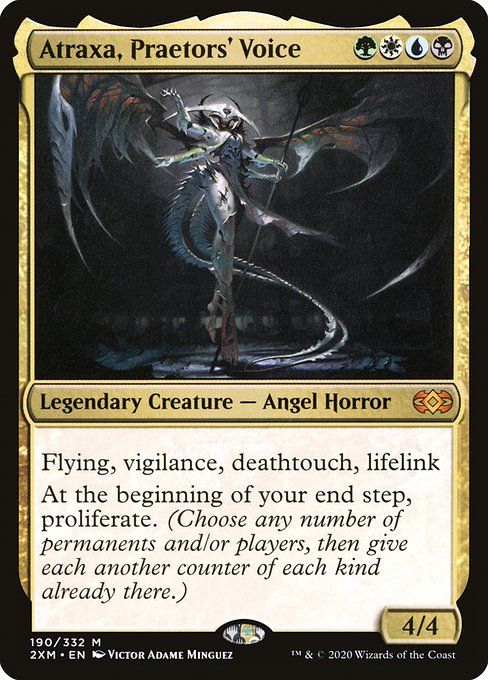
5. Atraxa, Praetors' Voice
Atraxa, Praetors' Voice | Illustration by Victor Adame Minguez
Colors: white-blue-black-green. Best for: broad card access and steady proliferation.
Atraxa proliferates at the beginning of your end step. Once your creatures have their first counters, she can grow the entire group while also contributing a vigilant, lifelinking flying threat.
Four colors give you a wide choice of counter producers, protection, recursion, and interaction. For this build, keep the focus on +1/+1 counters instead of trying to support every kind of counter strategy at once.
Extra proliferation:Evolution Sage turns land drops into more counter growth.
Counter enhancement:Winding Constrictor increases applicable counter placements on your artifacts and creatures.
Card draw:Fathom Mage can draw a card for each +1/+1 counter placed on it.
Combat finish:Abzan Falconer lets your developed board attack through many ground defenses.
Build around this weakness: Proliferate cannot put the first +1/+1 counter on a creature that has none. Atraxa also needs reliable access to four colors, and her end-step ability supplies neither initial counters nor card draw by itself.
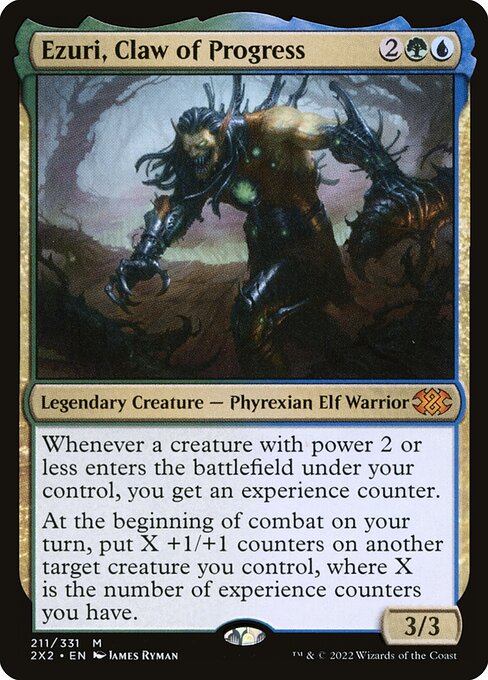
6. Ezuri, Claw of Progress
Ezuri, Claw of Progress | Illustration by James Ryman
Colors: green-blue. Best for: small creatures that build a lasting experience engine.
Ezuri gives you an experience counter whenever a creature with power two or less enters under your control. At the beginning of combat on your turn, he puts +1/+1 counters equal to your experience total on another creature you control.
Experience counters belong to you, so removing Ezuri does not erase that progress. Cheap utility creatures establish the engine, then Ezuri can make a small evasive creature into a serious threat.
Early utility:Coiling Oracle provides a small body and either a land onto the battlefield or a card to hand.
Late-game production:Avenger of Zendikar creates a batch of small Plants that can generate experience triggers.
Protection:Inspiring Call can protect developed creatures while refilling your hand.
Build around this weakness: Ezuri cannot target himself with his combat trigger. Power boosts can also make entering creatures too large to generate experience, so be deliberate about anthem effects.
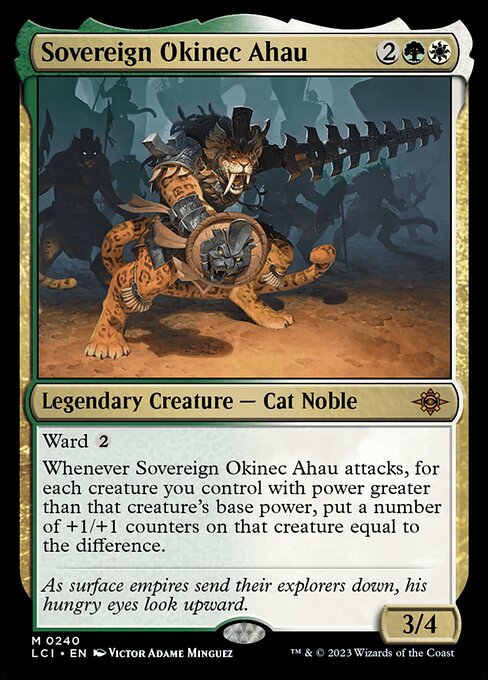
7. Sovereign Okinec Ahau
Sovereign Okinec Ahau | Illustration by Victor Adame Minguez
Colors: green-white. Best for: turning power boosts into permanent growth.
When Sovereign attacks, each creature you control whose power exceeds its base power receives +1/+1 counters equal to the difference. Existing counters help create that difference, but Equipment and other power boosts can contribute too.
For a creature whose only boost is three +1/+1 counters, the trigger adds three more. This rewards spreading early improvements across the board, then keeping your commander alive through repeated attacks.
Counters and mana:Rishkar, Peema Renegade places counters and lets creatures with counters tap for green mana.
Larger placements:Conclave Mentor increases the counters the attack trigger would add.
Trample:Duskshell Crawler places an initial counter and helps creatures with +1/+1 counters push damage through blockers.
Card draw:Guardian Project helps replace the nontoken creatures you deploy, subject to its name restrictions.
Build around this weakness: Sovereign must attack to trigger. Ward makes targeted interaction cost more, but does not guarantee a safe attack or protect the board from a sweeper.
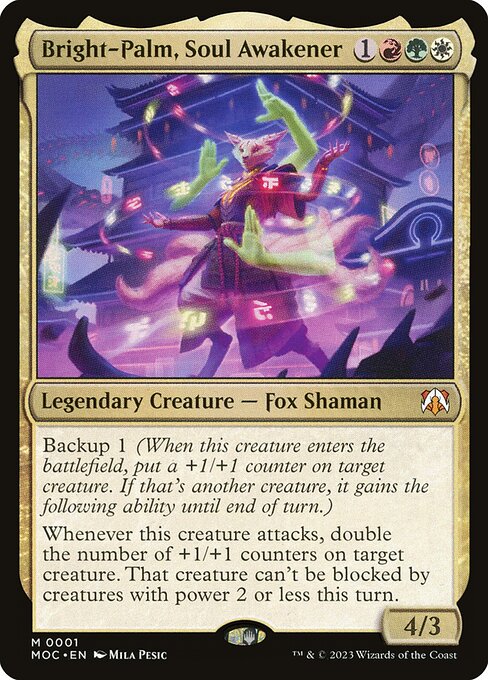
8. Bright-Palm, Soul Awakener
Bright-Palm, Soul Awakener | Illustration by Mila Pesic
Colors: red-green-white. Best for: explosive combat turns.
Bright-Palm's attack ability doubles the +1/+1 counters on a target creature and prevents creatures with power two or less from blocking that creature for the turn.
Backup adds a counter when Bright-Palm enters. If you choose another creature, that creature also receives the attack ability until end of turn. Choose a creature that can already attack to get immediate value; backup does not grant haste.
Counter supply:Forgotten Ancient accumulates counters and can move them onto the creature you want to grow.
Bigger doubling events:Conclave Mentor adds an extra counter when Bright-Palm's doubling effect places counters.
Team evasion:Champion of Lambholt can make more opposing creatures unable to block your army as its power grows.
Protection and draw:Inspiring Call helps protect creatures carrying counters and keeps your hand stocked.
Build around this weakness: Doubling zero counters still gives zero. Bright-Palm's blocking restriction also leaves larger blockers available, so add trample or broader evasion instead of assuming a huge attacker will connect.
9. Falco Spara, Pactweaver
Falco Spara, Pactweaver | Illustration by Kieran Yanner
Colors: green-white-blue. Best for: spending counters to access more spells.
Falco lets you inspect the top of your library and cast spells from there by removing a counter from a creature you control in addition to paying the spell's other costs. Counters become fuel for card access instead of simply making creatures larger.
You can remove different kinds of counters, including Falco's own shield counter. The tradeoff is deciding which counters you can afford to spend without weakening your next attack or exposing an important creature.
Unusual counter fuel:Devoted Druid makes green mana and puts a -1/-1 counter on itself to untap. Falco can remove that counter as part of casting a spell from the top.
Top-card control:Sensei's Divining Top rearranges your next draws and can move an unhelpful top card into your hand.
Steady production:Luminarch Aspirant supplies a +1/+1 counter at the beginning of combat on your turn.
Extra fuel:Branching Evolution doubles +1/+1 counters placed on your creatures.
Build around this weakness: Falco does not let you play lands from the top or ignore timing restrictions. You still need mana, legal spells, and counters to remove. A hand full of enhancers cannot solve every stalled top card.
10. Marchesa, the Black Rose
Marchesa, the Black Rose | Illustration by Matt Stewart
Colors: blue-black-red. Best for: using counters to recur value creatures.
Marchesa gives your other creatures dethrone, which adds a counter when they attack the player with the highest life total or a player tied for it. When a creature you control dies with a +1/+1 counter, her other ability sets up its return at the beginning of the next end step.
Here, one counter can be more valuable than ten. It enables a creature to die, return, and provide another entry effect. Marchesa suits players who enjoy sacrifice outlets and recursion more than building the largest attacker.
Reliable counters:Unspeakable Symbol lets you pay life to place a counter without relying on dethrone.
Sacrifice outlet:Viscera Seer lets you choose when your creatures die and gives you a scry.
Repeatable value:Baleful Strix draws when it enters and provides a useful flying deathtouch blocker.
Early setup:Iron Apprentice enters with a counter and can put its counters on another creature when it dies.
Build around this weakness: Exile, bounce, and graveyard interaction can disrupt the plan. Tokens cannot return this way, and a returning creature normally needs a new counter before another death qualifies. Marchesa can return herself if she dies with a counter, provided you leave her in the graveyard.
11. Kodama of the West Tree
Kodama of the West Tree | Illustration by Dai-XT
Colors: green. Best for: turning counter-bearing attackers into land ramp.
Kodama gives modified creatures you control trample. When one deals combat damage to a player, you can search your library for a basic land and put it onto the battlefield tapped.
A creature with a counter is modified, so counter development helps both halves of this plan. Several creatures connecting can produce several lands, giving you resources that remain after a creature sweeper.
Setup and mana:Rishkar, Peema Renegade distributes counters and gives your creatures with counters a mana ability.
Interaction:Scavenging Ooze can become modified while removing a creature card from a graveyard.
Growing attacks:Oran-Rief Ooze places a counter on entry and adds counters to attacking creatures that already have them.
Protection:Inspiring Call helps keep counter-bearing attackers alive and draws cards from your developed board.
Build around this weakness: Kodama does not supply the first modification. Its ramp also requires combat damage to a player, so you need enough attackers, ways to grow them, and basic lands to find.
12. Felisa, Fang of Silverquill
Felisa, Fang of Silverquill | Illustration by Sara Winters
Colors: white-black. Best for: converting creatures with counters into flying tokens.
When a nontoken creature you control dies with counters on it, Felisa creates that many tapped 2/1 flying Inklings. Her mentor ability can help place +1/+1 counters, but the death ability counts all counter types on the creature.
Felisa gives you a reason to spread counters among creatures you can profitably sacrifice. She can also leave you with a fresh army after a destroy-based sweeper, provided her ability sees the qualifying deaths.
Two token payoffs:Hangarback Walker can make Thopters through its own death trigger and Inklings through Felisa's.
Counter supply:Luminarch Aspirant adds a counter during each of your beginning-of-combat steps.
Sacrifice control:Viscera Seer lets you turn a developed creature into tokens at a useful moment.
Life-loss payoff:Zulaport Cutthroat rewards the deaths of both your original creatures and the tokens you later sacrifice.
Build around this weakness: Felisa's Inklings enter tapped, and sacrificing those tokens will not make more Inklings through her ability. Exile-based removal also bypasses the death payoff.
13. Rishkar, Peema Renegade
Rishkar, Peema Renegade | Illustration by Todd Lockwood
Colors: green. Best for: converting an early creature board into mana.
Rishkar places a +1/+1 counter on each of up to two creatures when it enters, and gives every creature you control with a counter the ability to tap for green mana. It can target itself with one of those initial counters.
This supplies both setup and a resource payoff for three mana. Small creatures can help fund larger threats, while the deck's counter synergies let those early bodies remain useful attackers later.
Untap utility:Quirion Ranger can return a Forest to untap a creature, once each turn.
Board-based draw:Armorcraft Judge refills your hand according to the number of creatures you control with +1/+1 counters.
Protection:Inspiring Call combines conditional card draw with indestructible for those creatures.
Ongoing draw:Beast Whisperer rewards the creature spells your mana engine helps cast.
Build around this weakness: Newly entered creatures normally cannot use their tap-symbol mana abilities without haste. Tapping the whole board for mana can also leave few blockers, and Rishkar needs help finding a decisive finish.
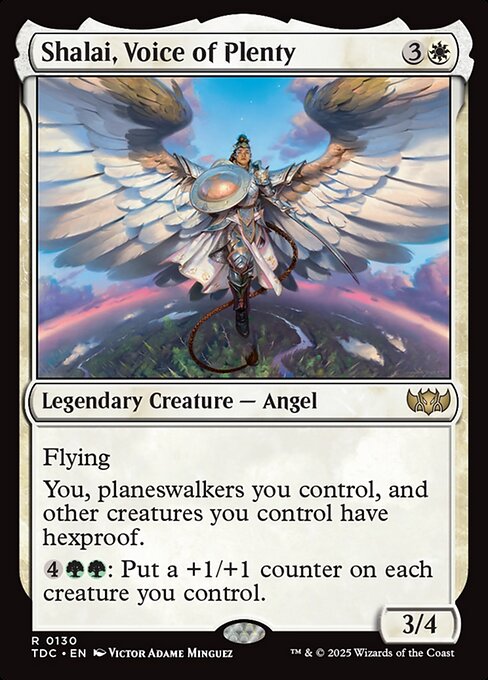
14. Shalai, Voice of Plenty
Shalai, Voice of Plenty | Illustration by Victor Adame Minguez
Colors: green-white. Best for: protecting a board and spending excess mana.
Shalai gives you, your planeswalkers, and your other creatures hexproof. Her six-mana activation puts a +1/+1 counter on every creature you control, allowing spare mana to improve a wide board.
Although her casting cost is white, the green symbols in her activated ability make her color identity green-white. She is a useful choice when you want protection in the command zone and plan to generate substantial mana over a longer game.
More counters per activation:Hardened Scales increases each applicable placement.
Early development:Good-Fortune Unicorn gets counters onto creatures before Shalai's activation becomes affordable.
Mana production:Cryptolith Rite lets your creatures tap for mana to help fund the activation.
Additional protection:Heroic Intervention can protect Shalai herself and help against destroy effects.
Build around this weakness: Shalai does not give herself hexproof. Opponents can remove her first, and hexproof alone does not stop a nontargeted sweeper. Her expensive activation also makes independent counter producers important.
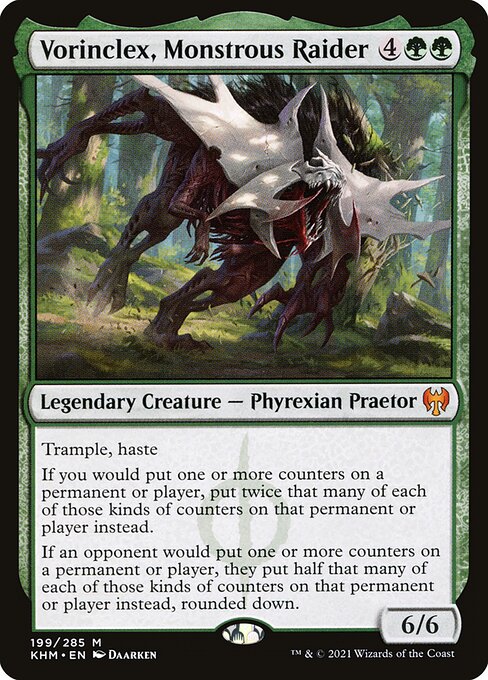
15. Vorinclex, Monstrous Raider
Vorinclex, Monstrous Raider | Illustration by Daarken
Colors: green. Best for: a large counter multiplier with immediate combat pressure.
Vorinclex doubles counters you would place on permanents or players, while halving counters opponents would place, rounded down. For this deck, the main attraction is increasing +1/+1 counter production alongside a hasty, trampling threat.
It is a powerful top end, but it ranks lower here because it costs six mana and relies on other cards to supply the counters. The deck should function before Vorinclex arrives.
Repeatable growth:Forgotten Ancient supplies counters through spell casts and later distributes them.
Mana payoff:Incubation Druid produces three mana instead of one when it has a +1/+1 counter.
Flexible damage:Walking Ballista receives more counters from applicable effects and spends them to damage creatures or players.
Hand refill or combat boost:Return of the Wildspeaker draws from your largest non-Human creature's power or boosts your non-Human team.
Build around this weakness: A multiplier does not replace counter production or card draw. Vorinclex also slows opponents' counter plans substantially, so expect it to attract removal and discuss that play pattern when choosing a deck for your group.
Choose your commander by how you want to win
Direct damage: Shalai and Hallar turns counter placement into a way around blockers. Animar can support creature-combo finishes, with the complexity and interaction those plans require.
Wide combat: Hakbal, Hamza, Sovereign, and Bright-Palm reward building a board and improving multiple creatures. Make room for flying, trample, or an effect that prevents blocking.
Resource engines: Falco trades counters for access to spells. Rishkar creates mana, while Kodama converts successful attacks into lands. Build a finish that uses those resources instead of assuming resource accumulation wins by itself.
Recovery and sacrifice: Marchesa returns qualifying creatures, while Felisa turns their deaths into flying tokens. They offer very different ways to keep making progress through creature removal.
How to build a +1/+1 counter deck that keeps working
Start with a dependable mana base. Around 36–38 lands and 8–10 ramp pieces can be a useful starting point for a typical midrange build. Adjust for your curve and commander; Animar's discounts and Rishkar's creature mana do not remove the need to develop before your commander resolves.
Include enough cards that place the first counter. As an initial test, try roughly 10–14 independent counter producers, adjusting downward if the commander reliably supplies counters. A multiplier is not a producer, and proliferate cannot start a new counter type on an empty creature.
Treat card draw and interaction as core parts of the engine. Counter-themed draw is attractive, but add some cards that still work when your board is small. Leave room for answers to creatures, artifacts, enchantments, and graveyards according to your colors and table.
Choose a route through blockers. Trample helps large creatures push damage through small blockers. Flying and unblockability reward a wide board. Direct damage gives you another route when attacking is difficult. A few cards supporting your chosen finish are usually more useful than another redundant counter multiplier.
Keep a recovery plan. Hold a useful creature or draw spell in reserve instead of committing every resource to the battlefield. Land ramp survives creature wipes. Experience counters remain on the player. Recursion and death payoffs can recover value, but exile effects demand different answers.
Match protection to the threat. Inspiring Call can protect counter-bearing creatures from destruction; it does not stop exile or bounce. Ripples of Potential can phase out eligible permanents after proliferating them. Keeping the right mana available matters as much as including the protection spell.
+1/+1 counter rules worth knowing
Does a +1/+1 bonus count as a counter?
No. An effect that says a creature gets +1/+1 is different from placing a +1/+1 counter. Merfolk Mistbinder's bonus does not trigger Shalai and Hallar or qualify a creature for Hamza's discount by itself. Sovereign is different because it checks current power against base power.
Does proliferate double counters?
No. Normally it adds one counter of each kind already present to each chosen permanent or player. A creature with six +1/+1 counters gets one more, not six more. Applicable replacement effects can increase that addition.
Do creatures entering with counters trigger counter abilities?
Yes. Entering with counters counts as counters being put on the permanent. An ability such as Shalai and Hallar's can see those placements when its other conditions are satisfied.
Do counters survive blinking or reanimation?
Normally, no. A creature leaving the battlefield and returning is a new object, without its old counters. Phasing out works differently: the permanent does not change zones and keeps its counters.
Do counter multipliers stack?
Applicable replacement effects can each modify the same event once. Two doublers normally turn one counter into four. With a doubler and Hardened Scales, order matters: applying Scales first turns one into two, then the doubler makes four; reversing the order gives three. For a creature you control, you choose the order of applicable replacement effects.
Start building your +1/+1 counter Commander deck
Choose the commander whose payoff you want to use most, then start with its Create a deck link. The free ElderDecks Commander deck builder helps you assemble the creatures, counter producers, interaction, and finishing cards around that plan.
Would you rather turn counters into damage, mana, cards, or an army that cannot be blocked?
Sources and card references
Card text and legality were checked on November 22, 2026. Rankings and deckbuilding recommendations are ElderDecks editorial judgments. Card images are supplied through Scryfall and include illustrator credits; the artwork and card designs belong to Wizards of the Coast and their respective rights holders.