20 Best Mono-Blue Commanders: Artifacts, Spells & Sea Monsters
By ElderArticles · Updated 11/28/2026 · 19 min read
Compare 20 of the best mono-blue commanders, with four synergy cards per pick, clear win plans, key weaknesses, and rules tips for your next MTG deck.
Table of contents
Urza, Lord High Artificer | Illustration by Grzegorz Rutkowski
Mono-blue Commander can mean a sky full of Drakes, a workshop full of artifacts, or one very large Kraken. The shared strength is access to cards and interaction. The real deckbuilding question is what you do with those resources before the other three players run out of patience—or find a way through your defenses.
Urza, Lord High Artificer leads our list for turning an artifact board into mana and pressure. Orvar and Azami follow for the powerful engines they make available from the command zone. For a more straightforward first build, Talrand and Sai offer clear paths from casting spells to attacking with tokens.
We ranked these twenty picks by engine strength, mana efficiency, ability to convert resources into a win, and practical deckbuilding flexibility. Later entries include more specialized choices for creature themes and sea monsters. This is an editorial multiplayer ranking, not a tournament-results table, and individual builds can differ enormously in power.
Checked November 27, 2026: Every featured commander has a mono-blue color identity and is Commander-legal. Each of the four supporting cards per entry fits that commander's color identity. These suggestions are starting points, not complete decklists.
1. Urza, Lord High Artificer
Urza, Lord High Artificer | Illustration by Grzegorz Rutkowski
Best for: artifact mana engines with several ways to finish.
Urza arrives with a Construct that grows with your artifact count, turns untapped artifacts into blue mana, and provides a five-mana ability to access another card. That combination earns the top spot: the cards that develop your mana also strengthen your attacker and feed your late-game engine.
His mana ability can tap artifact creatures that just entered because its cost does not use the tap symbol on those creatures. His last ability still observes normal timing and land-play limits; it does not let you cast everything whenever you choose.
Four synergies:Mishra's Bauble is a free artifact that can make mana before you eventually sacrifice it for a delayed draw. Sai, Master Thopterist makes more artifact bodies. Shimmer Dragon turns spare artifacts into cards. Cyberdrive Awakener converts a developed noncreature artifact board into flying 4/4 attackers for the turn.
Main weakness: Artifact removal can attack your mana and your threats at once. Keep recovery and protection alongside the inexpensive artifacts, and remember that newly acquired artifacts may be unable to attack when animated.
2. Orvar, the All-Form
Orvar, the All-Form | Illustration by DZO
Best for: turning cheap targeted spells into permanent copies.
Orvar rewards casting an instant or sorcery that targets another permanent you control. The payoff is a token copy of one of those permanents: a land to grow your mana, a creature with an enters ability, or another useful engine piece.
That unusual conversion makes modest targeting spells powerful, but also makes the deck dependent on its commander. The trigger creates one copy even if the spell targets several of your permanents; it does not copy each of them. Copied creatures can form a winning army, while combo builds can use repeated Drake untaps to fund a separate finisher.
Four synergies:Whim of Volrath is a cheap targeting spell with buyback. Trait Doctoring offers another inexpensive target and can be cast again through cipher. Peregrine Drake rewards copying it with land untaps. Archaeomancer can recover spent instants and sorceries when copied.
Main weakness: A hand full of targeting tricks can accomplish little without Orvar. Include independent draw and interaction, and choose whether your build is pursuing repeated value or explicit combo loops before adding tutors.
3. Azami, Lady of Scrolls
Azami, Lady of Scrolls | Illustration by Ittoku
Best for: Wizard-based card advantage and draw-combo finishes.
Azami lets you tap an untapped Wizard you control to draw a card. She can use herself and newly entered Wizards immediately: this cost does not contain the tap symbol. A board of utility creatures can therefore become a substantial draw engine as soon as she resolves.
Four synergies:Aphetto Alchemist can untap a Wizard for another Azami draw, once the Alchemist can use its own tap ability. Patron Wizard gives the same creature board a second job taxing opposing spells. Mind Over Matter lets you discard to untap Azami or another Wizard. Laboratory Maniac can turn a draw from an empty library into a win.
Main weakness: Five mana and a creature-heavy engine leave you exposed to board wipes. The Mind Over Matter plan also needs careful sequencing and a protected win condition; drawing through your deck without a working payoff is dangerous.
4. Emry, Lurker of the Loch
Emry, Lurker of the Loch | Illustration by Livia Prima
Best for: repeatedly casting artifacts from the graveyard.
Emry's artifact discount can make her inexpensive, and her entry mills four cards to help stock the graveyard. Her tap ability then gives permission to cast one targeted artifact card from there that turn. You still pay its costs and follow timing restrictions.
Four synergies:Mishra's Bauble can be sacrificed and recast, although its draw is delayed until the next upkeep. Ichor Wellspring rewards entering and going to the graveyard. Mirran Spy can untap Emry whenever you cast an artifact. Aetherflux Reservoir turns repeated casts into life and a possible damage finish.
With Emry able to tap, Spy and Bauble can support repeated recasts: target Bauble, cast it, untap Emry through Spy, and sacrifice Bauble again. Reservoir gives that sequence a finish; opponents can still disrupt its pieces.
Main weakness: Graveyard hate removes access to your resource pool. Keep ways to play a normal artifact game when Emry's recursion is unavailable.
5. Minn, Wily Illusionist
Minn, Wily Illusionist | Illustration by Dmitry Burmak
Best for: draw triggers, Illusions, and deploying permanents from hand.
Minn makes an Illusion when you draw your second card each turn. When one of your Illusions dies, its power determines the maximum mana value of a permanent you may put onto the battlefield from your hand.
The plan is to grow a group of Illusions, then use combat or sacrifice outlets to convert one into another permanent. It is a flexible engine because the reward is not limited to creatures.
Four synergies:Opt helps reach your second draw on your own turn. Think Twice offers instant-speed draw across multiple turns. Phantasmal Image copies a creature while remaining an Illusion. Ashnod's Altar lets you sacrifice an Illusion when its death trigger is useful.
Main weakness: One card drawn during an opponent's turn is usually only your first draw that turn. Plan enough draw to reach two, and keep useful permanents in hand for the death triggers. Putting those cards into play does not cast them.
6. Unctus, Grand Metatect
Unctus, Grand Metatect | Illustration by Andrew Mar
Best for: tapping creatures to filter cards and assemble an engine.
Unctus gives your other blue creatures a draw-then-discard trigger when they become tapped. He also strengthens other artifact creatures and can temporarily make your creatures blue artifacts. The draw is filtering, not a net extra card, but repeated filtering can find the pieces you need.
Four synergies:Aphetto Alchemist can tap to untap itself, repeatedly triggering Unctus once it is able to use that ability. Grand Architect taps blue creatures for mana restricted to artifact spells and abilities. Intruder Alarm offers more untaps when creatures enter. Laboratory Maniac gives an empty-library draw a possible winning result.
Main weakness: Unctus needs tapping outlets and payoff cards; he supplies neither unrestricted mana nor a win by himself. Intruder Alarm also stops normal creature untaps and affects opponents, so treat it as an engine component with real costs.
7. Talrand, Sky Summoner
Talrand, Sky Summoner | Illustration by Svetlin Velinov
Best for: a clear spells-to-creatures game plan.
Talrand turns each instant or sorcery you cast into a 2/2 flying Drake. Your card selection, removal, and counterspells can all build the army that eventually ends the game. That straightforward relationship makes him one of our strongest recommendations for a first mono-blue deck.
Four synergies:Ponder improves your next draws while producing a Drake. Counterspell protects your position. Rapid Hybridization answers a creature for one mana while leaving its controller a 3/3. Reconnaissance Mission rewards connecting with several flying tokens by drawing cards.
Main weakness: Talrand costs four mana and does nothing until you cast more spells. Avoid deploying him with no follow-up or protection available. Copying an instant or sorcery on the stack does not trigger Talrand unless the copy is actually cast.
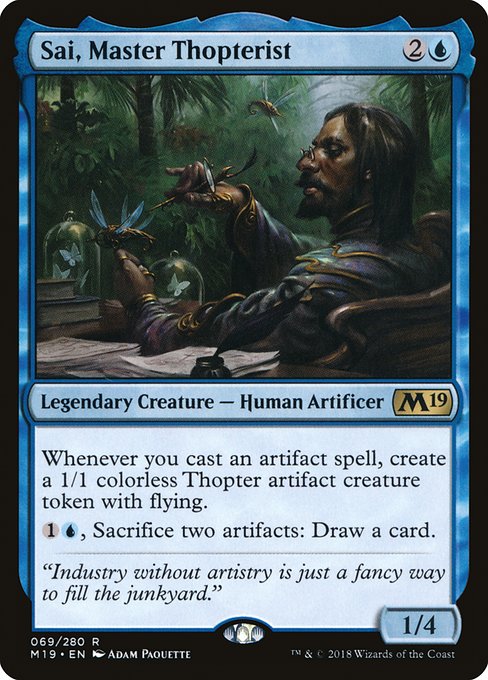
8. Sai, Master Thopterist
Sai, Master Thopterist | Illustration by Adam Paquette
Best for: artifact tokens with a built-in sacrifice outlet.
Sai makes a flying Thopter whenever you cast an artifact spell. His second ability lets you pay two mana and sacrifice two artifacts to draw a card. The tokens can attack, block, increase artifact counts, or become material for that draw ability.
Four synergies:Thoughtcast becomes cheaper as your artifacts accumulate. Ichor Wellspring pays you when it enters and again when sacrificed. Skullclamp can turn an unboosted 1/1 Thopter into two cards. Cyberdrive Awakener gives your noncreature artifacts a temporary 4/4 body and your other artifact creatures flying.
Main weakness: Casting artifacts produces the tokens; simply returning artifacts to the battlefield does not. Keep enough cheap spells and card draw to restart after a wipe, and account for anthem effects that can stop Skullclamp from immediately killing a token.
9. Thassa, Deep-Dwelling
Thassa, Deep-Dwelling | Illustration by Jason A. Engle
Best for: repeating useful creature enters abilities.
At your end step, Thassa can exile another creature you control and immediately return it under your control. She does not need enough devotion to be a creature for this ability to work. A useful enters ability becomes a recurring source of cards, mana, or control.
Four synergies:Mulldrifter provides two cards each time it enters. Archaeomancer recovers an instant or sorcery. Peregrine Drake untaps lands for interaction during the next players' turns. Agent of Treachery takes a permanent, providing a powerful but attention-grabbing control plan.
Main weakness: Thassa needs a worthwhile creature to blink. Her end-step timing cannot normally save a Mulldrifter you cast for its evoke cost earlier in the turn; that sacrifice trigger resolves much sooner. Have threats that can close the game after the extra value has accumulated.
10. Jin-Gitaxias, Progress Tyrant
Jin-Gitaxias, Progress Tyrant | Illustration by Chase Stone
Best for: expensive spells protected by a disruptive commander.
Jin copies the first qualifying artifact, instant, or sorcery you cast each turn and counters the first qualifying spell an opponent casts each turn. Those are two separate abilities, each limited to once per turn. The counter is not once for every opponent during that same turn.
Four synergies:Everflowing Chalice provides scalable ramp, and a copied kicked spell retains its kicker choices. Thoughtcast supplies cards in an artifact build. Reshape can find two artifacts when copied without making you pay its sacrifice cost twice. Metallurgic Summonings creates attackers from the instants and sorceries you cast.
Main weakness: Seven mana is a lot to invest before getting value. Opponents can use one qualifying spell to consume the counter trigger, then resolve another. Spell copies Jin creates are not cast, so they do not create extra Summonings triggers.
11. Baral, Chief of Compliance
Baral, Chief of Compliance | Illustration by Wesley Burt
Best for: efficient instant-and-sorcery control.
Baral reduces the generic cost of your instants and sorceries by one. When a spell or ability you control counters a spell, he can also let you draw and discard. His low cost makes it easier to develop the commander while preserving mana for interaction.
Four synergies:Frantic Search benefits from the reduction and untaps lands. Wavebreak Hippocamp rewards your first spell on each opponent's turn with a card. Counterspell remains a clean answer, although Baral cannot reduce its two blue requirements. Blue Sun's Zenith is a scalable draw spell and can become a finish with sufficient mana by forcing an opponent to draw more cards than remain in their library.
Main weakness: Answering threats does not itself win. Include a mana engine or independent threats, and avoid trading every card in your hand for opposing plays while another player quietly develops.
12. Tekuthal, Inquiry Dominus
Tekuthal, Inquiry Dominus | Illustration by Alejandro Mirabal
Best for: charge counters, proliferate, and accumulating advantages.
Tekuthal replaces each time you would proliferate with two proliferations. That can grow mana artifacts, loyalty, or other existing counters quickly. It does not create the first counter of a new kind, so your deck needs ways to establish counters before multiplying them.
Four synergies:Everflowing Chalice and Astral Cornucopia turn charge counters into more mana. Flux Channeler proliferates when you cast a noncreature spell. Inexorable Tide does so whenever you cast a spell, giving Tekuthal a reliable source of repeated growth.
Main weakness: Doubling proliferate does little on an empty setup. Choose a real endpoint, such as planeswalker ultimates or a large spell funded by your mana artifacts. If you include a poison finish, you still need a way to give opponents their initial poison counter.
13. Unesh, Criosphinx Sovereign
Unesh, Criosphinx Sovereign | Illustration by Adrian Majkrzak
Best for: Sphinxes, flying pressure, and repeated card selection.
Unesh discounts Sphinx spells by two generic mana. When he or another Sphinx enters under your control, an opponent splits your top four cards into two piles and you choose one for your hand. The other pile goes to your graveyard.
Four synergies:Sphinx of Uthuun supplies its own larger pile-splitting trigger alongside Unesh's. Sphinx of Foresight becomes cheaper and helps select future draws. Fact or Fiction supplies a similar effect without requiring your commander. Reflections of Littjara, naming Sphinx, copies the Sphinx spells you cast to build a larger airborne army.
Main weakness: Six mana comes before most of the discount's benefit. Include ramp and early interaction. Also, putting a pile into your hand is not drawing cards, so those cards do not trigger abilities that specifically care about a draw.
14. Naban, Dean of Iteration
Naban, Dean of Iteration | Illustration by Ryan Alexander Lee
Best for: doubling the value of Wizards entering.
If a Wizard entering under your control causes a permanent you control to trigger, Naban adds another instance of that trigger. His two-mana cost lets you establish him before playing the creatures you want to reward.
Four synergies:Aether Channeler supplies two enters triggers, with choices such as bouncing a permanent, making a Bird, or drawing a card. Archaeomancer can return two separate spells if suitable targets are available. Merchant of Secrets becomes a two-card draw creature. Panharmonicon adds another trigger for qualifying enters events.
Main weakness: Naban rewards the right creature type entering, not every Wizard ability. Panharmonicon and Naban normally give three total instances of a qualifying trigger, not four. Build toward an evasive token board or another explicit finish rather than collecting value creatures indefinitely.
15. Alandra, Sky Dreamer
Alandra, Sky Dreamer | Illustration by Caroline Gariba
Best for: card draw that builds and then boosts a Drake army.
Your second card drawn each turn makes a Drake. Your fifth gives Alandra and your Drakes a temporary power-and-toughness bonus based on your hand size when the ability resolves. The deck therefore has a natural sequence: develop tokens, then draw enough cards before combat to make them dangerous.
Four synergies:Opt can supply the second draw on your turn. Reconnaissance Mission and Coastal Piracy reward successful attacks. Windfall can reach the fifth draw while refilling your hand, depending on how many cards were discarded.
Main weakness: A boost triggered by ordinary combat-damage draws arrives after that damage has already happened. For a larger hit in that combat, reach the fifth draw before damage. Windfall also gives opponents fresh hands, so consider who benefits most.
16. Octavia, Living Thesis
Octavia, Living Thesis | Illustration by Simon Dominic
Best for: turning small evasive creatures into 8/8 threats.
With eight instant and/or sorcery cards in your graveyard, Octavia's cost drops by eight generic mana. Her magecraft ability makes a target creature's base power and toughness 8/8 whenever you cast or copy an instant or sorcery. That includes spell copies that are not cast, unlike Talrand's ability.
Four synergies:Consider selects a card and can put another into the graveyard. Frantic Search helps stock that graveyard while untapping lands. Shadow Rift gives a creature shadow and replaces itself. Slip Through Space makes a creature unblockable for the turn while also drawing a card.
Main weakness: Graveyard hate can turn a two-mana Octavia back into a ten-mana spell before commander tax. The deck also needs creatures to receive her magecraft effect. Cheap spells alone do not produce an army.
17. Jalira, Master Polymorphist
Jalira, Master Polymorphist | Illustration by Steve Prescott
Best for: exchanging expendable creatures for carefully chosen threats.
Jalira lets you pay three mana, tap her, and sacrifice another creature to reveal into a nonlegendary creature from your library. Control the pool of possible hits and a small token can become a major threat.
Four synergies:Hard Evidence produces a Crab to sacrifice and a Clue for later. Myr Battlesphere supplies a large body plus four more tokens. Blightsteel Colossus offers a dangerous infect finisher. Proteus Staff provides a second way to transform a creature into a library hit.
Main weakness: Every cheap nonlegendary creature in the deck dilutes Jalira's reveals. Proteus Staff also stops at legendary creatures, unlike Jalira, so the two effects do not have identical hit pools. Both need setup, and Jalira must be able to use her tap ability.
18. Charix, the Raging Isle
Charix, the Raging Isle | Illustration by Viktor Titov
Best for: Island-heavy commander combat.
Charix is a 0/17 Leviathan Crab that can spend three mana to gain power and lose toughness according to how many Islands you control. He offers an unusual mono-blue combat plan: develop Islands, make him hard to block, and turn that defensive body into commander damage.
Four synergies:High Tide gives Islands extra blue mana for a large turn, including opposing Islands. Rogue's Passage bypasses blockers. Fireshrieker grants double strike. Sword of the Animist finds more basic lands as Charix attacks.
Main weakness: Every activation reduces toughness as well as increasing power. Without other modifications, activating twice with nine Islands gives Charix 18/-1 and puts him into the graveyard. Calculate the full result, including marked damage, before stacking activations.
Best for: high-impact permanents and a deliberately shared acceleration effect.
At each player's upkeep, Braids lets that player put an artifact, creature, or land from hand onto the battlefield. Your plan is to have better permanents ready than everyone else, but the benefit is genuinely symmetrical.
Four synergies:Paradox Haze can give you an additional upkeep. Sphinx of Uthuun refills your hand with a pile choice. Portal to Phyrexia disrupts opposing creature boards and supplies later reanimation. Lightning Greaves can help protect Braids or give a newly deployed threat haste.
Main weakness: If you cast Braids on your turn, opponents generally get their upkeep opportunities before you get yours. An enchantment or planeswalker must also be an artifact or creature to qualify for her ability. Putting a creature onto the battlefield does not trigger its cast abilities.
20. Tromokratis
Tromokratis | Illustration by Jaime Jones
Best for: a straightforward Kraken finisher and sea-monster theme.
Tromokratis is an 8/8 that cannot be blocked unless every creature the defending player controls blocks it. If one of those creatures is tapped or otherwise cannot block, the defending player cannot make the required block. Its hexproof applies only while it is neither attacking nor blocking.
Four synergies:Quest for Ula's Temple can deploy qualifying sea monsters from your hand once charged. Serpent of Yawning Depths restricts which creatures can block your sea monsters. Whelming Wave clears creatures while leaving Krakens, Leviathans, Octopuses, and Serpents. Engulf the Shore can return smaller creatures while sparing Tromokratis if your Island count is below its toughness.
Main weakness: Seven mana buys a threat rather than a draw or mana engine. Ramp and independent card advantage must come from the rest of the deck. Quest cannot deploy a commander directly from the command zone, and Tromokratis loses hexproof during the combat where it most needs protection.
Which mono-blue commander fits your deck?
For artifacts: Urza gives the broadest resource engine; Sai focuses on token development; Emry rewards recurring artifacts from the graveyard.
For spells: Talrand supplies a clear combat finish, Baral helps control the game efficiently, and Octavia makes small creatures hit much harder. Jin-Gitaxias offers a more expensive copying and disruption plan.
For card-driven creature engines: Choose Azami for Wizards tapping to draw, Naban for Wizards entering, Minn for Illusions, or Alandra for a draw-powered Drake attack.
For unusual construction: Orvar rewards targeted spells, Unctus rewards tapping creatures, Tekuthal rewards existing counters, and Jalira rewards controlling your nonlegendary creature pool.
For bigger creatures: Unesh supports Sphinxes, Thassa repeats enters abilities, Braids accelerates the whole table, and Charix or Tromokratis can lead a sea-creature combat deck.
Common mono-blue deckbuilding mistakes
Holding answers without developing a win
Interaction buys time. It does not automatically put you ahead of three opponents. Make sure the commander or the rest of the deck provides a way to turn that time into tokens, a threatening board, or a defined combo finish.
Talrand is a useful example because the same spell that answers a threat also creates a Drake. A Baral list has to work harder to supply that second half.
Treating card selection as extra cards
Unctus's draw-then-discard improves card quality without increasing hand size. Frantic Search does the same before considering the mana it untaps. Unesh puts chosen cards into your hand, but that action is not a draw. These distinctions matter both for resource planning and for cards that trigger when you draw.
Depending on one permanent to make every card work
Orvar's targeting spells, Tekuthal's proliferate effects, and Jalira's sacrifice setup all become less useful when the relevant engine disappears. Include independent card draw, mana development, and a backup way to use your resources.
You do not need a second unrelated deck hiding in the ninety-nine. You need enough overlap that removing your commander delays your plan rather than ending it.
Mono-blue Commander FAQs
What is the best mono-blue commander for beginners?
Our recommendation is Talrand for spells or Sai for artifacts. Both offer a visible connection between casting spells, producing tokens, and winning through combat. Their final power still depends on the cards you choose.
Can mono-blue decks use colorless cards?
Yes. Cards with a colorless identity fit, but appearance or card type is not enough: colored mana symbols in rules text can affect color identity. For example, an artifact with an off-color identity does not become legal simply because its casting cost is generic.
Does copying a spell trigger Talrand or Sai?
Only if you cast the copy. Most effects that copy a spell on the stack do not cast that copy. Octavia explicitly cares about casting or copying, so her magecraft ability works differently.
Does a mono-blue deck need to win with a combo?
No. Drakes, Thopters, Sphinxes, animated artifacts, and commander damage can all provide combat finishes. If you choose a repeatable combo, know its costs and stopping points, and describe that plan accurately to the group before the game.
Start with the commander's four suggested synergy cards, add mana and interaction, and test what happens when the commander is removed. For more choices and practical upgrades, browse the ElderDecks article archive.
Would you rather win with Urza's artifacts, Talrand's Drakes, or a Kraken that refuses to be blocked?
Sources and editorial notes
Oracle text, color identities, legality, and support-card interactions were checked on November 27, 2026 using Scryfall and the official references below. The ordering and deck recommendations are original ElderDecks editorial judgments, not claims about tournament performance or personal playtesting. Card images include illustrator credits; Magic artwork and card designs belong to Wizards of the Coast and the respective rights holders.