15 Best Lifegain Commanders: Turn Extra Life Into a Win
By ElderArticles · Updated 11/26/2026 · 16 min read
Find your next MTG lifegain commander, from Oloro and Karlov to Heliod and Vito. Compare win conditions, key synergies, and important rules interactions.
Table of contents
Gaining 40 life feels great. It feels less useful when another player wins while you are still looking for a way to finish the game.
The best lifegain commanders give those extra points a job. Some turn each small gain into counters or life loss. Others reward one enormous burst with cards, cheaper spells, or creatures brought back from the graveyard.
Our first picks are Oloro for steady support, Karlov for cheap pressure and removal, and Heliod for a focused counters or combo build. The right choice depends on what you want your life total to accomplish.
These are fifteen editorial recommendations for multiplayer Commander, ordered to introduce a range of strong, distinct strategies. They are not a cEDH power ranking. Card text, Commander legality, and the color identity of the suggested support cards were checked on November 26, 2026.
Choose the payoff before the lifegain cards
There are three useful questions to ask before building. Does your commander care about the number of times you gain life, the total amount you gain, or your current life total?
Karlov and Dina reward separate events. Gaining one life five times produces five triggers; gaining five life once produces one. Vito and Lathiel reward the amount gained. Ayli and Bilbo need you to reach a life-total threshold before you can activate their larger abilities.
That distinction changes which cards deserve space. A repeatable one-life trigger can be excellent for Karlov and too slow for a deck trying to cast one enormous discounted spell with Will.
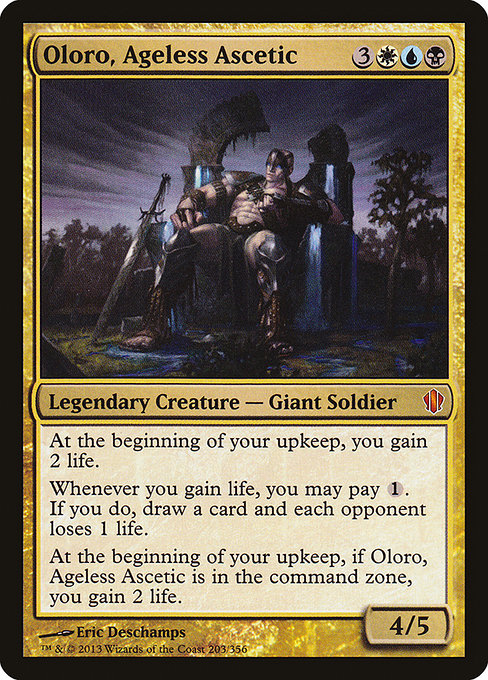
1. Oloro, Ageless Ascetic
Oloro, Ageless Ascetic | Illustration by Eric Deschamps
Colors: white-blue-black. Best for: consistent lifegain with flexible control tools.
Oloro gives you two life at the beginning of your upkeep while he is in the command zone. That makes him a reliable starting point for a deck whose other cards reward gaining life: you can establish the support pieces without first spending six mana on your commander.
Once Oloro is on the battlefield, gaining life lets you pay one mana to draw a card and make each opponent lose one life. That ability does not function from the command zone. His dependable background lifegain and his battlefield payoff are separate parts of the plan.
Main limitation: Two life per upkeep will not win by itself. Keep enough interaction and a real finisher instead of filling the deck with cards that only increase your total.
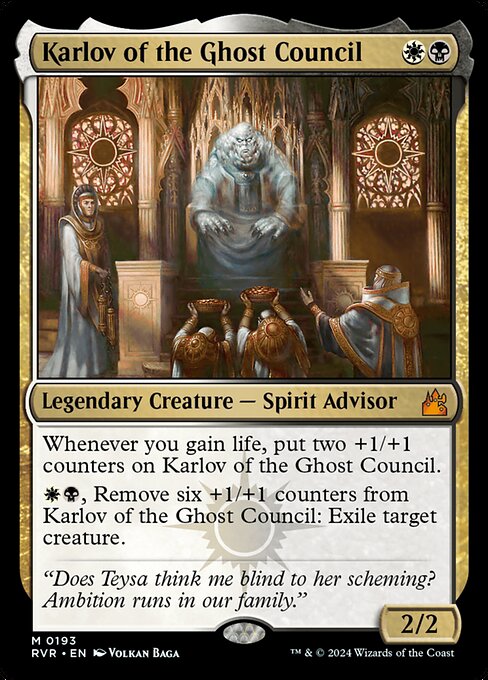
2. Karlov of the Ghost Council
Karlov of the Ghost Council | Illustration by Volkan Baǵa
Colors: white-black. Best for: efficient pressure and repeatable creature removal.
Karlov receives two +1/+1 counters whenever you gain life. Three separate gains can therefore supply the six counters needed for his exile ability, although activating it still costs white and black mana.
That gives a two-mana commander two useful jobs: threaten combat damage or spend accumulated size to remove a dangerous creature. Small, frequent gains are the priority. One ten-life event still adds only two counters.
Cards to consider:Soul Warden and Soul's Attendant turn creatures entering on either side of the table into lifegain opportunities. Shadowspear gives Karlov trample and lifelink, helping his size matter in combat.
Main limitation: Counters disappear when Karlov leaves the battlefield. Save mana for interaction and decide whether a large attacker or another exile activation matters more right now.
3. Heliod, Sun-Crowned
Heliod, Sun-Crowned | Illustration by Lius Lasahido
Colors: white. Best for: counters with an optional compact combo finish.
Heliod places a +1/+1 counter on a creature or enchantment you control whenever you gain life. He can also give another creature lifelink for two mana. His devotion requirement controls whether he is a creature; it does not switch off those abilities.
Cards to consider:Soul Warden supplies repeated triggers. Dawn of Hope offers paid card draw and lifelink tokens. Walking Ballista can serve as removal or a combo finisher.
The Ballista setup: With Heliod on the battlefield and Ballista starting with at least two +1/+1 counters, give Ballista lifelink. Remove a counter to deal one damage, gain one life from lifelink, then use Heliod's trigger to replace that counter. With no interruption or effect preventing the relevant damage or lifegain, repeat to deal lethal damage. A normal 0/0 Ballista starting with only one counter dies after you remove it, before that counter can be replaced.
Main limitation: This finish changes the deck's expectations. Tell your group if you are building around it, and include a creature plan if the combo pieces are answered.
4. Vito, Thorn of the Dusk Rose
Vito, Thorn of the Dusk Rose | Illustration by Susumu Kuroi
Colors: black. Best for: turning large life gains into targeted life loss.
Whenever you gain life, Vito makes a target opponent lose that much life. He rewards the size of a gain, so a large drain spell can damage everyone's position and direct an additional loss at one player. His activated ability can give your creatures lifelink for a combat turn.
Cards to consider:Exsanguinate drains every opponent and aggregates the life you gain. Gray Merchant of Asphodel offers a similar payoff based on black devotion. Exquisite Blood creates a repeatable loop with Vito once you gain life or an opponent loses life: one trigger feeds the other, normally ending the game unless interrupted.
Main limitation: Vito's trigger targets one opponent, not the whole table. Protect him when committing a large spell, and make sure the group knows if the Exquisite Blood loop is part of the deck.
5. Dina, Soul Steeper
Dina, Soul Steeper | Illustration by Chris Rahn
Colors: black-green. Best for: many small gains and sacrifice engines.
Dina makes each opponent lose one life whenever you gain life. The size of each gain does not change that loss, making repeated triggers more valuable than a single large burst. She also offers a paid sacrifice outlet that temporarily increases her power.
Cards to consider:Essence Warden rewards creatures entering. Witherbloom Apprentice supplies a life gain and table-wide drain when you cast or copy an instant or sorcery. Pest Infestation removes artifacts or enchantments and creates Pests that gain you life when they die.
Main limitation: A pile of lifegain cards is not automatically an engine. Include ways to create and sacrifice creatures repeatedly, plus enough draw to keep the sequence going.
6. Lathiel, the Bounteous Dawn
Lathiel, the Bounteous Dawn | Illustration by Lucas Graciano
Colors: green-white. Best for: turning a large gain into a threatening creature board.
At the beginning of each end step, if you gained life that turn, Lathiel can distribute up to that much life in +1/+1 counters among other creatures. The counters cannot go on Lathiel itself.
Because the ability checks each end step, gaining life on an opponent's turn can grow your team before your next attack. You need to gain that life before the end step begins for the ability to trigger.
Cards to consider:Essence Warden creates opportunities during other players' turns. Spike Feeder converts counters into life that can fuel the next distribution. Inspiring Call draws from your creatures with +1/+1 counters and gives them indestructible for the turn.
Main limitation: Lathiel needs other creatures to reward. Balance lifegain with bodies, protection, and ways for large attackers to get through blockers.
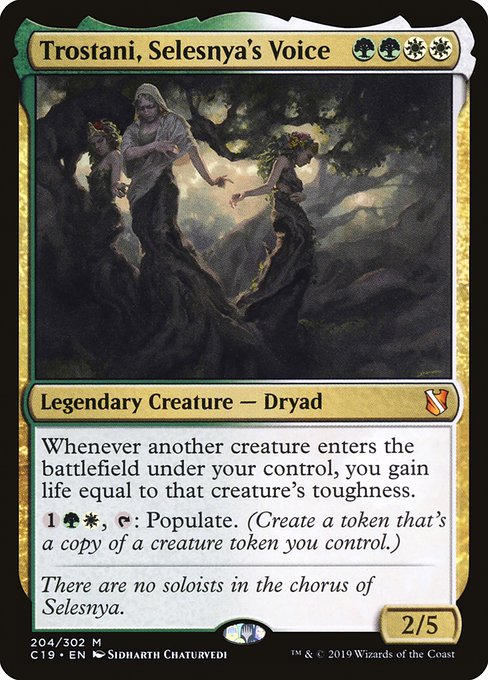
7. Trostani, Selesnya's Voice
Trostani, Selesnya's Voice | Illustration by Sidharth Chaturvedi
Colors: green-white. Best for: large tokens and toughness-based life gains.
Trostani gains you life equal to the toughness of each other creature entering under your control. Her populate ability then copies a creature token you already have, creating another body and another opportunity to gain life.
This is a creature deck with a lifegain engine built in. Large tokens make both halves useful: they provide meaningful life gains and an army that can actually end the game.
Cards to consider:Phyrexian Processor lets you pay life up front to produce large tokens later. Rhox Faithmender doubles the life you would gain. Well of Lost Dreams turns those larger gains into card draw if you can pay for it.
Main limitation: Processor spends life before it produces a token, and Trostani may be removed before you recover that payment. Avoid committing so much life that one answer leaves you exposed.
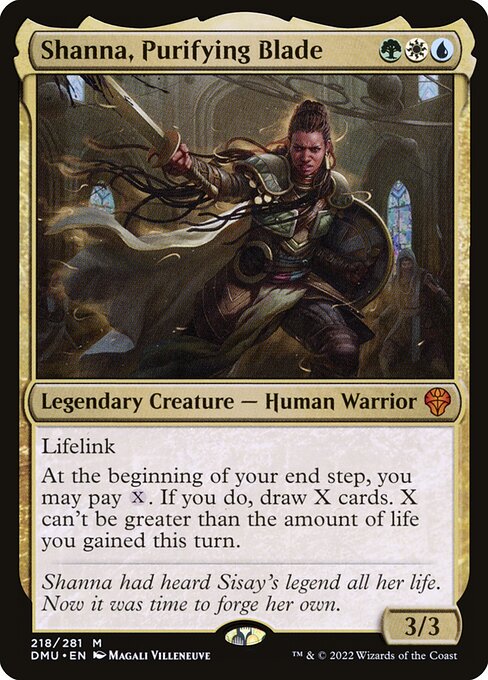
8. Shanna, Purifying Blade
Shanna, Purifying Blade | Illustration by Magali Villeneuve
Colors: green-white-blue. Best for: turning lifegain into a fresh hand.
Shanna has lifelink and, at the beginning of your end step, lets you pay mana to draw cards up to the amount of life you gained that turn. She supplies both an initial source of life and a reason to gain more.
The important constraint is mana. Gaining fifteen life does not draw fifteen cards for free. Ramp and efficient interaction help you reach the end step with enough mana left to use her ability.
Cards to consider:Nature's Lore develops your mana. Boon Reflection raises how much life you gain and therefore your potential draw ceiling. Swords to Plowshares is cheap interaction; exiling an opponent's creature gives that opponent life, so it does not fuel your Shanna trigger.
Main limitation: Cards still need a destination. Use the extra hand to establish threats and protect a winning board, not simply to draw into more lifegain.
9. Will, Scion of Peace
Will, Scion of Peace | Illustration by Ryan Pancoast
Colors: white-blue. Best for: converting one big life gain into cheaper spells.
Will taps to reduce the generic cost of your white and/or blue spells for the rest of the turn by the life you have gained that turn. Gain life first, then activate him during your main phase with an empty stack. The reduction is set when the ability resolves; later gains do not increase that activation's discount.
Cards to consider:Union of the Third Path draws a card and gains life based on your resulting hand size. Sphinx's Revelation turns a discount into a larger X while supplying cards and life. Approach of the Second Sun offers a clear win condition: its winning resolution requires casting it from your hand after an earlier spell with that name was cast that game.
Main limitation: The discount does not pay colored mana requirements. Will also needs to be able to tap, so summoning sickness and timely removal can delay the turn you planned around him.
10. Amalia Benavides Aguirre
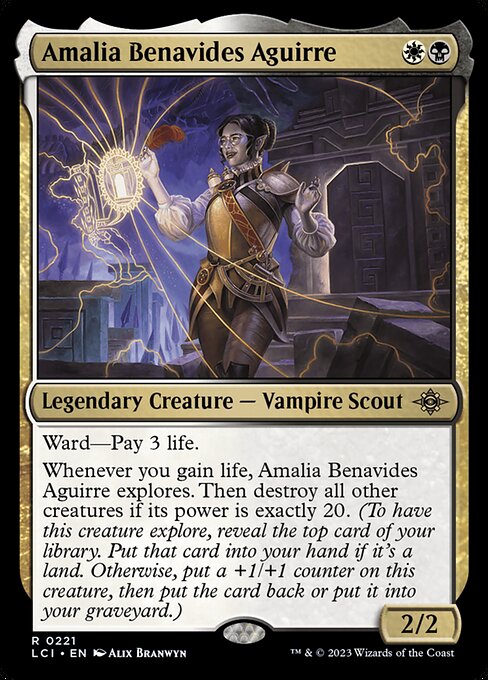
Amalia Benavides Aguirre | Illustration by Alix Branwyn
Colors: white-black. Best for: frequent triggers, card selection, and a growing attacker.
Each time you gain life, Amalia explores. A revealed land goes to your hand; a nonland gives her a counter and can stay on top or go to your graveyard. That turns cheap lifegain into help with land drops, graveyard setup, and combat pressure.
After exploring, if her power is exactly 20, the same ability destroys every other creature. It is not a “20 or more” condition. Extra power bonuses can cause you to miss that exact number.
Cards to consider:Soul Warden generates explores. Bastion of Remembrance turns your creatures dying into additional gains and drain. Selfless Spirit can give your creatures indestructible before Amalia's ability resolves, protecting them from its destruction effect.
Main limitation: Twenty power is not automatically a commander-damage elimination from a fresh total; that takes 21 combat damage from the same commander over the game. Have a plan for the final point and for rebuilding after removal.
11. Rodolf Duskbringer
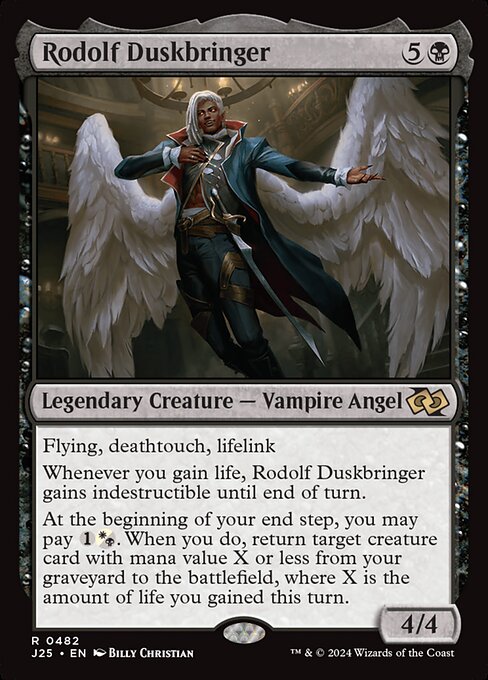
Rodolf Duskbringer | Illustration by Billy Christian
Colors: white-black. Best for: reanimation backed by lifelink.
Rodolf turns life gained during your turn into a ceiling for reanimation. At your end step, you may pay two mana to return a creature from your graveyard whose mana value is no greater than the life you gained that turn.
His flying, deathtouch, and lifelink make combat a useful starting point, and gaining life triggers an ability that gives him indestructible for the turn. His white-black color identity comes from the hybrid mana symbol in his text, even though his casting cost is black.
Main limitation: Six mana is a substantial investment. Ramp, graveyard setup, and cheaper plays matter. Also, creatures returned with the Whip are subject to its exile replacement; do not expect to sacrifice them straight back into the graveyard for Rodolf.
12. Ayli, Eternal Pilgrim
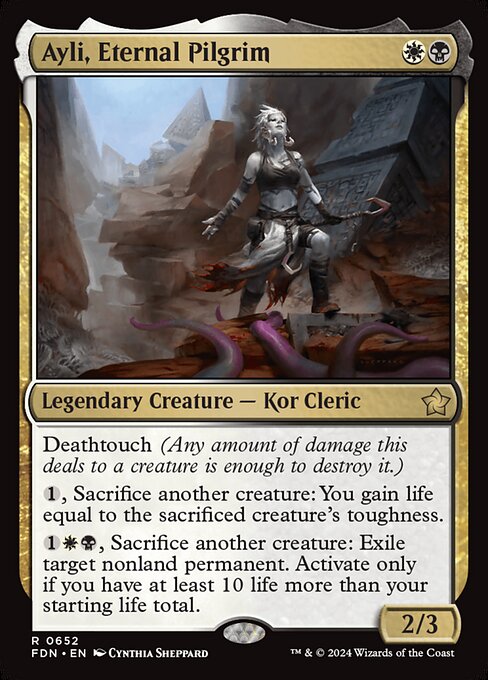
Ayli, Eternal Pilgrim | Illustration by Cynthia Sheppard
Colors: white-black. Best for: sacrifice control with a life-total threshold.
Ayli can sacrifice another creature for one mana to gain life equal to its toughness. At ten or more life above your starting total—normally 50 in multiplayer Commander—her second ability lets you pay three mana and sacrifice a creature to exile a nonland permanent.
That provides useful removal from a two-mana commander, but the requirement is your current life total, not how much life you have gained across the game.
Main limitation: Each exile activation consumes mana and a creature. Include card advantage and a finisher so that controlling the battlefield eventually becomes a win.
13. Kambal, Consul of Allocation
Kambal, Consul of Allocation | Illustration by Vincent Proce
Colors: white-black. Best for: draining opponents who cast many noncreature spells.
Kambal makes an opponent lose two life and gives you two life whenever that opponent casts a noncreature spell. He can generate value without you spending additional cards, although his output depends on what the other decks are casting.
Cards to consider:Bloodchief Ascension can collect a quest counter at an end step after an opponent has lost at least two life that turn. Blind Obedience slows opposing artifacts and creatures while offering extort on your spells. Sanguine Bond turns your gains into additional targeted life loss.
Main limitation: Creature-heavy tables give Kambal fewer triggers. Bring your own lifegain sources and ways to close the game instead of waiting for opponents to cast enough spells to lose.
14. Licia, Sanguine Tribune
Licia, Sanguine Tribune | Illustration by Magali Villeneuve
Colors: red-white-black. Best for: an aggressive lifelink commander.
Licia costs one generic mana less for each life you gained that turn. She combines first strike and lifelink with an ability to pay five life for three +1/+1 counters, usable only during your turn and once each turn.
That makes lifegain a way to deploy a large attacker, then use combat to recover the life spent growing her. Her reduction can also offset generic commander tax, but it cannot remove her red, white, and black requirements.
Cards to consider:Children of Korlis can recover life lost earlier in the turn and help create a casting discount. Whip of Erebos gives other attackers lifelink. Boros Charm can protect your permanents or give Licia double strike.
Main limitation: You need a life-gain source before casting Licia cheaply. Keep enough enablers that the deck does not rely on an eight-mana commander to start its engine.
15. Bilbo, Birthday Celebrant
Bilbo, Birthday Celebrant | Illustration by Billy Christian
Colors: white-black-green. Best for: a huge life-total goal with a dramatic payoff.
Bilbo adds one to each life gain. He does not double it: a one-life event becomes two, while a ten-life event becomes eleven. Frequent small gains therefore get more benefit from his replacement effect.
At 111 or more life, you can pay five mana, tap and exile Bilbo to put any number of creature cards from your library onto the battlefield. Build toward a specific winning collection of creatures, rather than assuming a huge battlefield will survive until your next turn.
Cards to consider:Soul Warden rewards creatures entering. Rhox Faithmender multiplies your life gains. Aetherflux Reservoir offers another payoff for a large reserve, letting you pay 50 life to deal 50 damage.
Main limitation: Reservoir and Bilbo compete for the same life total. Spending 50 can put you below 111, and paying down to zero normally makes you lose before Reservoir's damage ability resolves. Plan the order and retain enough life to survive.
Which lifegain commander should you choose?
Start with Karlov if you want your engine to affect combat and removal immediately. His low casting cost and clear trigger-to-counter conversion make the deck's priorities easy to understand.
Choose Oloro for flexibility or Shanna for card draw. Both support longer games, but they still need a deliberate route from accumulating resources to winning.
Choose Vito or Dina for drain. Vito rewards larger amounts and targets one opponent per trigger; Dina rewards repeated gains and hits every opponent.
Choose Lathiel or Trostani for creatures, and Licia for commander combat. These are natural homes for players who want the finish to happen on the battlefield.
Choose Will for a big spell turn, Rodolf for reanimation, or Heliod for counters and a possible combo. Amalia, Ayli, Kambal, and Bilbo offer more specific incentives worth building around when their play patterns appeal to you.
Three mistakes to avoid in lifegain decks
Counting life without counting triggers
Gaining ten life once gives Karlov one trigger and two counters. Gaining one life ten separate times gives him ten triggers and twenty counters. Read the payoff before deciding whether a life-gain doubler or another repeatable source is more useful.
Lifelink works with noncombat damage too, which is why Heliod and Ballista interact. Multiple instances of lifelink on the same creature do not multiply the life gained.
Treating a high total as protection from everything
Life does not undo accumulated commander damage or poison counters. You can still lose to 21 combat damage from the same commander, ten poison counters, or an effect that wins the game without reducing your life to zero. Keep removal and protection in the deck.
Also distinguish damage from life loss. Vito's triggered ability causes life loss; it does not deal damage. Giving Vito lifelink does not make that trigger gain you life.
Forgetting to reserve mana for the payoff
Shanna and Well of Lost Dreams require mana to draw. Ayli needs mana and sacrifice material to exile. Rodolf needs payment at the end step. A turn that spends every available mana gaining life can leave the best part of your engine unused.
Choose a primary finish, keep enough draw and ramp to support it, and test how the deck functions after its commander is removed. A good lifegain deck should do more than survive for another turn.
Build your lifegain Commander deck
Use the Create a deck link beside your chosen commander to start with it selected in the free ElderDecks Commander deck builder. Add the life-gain sources, payoff cards, interaction, and mana your strategy needs, then test whether you can turn the engine into a win.
Which sounds better: Karlov's growing threat, Vito's life drain, or Bilbo's 111-life celebration?
Sources and card references
Card text, images, illustrator credits, color identities, and format legality were checked against Scryfall on November 26, 2026. Selection and strategy assessments are ElderDecks editorial judgments; these are suggested builds, not measured tournament rankings. Card artwork belongs to Wizards of the Coast and the respective rights holders.
15 Best Lifegain Commanders: Turn Extra Life Into a Win
By ElderArticles · Updated 11/26/2026 · 16 min read
Find your next MTG lifegain commander, from Oloro and Karlov to Heliod and Vito. Compare win conditions, key synergies, and important rules interactions.
Table of contents
Gaining 40 life feels great. It feels less useful when another player wins while you are still looking for a way to finish the game.
The best lifegain commanders give those extra points a job. Some turn each small gain into counters or life loss. Others reward one enormous burst with cards, cheaper spells, or creatures brought back from the graveyard.
Our first picks are Oloro for steady support, Karlov for cheap pressure and removal, and Heliod for a focused counters or combo build. The right choice depends on what you want your life total to accomplish.
These are fifteen editorial recommendations for multiplayer Commander, ordered to introduce a range of strong, distinct strategies. They are not a cEDH power ranking. Card text, Commander legality, and the color identity of the suggested support cards were checked on November 26, 2026.
Choose the payoff before the lifegain cards
There are three useful questions to ask before building. Does your commander care about the number of times you gain life, the total amount you gain, or your current life total?
Karlov and Dina reward separate events. Gaining one life five times produces five triggers; gaining five life once produces one. Vito and Lathiel reward the amount gained. Ayli and Bilbo need you to reach a life-total threshold before you can activate their larger abilities.
That distinction changes which cards deserve space. A repeatable one-life trigger can be excellent for Karlov and too slow for a deck trying to cast one enormous discounted spell with Will.
Colors: white-blue-black. Best for: consistent lifegain with flexible control tools.
Oloro gives you two life at the beginning of your upkeep while he is in the command zone. That makes him a reliable starting point for a deck whose other cards reward gaining life: you can establish the support pieces without first spending six mana on your commander.
Once Oloro is on the battlefield, gaining life lets you pay one mana to draw a card and make each opponent lose one life. That ability does not function from the command zone. His dependable background lifegain and his battlefield payoff are separate parts of the plan.
Main limitation: Two life per upkeep will not win by itself. Keep enough interaction and a real finisher instead of filling the deck with cards that only increase your total.
Colors: white-black. Best for: efficient pressure and repeatable creature removal.
Karlov receives two +1/+1 counters whenever you gain life. Three separate gains can therefore supply the six counters needed for his exile ability, although activating it still costs white and black mana.
That gives a two-mana commander two useful jobs: threaten combat damage or spend accumulated size to remove a dangerous creature. Small, frequent gains are the priority. One ten-life event still adds only two counters.
Cards to consider:Soul Warden and Soul's Attendant turn creatures entering on either side of the table into lifegain opportunities. Shadowspear gives Karlov trample and lifelink, helping his size matter in combat.
Main limitation: Counters disappear when Karlov leaves the battlefield. Save mana for interaction and decide whether a large attacker or another exile activation matters more right now.
Colors: white. Best for: counters with an optional compact combo finish.
Heliod places a +1/+1 counter on a creature or enchantment you control whenever you gain life. He can also give another creature lifelink for two mana. His devotion requirement controls whether he is a creature; it does not switch off those abilities.
Cards to consider:Soul Warden supplies repeated triggers. Dawn of Hope offers paid card draw and lifelink tokens. Walking Ballista can serve as removal or a combo finisher.
The Ballista setup: With Heliod on the battlefield and Ballista starting with at least two +1/+1 counters, give Ballista lifelink. Remove a counter to deal one damage, gain one life from lifelink, then use Heliod's trigger to replace that counter. With no interruption or effect preventing the relevant damage or lifegain, repeat to deal lethal damage. A normal 0/0 Ballista starting with only one counter dies after you remove it, before that counter can be replaced.
Main limitation: This finish changes the deck's expectations. Tell your group if you are building around it, and include a creature plan if the combo pieces are answered.
Colors: black. Best for: turning large life gains into targeted life loss.
Whenever you gain life, Vito makes a target opponent lose that much life. He rewards the size of a gain, so a large drain spell can damage everyone's position and direct an additional loss at one player. His activated ability can give your creatures lifelink for a combat turn.
Cards to consider:Exsanguinate drains every opponent and aggregates the life you gain. Gray Merchant of Asphodel offers a similar payoff based on black devotion. Exquisite Blood creates a repeatable loop with Vito once you gain life or an opponent loses life: one trigger feeds the other, normally ending the game unless interrupted.
Main limitation: Vito's trigger targets one opponent, not the whole table. Protect him when committing a large spell, and make sure the group knows if the Exquisite Blood loop is part of the deck.
Colors: black-green. Best for: many small gains and sacrifice engines.
Dina makes each opponent lose one life whenever you gain life. The size of each gain does not change that loss, making repeated triggers more valuable than a single large burst. She also offers a paid sacrifice outlet that temporarily increases her power.
Cards to consider:Essence Warden rewards creatures entering. Witherbloom Apprentice supplies a life gain and table-wide drain when you cast or copy an instant or sorcery. Pest Infestation removes artifacts or enchantments and creates Pests that gain you life when they die.
Main limitation: A pile of lifegain cards is not automatically an engine. Include ways to create and sacrifice creatures repeatedly, plus enough draw to keep the sequence going.
Colors: green-white. Best for: turning a large gain into a threatening creature board.
At the beginning of each end step, if you gained life that turn, Lathiel can distribute up to that much life in +1/+1 counters among other creatures. The counters cannot go on Lathiel itself.
Because the ability checks each end step, gaining life on an opponent's turn can grow your team before your next attack. You need to gain that life before the end step begins for the ability to trigger.
Cards to consider:Essence Warden creates opportunities during other players' turns. Spike Feeder converts counters into life that can fuel the next distribution. Inspiring Call draws from your creatures with +1/+1 counters and gives them indestructible for the turn.
Main limitation: Lathiel needs other creatures to reward. Balance lifegain with bodies, protection, and ways for large attackers to get through blockers.
Colors: green-white. Best for: large tokens and toughness-based life gains.
Trostani gains you life equal to the toughness of each other creature entering under your control. Her populate ability then copies a creature token you already have, creating another body and another opportunity to gain life.
This is a creature deck with a lifegain engine built in. Large tokens make both halves useful: they provide meaningful life gains and an army that can actually end the game.
Cards to consider:Phyrexian Processor lets you pay life up front to produce large tokens later. Rhox Faithmender doubles the life you would gain. Well of Lost Dreams turns those larger gains into card draw if you can pay for it.
Main limitation: Processor spends life before it produces a token, and Trostani may be removed before you recover that payment. Avoid committing so much life that one answer leaves you exposed.
Colors: green-white-blue. Best for: turning lifegain into a fresh hand.
Shanna has lifelink and, at the beginning of your end step, lets you pay mana to draw cards up to the amount of life you gained that turn. She supplies both an initial source of life and a reason to gain more.
The important constraint is mana. Gaining fifteen life does not draw fifteen cards for free. Ramp and efficient interaction help you reach the end step with enough mana left to use her ability.
Cards to consider:Nature's Lore develops your mana. Boon Reflection raises how much life you gain and therefore your potential draw ceiling. Swords to Plowshares is cheap interaction; exiling an opponent's creature gives that opponent life, so it does not fuel your Shanna trigger.
Main limitation: Cards still need a destination. Use the extra hand to establish threats and protect a winning board, not simply to draw into more lifegain.
Colors: white-blue. Best for: converting one big life gain into cheaper spells.
Will taps to reduce the generic cost of your white and/or blue spells for the rest of the turn by the life you have gained that turn. Gain life first, then activate him during your main phase with an empty stack. The reduction is set when the ability resolves; later gains do not increase that activation's discount.
Cards to consider:Union of the Third Path draws a card and gains life based on your resulting hand size. Sphinx's Revelation turns a discount into a larger X while supplying cards and life. Approach of the Second Sun offers a clear win condition: its winning resolution requires casting it from your hand after an earlier spell with that name was cast that game.
Main limitation: The discount does not pay colored mana requirements. Will also needs to be able to tap, so summoning sickness and timely removal can delay the turn you planned around him.
Colors: white-black. Best for: frequent triggers, card selection, and a growing attacker.
Each time you gain life, Amalia explores. A revealed land goes to your hand; a nonland gives her a counter and can stay on top or go to your graveyard. That turns cheap lifegain into help with land drops, graveyard setup, and combat pressure.
After exploring, if her power is exactly 20, the same ability destroys every other creature. It is not a “20 or more” condition. Extra power bonuses can cause you to miss that exact number.
Cards to consider:Soul Warden generates explores. Bastion of Remembrance turns your creatures dying into additional gains and drain. Selfless Spirit can give your creatures indestructible before Amalia's ability resolves, protecting them from its destruction effect.
Main limitation: Twenty power is not automatically a commander-damage elimination from a fresh total; that takes 21 combat damage from the same commander over the game. Have a plan for the final point and for rebuilding after removal.
Colors: white-black. Best for: reanimation backed by lifelink.
Rodolf turns life gained during your turn into a ceiling for reanimation. At your end step, you may pay two mana to return a creature from your graveyard whose mana value is no greater than the life you gained that turn.
His flying, deathtouch, and lifelink make combat a useful starting point, and gaining life triggers an ability that gives him indestructible for the turn. His white-black color identity comes from the hybrid mana symbol in his text, even though his casting cost is black.
Main limitation: Six mana is a substantial investment. Ramp, graveyard setup, and cheaper plays matter. Also, creatures returned with the Whip are subject to its exile replacement; do not expect to sacrifice them straight back into the graveyard for Rodolf.
Colors: white-black. Best for: sacrifice control with a life-total threshold.
Ayli can sacrifice another creature for one mana to gain life equal to its toughness. At ten or more life above your starting total—normally 50 in multiplayer Commander—her second ability lets you pay three mana and sacrifice a creature to exile a nonland permanent.
That provides useful removal from a two-mana commander, but the requirement is your current life total, not how much life you have gained across the game.
Main limitation: Each exile activation consumes mana and a creature. Include card advantage and a finisher so that controlling the battlefield eventually becomes a win.
Colors: white-black. Best for: draining opponents who cast many noncreature spells.
Kambal makes an opponent lose two life and gives you two life whenever that opponent casts a noncreature spell. He can generate value without you spending additional cards, although his output depends on what the other decks are casting.
Cards to consider:Bloodchief Ascension can collect a quest counter at an end step after an opponent has lost at least two life that turn. Blind Obedience slows opposing artifacts and creatures while offering extort on your spells. Sanguine Bond turns your gains into additional targeted life loss.
Main limitation: Creature-heavy tables give Kambal fewer triggers. Bring your own lifegain sources and ways to close the game instead of waiting for opponents to cast enough spells to lose.
Colors: red-white-black. Best for: an aggressive lifelink commander.
Licia costs one generic mana less for each life you gained that turn. She combines first strike and lifelink with an ability to pay five life for three +1/+1 counters, usable only during your turn and once each turn.
That makes lifegain a way to deploy a large attacker, then use combat to recover the life spent growing her. Her reduction can also offset generic commander tax, but it cannot remove her red, white, and black requirements.
Cards to consider:Children of Korlis can recover life lost earlier in the turn and help create a casting discount. Whip of Erebos gives other attackers lifelink. Boros Charm can protect your permanents or give Licia double strike.
Main limitation: You need a life-gain source before casting Licia cheaply. Keep enough enablers that the deck does not rely on an eight-mana commander to start its engine.
Colors: white-black-green. Best for: a huge life-total goal with a dramatic payoff.
Bilbo adds one to each life gain. He does not double it: a one-life event becomes two, while a ten-life event becomes eleven. Frequent small gains therefore get more benefit from his replacement effect.
At 111 or more life, you can pay five mana, tap and exile Bilbo to put any number of creature cards from your library onto the battlefield. Build toward a specific winning collection of creatures, rather than assuming a huge battlefield will survive until your next turn.
Cards to consider:Soul Warden rewards creatures entering. Rhox Faithmender multiplies your life gains. Aetherflux Reservoir offers another payoff for a large reserve, letting you pay 50 life to deal 50 damage.
Main limitation: Reservoir and Bilbo compete for the same life total. Spending 50 can put you below 111, and paying down to zero normally makes you lose before Reservoir's damage ability resolves. Plan the order and retain enough life to survive.
Which lifegain commander should you choose?
Start with Karlov if you want your engine to affect combat and removal immediately. His low casting cost and clear trigger-to-counter conversion make the deck's priorities easy to understand.
Choose Oloro for flexibility or Shanna for card draw. Both support longer games, but they still need a deliberate route from accumulating resources to winning.
Choose Vito or Dina for drain. Vito rewards larger amounts and targets one opponent per trigger; Dina rewards repeated gains and hits every opponent.
Choose Lathiel or Trostani for creatures, and Licia for commander combat. These are natural homes for players who want the finish to happen on the battlefield.
Choose Will for a big spell turn, Rodolf for reanimation, or Heliod for counters and a possible combo. Amalia, Ayli, Kambal, and Bilbo offer more specific incentives worth building around when their play patterns appeal to you.
Three mistakes to avoid in lifegain decks
Counting life without counting triggers
Gaining ten life once gives Karlov one trigger and two counters. Gaining one life ten separate times gives him ten triggers and twenty counters. Read the payoff before deciding whether a life-gain doubler or another repeatable source is more useful.
Lifelink works with noncombat damage too, which is why Heliod and Ballista interact. Multiple instances of lifelink on the same creature do not multiply the life gained.
Treating a high total as protection from everything
Life does not undo accumulated commander damage or poison counters. You can still lose to 21 combat damage from the same commander, ten poison counters, or an effect that wins the game without reducing your life to zero. Keep removal and protection in the deck.
Also distinguish damage from life loss. Vito's triggered ability causes life loss; it does not deal damage. Giving Vito lifelink does not make that trigger gain you life.
Forgetting to reserve mana for the payoff
Shanna and Well of Lost Dreams require mana to draw. Ayli needs mana and sacrifice material to exile. Rodolf needs payment at the end step. A turn that spends every available mana gaining life can leave the best part of your engine unused.
Choose a primary finish, keep enough draw and ramp to support it, and test how the deck functions after its commander is removed. A good lifegain deck should do more than survive for another turn.
Build your lifegain Commander deck
Use the Create a deck link beside your chosen commander to start with it selected in the free ElderDecks Commander deck builder. Add the life-gain sources, payoff cards, interaction, and mana your strategy needs, then test whether you can turn the engine into a win.
Which sounds better: Karlov's growing threat, Vito's life drain, or Bilbo's 111-life celebration?
Sources and card references
Card text, images, illustrator credits, color identities, and format legality were checked against Scryfall on November 26, 2026. Selection and strategy assessments are ElderDecks editorial judgments; these are suggested builds, not measured tournament rankings. Card artwork belongs to Wizards of the Coast and the respective rights holders.